IELTS Travel Vocabulary: 50 Words with Examples
This list of IELTS travel vocabulary covers holidays, tourism and its effects on people and places, which come up often in Speaking and Writing. Each word has a simple meaning, its sound, a band level, examples for Writing and Speaking, and the mistake to avoid.
50 words · free quiz and flashcards · updated October 2026
tourist attraction
TOUR·ist at·TRAC·tion · nounA place that many visitors go to see.Band 6 · everyday
Word family: attract (verb)
Collocations
- a popular tourist attraction
- major tourist attractions
- visit tourist attractions
Similar: sight, landmark
WritingFamous tourist attractions can become overcrowded in summer.
SpeakingThe main tourist attraction in my city is the old castle.
Common mistake: Saying “tourism attraction”. The term is “tourist attraction”.
sightseeing
SIGHT·see·ing · nounVisiting famous places as a tourist.Band 6 · everyday
Word family: sightseer (noun)
Collocations
- go sightseeing
- a sightseeing tour
- do some sightseeing
Similar: touring
WritingMany visitors spend their holidays sightseeing rather than relaxing.
SpeakingWe went sightseeing in Rome for three days.
Common mistake: Writing “site-seeing”. You see the “sights”, so write “sightseeing”.
destination
des·ti·NA·tion · nounThe place you are travelling to.Band 6 · everyday
Collocations
- a popular destination
- a holiday destination
- reach your destination
Similar: place, stop
WritingCheap flights have made distant destinations affordable for many people.
SpeakingMy dream destination is Japan.
Common mistake: Saying “a destiny” for a place. Your destination is where you are going; your destiny is your future.
accommodation
ac·com·mo·DA·tion · nounA place to stay, like a hotel or a flat.Band 6 · everyday
Word family: accommodate (verb)
Collocations
- cheap accommodation
- book accommodation
- tourist accommodation
Similar: lodging, place to stay
WritingShort-term holiday rentals have reduced the accommodation available to local people.
SpeakingWe found cheap accommodation near the beach.
Common mistake: Spelling it “accomodation”. Write it with double c and double m.
souvenir
sou·ve·NIR · nounSomething you buy to remember a place you visited.Band 6 · everyday
Collocations
- buy souvenirs
- a souvenir shop
- as a souvenir
Similar: keepsake, memento
WritingLocal crafts sold as souvenirs can support small businesses.
SpeakingI always buy a fridge magnet as a souvenir.
Common mistake: Spelling it “suvenir”. Write “souvenir”.
package holiday
PACK·age HOL·i·day · nounA holiday where a travel company arranges the flights, the hotel and sometimes the meals.Band 6 · everyday
Collocations
- go on a package holiday
- cheap package holidays
- book a package holiday
Similar: package tour
WritingPackage holidays make travel easy, but tourists may see little of local life.
SpeakingWe went on a package holiday to Turkey last year.
Common mistake: Saying “pack holiday”. The term is “package holiday” (UK) or “package tour”.
travel agent
TRAV·el A·gent · nounA person or company that arranges trips for people.Band 6 · everyday
Word family: travel agency (noun)
Collocations
- book through a travel agent
- a local travel agent
- online travel agents
Similar: tour operator
WritingFewer people use travel agents now that they can book online.
SpeakingMy parents still book everything through a travel agent.
Common mistake: Mixing up “travel agent” (the person) and “travel agency” (the business).
passport
PASS·port · nounAn official document that lets you travel to other countries.Band 6 · everyday
Collocations
- renew a passport
- passport control
- a valid passport
Similar: travel document
WritingTravellers should check that their passport is valid before booking.
SpeakingI need to renew my passport before the summer.
Common mistake: Writing “pass port” as two words. Write “passport”.
luggage
LUG·gage · nounThe bags and suitcases you take on a trip.Band 6 · everyday
Collocations
- hand luggage
- lost luggage
- carry luggage
Similar: baggage, bags
WritingAirlines now charge extra for checked luggage.
SpeakingI only take hand luggage for short trips.
Common mistake: Saying “luggages”. It is uncountable: “a piece of luggage”.
tour guide
TOUR GUIDE · nounA person whose job is to show tourists around a place.Band 6 · everyday
Word family: guide (verb)
Collocations
- a local tour guide
- hire a tour guide
- work as a tour guide
Similar: guide
WritingLocal tour guides help visitors understand the history of a place.
SpeakingOur tour guide in Egypt knew so much about history.
Common mistake: Saying “a guider”. The person is “a guide” or “a tour guide”.
landmark
LAND·mark · nounA famous building or place that is easy to recognise.Band 6 · everyday
Collocations
- a famous landmark
- a historic landmark
- city landmarks
Similar: monument, sight
WritingHistoric landmarks should be protected from damage caused by tourism.
SpeakingThe tower is the most famous landmark in my city.
Common mistake: Using it only for nature. A landmark can be a building, a statue or a mountain.
flight
FLIGHT · nounA journey in a plane.Band 6 · everyday
Word family: fly (verb)
Collocations
- book a flight
- a long-haul flight
- a delayed flight
Similar: plane journey
WritingCheap flights have made weekend trips abroad very popular.
SpeakingMy flight was delayed by six hours last time.
Common mistake: Saying “take an airplane flight”. Just say “take a flight” or “fly”.
budget airline
BUDG·et AIR·line · nounAn airline with very cheap tickets and few extra services.Band 6 · everyday
Collocations
- fly with a budget airline
- the rise of budget airlines
- budget airline tickets
Similar: low-cost airline
WritingBudget airlines have made air travel possible for millions more people.
SpeakingI always fly with budget airlines to save money.
Common mistake: Saying “cheap airplane company”. The term is “budget airline” or “low-cost airline”.
backpacker
BACK·pack·er · nounA person who travels cheaply, carrying their things in a backpack.Band 6 · everyday
Word family: backpacking (noun)
Collocations
- young backpackers
- backpacker hostels
- go backpacking
Similar: budget traveller
WritingCheap hostels attract backpackers who stay for weeks rather than days.
SpeakingI was a backpacker in Asia for three months after school.
Common mistake: Saying “backpack traveller”. The usual word is “backpacker”.
go abroad
GO a·BROAD · verb phraseTo travel to another country.Band 6 · everyday
Word family: abroad (adverb)
Collocations
- go abroad
- study abroad
- travel abroad
Similar: travel overseas
WritingMore students than ever go abroad to study.
SpeakingI’d love to go abroad for a year to work.
Common mistake: Saying “go to abroad”. “Abroad” needs no “to”: “go abroad”.
holidaymaker
HOL·i·day·mak·er · nounA person who is on holiday.Band 6 · everyday
Collocations
- attract holidaymakers
- crowds of holidaymakers
- British holidaymakers
Similar: tourist, visitor
WritingBeach towns depend on holidaymakers for most of their income.
SpeakingIn summer my town is full of holidaymakers.
Common mistake: Writing “holiday maker” as two words. Write “holidaymaker”.
peak season
PEAK SEA·son · nounThe busiest time of year for travel, when prices are highest.Band 6 · everyday
Word family: off-season (noun)
Collocations
- during peak season
- peak-season prices
- avoid the peak season
Similar: high season
WritingHotels often double their prices during peak season.
SpeakingI never travel in peak season; it’s too crowded.
Common mistake: Writing “pick season”. A peak is the highest point: “peak season”.
locals
LO·cals · noun, pluralThe people who live in a place.Band 6 · everyday
Word family: local (adjective)
Collocations
- chat with the locals
- locals and tourists
- popular with locals
Similar: residents, local people
WritingMass tourism can make life harder for locals by raising prices.
SpeakingThe best restaurants are the ones the locals go to.
Common mistake: Saying “the localities” for people. Use “locals” or “local people”.
mass tourism
MASS TOUR·ism · nounWhen very large numbers of people visit the same places.Band 7 · less common
Collocations
- the effects of mass tourism
- mass tourism destinations
- the rise of mass tourism
Similar: large-scale tourism
WritingMass tourism can damage fragile places like coral reefs and old cities.
SpeakingMass tourism has changed the island where I grew up.
Common mistake: Saying “massive tourism”. The term is “mass tourism”.
itinerary
i·TIN·er·ar·y · nounA detailed plan of a journey.Band 7 · less common
Collocations
- plan an itinerary
- a busy itinerary
- a two-week itinerary
Similar: travel plan, schedule
WritingPackage tours often have a fixed itinerary with little free time.
SpeakingI made a detailed itinerary for our trip to Italy.
Common mistake: Saying “itinery”. It has five parts: i-TIN-er-ar-y.
heritage site
HER·i·tage SITE · nounA place that is protected because of its history or culture.Band 7 · less common
Collocations
- a World Heritage Site
- protect heritage sites
- a cultural heritage site
Similar: historic site
WritingPopular heritage sites may need to limit visitor numbers.
SpeakingMy country has several heritage sites, including an old palace.
Common mistake: Writing “heritage sight”. A place is a “site”.
ecotourism
E·co·tour·ism · nounTravel to natural places that tries to protect the environment and help local people.Band 7 · less common
Word family: ecotourist (noun)
Collocations
- promote ecotourism
- ecotourism projects
- the growth of ecotourism
Similar: green tourism
WritingEcotourism can fund conservation while creating local jobs.
SpeakingWe did an ecotourism trip to see turtles in Costa Rica.
Common mistake: Writing “eco tourism” as two words. Write “ecotourism”.
off the beaten track
OFF the BEAT·en TRACK · phraseFar from the places that most tourists go to.Band 7 · less common
Collocations
- go off the beaten track
- places off the beaten track
- explore off the beaten track
Similar: remote, little-known
WritingTravellers who go off the beaten track spread tourist money more widely.
SpeakingI prefer villages off the beaten track to busy cities.
Common mistake: Saying “out of the beaten track”. The idiom is “off the beaten track”.
cultural exchange
CUL·tur·al ex·CHANGE · nounWhen people from different countries share and learn about each other’s way of life.Band 7 · less common
Collocations
- promote cultural exchange
- a cultural exchange programme
- encourage cultural exchange
Similar: sharing of cultures
WritingInternational travel encourages cultural exchange and understanding.
SpeakingI joined a cultural exchange programme in Germany at sixteen.
Common mistake: Saying “culture exchange”. Use the adjective: “cultural exchange”.
broaden your horizons
BROAD·en your ho·RI·zons · verb phraseTo learn about new things and widen your experience.Band 7 · less common
Word family: broad (adjective)
Collocations
- travel broadens your horizons
- broaden students’ horizons
- help to broaden horizons
Similar: widen your experience
WritingTravelling abroad can broaden the horizons of young people.
SpeakingLiving in another country really broadened my horizons.
Common mistake: Saying “widen your horizon”. The usual phrase is “broaden your horizons”, in the plural.
hospitality industry
hos·pi·TAL·i·ty IN·dus·try · nounHotels, restaurants and other businesses that look after visitors.Band 7 · less common
Word family: hospitable (adjective)
Collocations
- work in the hospitality industry
- jobs in the hospitality industry
- the hospitality industry employs
Similar: tourism industry
WritingThe hospitality industry employs millions of young people worldwide.
SpeakingI worked in the hospitality industry as a waiter for two years.
Common mistake: Mixing it up with “hospital”. Hospitality means looking after guests.
boost the local economy
BOOST the LO·cal e·CON·o·my · verb phraseTo help the businesses and jobs in an area grow.Band 7 · less common
Collocations
- boost the local economy
- a boost to the local economy
- tourism boosts local economies
Similar: stimulate the economy
WritingTourism can boost the local economy by creating jobs in shops and hotels.
SpeakingThe new festival really boosted the local economy.
Common mistake: Saying “boost up the economy”. Just say “boost the economy”.
jet lag
JET LAG · nounFeeling tired after a long flight across time zones.Band 7 · less common
Word family: jet-lagged (adjective)
Collocations
- suffer from jet lag
- bad jet lag
- get over jet lag
Similar: travel tiredness
WritingLong-haul travel often causes jet lag, which affects sleep for days.
SpeakingI had terrible jet lag after flying to Canada.
Common mistake: Saying “a jet lag”. It is uncountable: “I had jet lag”.
stopover
STOP·o·ver · nounA short stay in a place during a long journey.Band 7 · less common
Word family: stop over (phrasal verb)
Collocations
- a stopover in Dubai
- a one-night stopover
- a long stopover
Similar: layover
WritingSome airlines offer a free hotel night during a stopover.
SpeakingWe had a two-day stopover in Singapore on the way to Australia.
Common mistake: Mixing it up with “layover”, which is usually a shorter wait at the airport.
all-inclusive
all-in·CLU·sive · adjectiveDescribing a holiday where the price includes food, drinks and activities.Band 7 · less common
Word family: include (verb)
Collocations
- an all-inclusive holiday
- all-inclusive resorts
- go all-inclusive
Similar: everything included
WritingAll-inclusive resorts may bring little money to local restaurants.
SpeakingWe stayed at an all-inclusive hotel, so we never left it!
Common mistake: Writing “all inclusive” without the hyphen. Write “all-inclusive”.
culture shock
CUL·ture SHOCK · nounFeeling confused or upset when you visit or move to a very different culture.Band 7 · less common
Collocations
- experience culture shock
- suffer from culture shock
- a real culture shock
Similar: feeling out of place
WritingInternational students often experience culture shock in their first months.
SpeakingI had real culture shock when I first moved to London.
Common mistake: Saying “cultural shock”. The usual phrase is “culture shock”.
picturesque
pic·tur·ESQUE · adjectiveVery pretty, like a picture.Band 7 · less common
Collocations
- a picturesque village
- picturesque scenery
- a picturesque harbour
Similar: pretty, charming
WritingPicturesque villages can become overcrowded once they appear on social media.
SpeakingThe town is so picturesque; every street looks like a postcard.
Common mistake: Saying “pictureful”. The word is “picturesque”: pik-chuh-RESK.
breathtaking
BREATH·tak·ing · adjectiveExtremely beautiful or exciting.Band 7 · less common
Collocations
- breathtaking views
- breathtaking scenery
- absolutely breathtaking
Similar: stunning, spectacular
WritingMountain resorts attract visitors with breathtaking views.
SpeakingThe view from the top was breathtaking.
Common mistake: Saying “very breathtaking”. It is already strong; say “absolutely breathtaking”.
tourist trap
TOUR·ist TRAP · nounA place full of tourists where prices are high and quality is low.Band 7 · less common
Collocations
- a tourist trap
- avoid tourist traps
- turn into a tourist trap
Similar: overpriced place
WritingOnce a place becomes a tourist trap, its local character can disappear.
SpeakingThat street is a tourist trap; the food is awful and expensive.
Common mistake: Using it for any popular place. A tourist trap is overpriced and disappointing.
seasonal work
SEA·son·al WORK · nounJobs that only exist at certain times of year, like the summer.Band 7 · less common
Word family: season (noun)
Collocations
- do seasonal work
- seasonal workers
- seasonal jobs in tourism
Similar: temporary work
WritingMany tourism jobs are seasonal work, with no income in winter.
SpeakingEvery summer I do seasonal work at a beach café.
Common mistake: Saying “season work”. Use the adjective: “seasonal work”.
cruise
CRUISE · noun / verbA holiday on a large ship that visits several places.Band 7 · less common
Word family: cruise ship (noun)
Collocations
- go on a cruise
- a cruise ship
- a Mediterranean cruise
Similar: voyage
WritingHuge cruise ships can bring thousands of visitors to a small port in one day.
SpeakingMy grandparents went on a cruise for their anniversary.
Common mistake: Spelling it “cruse”. Write “cruise”.
remote
re·MOTE · adjectiveFar away from towns and other people.Band 7 · less common
Word family: remoteness (noun)
Collocations
- remote areas
- a remote village
- remote islands
Similar: isolated, far-flung
WritingTourism can bring jobs to remote areas with few other industries.
SpeakingWe stayed in a remote cabin with no phone signal.
Common mistake: Thinking it only means a TV remote. It also means far away.
travel insurance
TRAV·el in·SUR·ance · nounInsurance that pays if you get ill or lose things on a trip.Band 7 · less common
Word family: insure (verb)
Collocations
- buy travel insurance
- travel insurance cover
- a travel insurance policy
Similar: trip insurance
WritingTravellers should always buy travel insurance before going abroad.
SpeakingMy travel insurance paid for the doctor when I was ill in Spain.
Common mistake: Saying “travel assurance”. The term is “travel insurance”.
overtourism
o·ver·TOUR·ism · nounWhen too many tourists visit a place, damaging it or making life hard for local people.Band 8 · uncommon
Collocations
- the problem of overtourism
- tackle overtourism
- cities suffering from overtourism
Similar: too many tourists
WritingSome popular cities now charge entry fees or limit cruise ships to fight overtourism.
SpeakingOvertourism is ruining some of the beaches near my home.
Common mistake: Writing “over tourism” as two words. Write “overtourism”.
unspoilt
un·SPOILT · adjectiveStill beautiful because it has not been changed by building or tourism.Band 8 · uncommon
Word family: spoil (verb)
Collocations
- unspoilt countryside
- unspoilt beaches
- remain unspoilt
Similar: untouched, pristine
WritingEcotourism aims to keep natural areas unspoilt.
SpeakingThe island is still unspoilt; there are no big hotels.
Common mistake: Mixing spellings. British English uses “unspoilt”; American English uses “unspoiled”.
influx
IN·flux · nounA large number of people or things arriving at the same time.Band 8 · uncommon
Collocations
- an influx of tourists
- a sudden influx
- cope with an influx
Similar: flood, surge
WritingA sudden influx of tourists can overwhelm local services.
SpeakingThere’s a huge influx of visitors every August.
Common mistake: Saying “an influx to”. Use “of”: “an influx of tourists”.
commercialisation
com·mer·cial·i·SA·tion · nounChanging something to make money from it, which often spoils it.Band 8 · uncommon
Word family: commercialise (verb) · commercial (adjective)
Collocations
- the commercialisation of culture
- resist commercialisation
- excessive commercialisation
Similar: turning into a business
WritingThe commercialisation of traditional festivals can make them feel fake.
SpeakingThe commercialisation of the old market has made it lose its charm.
Common mistake: Mixing spellings. British English writes “commercialisation”; American English writes “commercialization”.
authenticity
au·then·TIC·i·ty · nounBeing real and true, not copied or fake.Band 8 · uncommon
Word family: authentic (adjective)
Collocations
- cultural authenticity
- lose its authenticity
- a sense of authenticity
Similar: genuineness
WritingTourists increasingly look for authenticity rather than luxury.
SpeakingI love the authenticity of small family restaurants.
Common mistake: Saying “authenticness”. The noun is “authenticity”.
globetrotter
GLOBE·trot·ter · nounA person who travels to many countries.Band 8 · uncommon
Word family: globetrotting (noun)
Collocations
- a seasoned globetrotter
- young globetrotters
- a keen globetrotter
Similar: world traveller
WritingSocial media has turned some globetrotters into celebrities.
SpeakingMy aunt is a real globetrotter; she’s been to sixty countries.
Common mistake: Writing “globe trotter” as two words. Write “globetrotter”.
wanderlust
WAN·der·lust · nounA strong wish to travel.Band 8 · uncommon
Collocations
- be full of wanderlust
- a sense of wanderlust
- satisfy your wanderlust
Similar: love of travel
WritingTravel adverts are designed to create wanderlust in viewers.
SpeakingI have serious wanderlust; I’m always planning the next trip.
Common mistake: Writing “wonderlust”. The first part is “wander”, which means to travel around.
exotic
ex·OT·ic · adjectiveUnusual and exciting because it comes from a faraway place.Band 8 · uncommon
Collocations
- exotic destinations
- exotic food
- exotic animals
Similar: foreign, unusual
WritingCheap flights have made exotic destinations easy to reach.
SpeakingI tried some really exotic fruit in Thailand.
Common mistake: Using it for anything foreign. Exotic means from a distant place and unusual.
idyllic
i·DYL·lic · adjectiveExtremely peaceful and beautiful.Band 8 · uncommon
Word family: idyll (noun)
Collocations
- an idyllic setting
- an idyllic island
- idyllic countryside
Similar: perfect, peaceful
WritingPhotos of idyllic beaches attract tourists, but the reality is often crowded.
SpeakingWe stayed in an idyllic cottage by a lake.
Common mistake: Spelling it “idylic”. Write “idyllic”, with double l.
carrying capacity
CAR·ry·ing ca·PAC·i·ty · nounThe largest number of visitors a place can take without being damaged.Band 8 · uncommon
Collocations
- exceed its carrying capacity
- the carrying capacity of an island
- stay within the carrying capacity
Similar: visitor limit
WritingSome islands now limit visitors to stay within their carrying capacity.
SpeakingOur beach is way over its carrying capacity in summer.
Common mistake: Saying “carry capacity”. The term is “carrying capacity”.
cultural erosion
CUL·tur·al e·RO·sion · nounThe slow loss of a place’s traditions and way of life.Band 8 · uncommon
Word family: erode (verb)
Collocations
- lead to cultural erosion
- fears of cultural erosion
- prevent cultural erosion
Similar: loss of traditions
WritingMass tourism can lead to cultural erosion in small communities.
SpeakingOlder people here worry about cultural erosion as more tourists arrive.
Common mistake: Using “erosion” only for rocks and soil. It can also mean the slow loss of a culture.
quintessential
quin·tes·SEN·tial · adjectiveBeing the most typical example of something.Band 8 · uncommon
Word family: quintessence (noun)
Collocations
- the quintessential English village
- a quintessential experience
- quintessentially British
Similar: typical, classic
WritingMany visitors see afternoon tea as a quintessential British experience.
SpeakingEating street food is the quintessential way to experience my city.
Common mistake: Spelling it “quintesential”. Write “quintessential”, with double s.
Travel vocabulary in IELTS Writing and Speaking
Here is how IELTS travel vocabulary can come up in the test, with our own practice questions. So, try to answer them with words from the list above.
Writing Task 2
International tourism has grown quickly in recent years. Do the advantages of this for local communities outweigh the disadvantages?
Speaking
- Part 1: Do you like travelling?
- Part 1: Where did you go on your last holiday?
- Part 2: Describe a place you visited that you would like to go back to.
- Part 3: How does tourism change the places people visit?
- Part 3: Is it better to travel alone or with a group?
Our free tests on this topic
- Listening Practice Test 3, Part 3tourism in a fishing village
- Listening Practice Test 1, Part 1a call to book a cycle tour
- Listening Practice Test 10, Part 2a talk about a new airport terminal
- Writing Practice Test 8, Task 2taking a year off to work or travel
A model paragraph with IELTS travel vocabulary
Mass tourism can boost the local economy, but it also brings problems. In popular places, a sudden influx of visitors during peak season raises prices for locals and can damage heritage sites. Ecotourism offers a better balance: it brings money to remote communities while keeping the environment unspoilt.
Practise this IELTS travel vocabulary
Take the 10-question quiz on this IELTS travel vocabulary, or go through every word with the flashcards.
Question 1 of 10
Which word means “the place you are travelling to”?
Now use the words
Write a Task 2 essay with five of these words. Then our free Writing Checker gives you a band for vocabulary and for the other three criteria.
Open the Writing Checker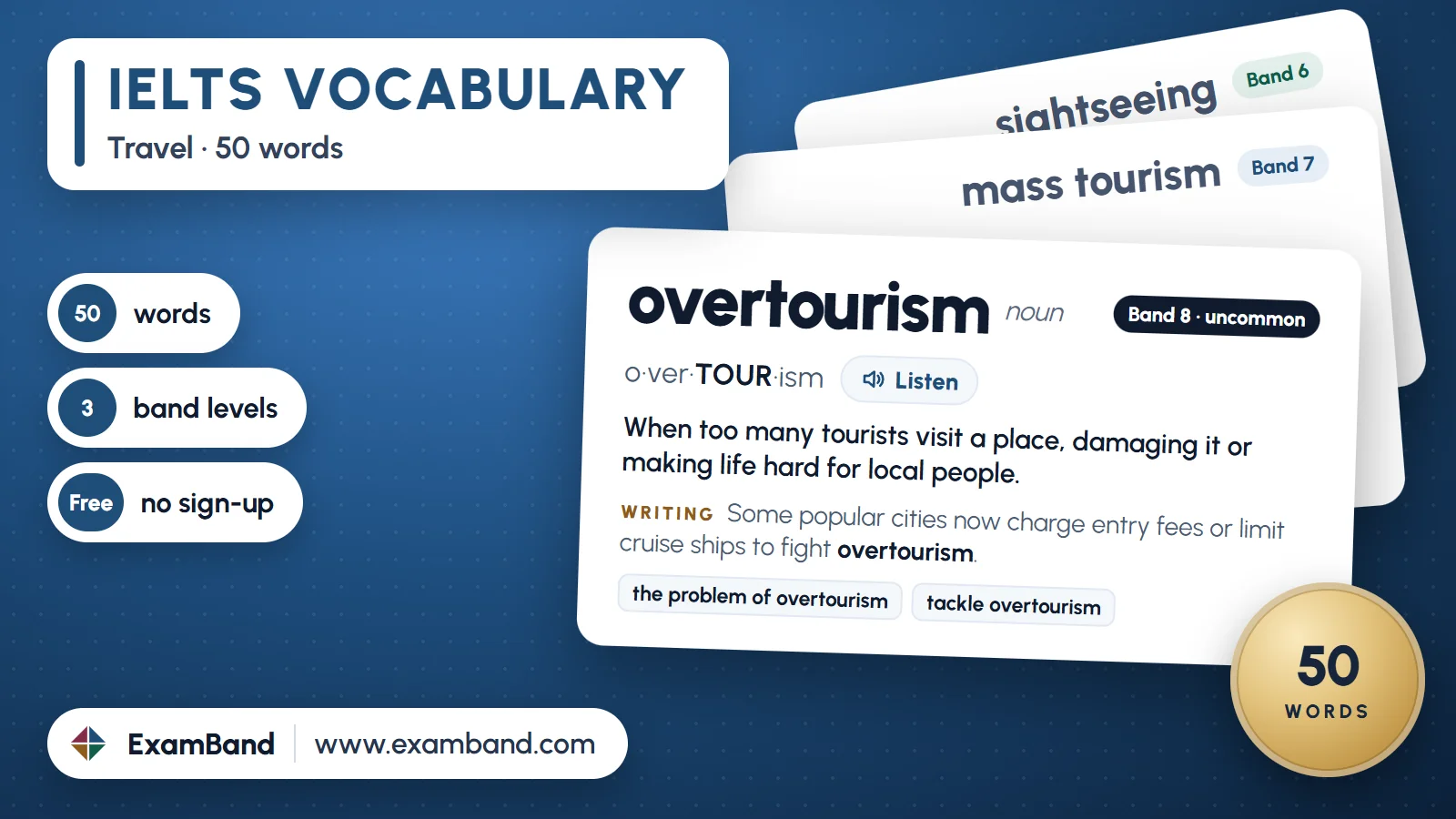
Questions about IELTS travel vocabulary
How do I learn IELTS travel vocabulary?
Learn about ten words a day. First, read the meaning, listen to the word and say it out loud with the right stress. Then test yourself with the quiz and the flashcards on this page. Finally, use five of the words in an essay and check it with our free Writing Checker.
Which words should I learn first?
Start with the band 6 words, because you need them to explain any idea clearly. After that, add the band 7 words. However, use the band 8 words only when you are sure of their meaning, because a rare word used wrongly can lower your score.
Are these official IELTS words?
No. IELTS has no official word list. Instead, our levels follow the words of the public IELTS band descriptors: band 7 asks for some “less common” words, and band 8 for “uncommon” words used with skill.