IELTS Collocations: Word Partners for Writing and Speaking
These IELTS collocations are words that naturally go together, like “make a decision” and “heavy traffic”. Using them correctly is part of your vocabulary score. Each one has a meaning, its sound, a band level, examples for Writing and Speaking, and the mistake to avoid.
46 words · free quiz and flashcards · updated October 2026
With make, do, take and have
Many learners mix these verbs up. These pairs are fixed, so learn each one as a single unit.
make a decision
MAKE a de·CI·sion · verb + nounTo decide something.Band 6 · everyday
Word family: decide (verb) · decisive (adjective)
Collocations
- make a difficult decision
- make an important decision
- make a decision about
Similar: decide
WritingTeenagers should be allowed to make decisions about their own education.
SpeakingI made a decision to study abroad when I was nineteen.
Common mistake: Saying “do a decision”. The verb is “make”: “make a decision”.
make progress
MAKE PROG·ress · verb + nounTo improve or move forward.Band 6 · everyday
Word family: progressive (adjective)
Collocations
- make good progress
- make rapid progress
- make little progress
Similar: advance, improve
WritingMany countries have made progress in reducing child poverty.
SpeakingI’ve made a lot of progress in English this year.
Common mistake: Saying “make a progress” or “progresses”. It is uncountable: “make progress”.
make an effort
MAKE an EF·fort · verb + nounTo try hard to do something.Band 6 · everyday
Word family: effortless (adjective)
Collocations
- make a real effort
- make every effort
- make an effort to
Similar: try hard
WritingGovernments must make an effort to reduce waste.
SpeakingI make an effort to call my grandparents every week.
Common mistake: Saying “do an effort”. The verb is “make”: “make an effort”.
make a mistake
MAKE a mis·TAKE · verb + nounTo do something wrong without meaning to.Band 6 · everyday
Word family: mistaken (adjective)
Collocations
- make a big mistake
- make the same mistake
- make a mistake about
Similar: get it wrong
WritingEveryone makes mistakes when learning a new skill.
SpeakingI made a mistake with the date and missed my flight.
Common mistake: Saying “do a mistake”. The verb is “make”: “make a mistake”.
do research
DO re·SEARCH · verb + nounTo study something carefully to find out new facts.Band 6 · everyday
Word family: researcher (noun)
Collocations
- do research into
- do some research
- carry out research
Similar: investigate
WritingUniversities do research that benefits the whole of society.
SpeakingI did some research online before I bought my phone.
Common mistake: Saying “make a research”. Use “do research”; it is uncountable.
do your best
DO your BEST · verb + nounTo try as hard as you can.Band 6 · everyday
Collocations
- do your best to
- always do your best
Similar: try your hardest
WritingSchools should encourage children to do their best, not just to win.
SpeakingI’ll do my best to answer every question.
Common mistake: Saying “make your best”. The verb is “do”: “do your best”.
take a break
TAKE a BREAK · verb + nounTo stop working or studying for a short time.Band 6 · everyday
Collocations
- take a short break
- take a break from
Similar: have a rest
WritingWorkers who take regular breaks are often more productive.
SpeakingI take a break every hour when I’m studying.
Common mistake: Saying “make a break”. The verb is “take”: “take a break”.
take action
TAKE AC·tion · verb + nounTo do something to solve a problem.Band 7 · less common
Word family: act (verb) · active (adjective)
Collocations
- take urgent action
- take action against
- take immediate action
Similar: act
WritingGovernments must take action now to slow climate change.
SpeakingIf people see a problem, they should take action, not just complain.
Common mistake: Saying “take an action”. It is uncountable here: “take action”.
take responsibility
TAKE re·spon·si·BIL·i·ty · verb + nounTo accept that you must deal with something, or that something was your fault.Band 7 · less common
Word family: responsible (adjective)
Collocations
- take responsibility for
- take full responsibility
Similar: be accountable
WritingParents should take responsibility for what their children watch online.
SpeakingI take responsibility for my own mistakes.
Common mistake: Saying “take responsibility of”. Use “for”: “take responsibility for”.
have an impact
HAVE an IM·pact · verb + nounTo have a strong effect on something.Band 7 · less common
Collocations
- have a big impact on
- have a positive impact
- have a negative impact
Similar: affect, influence
WritingSocial media has a huge impact on how teenagers see themselves.
SpeakingMy teacher had a big impact on my life.
Common mistake: Saying “an impact to” or “in”. Use “on”: “an impact on”.
Verb + noun for essays
Strong pairs that fit almost any Writing Task 2 essay.
raise awareness
RAISE a·WARE·ness · verb + nounTo help people know more about a problem.Band 7 · less common
Word family: aware (adjective)
Collocations
- raise awareness of
- raise public awareness
- campaigns to raise awareness
Similar: highlight
WritingSchools can raise awareness of the dangers of smoking.
SpeakingOur club did a fun run to raise awareness of mental health.
Common mistake: Saying “rise awareness”. The verb is “raise”: “raise awareness”.
play a role
PLAY a ROLE · verb + nounTo be part of something and have an effect on it.Band 7 · less common
Collocations
- play a key role
- play an important role
- play a role in
Similar: be involved in
WritingParents play a vital role in a child’s education.
SpeakingMusic plays a big role in my life.
Common mistake: Saying “play a role on”. Use “in”: “play a role in”.
pose a threat
POSE a THREAT · verb + nounTo be a danger to something.Band 7 · less common
Word family: threaten (verb)
Collocations
- pose a serious threat
- pose a threat to
Similar: endanger, threaten
WritingRising sea levels pose a serious threat to coastal cities.
SpeakingHonestly, I don’t think robots pose a threat to my job.
Common mistake: Saying “make a threat” for a danger. Use “pose a threat to”.
address an issue
ad·DRESS an IS·sue · verb + nounTo start dealing with a problem.Band 7 · less common
Collocations
- address the issue of
- address the problem
- address concerns
Similar: tackle, deal with
WritingThe government must address the issue of youth unemployment.
SpeakingOur school finally addressed the issue of bullying.
Common mistake: Saying “address to an issue”. There is no “to”: “address an issue”.
meet the needs of
MEET the NEEDS of · verb + nounTo give people what they need.Band 7 · less common
Collocations
- meet the needs of students
- meet people’s needs
- fail to meet the needs of
Similar: satisfy, provide for
WritingSchools must meet the needs of every child, including those with disabilities.
SpeakingThis town doesn’t really meet the needs of young people.
Common mistake: Saying “answer the needs”. The collocation is “meet the needs”.
reach a conclusion
REACH a con·CLU·sion · verb + nounTo decide something after thinking about it.Band 7 · less common
Word family: conclude (verb)
Collocations
- reach the conclusion that
- come to a conclusion
Similar: conclude, decide
WritingScientists reached the conclusion that the drug was safe.
SpeakingWe talked for hours but couldn’t reach a conclusion.
Common mistake: Saying “arrive a conclusion”. Say “reach a conclusion” or “arrive at a conclusion”.
draw attention to
DRAW at·TEN·tion to · verb + nounTo make people notice something.Band 7 · less common
Word family: attentive (adjective)
Collocations
- draw attention to the problem
- draw public attention to
Similar: highlight, point out
WritingThe documentary drew attention to the problem of plastic in the sea.
SpeakingBright colours draw attention to shop windows.
Common mistake: Saying “draw attention on”. Use “to”: “draw attention to”.
bridge the gap
BRIDGE the GAP · verb + nounTo reduce the difference between two groups or things.Band 8 · uncommon
Collocations
- bridge the gap between
- help bridge the gap
Similar: close the gap
WritingFree tutoring could help bridge the gap between rich and poor students.
SpeakingVideo calls bridge the gap between me and my family abroad.
Common mistake: Saying “close the bridge”. The phrase is “bridge the gap”.
set an example
SET an ex·AM·ple · verb + nounTo behave in a way others should copy.Band 6 · everyday
Collocations
- set a good example
- set an example to
- set a bad example
Similar: be a role model
WritingCelebrities should set a good example for young fans.
SpeakingAs the oldest child, I had to set an example.
Common mistake: Saying “give an example” for behaviour. “Give an example” means show a case; “set an example” means be a model.
solve a problem
SOLVE a PROB·lem · verb + nounTo find an answer to a difficulty.Band 6 · everyday
Word family: solution (noun)
Collocations
- solve the problem of
- help solve a problem
Similar: fix, resolve
WritingBuilding more roads rarely solves the problem of traffic.
SpeakingI love puzzles that make me solve a problem.
Common mistake: Saying “solve a solution”. You solve a problem; you find a solution.
gain experience
GAIN ex·PE·ri·ence · verb + nounTo get skills and knowledge by doing something.Band 6 · everyday
Word family: experienced (adjective)
Collocations
- gain work experience
- gain valuable experience
- gain experience in
Similar: get experience
WritingInternships help graduates gain experience before they start a career.
SpeakingI worked in a café to gain some experience.
Common mistake: Saying “gain experiences” for skills. For skills, it is uncountable: “gain experience”.
Adjective + noun
The right adjective makes a noun sound natural: we say “heavy rain”, not “strong rain”.
heavy traffic
HEAV·y TRAF·fic · adjective + nounA lot of cars on the road.Band 6 · everyday
Collocations
- be stuck in heavy traffic
- heavy traffic in the city centre
Similar: congestion
WritingHeavy traffic makes city air dangerous to breathe.
SpeakingThere’s always heavy traffic on my way to work.
Common mistake: Saying “big traffic” or “many traffic”. Say “heavy traffic” or “a lot of traffic”.
heavy rain
HEAV·y RAIN · adjective + nounA lot of rain falling.Band 6 · everyday
Collocations
- heavy rain falls
- after heavy rain
- periods of heavy rain
Similar: downpour
WritingHeavy rain is becoming more frequent in many regions.
SpeakingWe had heavy rain all weekend, so we stayed in.
Common mistake: Saying “strong rain”. The partner is “heavy”: “heavy rain”.
a key factor
a KEY FAC·tor · adjective + nounOne of the most important reasons for something.Band 7 · less common
Collocations
- a key factor in
- one of the key factors
Similar: a major reason
WritingGood teachers are a key factor in a child’s success.
SpeakingPrice is a key factor when I choose a hotel.
Common mistake: Saying “a key factor of”. Use “in”: “a key factor in success”.
a major concern
a MA·jor con·CERN · adjective + nounA very important worry.Band 7 · less common
Word family: concerned (adjective)
Collocations
- a major concern for
- become a major concern
Similar: a serious worry
WritingAir pollution is a major concern for people living in cities.
SpeakingSafety is a major concern for my parents.
Common mistake: Saying “a big concerning”. The noun is “concern”: “a major concern”.
a wide range of
a WIDE RANGE of · adjective + nounMany different kinds of something.Band 6 · everyday
Collocations
- a wide range of options
- offer a wide range of
Similar: a variety of, many
WritingCities offer a wide range of jobs and services.
SpeakingThe library has a wide range of books in English.
Common mistake: Saying “a large range” or “a big range”. Say “a wide range of”.
a growing number of
a GROW·ing NUM·ber of · adjective + nounMore and more people or things.Band 7 · less common
Word family: grow (verb)
Collocations
- a growing number of people
- a growing number of countries
Similar: more and more
WritingA growing number of people now work from home.
SpeakingA growing number of my friends are vegetarian.
Common mistake: Saying “a growing number of people is”. Use a plural verb: “a growing number of people are”.
a high priority
a HIGH pri·OR·i·ty · adjective + nounSomething very important that must be done first.Band 7 · less common
Word family: prioritise (verb)
Collocations
- a high priority for
- give high priority to
- a top priority
Similar: a top priority
WritingMental health should be a high priority for schools.
SpeakingGetting fit is a high priority for me this year.
Common mistake: Saying “a big priority”. The usual partners are “high” or “top”.
rapid growth
RAP·id GROWTH · adjective + nounVery fast increase or development.Band 7 · less common
Word family: rapidly (adverb)
Collocations
- rapid growth in
- experience rapid growth
- rapid population growth
Similar: fast expansion
WritingRapid growth in car ownership has made cities noisier.
SpeakingMy town has seen rapid growth in the last ten years.
Common mistake: Saying “fast growth” in a formal essay. “Rapid growth” sounds better.
a common misconception
a COM·mon mis·con·CEP·tion · adjective + nounA wrong idea that many people believe.Band 8 · uncommon
Word family: misconceive (verb)
Collocations
- it is a common misconception that
- challenge a common misconception
Similar: a popular myth
WritingIt is a common misconception that video games are only for children.
SpeakingIt’s a common misconception that it rains every day in London.
Common mistake: Saying “a common mistake idea”. The phrase is “a common misconception”.
Adverb + adjective
These pairs add precision. “Highly” and “deeply” only go with some words.
highly likely
HIGH·ly LIKE·ly · adverb + adjectiveVery probable.Band 7 · less common
Word family: likelihood (noun)
Collocations
- it is highly likely that
- highly unlikely
Similar: very probable
WritingIt is highly likely that more jobs will be done by machines.
SpeakingIt’s highly likely I’ll study abroad next year.
Common mistake: Saying “very much likely”. Say “highly likely” or “very likely”.
deeply concerned
DEEP·ly con·CERNED · adverb + adjectiveVery worried.Band 8 · uncommon
Word family: concern (noun)
Collocations
- deeply concerned about
- deeply concerned that
Similar: very worried
WritingMany parents are deeply concerned about online safety.
SpeakingI’m deeply concerned about my grandmother’s health.
Common mistake: Saying “highly concerned”. The usual partner is “deeply”.
widely available
WIDE·ly a·VAIL·a·ble · adverb + adjectiveEasy to find or get in many places.Band 7 · less common
Word family: availability (noun)
Collocations
- widely available online
- now widely available
Similar: easy to find
WritingHealthy food should be cheap and widely available.
SpeakingFree Wi-Fi is widely available in my city.
Common mistake: Saying “largely available”. The partner is “widely”: “widely available”.
fully aware
FUL·ly a·WARE · adverb + adjectiveKnowing something completely.Band 7 · less common
Word family: awareness (noun)
Collocations
- fully aware of
- fully aware that
Similar: completely conscious
WritingSmokers are fully aware of the risks, yet many cannot stop.
SpeakingI’m fully aware that I spend too much time online.
Common mistake: Saying “fully aware about”. Use “of”: “fully aware of the risks”.
increasingly popular
in·CREAS·ing·ly POP·u·lar · adverb + adjectiveBecoming more and more popular.Band 7 · less common
Word family: popularity (noun)
Collocations
- become increasingly popular
- increasingly popular among
Similar: more and more popular
WritingOnline courses have become increasingly popular among adults.
SpeakingCycling is getting increasingly popular where I live.
Common mistake: Saying “more and more increasingly popular”. “Increasingly” is enough.
bitterly disappointed
BIT·ter·ly dis·ap·POINT·ed · adverb + adjectiveVery disappointed.Band 8 · uncommon
Word family: disappointment (noun)
Collocations
- bitterly disappointed with
- bitterly disappointed by
Similar: very let down
WritingFans were bitterly disappointed when the match was cancelled.
SpeakingI was bitterly disappointed when I missed the concert.
Common mistake: Saying “strongly disappointed”. The partner is “bitterly”.
strongly believe
STRONG·ly be·LIEVE · adverb + verbTo be very sure that something is true or right.Band 7 · less common
Word family: belief (noun)
Collocations
- I strongly believe that
- strongly believe in
Similar: firmly believe
WritingI strongly believe that education should be free.
SpeakingI strongly believe everyone should learn to swim.
Common mistake: Saying “I strongly think”. Say “I strongly believe” or “I firmly believe”.
vitally important
VI·tal·ly im·POR·tant · adverb + adjectiveExtremely important.Band 8 · uncommon
Word family: vital (adjective)
Collocations
- vitally important for
- it is vitally important that
Similar: crucial, essential
WritingIt is vitally important that children learn to read early.
SpeakingSleep is vitally important for me before exams.
Common mistake: Saying “vital important”. Use the adverb: “vitally important”.
entirely different
en·TIRE·ly DIF·fer·ent · adverb + adjectiveCompletely different.Band 7 · less common
Collocations
- an entirely different matter
- entirely different from
Similar: completely different
WritingStudying online is entirely different from sitting in a classroom.
SpeakingLife in the city is entirely different from life in my village.
Common mistake: Saying “entirely different than” in a British essay. Use “different from”.
Time and change
Pairs for trends and change, in Writing Task 1 and Task 2.
in recent years
in RE·cent YEARS · phraseDuring the last few years.Band 6 · everyday
Collocations
- in recent years
- over recent years
Similar: lately
WritingIn recent years, more young people have started their own businesses.
SpeakingIn recent years, my town has changed a lot.
Common mistake: Using the past simple with it: “In recent years, prices rose.” The present perfect is usual: “prices have risen”.
in the long run
in the LONG RUN · phraseOver a long time in the future.Band 7 · less common
Word family: long-term (adjective)
Collocations
- in the long run
- cheaper in the long run
Similar: eventually, over time
WritingSolar panels are expensive at first but save money in the long run.
SpeakingLearning to cook saves you money in the long run.
Common mistake: Saying “in the long time”. The phrase is “in the long run”.
a turning point
a TURN·ing POINT · noun phraseA time when an important change happens.Band 7 · less common
Collocations
- a turning point in
- mark a turning point
Similar: a milestone
WritingThe invention of the internet was a turning point in human history.
SpeakingMoving to London was a turning point in my life.
Common mistake: Saying “a turn point”. The phrase is “a turning point”.
at an alarming rate
at an a·LARM·ing RATE · phraseVery fast, in a worrying way.Band 8 · uncommon
Word family: alarm (noun, verb)
Collocations
- grow at an alarming rate
- disappear at an alarming rate
Similar: rapidly, worryingly fast
WritingForests are disappearing at an alarming rate.
SpeakingPrices in my city are rising at an alarming rate.
Common mistake: Saying “with an alarming rate”. Use “at”: “at an alarming rate”.
on a daily basis
on a DAI·ly BA·sis · phraseEvery day.Band 7 · less common
Collocations
- on a daily basis
- on a regular basis
- on a weekly basis
Similar: every day, daily
WritingMany teenagers use social media on a daily basis.
SpeakingI speak English on a daily basis at work.
Common mistake: Saying “in a daily basis”. Use “on”: “on a daily basis”.
for the foreseeable future
for the fore·SEE·a·ble FU·ture · phraseFor as long as anyone can predict.Band 8 · uncommon
Word family: foresee (verb)
Collocations
- for the foreseeable future
- in the foreseeable future
Similar: for now, in the near future
WritingOil will remain important for the foreseeable future.
SpeakingI’ll be living in this flat for the foreseeable future.
Common mistake: Spelling it “forseeable”. Write “foreseeable”, with -fore-.
stand the test of time
STAND the TEST of TIME · phraseTo stay good, useful or popular for a long time.Band 8 · uncommon
Collocations
- stand the test of time
- has stood the test of time
Similar: last, endure
WritingClassic novels stand the test of time because their themes are universal.
SpeakingSome songs stand the test of time; my kids love my old favourites.
Common mistake: Saying “stand the time test”. The phrase is “stand the test of time”.
How to use IELTS collocations
Learn words in pairs
When you meet a new noun, note the verb and the adjective that go with it. “Heavy traffic” is one unit, not two words.
Don’t guess a partner
The band 7 descriptor asks for “awareness of style and collocation”. If you are not sure a pair is natural, use one you know is right.
Recycle them
Use five of these pairs in your next essay, then check it with our free Writing Checker.
A model paragraph with IELTS collocations
A growing number of young people are moving to cities, and heavy traffic has become a major concern. Governments must take action and raise awareness of cleaner ways to travel. In the long run, these steps will have a positive impact on everyone’s health.
Practise IELTS collocations
Take the 10-question quiz on this list, or go through every word with the flashcards.
Question 1 of 10
Which word means “to try hard to do something”?
Now use the words
Write a Task 2 essay with five of these words. Then our free Writing Checker gives you a band for vocabulary and for the other three criteria.
Open the Writing Checker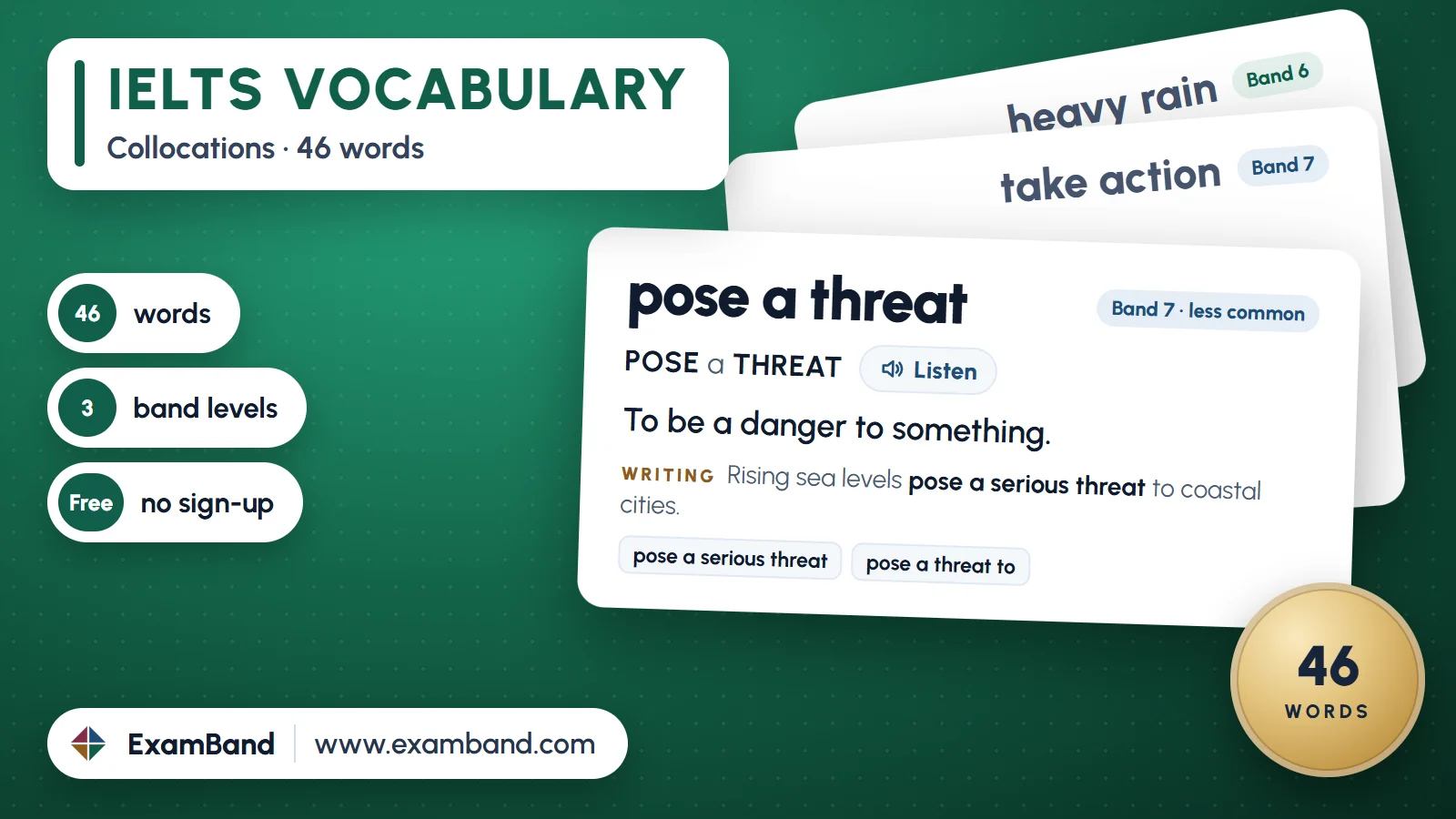
Questions about IELTS collocations
How do I learn these collocations?
Learn about ten words a day. First, read the meaning, listen to the word and say it out loud with the right stress. Then test yourself with the quiz and the flashcards on this page. Finally, use five of the words in an essay and check it with our free Writing Checker.
Which words should I learn first?
Start with the band 6 words, because you need them to explain any idea clearly. After that, add the band 7 words. However, use the band 8 words only when you are sure of their meaning, because a rare word used wrongly can lower your score.
Are these official IELTS words?
No. IELTS has no official word list. Instead, our levels follow the words of the public IELTS band descriptors: band 7 asks for some “less common” words, and band 8 for “uncommon” words used with skill.