IELTS Animals Vocabulary: 50 Words with Examples
These 50 words of IELTS animals vocabulary come up again and again in Writing Task 2 essays on zoos and animal testing, in Speaking Part 1, and in Reading passages and Listening lectures about wildlife. Each word has a simple meaning, its sound, a band level, examples for Writing and Speaking, and the mistake to avoid.
50 words · free quiz and flashcards · updated October 2026
wildlife
WILD·life · nounAnimals and plants that live in nature.Band 6 · everyday
Word family: wild (adjective)
Collocations
- protect wildlife
- local wildlife
- a wildlife park
Similar: nature, fauna
WritingBuilding new roads can harm local wildlife.
SpeakingI love watching wildlife documentaries.
Common mistake: Saying “wildlifes”. It is uncountable: “a lot of wildlife”.
zoo
ZOO · nounA place where wild animals are kept so people can see them.Band 6 · everyday
Word family: zookeeper (noun)
Collocations
- visit a zoo
- close zoos
- zoo animals
Similar: wildlife park
WritingModern zoos claim to focus on education and conservation.
SpeakingI went to the zoo every summer as a child.
Common mistake: Saying “a zoo park” for every zoo. Just say “a zoo”; a “safari park” is one where animals roam freely.
pet
PET · nounAn animal kept at home as a companion.Band 6 · everyday
Collocations
- keep a pet
- a pet dog
- pet owners
Similar: companion animal
WritingLooking after a pet teaches children responsibility.
SpeakingWe’ve got two cats, and they’re the best pets ever.
Common mistake: Saying “I have a pet animal of a dog”. Just say “I have a dog” or “a pet dog”.
domestic animals
do·MES·tic AN·i·mals · noun, pluralAnimals that live with or work for people, like dogs, cows and horses.Band 6 · everyday
Word family: domesticate (verb)
Collocations
- domestic and wild animals
- keep domestic animals
Similar: tame animals
WritingDomestic animals depend on humans for food and shelter.
SpeakingIn my village, every family keeps domestic animals like goats.
Common mistake: Saying “home animals”. Use “domestic animals” or “pets”.
wild animals
WILD AN·i·mals · noun, pluralAnimals that live freely in nature.Band 6 · everyday
Collocations
- keep wild animals
- protect wild animals
- wild animals in captivity
Similar: wildlife
WritingWild animals should not be kept as pets.
SpeakingI’ve seen wild animals like elephants on safari.
Common mistake: Saying “wilds animals”. The adjective has no s: “wild animals”.
animal testing
AN·i·mal TEST·ing · nounUsing animals in experiments to check if medicines or products are safe.Band 6 · everyday
Collocations
- ban animal testing
- alternatives to animal testing
- cosmetics tested on animals
Similar: animal experiments
WritingThe EU has banned animal testing for cosmetics.
SpeakingI only buy shampoo that isn’t linked to animal testing.
Common mistake: Saying “testing animal” or “animals test”. The term is “animal testing”.
animal rights
AN·i·mal RIGHTS · noun, pluralThe idea that animals should be protected from cruelty and harm.Band 6 · everyday
Collocations
- animal rights groups
- campaign for animal rights
- animal rights activists
Similar: animal welfare
WritingAnimal rights groups campaign against fur farming.
SpeakingI’m interested in animal rights, so I don’t wear fur.
Common mistake: Saying “animals’ right”. The usual term is “animal rights”.
extinct
ex·TINCT · adjectiveNo longer existing; all of a kind of animal or plant have died.Band 6 · everyday
Word family: extinction (noun)
Collocations
- become extinct
- an extinct species
- almost extinct
Similar: died out
WritingMany species have become extinct because of hunting and habitat loss.
SpeakingDinosaurs became extinct millions of years ago.
Common mistake: Saying “extincted”. It is an adjective: “The bird is extinct” or “became extinct”.
hunting
HUNT·ing · nounChasing and killing wild animals for food or sport.Band 6 · everyday
Word family: hunt (verb) · hunter (noun)
Collocations
- ban hunting
- hunting for sport
- illegal hunting
Similar: shooting
WritingHunting for sport should be banned in all countries.
SpeakingMy uncle used to go hunting, but he stopped years ago.
Common mistake: Saying “go to hunting”. Say “go hunting”.
cage
CAGE · nounA box made of bars where animals are kept.Band 6 · everyday
Word family: caged (adjective)
Collocations
- keep in a cage
- a small cage
- cage-free eggs
Similar: enclosure, pen
WritingKeeping birds in small cages is cruel.
SpeakingI hate seeing birds in cages.
Common mistake: Saying “close a bird in a cage”. Say “keep a bird in a cage”.
farm animals
FARM AN·i·mals · noun, pluralAnimals kept on farms, like cows, sheep and chickens.Band 6 · everyday
Word family: farmer (noun)
Collocations
- rear farm animals
- the welfare of farm animals
Similar: livestock
WritingFarm animals should have enough space to move freely.
SpeakingMy kids love feeding the farm animals at my parents’ house.
Common mistake: Saying “farming animals”. The term is “farm animals”.
vet
VET · nounAn animal doctor.Band 6 · everyday
Word family: veterinary (adjective)
Collocations
- take a pet to the vet
- a vet’s bill
Similar: veterinarian
WritingVet bills can make keeping a pet very expensive.
SpeakingI took my cat to the vet last week.
Common mistake: Saying “veterinary” for the person. The person is a “vet”, short for veterinary surgeon.
breed
BREED · verb / nounTo keep animals to produce young; also, a type of dog, cat or other animal.Band 6 · everyday
Word family: breeder (noun) · breeding (noun)
Collocations
- breed dogs
- a rare breed
- breed in captivity
Similar: type, raise
WritingSome zoos breed rare animals to return them to the wild.
SpeakingMy dog is a mixed breed.
Common mistake: Mixing up “breed” and “race”. For animals, use “breed”: “a dog breed”.
nature reserve
NA·ture re·SERVE · nounA protected area where wild animals and plants can live safely.Band 6 · everyday
Collocations
- a national nature reserve
- visit a nature reserve
- create a nature reserve
Similar: wildlife reserve, sanctuary
WritingCreating more nature reserves is better than building bigger zoos.
SpeakingThere’s a nature reserve near my town with lots of birds.
Common mistake: Saying “nature reservation”. The term is “nature reserve”.
livestock
LIVE·stock · nounAnimals kept on a farm, like cows and sheep.Band 6 · everyday
Collocations
- raise livestock
- livestock farming
- graze livestock
Similar: farm animals, cattle
WritingLivestock farming produces a large share of greenhouse gases.
SpeakingMy grandfather keeps livestock, mostly sheep.
Common mistake: Saying “livestocks”. It is uncountable: “a lot of livestock”.
animal shelter
AN·i·mal SHEL·ter · nounA place that looks after lost or unwanted animals.Band 6 · everyday
Collocations
- adopt from an animal shelter
- volunteer at an animal shelter
Similar: rescue centre
WritingPeople should adopt pets from an animal shelter instead of buying them.
SpeakingWe got our dog from an animal shelter.
Common mistake: Saying “animal hotel” for this. The usual term is “animal shelter” or “rescue centre”.
mammal
MAM·mal · nounAn animal that feeds its babies with milk, like humans, whales and dogs.Band 6 · everyday
Word family: mammalian (adjective)
Collocations
- marine mammals
- large mammals
- a species of mammal
WritingWhales are mammals, not fish.
SpeakingMy favourite mammal is the dolphin.
Common mistake: Spelling it “mamal”. Write “mammal”, with double m.
animal cruelty
AN·i·mal CRU·el·ty · nounCausing pain or suffering to animals.Band 6 · everyday
Word family: cruel (adjective)
Collocations
- prevent animal cruelty
- a case of animal cruelty
- laws against animal cruelty
Similar: mistreatment, abuse
WritingStronger laws are needed to punish animal cruelty.
SpeakingI can’t watch videos of animal cruelty.
Common mistake: Saying “cruelness”. The noun is “cruelty”.
captivity
cap·TIV·i·ty · nounBeing kept in a cage or a closed space, not free.Band 7 · less common
Word family: captive (adjective, noun)
Collocations
- in captivity
- bred in captivity
- animals in captivity
Similar: confinement
WritingAnimals born in captivity often cannot survive in the wild.
SpeakingSeeing dolphins in captivity makes me sad.
Common mistake: Saying “in a captivity”. Use “in captivity”, with no “a”.
poaching
POACH·ing · nounIllegally hunting or catching animals.Band 7 · less common
Word family: poach (verb) · poacher (noun)
Collocations
- stop poaching
- elephant poaching
- anti-poaching patrols
Similar: illegal hunting
WritingPoaching for ivory has pushed elephants close to extinction in some areas.
SpeakingThere’s a lot of poaching in some national parks, sadly.
Common mistake: Mixing it up with cooking. Poaching eggs is cooking; poaching animals is illegal hunting.
natural habitat
NAT·u·ral HAB·i·tat · nounThe place where an animal or plant normally lives.Band 7 · less common
Word family: inhabit (verb)
Collocations
- in their natural habitat
- destroy natural habitats
- protect natural habitats
Similar: home, environment
WritingIt is better to see animals in their natural habitat than in a zoo.
SpeakingI saw orangutans in their natural habitat in Borneo.
Common mistake: Saying “natural house”. The term is “natural habitat”.
factory farming
FAC·to·ry FARM·ing · nounKeeping large numbers of animals indoors in small spaces to produce cheap food.Band 7 · less common
Collocations
- the cruelty of factory farming
- end factory farming
Similar: intensive farming
WritingFactory farming keeps meat cheap, but the animals suffer.
SpeakingAfter a documentary about factory farming, I stopped eating chicken.
Common mistake: Saying “factory farms” for the method. The farms are “factory farms”; the system is “factory farming”.
predator
PRED·a·tor · nounAn animal that kills and eats other animals.Band 7 · less common
Word family: predatory (adjective) · predation (noun)
Collocations
- natural predators
- a top predator
- protect from predators
Similar: hunter
WritingPet cats are skilled predators that kill millions of birds each year.
SpeakingSharks are amazing predators.
Common mistake: Spelling it “predetor”. Write “predator”, with -a-.
prey
PREY · nounAn animal that is hunted and eaten by another.Band 7 · less common
Collocations
- hunt prey
- birds of prey
- fall prey to
Similar: quarry, victim
WritingOwls hunt their prey at night.
SpeakingI love watching birds of prey at the falconry show.
Common mistake: Mixing it up with “pray” (talk to God). An animal that is hunted is “prey”.
wildlife sanctuary
WILD·life SANC·tu·ar·y · nounA protected place where wild animals can live safely.Band 7 · less common
Collocations
- a wildlife sanctuary for
- create a wildlife sanctuary
Similar: nature reserve
WritingWildlife sanctuaries give injured animals a safe home.
SpeakingI volunteered at a wildlife sanctuary for rescued bears.
Common mistake: Spelling it “sanctuery”. Write “sanctuary”.
ivory
I·vo·ry · nounThe hard white material that elephants’ tusks are made of.Band 7 · less common
Collocations
- the ivory trade
- ban ivory
- illegal ivory
Similar: tusks
WritingBanning the ivory trade is essential to protect elephants.
SpeakingMy grandmother has an old ivory necklace that she never wears now.
Common mistake: Saying “ivories”. It is uncountable: “a ban on ivory”.
breeding programme
BREED·ing PRO·gramme · nounA plan to help rare animals have young, often in zoos.Band 7 · less common
Word family: breed (verb)
Collocations
- a captive breeding programme
- run a breeding programme
WritingZoo breeding programmes have saved several species from extinction.
SpeakingThe zoo has a breeding programme for snow leopards.
Common mistake: Writing “breeding program” in a British essay. UK: “programme”; US: “program”.
free-range
free-RANGE · adjectiveKept outside, free to move around, not in cages.Band 7 · less common
Collocations
- free-range eggs
- free-range chickens
- free-range farming
Similar: cage-free
WritingFree-range eggs cost more, but the hens live better lives.
SpeakingI always buy free-range eggs.
Common mistake: Writing “free range” with no hyphen before a noun. Write “free-range eggs”.
humane
hu·MANE · adjectiveTreating people or animals kindly, without causing pain.Band 7 · less common
Word family: humanely (adverb)
Collocations
- humane treatment
- a humane way
- humane farming
Similar: kind, compassionate
WritingFarms must treat animals in a more humane way.
SpeakingI think there must be a more humane way to deal with stray dogs.
Common mistake: Mixing up “humane” and “human”. Humane means kind; human means a person.
extinction
ex·TINC·tion · nounWhen a type of animal or plant dies out completely.Band 7 · less common
Word family: extinct (adjective)
Collocations
- face extinction
- on the brink of extinction
- mass extinction
Similar: dying out
WritingThousands of species face extinction because of human activity.
SpeakingIt’s scary how many animals are close to extinction.
Common mistake: Saying “extinguish” for animals. Fires are extinguished; species face extinction.
food chain
FOOD CHAIN · nounThe order in which animals and plants eat each other.Band 7 · less common
Collocations
- at the top of the food chain
- enter the food chain
- the marine food chain
WritingPlastic in the sea enters the food chain and ends up on our plates.
SpeakingHumans are at the top of the food chain.
Common mistake: Saying “food circle”. The term is “food chain”.
marine life
ma·RINE LIFE · nounAnimals and plants that live in the sea.Band 7 · less common
Collocations
- protect marine life
- rich marine life
- threaten marine life
Similar: sea life
WritingPlastic waste is a serious threat to marine life.
SpeakingSnorkelling showed me how colourful marine life is.
Common mistake: Saying “sea lives”. The term is “marine life”, and it is uncountable.
nocturnal
noc·TUR·nal · adjectiveActive at night and asleep during the day.Band 7 · less common
Collocations
- nocturnal animals
- mainly nocturnal
- nocturnal habits
WritingMany nocturnal animals suffer because of light pollution.
SpeakingOwls are nocturnal, so you hardly ever see them.
Common mistake: Mixing it up with “eternal”. Nocturnal means active at night.
camouflage
CAM·ou·flage · noun / verbColours or patterns that help an animal hide.Band 7 · less common
Collocations
- natural camouflage
- use camouflage
- perfect camouflage
Similar: disguise
WritingMany animals depend on camouflage to hide from predators.
SpeakingThe camouflage of that lizard was so good I nearly missed it.
Common mistake: Spelling it “camoflage”. Write “camouflage”, with -ou-.
invasive species
in·VA·sive SPE·cies · nounA plant or animal brought to a new place, where it harms local wildlife.Band 7 · less common
Word family: invade (verb) · invasion (noun)
Collocations
- control invasive species
- the spread of invasive species
Similar: non-native species
WritingRats are an invasive species that have wiped out birds on many islands.
SpeakingSome invasive species came here on ships.
Common mistake: Saying “invader species”. The term is “invasive species”.
stray
STRAY · adjective / nounAn animal, like a dog or cat, that has no home.Band 7 · less common
Collocations
- stray dogs
- stray cats
- feed strays
Similar: homeless animal
WritingCities should neuter stray dogs rather than kill them.
SpeakingThere are lots of stray cats in my neighbourhood.
Common mistake: Saying “street dog” in an essay. The usual word is “stray dog”.
release into the wild
re·LEASE into the WILD · phraseTo let an animal go free in nature.Band 7 · less common
Collocations
- release animals into the wild
- be released into the wild
Similar: set free
WritingRescued turtles are released into the wild once they recover.
SpeakingI’d love to see an animal being released into the wild.
Common mistake: Saying “release to the nature”. Say “release into the wild”.
hibernate
HI·ber·nate · verbTo sleep through the winter.Band 7 · less common
Word family: hibernation (noun)
Collocations
- hibernate in winter
- animals that hibernate
Similar: sleep through winter
WritingWarmer winters are confusing animals that normally hibernate.
SpeakingBears hibernate, and in January I feel like doing the same!
Common mistake: Using it for people sleeping late. It means a long winter sleep, mostly for animals.
de-extinction
de-ex·TINC·tion · nounBringing back extinct animals using science.Band 8 · uncommon
Collocations
- the ethics of de-extinction
- de-extinction projects
Similar: resurrection biology
WritingCritics say money for de-extinction would be better spent saving living species.
SpeakingDe-extinction sounds like science fiction to me.
Common mistake: Writing “de extinction” with no hyphen. Write “de-extinction”.
sentient
SEN·tient · adjectiveAble to feel pain and pleasure.Band 8 · uncommon
Word family: sentience (noun)
Collocations
- sentient beings
- sentient animals
- fully sentient
Similar: conscious, feeling
WritingIf animals are sentient, their suffering must count morally.
SpeakingI’m sure my dog is sentient; she knows when I’m sad.
Common mistake: Saying “sen-TI-ent”. It is said “SEN-shunt”.
vivisection
viv·i·SEC·tion · nounOperating on live animals for scientific research.Band 8 · uncommon
Collocations
- oppose vivisection
- the practice of vivisection
Similar: animal experimentation
WritingOpponents of vivisection argue that computer models can replace many experiments.
SpeakingI think vivisection is hard to justify today.
Common mistake: Using it for any animal research. It means cutting into living animals.
keystone species
KEY·stone SPE·cies · nounAn animal or plant that many others in an ecosystem depend on.Band 8 · uncommon
Collocations
- a keystone species
- protect keystone species
WritingWolves are a keystone species: removing them can change a whole ecosystem.
SpeakingBees are a keystone species, so their decline worries me.
Common mistake: Thinking it means the most popular animal. It means the one that others depend on most.
apex predator
A·pex PRED·a·tor · nounAn animal at the top of the food chain that no other animal hunts.Band 8 · uncommon
Collocations
- an apex predator
- the role of apex predators
Similar: top predator
WritingSharks are apex predators that keep ocean food chains in balance.
SpeakingLions are apex predators, but they still struggle to survive.
Common mistake: Saying “a-PEX”. The stress is at the start: “AY-pex”.
rewilding
re·WILD·ing · nounReturning land to nature and bringing back missing animals.Band 8 · uncommon
Word family: rewild (verb)
Collocations
- rewilding projects
- large-scale rewilding
Similar: habitat restoration
WritingRewilding projects have brought beavers back to parts of Britain.
SpeakingI love the idea of rewilding old farmland.
Common mistake: Writing “re-wilding” with a hyphen. It is usually one word: “rewilding”.
culling
CULL·ing · nounKilling some animals to control their numbers.Band 8 · uncommon
Word family: cull (verb, noun)
Collocations
- the culling of
- a badger cull
- controversial culling
Similar: selective killing
WritingThe culling of wild animals to protect farms is highly controversial.
SpeakingThere was a big argument about culling deer near my town.
Common mistake: Saying “culling” for hunting for fun. It means killing to control numbers.
endemic
en·DEM·ic · adjectiveFound naturally in only one place.Band 8 · uncommon
Collocations
- endemic to
- endemic species
- an endemic bird
Similar: native, indigenous
WritingThe kākāpō is endemic to New Zealand.
SpeakingMany animals in Madagascar are endemic; you can’t see them anywhere else.
Common mistake: Mixing it up with “epidemic”. Endemic means found only in one place.
symbiotic
sym·bi·OT·ic · adjectiveDescribing two living things that help each other.Band 8 · uncommon
Word family: symbiosis (noun)
Collocations
- a symbiotic relationship
- symbiotic species
Similar: mutually beneficial
WritingBees and flowers have a symbiotic relationship.
SpeakingMy cat and dog have an almost symbiotic friendship.
Common mistake: Using it for any relationship. It means both sides help each other.
dwindling
DWIN·dling · adjectiveBecoming smaller in number.Band 8 · uncommon
Word family: dwindle (verb)
Collocations
- dwindling numbers
- dwindling populations
- dwindling resources
Similar: declining, shrinking
WritingDwindling numbers of bees threaten crops around the world.
SpeakingFish stocks near my coast are dwindling.
Common mistake: Spelling it “dwindeling”. Write “dwindling”.
anthropomorphism
an·thro·po·MOR·phism · nounGiving animals human feelings or qualities.Band 8 · uncommon
Word family: anthropomorphic (adjective) · anthropomorphise (verb)
Collocations
- a form of anthropomorphism
- avoid anthropomorphism
WritingCartoons use anthropomorphism to make animals more likeable.
SpeakingSaying my cat is jealous is probably just anthropomorphism.
Common mistake: Spelling it “antropomorphism”. Write “anthropomorphism”, with th.
domestication
do·mes·ti·CA·tion · nounThe process of taming wild animals so they live with people.Band 8 · uncommon
Word family: domesticate (verb) · domestic (adjective)
Collocations
- the domestication of dogs
- early domestication
Similar: taming
WritingThe domestication of animals made settled farming possible.
SpeakingThe domestication of dogs happened thousands of years ago.
Common mistake: Saying “domestification”. The noun is “domestication”.
Animals vocabulary in IELTS Writing and Speaking
Here is how IELTS animals vocabulary can come up in the test, with our own practice questions. So, try to answer them with words from the list above.
Writing Task 2
Some people think animals should have the same rights as humans, while others believe humans may use animals for food and research. Discuss both views and give your own opinion.
Speaking
- Part 1: Do you have a pet?
- Part 1: What is your favourite animal?
- Part 2: Describe a wild animal that you find interesting.
- Part 3: Should people be allowed to keep wild animals as pets?
- Part 3: What can ordinary people do to protect wildlife?
Our free tests on this topic
- Writing Practice Test 11, Task 2whether all zoos should be closed
- Reading Practice Test 1, Passage 1how New Zealand is saving the kākāpō
- Reading Practice Test 2, Passage 3whether extinct animals should be brought back
- Listening Practice Test 5, Part 4a lecture on sleep in animals
A model paragraph with IELTS animals vocabulary
Supporters of zoos argue that breeding programmes save species from becoming extinct. However, keeping intelligent, sentient animals in captivity for our entertainment is hard to defend. Money would be better spent protecting natural habitats and stopping poaching, so that wildlife can survive in the wild.
Practise this IELTS animals vocabulary
Take the 10-question quiz on this IELTS animals vocabulary, or go through every word with the flashcards.
Question 1 of 10
Which word means “an animal kept at home as a companion”?
Now use the words
Write a Task 2 essay with five of these words. Then our free Writing Checker gives you a band for vocabulary and for the other three criteria.
Open the Writing Checker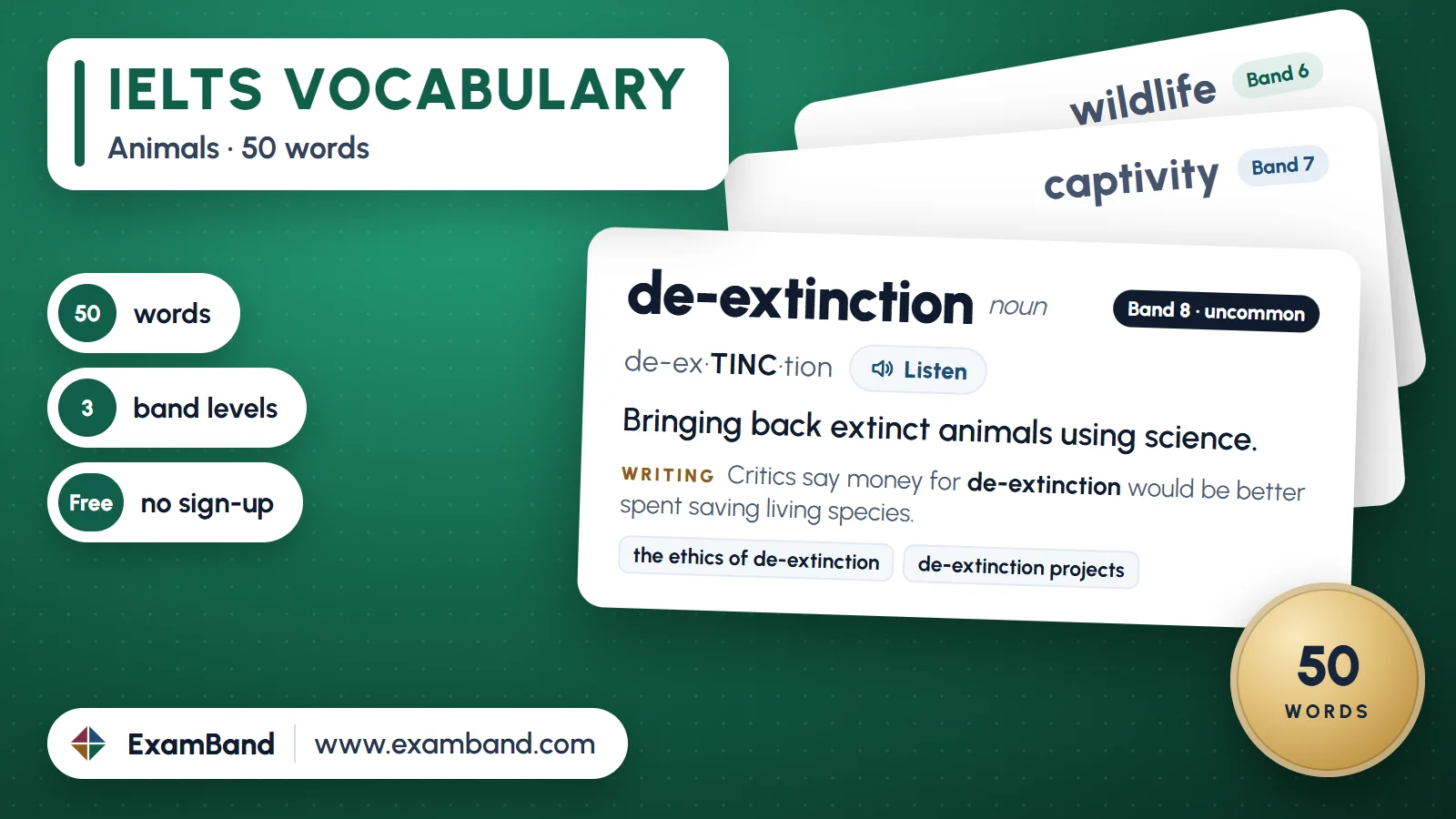
Questions about IELTS animals vocabulary
How do I learn IELTS animals vocabulary?
Learn about ten words a day. First, read the meaning, listen to the word and say it out loud with the right stress. Then test yourself with the quiz and the flashcards on this page. Finally, use five of the words in an essay and check it with our free Writing Checker.
Which words should I learn first?
Start with the band 6 words, because you need them to explain any idea clearly. After that, add the band 7 words. However, use the band 8 words only when you are sure of their meaning, because a rare word used wrongly can lower your score.
Are these official IELTS words?
No. IELTS has no official word list. Instead, our levels follow the words of the public IELTS band descriptors: band 7 asks for some “less common” words, and band 8 for “uncommon” words used with skill.