IELTS Health Vocabulary: 50 Words with Examples
This list of IELTS health vocabulary covers illness, healthy living, hospitals and public health, which are all common in Writing Task 2 and Speaking. Each word has a simple meaning, its sound, a band level, examples for Writing and Speaking, and the mistake to avoid.
50 words · free quiz and flashcards · updated October 2026
obesity
o·BE·si·ty · nounBeing so overweight that it is dangerous for your health.Band 6 · everyday
Word family: obese (adjective)
Collocations
- childhood obesity
- rising obesity rates
- tackle obesity
Similar: being seriously overweight
WritingChildhood obesity has risen sharply as children move less and eat more sugar.
SpeakingObesity is becoming a problem in my country because of fast food.
Common mistake: Saying “obesity people”. Use the adjective: “obese people” or “people with obesity”.
life expectancy
LIFE ex·PEC·tan·cy · nounHow long a person is expected to live.Band 6 · everyday
Word family: expect (verb)
Collocations
- average life expectancy
- increase life expectancy
- a longer life expectancy
Similar: lifespan
WritingBetter healthcare has greatly increased life expectancy in many countries.
SpeakingLife expectancy in my country is about seventy-five.
Common mistake: Saying “life expectation”. The term is “life expectancy”.
mental health
MEN·tal HEALTH · nounThe health of your mind and feelings.Band 6 · everyday
Collocations
- mental health problems
- look after your mental health
- mental health services
Similar: emotional well-being
WritingSchools should do more to support students’ mental health.
SpeakingGoing for walks really helps my mental health.
Common mistake: Saying “mental healthy”. The noun is “mental health”; the adjective is “mentally healthy”.
healthcare
HEALTH·care · nounThe services that look after people’s health, like doctors and hospitals.Band 6 · everyday
Collocations
- free healthcare
- access to healthcare
- the healthcare system
Similar: medical care
WritingGovernments should guarantee free healthcare for every citizen.
SpeakingHealthcare in my country is free, but you wait a long time.
Common mistake: Saying “healthcares”. It is uncountable.
stress
STRESS · noun / verbA feeling of worry caused by difficult situations.Band 6 · everyday
Word family: stressful (adjective) · stressed (adjective)
Collocations
- work stress
- reduce stress
- under stress
Similar: pressure, strain
WritingLong working hours are a major cause of stress.
SpeakingExams always give me a lot of stress.
Common mistake: Mixing up “stressed” and “stressful”. You feel stressed; a situation is stressful.
disease
dis·EASE · nounAn illness of people, animals or plants, often one with a name.Band 6 · everyday
Word family: diseased (adjective)
Collocations
- heart disease
- prevent disease
- spread disease
Similar: illness, condition
WritingA poor diet is linked to heart disease and diabetes.
SpeakingMy grandfather has heart disease, so our family eats healthily now.
Common mistake: Using “disease” for a small problem like a cold. A cold is an illness; a disease is usually more serious.
symptom
SYMP·tom · nounA sign that you have an illness, like a cough or a fever.Band 6 · everyday
Word family: symptomatic (adjective)
Collocations
- common symptoms
- show symptoms
- symptoms of stress
Similar: sign
WritingMany people ignore the early symptoms of serious illness.
SpeakingI had all the symptoms of flu: a fever, a cough and a headache.
Common mistake: Spelling it “symptome”. Write “symptom”.
treatment
TREAT·ment · nounMedical care given to make someone better.Band 6 · everyday
Word family: treat (verb)
Collocations
- receive treatment
- medical treatment
- effective treatment
Similar: therapy, care
WritingMany patients wait months for hospital treatment.
SpeakingThe treatment for my knee took six weeks.
Common mistake: Saying “a treat” for medical care. A treat is a small present; medical care is “treatment”.
prescription
pre·SCRIP·tion · nounA doctor’s written order for medicine.Band 6 · everyday
Word family: prescribe (verb)
Collocations
- a prescription for antibiotics
- prescription medicine
- get a prescription
Similar: doctor’s order
WritingSome medicines should only be available with a prescription.
SpeakingThe doctor gave me a prescription for my allergy.
Common mistake: Mixing up “prescription” (from a doctor) and “description” (words that describe something).
vaccine
VAC·cine · nounA substance that protects people from a disease.Band 6 · everyday
Word family: vaccinate (verb) · vaccination (noun)
Collocations
- develop a vaccine
- get a vaccine
- vaccine programmes
Similar: jab (informal), vaccination
WritingVaccines have saved millions of lives around the world.
SpeakingI got the flu vaccine this year for the first time.
Common mistake: Spelling it “vaccin”. Write “vaccine”, with an e at the end.
check-up
CHECK-up · nounA medical examination to see if you are healthy.Band 6 · everyday
Word family: check (verb)
Collocations
- a regular check-up
- go for a check-up
- an annual check-up
Similar: medical examination
WritingRegular check-ups can find health problems before they become serious.
SpeakingI go to the dentist for a check-up every six months.
Common mistake: Writing the noun as “check up”. In British English the noun is “check-up”.
overweight
o·ver·WEIGHT · adjectiveHeavier than is healthy.Band 6 · everyday
Word family: weight (noun)
Collocations
- seriously overweight
- become overweight
- overweight children
Similar: heavy
WritingThe number of overweight children has doubled in thirty years.
SpeakingI was a bit overweight, so I started running.
Common mistake: Writing “over weight” as two words. Write “overweight”.
illness
ILL·ness · nounBeing sick, or a particular kind of sickness.Band 6 · everyday
Word family: ill (adjective)
Collocations
- a serious illness
- mental illness
- recover from an illness
Similar: sickness, disease
WritingStress can lead to physical illness as well as mental problems.
SpeakingI missed a week of school because of illness.
Common mistake: Saying “an ill person”. Say “a sick person” or “a person who is ill”.
injury
IN·ju·ry · nounDamage to the body, for example from an accident.Band 6 · everyday
Word family: injure (verb) · injured (adjective)
Collocations
- a serious injury
- suffer an injury
- sports injuries
Similar: harm
WritingMany sports injuries could be avoided with a proper warm-up.
SpeakingI had a knee injury from playing football.
Common mistake: Saying “wound” for every injury. A wound is a cut; an injury can be any damage to the body.
medicine
MED·i·cine · nounSomething you take to treat an illness; also the study of treating illness.Band 6 · everyday
Word family: medical (adjective) · medication (noun)
Collocations
- take medicine
- study medicine
- modern medicine
Similar: medication, drugs
WritingModern medicine has made many deadly diseases curable.
SpeakingI hate taking medicine; it always tastes awful.
Common mistake: Saying all three parts slowly. In British English it often sounds like two: MED-sin.
health insurance
HEALTH in·SUR·ance · nounA plan you pay into, so that it pays your medical costs.Band 6 · everyday
Word family: insure (verb)
Collocations
- private health insurance
- pay for health insurance
- health insurance cover
Similar: medical insurance
WritingWithout health insurance, a single operation can leave a family in debt.
SpeakingMy job gives me free health insurance, which is great.
Common mistake: Saying “health assurance”. The usual term is “health insurance”.
cure
CURE · noun / verbA treatment that makes an illness go away completely.Band 6 · everyday
Word family: curable (adjective)
Collocations
- find a cure
- a cure for cancer
- cure a disease
Similar: remedy
WritingScientists are still searching for a cure for many cancers.
SpeakingMy grandma says ginger tea is a cure for everything!
Common mistake: Saying “a cure of”. Use “for”: “a cure for cancer”.
allergy
AL·ler·gy · nounA bad reaction of the body to something like a food, dust or an animal.Band 6 · everyday
Word family: allergic (adjective)
Collocations
- a food allergy
- have an allergy to
- allergy symptoms
Similar: sensitivity
WritingFood allergies among children have become more common.
SpeakingI have an allergy to cats, so I can’t visit my aunt.
Common mistake: Saying “I have allergic”. Say “I have an allergy” or “I am allergic”.
sedentary lifestyle
SED·en·ta·ry LIFE·style · nounA way of life with a lot of sitting and very little exercise.Band 7 · less common
Word family: sedentary (adjective)
Collocations
- lead a sedentary lifestyle
- the risks of a sedentary lifestyle
- increasingly sedentary
Similar: inactive lifestyle
WritingOffice work has led many adults into a sedentary lifestyle.
SpeakingStudying online gave me a really sedentary lifestyle.
Common mistake: Saying “sedentarian”. The adjective is “sedentary”.
chronic
CHRON·ic · adjectiveLasting for a long time, often for life.Band 7 · less common
Word family: chronically (adverb)
Collocations
- chronic illness
- chronic pain
- chronic diseases
Similar: long-term, persistent
WritingChronic diseases like diabetes put heavy pressure on health services.
SpeakingMy mum has chronic back pain from her job.
Common mistake: Using it to mean “very bad”. In medicine it means long-lasting.
preventable
pre·VENT·a·ble · adjectiveAble to be stopped before it happens.Band 7 · less common
Word family: prevent (verb) · prevention (noun)
Collocations
- preventable diseases
- preventable deaths
- largely preventable
Similar: avoidable
WritingMany heart attacks are preventable with a healthy diet.
SpeakingIt’s sad that so many illnesses are preventable but still common.
Common mistake: Spelling it “preventible”. It ends in “-able”.
epidemic
ep·i·DEM·ic · nounA disease that spreads quickly to many people in one area.Band 7 · less common
Word family: epidemiology (noun)
Collocations
- an obesity epidemic
- a flu epidemic
- reach epidemic levels
Similar: outbreak
WritingSome experts describe childhood obesity as an epidemic.
SpeakingThere was a flu epidemic in my city last winter.
Common mistake: Mixing it up with “pandemic”. An epidemic is in one area; a pandemic spreads across the world.
side effects
SIDE ef·FECTS · noun, pluralUnwanted effects of a medicine.Band 7 · less common
Collocations
- serious side effects
- cause side effects
- have side effects
Similar: unwanted effects
WritingAll medicines have possible side effects, so doctors must explain them.
SpeakingMy new medicine has a strange side effect: it makes me sleepy.
Common mistake: Saying “second effects”. The term is “side effects”.
well-being
well-BE·ing · nounFeeling healthy, happy and comfortable.Band 7 · less common
Collocations
- mental well-being
- physical well-being
- improve well-being
Similar: wellness, health
WritingGreen spaces in cities improve residents’ well-being.
SpeakingYoga has done wonders for my well-being.
Common mistake: Writing “well being” as two words. Write “well-being” or “wellbeing”.
anxiety
anx·I·e·ty · nounA strong feeling of worry or fear.Band 7 · less common
Word family: anxious (adjective)
Collocations
- suffer from anxiety
- anxiety disorders
- cause anxiety
Similar: worry, nervousness
WritingSocial media use has been linked to anxiety among teenagers.
SpeakingI get terrible anxiety before speaking in public.
Common mistake: Putting the stress at the start. Stress the second part: ang-ZY-uh-tee.
public health
PUB·lic HEALTH · nounThe health of a whole population, and the work to protect it.Band 7 · less common
Collocations
- a threat to public health
- public health campaigns
- improve public health
Similar: community health
WritingSmoking bans have been a great success for public health.
SpeakingMy sister works in public health, mostly on vaccine campaigns.
Common mistake: Saying “people’s health” in formal writing. The term is “public health”.
diagnosis
di·ag·NO·sis · nounFinding out exactly what illness someone has.Band 7 · less common
Word family: diagnose (verb)
Collocations
- an early diagnosis
- make a diagnosis
- receive a diagnosis
Similar: identification
WritingEarly diagnosis greatly improves the chances of surviving cancer.
SpeakingThe doctor’s diagnosis was just a bad cold.
Common mistake: Using “diagnose” as the noun. The noun is “diagnosis”; the plural is “diagnoses”.
recover
re·COV·er · verbTo become healthy again after an illness or an injury.Band 7 · less common
Word family: recovery (noun)
Collocations
- recover from an illness
- fully recover
- recover quickly
Similar: get better, heal
WritingPatients recover faster when they have support from their family.
SpeakingIt took me a month to recover from the operation.
Common mistake: Leaving out “from”: “recover the flu”. Say “recover from the flu”.
immune system
im·MUNE SYS·tem · nounThe parts of the body that fight infection.Band 7 · less common
Word family: immunity (noun)
Collocations
- a strong immune system
- weaken the immune system
- boost the immune system
Similar: the body’s defences
WritingLack of sleep can weaken the immune system.
SpeakingI take vitamin C to help my immune system in winter.
Common mistake: Saying “immunity system”. The term is “immune system”.
sleep deprivation
SLEEP dep·ri·VA·tion · nounNot getting enough sleep over a long time.Band 7 · less common
Word family: deprived (adjective)
Collocations
- suffer from sleep deprivation
- the effects of sleep deprivation
- chronic sleep deprivation
Similar: lack of sleep
WritingSleep deprivation reduces concentration and increases the risk of accidents.
SpeakingDuring exams I always suffer from sleep deprivation.
Common mistake: Saying “sleep deprivement”. The noun is “deprivation”.
malnutrition
mal·nu·TRI·tion · nounPoor health caused by not eating enough of the right food.Band 7 · less common
Word family: malnourished (adjective)
Collocations
- suffer from malnutrition
- child malnutrition
- tackle malnutrition
Similar: undernourishment
WritingMalnutrition still affects millions of children in poorer countries.
SpeakingI didn’t know you can have malnutrition even if you eat a lot of junk food.
Common mistake: Thinking it only means not eating. It also means eating the wrong food.
addiction
ad·DIC·tion · nounBeing unable to stop taking a drug or doing an activity.Band 7 · less common
Word family: addicted (adjective) · addict (noun)
Collocations
- drug addiction
- gambling addiction
- overcome an addiction
Similar: dependence
WritingAddiction should be treated as a health problem, not just as a crime.
SpeakingMy uncle had a terrible gambling addiction.
Common mistake: Saying “an addiction of sugar”. Use “to”: “an addiction to sugar”.
contagious
con·TA·gious · adjectiveAble to pass from one person to another.Band 7 · less common
Word family: contagion (noun)
Collocations
- highly contagious
- a contagious disease
- contagious laughter
Similar: infectious, catching
WritingMeasles is one of the most contagious diseases in the world.
SpeakingStay home if you’re contagious; don’t come to class!
Common mistake: Spelling it “contagous”. Write “contagious”.
alternative medicine
al·TER·na·tive MED·i·cine · nounTreatments like herbs or acupuncture that are not part of normal medicine.Band 7 · less common
Collocations
- use alternative medicine
- try alternative medicine
- alternative medicine and modern medicine
Similar: complementary medicine
WritingAlternative medicine should never replace treatment that has been properly tested.
SpeakingMy aunt swears by alternative medicine, especially herbal tea.
Common mistake: Saying “alternate medicine”. The adjective is “alternative”.
outbreak
OUT·break · nounThe sudden start of a disease in a place.Band 7 · less common
Word family: break out (phrasal verb)
Collocations
- an outbreak of measles
- a disease outbreak
- control an outbreak
Similar: epidemic
WritingClean water is essential to prevent an outbreak of cholera.
SpeakingThere was a food poisoning outbreak at my school once.
Common mistake: Using “break out” as the noun. The noun is “outbreak”.
hygiene
HY·giene · nounKeeping yourself and the things around you clean, to stop disease.Band 7 · less common
Word family: hygienic (adjective)
Collocations
- personal hygiene
- poor hygiene
- food hygiene
Similar: cleanliness
WritingGood hygiene, such as washing hands, stops many diseases spreading.
SpeakingMy mum is very strict about kitchen hygiene.
Common mistake: Spelling it “hygene”. Write “hygiene”, with i before e.
life-threatening
LIFE-threat·en·ing · adjectiveSo serious that it could cause death.Band 7 · less common
Word family: threaten (verb)
Collocations
- a life-threatening illness
- life-threatening injuries
- potentially life-threatening
Similar: fatal, deadly
WritingSome allergies can be life-threatening if they are not treated.
SpeakingLuckily, his injury wasn’t life-threatening.
Common mistake: Writing “life threatening” without a hyphen. Write “life-threatening”.
ageing population
AGE·ing pop·u·LA·tion · nounWhen the number of old people in a country grows faster than the number of young people.Band 7 · less common
Word family: ageing (adjective)
Collocations
- cope with an ageing population
- the challenge of an ageing population
- a rapidly ageing population
Similar: greying population
WritingAn ageing population puts pressure on hospitals and pension systems.
SpeakingJapan is famous for its ageing population.
Common mistake: Mixing spellings. British English writes “ageing”; American English writes “aging”.
pandemic
pan·DEM·ic · nounA disease that spreads across many countries or the whole world.Band 8 · uncommon
Collocations
- a global pandemic
- during the pandemic
- prepare for future pandemics
Similar: global outbreak
WritingThe pandemic showed how quickly a disease can spread around the world.
SpeakingDuring the pandemic, I studied at home for a whole year.
Common mistake: Using it for a disease in one city. That is an epidemic or an outbreak.
debilitating
de·BIL·i·tat·ing · adjectiveMaking someone very weak or unable to live normally.Band 8 · uncommon
Word family: debilitate (verb)
Collocations
- a debilitating illness
- debilitating pain
- debilitating effects
Similar: disabling, crippling
WritingChronic pain can be debilitating and can lead to depression.
SpeakingMy migraines used to be debilitating; I couldn’t go to work.
Common mistake: Saying “debilating”. Write “debilitating”.
susceptible
sus·CEP·ti·ble · adjectiveEasily affected or harmed by something.Band 8 · uncommon
Word family: susceptibility (noun)
Collocations
- susceptible to disease
- highly susceptible
- particularly susceptible
Similar: vulnerable, prone
WritingElderly people are more susceptible to infections in winter.
SpeakingI’m really susceptible to colds; I get one every month.
Common mistake: Saying “susceptible for”. Use “to”: “susceptible to infection”.
longevity
lon·GEV·i·ty · nounLiving for a long time.Band 8 · uncommon
Collocations
- increase longevity
- the secret of longevity
- human longevity
Similar: long life
WritingDiet and exercise play a major role in longevity.
SpeakingMy grandmother is ninety-five; she says the secret of longevity is walking.
Common mistake: Saying it with a hard g. The g sounds like the j in “jam”: lon-JEV-i-ty.
adverse effects
AD·verse ef·FECTS · noun, pluralHarmful results, especially of a medicine or an activity.Band 8 · uncommon
Word family: adversely (adverb)
Collocations
- have adverse effects on
- suffer adverse effects
- possible adverse effects
Similar: harmful effects
WritingToo much screen time may have adverse effects on children’s sleep.
SpeakingThe medicine had some adverse effects, so I stopped taking it.
Common mistake: Mixing up “adverse” (harmful) and “averse” (not liking something).
prevalence
PREV·a·lence · nounHow common something is in a group of people.Band 8 · uncommon
Word family: prevalent (adjective)
Collocations
- the prevalence of obesity
- a high prevalence
- an increasing prevalence
Similar: frequency, extent
WritingThe prevalence of diabetes has doubled in thirty years.
SpeakingI’m surprised by the prevalence of back problems among young people.
Common mistake: Saying “prevalency”. The noun is “prevalence”.
alleviate
al·LE·vi·ate · verbTo make pain or a problem less severe.Band 8 · uncommon
Word family: alleviation (noun)
Collocations
- alleviate pain
- alleviate symptoms
- alleviate pressure on hospitals
Similar: ease, relieve
WritingMore nurses would alleviate the pressure on busy hospitals.
SpeakingA hot bath alleviates my back pain a bit.
Common mistake: Spelling it “aleviate”. Write “alleviate”, with double l.
incurable
in·CUR·a·ble · adjectiveImpossible to cure.Band 8 · uncommon
Collocations
- an incurable disease
- incurable illnesses
- currently incurable
Similar: untreatable
WritingMany once incurable diseases can now be treated.
SpeakingMy aunt has an incurable condition, but medicine controls it.
Common mistake: Saying “uncurable”. The opposite of “curable” is “incurable”.
mortality rate
mor·TAL·i·ty RATE · nounThe number of deaths in a group of people in a period of time.Band 8 · uncommon
Word family: mortal (adjective)
Collocations
- infant mortality rate
- reduce the mortality rate
- a high mortality rate
Similar: death rate
WritingClean water has cut the infant mortality rate dramatically.
SpeakingThe mortality rate for that disease is really low now.
Common mistake: Saying “death number” in formal writing. The term is “mortality rate” or “death rate”.
eradicate
e·RAD·i·cate · verbTo destroy something completely.Band 8 · uncommon
Word family: eradication (noun)
Collocations
- eradicate a disease
- eradicate poverty
- completely eradicate
Similar: wipe out, eliminate
WritingSmallpox was the first human disease to be completely eradicated.
SpeakingI hope scientists can eradicate malaria in my lifetime.
Common mistake: Using it for reducing something a little. Eradicate means removing it completely.
hereditary
he·RED·i·ta·ry · adjectivePassed from parents to children through the genes.Band 8 · uncommon
Word family: heredity (noun)
Collocations
- a hereditary disease
- hereditary conditions
- partly hereditary
Similar: genetic, inherited
WritingSome heart conditions are hereditary, so family history matters.
SpeakingBad eyesight is hereditary in my family.
Common mistake: Spelling it “heredetary”. Write “hereditary”.
therapeutic
ther·a·PEU·tic · adjectiveHelping to heal the body or mind, or making you feel relaxed.Band 8 · uncommon
Word family: therapy (noun) · therapist (noun)
Collocations
- therapeutic effects
- therapeutic benefits
- find something therapeutic
Similar: healing, relaxing
WritingGardening can have a therapeutic effect on people with depression.
SpeakingI find cooking really therapeutic after a long day.
Common mistake: Saying “therapic”. The adjective is “therapeutic”.
Health vocabulary in IELTS Writing and Speaking
Here is how IELTS health vocabulary can come up in the test, with our own practice questions. So, try to answer them with words from the list above.
Writing Task 2
Some people believe governments should spend more money on preventing illness than on treating it. To what extent do you agree or disagree?
Speaking
- Part 1: What do you do to stay healthy?
- Part 1: How often do you go to the doctor?
- Part 2: Describe a time when you were ill and how you got better.
- Part 3: Should unhealthy food be taxed?
- Part 3: Why are more young people suffering from stress today?
Our free tests on this topic
- Writing Practice Test 4, Task 2a tax on sugary drinks
- Reading Practice Test 6, Passage 1how scurvy was finally understood
- Reading Practice Test 3, Passage 3the puzzle of the placebo
- Reading Practice Test 8, Passage 3screening healthy people for disease
A model paragraph with IELTS health vocabulary
Many modern illnesses are preventable. A sedentary lifestyle and a poor diet increase the risk of obesity and other chronic diseases, which put heavy pressure on healthcare systems. Governments could alleviate this pressure by funding public health campaigns that encourage exercise, since prevention is far cheaper than treatment.
Practise this IELTS health vocabulary
Take the 10-question quiz on this IELTS health vocabulary, or go through every word with the flashcards.
Question 1 of 10
Which word means “the health of your mind and feelings”?
Now use the words
Write a Task 2 essay with five of these words. Then our free Writing Checker gives you a band for vocabulary and for the other three criteria.
Open the Writing Checker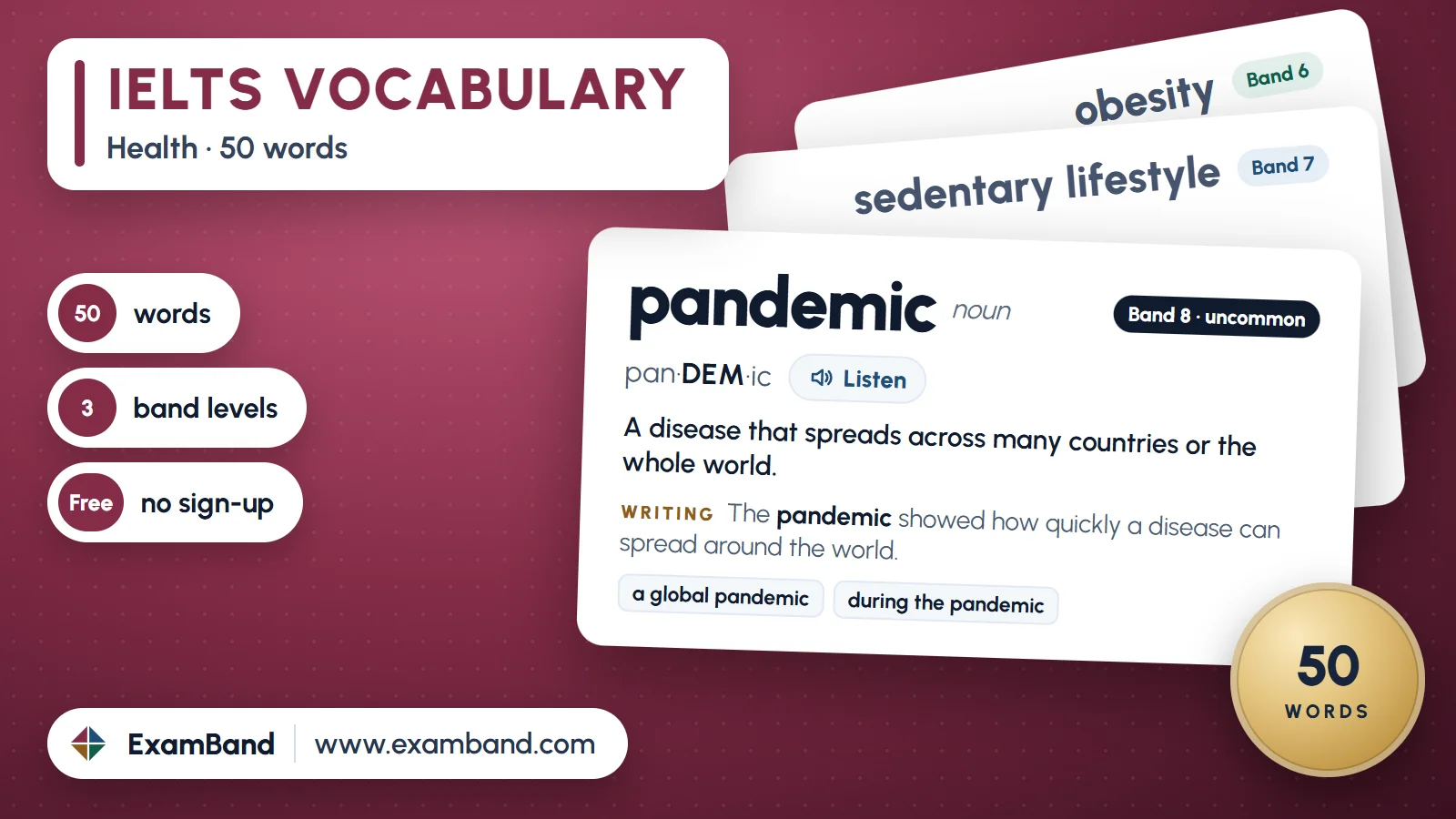
Questions about IELTS health vocabulary
How do I learn IELTS health vocabulary?
Learn about ten words a day. First, read the meaning, listen to the word and say it out loud with the right stress. Then test yourself with the quiz and the flashcards on this page. Finally, use five of the words in an essay and check it with our free Writing Checker.
Which words should I learn first?
Start with the band 6 words, because you need them to explain any idea clearly. After that, add the band 7 words. However, use the band 8 words only when you are sure of their meaning, because a rare word used wrongly can lower your score.
Are these official IELTS words?
No. IELTS has no official word list. Instead, our levels follow the words of the public IELTS band descriptors: band 7 asks for some “less common” words, and band 8 for “uncommon” words used with skill.