IELTS Globalisation Vocabulary: 50 Words with Examples
These 50 words of IELTS globalisation vocabulary come up again and again in Writing Task 2 essays on trade, migration and culture, in Speaking Part 3 and in Academic Reading passages. Each word has a simple meaning, its sound, a band level, examples for Writing and Speaking, and the mistake to avoid.
50 words · free quiz and flashcards · updated October 2026
globalisation
glo·bal·i·SA·tion · nounThe way countries become more connected through trade, travel, technology and culture.Band 6 · everyday
Word family: globalise (verb) · global (adjective) · globally (adverb)
Collocations
- the effects of globalisation
- economic globalisation
- the impact of globalisation
Similar: internationalisation
WritingGlobalisation has made many products cheaper for consumers.
SpeakingI think globalisation is why every city now has the same shops.
Common mistake: Writing “globalization” and “globalisation” in one essay. Both are right; keep one spelling all through.
international trade
in·ter·NA·tion·al TRADE · nounBuying and selling goods between countries.Band 6 · everyday
Word family: trader (noun)
Collocations
- promote international trade
- barriers to international trade
- rules on international trade
Similar: global trade, commerce
WritingInternational trade allows countries to sell what they produce best.
SpeakingMy country depends on international trade, especially oil.
Common mistake: Saying “international trades”. It is usually uncountable: “international trade”.
import
im·PORT · verb / nounTo bring goods into a country to sell; goods brought in.Band 6 · everyday
Word family: importer (noun) · imported (adjective)
Collocations
- import goods
- cheap imports
- import from
Similar: bring in
WritingRich countries import huge amounts of fruit from abroad.
SpeakingMost of the clothes in my country are imported.
Common mistake: Saying the noun and the verb the same way. The noun is “IM-port”; the verb is “im-PORT”.
export
ex·PORT · verb / nounTo send goods to another country to sell; goods sent out.Band 6 · everyday
Word family: exporter (noun)
Collocations
- export goods
- a major exporter
- export to
Similar: ship, sell abroad
WritingPoorer countries often export raw materials and import finished goods.
SpeakingMy country exports a lot of dates and coffee.
Common mistake: Saying “export to abroad”. Just say “export” or “export to other countries”.
multinational
mul·ti·NA·tion·al · adjective / nounA company that works in many countries.Band 6 · everyday
Word family: nation (noun) · national (adjective)
Collocations
- a multinational company
- large multinationals
- multinational corporations
Similar: global company
WritingMultinational companies bring jobs, but profits often leave the country.
SpeakingI work for a multinational, so my colleagues are from everywhere.
Common mistake: Writing “multi-national” with a hyphen. It is one word: “multinational”.
developing countries
de·VEL·op·ing COUN·tries · noun, pluralPoorer countries that are building up their economy and industry.Band 6 · everyday
Word family: develop (verb) · development (noun)
Collocations
- aid to developing countries
- in many developing countries
Similar: low-income countries
WritingMany developing countries lack clean water and good schools.
SpeakingMy country used to be one of the developing countries, but it has changed fast.
Common mistake: Saying “under-developing countries”. Use “developing countries” or “less developed countries”.
developed countries
de·VEL·oped COUN·tries · noun, pluralRich countries with modern industry and services.Band 6 · everyday
Collocations
- in developed countries
- developed and developing countries
Similar: industrialised countries
WritingDeveloped countries have produced most of the carbon emissions in history.
SpeakingLife in developed countries isn’t perfect either.
Common mistake: Saying “develop countries”. You need -ed: “developed countries”.
foreign investment
FOR·eign in·VEST·ment · nounMoney that people or companies from other countries put into a country’s businesses.Band 6 · everyday
Word family: invest (verb) · investor (noun)
Collocations
- attract foreign investment
- rely on foreign investment
Similar: overseas investment
WritingLow taxes are often used to attract foreign investment.
SpeakingThere’s been a lot of foreign investment in my city lately.
Common mistake: Saying “foreign investments money”. Just say “foreign investment”.
immigrant
IM·mi·grant · nounA person who comes to live in a country from another country.Band 6 · everyday
Word family: immigrate (verb) · immigration (noun)
Collocations
- new immigrants
- a community of immigrants
- the children of immigrants
Similar: migrant, newcomer
WritingImmigrants often do the jobs that local people do not want.
SpeakingMy grandparents were immigrants; they came here in the 1970s.
Common mistake: Mixing up “immigrant” and “emigrant”. An immigrant comes in; an emigrant leaves.
migration
mi·GRA·tion · nounMoving from one place to another to live or work.Band 6 · everyday
Word family: migrate (verb) · migrant (noun)
Collocations
- mass migration
- economic migration
- patterns of migration
WritingMigration from the countryside to cities has changed many economies.
SpeakingThere’s a lot of migration from my village to the capital.
Common mistake: Spelling it “migraton”. Write “migration”.
economy
e·CON·o·my · nounThe system of money, trade and business in a country.Band 6 · everyday
Word family: economic (adjective) · economist (noun)
Collocations
- the global economy
- boost the economy
- a strong economy
WritingTourism makes up a large part of the economy in many island nations.
SpeakingThe economy in my country is growing quickly.
Common mistake: Saying “economic” as a noun. The noun is “economy”.
goods
GOODS · noun, pluralThings that are made to be sold.Band 6 · everyday
Collocations
- consumer goods
- cheap goods
- manufactured goods
Similar: products
WritingCheap imported goods can put local factories out of business.
SpeakingMost of the goods in our shops come from abroad.
Common mistake: Saying “a good” for one item. Use “a product” or “an item”; “goods” is plural.
worldwide
world·WIDE · adjective / adverbIn every part of the world.Band 6 · everyday
Collocations
- worldwide popularity
- sold worldwide
- a worldwide network
Similar: global
WritingThe internet has created a worldwide market for small businesses.
SpeakingKorean music is popular worldwide now.
Common mistake: Writing “world wide” as two words. It is one word: “worldwide”.
overseas
o·ver·SEAS · adjective / adverbIn or to a foreign country, especially across the sea.Band 6 · everyday
Collocations
- work overseas
- overseas students
- overseas markets
Similar: abroad
WritingMany companies now sell most of their products overseas.
SpeakingI’d like to study overseas for a year.
Common mistake: Saying “go to overseas”. It is an adverb: “go overseas”.
local businesses
LO·cal BUSI·ness·es · noun, pluralSmall companies owned by people from the area.Band 6 · everyday
Collocations
- support local businesses
- local businesses struggle
Similar: small firms
WritingBig supermarket chains make it hard for local businesses to survive.
SpeakingI try to support local businesses, like the bakery on my street.
Common mistake: Saying “local business” for all of them. Use the plural: “local businesses”.
free trade
FREE TRADE · nounTrade between countries without taxes or limits.Band 6 · everyday
Collocations
- free trade agreements
- promote free trade
Similar: open trade
WritingFree trade agreements can lower prices for consumers.
SpeakingThanks to free trade, phones are much cheaper now.
Common mistake: Writing “free-trade” with a hyphen when it is not before a noun. Write “free trade”; before a noun, “a free-trade deal”.
global village
GLO·bal VIL·lage · nounThe idea that the world feels small because people everywhere are connected.Band 6 · everyday
Collocations
- live in a global village
- the world as a global village
WritingThe internet has turned the world into a global village.
SpeakingWith video calls, it really feels like a global village.
Common mistake: Saying “the world village”. The phrase is “the global village”.
emigrate
EM·i·grate · verbTo leave your country to live in another.Band 6 · everyday
Word family: emigrant (noun) · emigration (noun)
Collocations
- emigrate to
- emigrate from
- decide to emigrate
Similar: move abroad
WritingMany young doctors emigrate to countries that pay better.
SpeakingMy uncle emigrated to Australia when he was twenty.
Common mistake: Mixing it up with “immigrate”. You emigrate from your country; you immigrate to a new one.
interdependent
in·ter·de·PEND·ent · adjectiveDepending on each other.Band 7 · less common
Word family: interdependence (noun)
Collocations
- economically interdependent
- increasingly interdependent
Similar: interconnected, linked
WritingToday’s economies are so interdependent that one crisis affects everyone.
SpeakingCountries are so interdependent now; one shortage hits everyone.
Common mistake: Writing “inter-dependent” with a hyphen. It is one word: “interdependent”.
supply chain
sup·PLY CHAIN · nounAll the steps and companies needed to make a product and get it to customers.Band 7 · less common
Word family: supplier (noun)
Collocations
- global supply chains
- disrupt supply chains
- a supply chain problem
WritingThe pandemic showed how fragile global supply chains can be.
SpeakingBecause of supply chain problems, my new phone took weeks to arrive.
Common mistake: Saying “supplying chain”. The term is “supply chain”.
cheap labour
CHEAP LA·bour · nounWorkers who are paid very little.Band 7 · less common
Word family: labourer (noun)
Collocations
- rely on cheap labour
- a source of cheap labour
- exploit cheap labour
Similar: low-paid workers
WritingSome companies move factories abroad to find cheap labour.
SpeakingLots of factories came here because of cheap labour.
Common mistake: Writing “cheap labor” in a British essay. UK: “labour”; US: “labor”.
sweatshop
SWEAT·shop · nounA factory where people work long hours for very little money in bad conditions.Band 7 · less common
Collocations
- sweatshop labour
- sweatshop conditions
- ban sweatshops
WritingCheap fashion often depends on sweatshop labour.
SpeakingI stopped buying from that brand after a sweatshop scandal.
Common mistake: Writing “sweat shop” as two words. It is one word: “sweatshop”.
exploitation
ex·ploi·TA·tion · nounTreating people unfairly to gain from their work.Band 7 · less common
Word family: exploit (verb) · exploitative (adjective)
Collocations
- the exploitation of workers
- protect from exploitation
- child exploitation
Similar: abuse, mistreatment
WritingStrict laws are needed to stop the exploitation of migrant workers.
SpeakingThe documentary showed shocking exploitation of farm workers.
Common mistake: Using “exploit” as a noun for this. The noun is “exploitation”.
standard of living
STAND·ard of LIV·ing · nounHow much money and comfort people have.Band 7 · less common
Collocations
- raise the standard of living
- a high standard of living
Similar: quality of life, living standards
WritingTrade has raised the standard of living in many Asian countries.
SpeakingThe standard of living in my country has improved a lot.
Common mistake: Saying “the living of standard”. Say “the standard of living” or “living standards”.
economic migrant
ec·o·NOM·ic MI·grant · nounA person who moves to another country to find work or earn more.Band 7 · less common
Word family: migrate (verb)
Collocations
- economic migrants
- treat economic migrants fairly
Similar: migrant worker
WritingEconomic migrants often send money home to their families.
SpeakingMany people from my town are economic migrants in the Gulf.
Common mistake: Mixing it up with “refugee”. A refugee escapes danger; an economic migrant looks for work.
trade barriers
TRADE BAR·ri·ers · noun, pluralRules or taxes that make trade between countries harder.Band 7 · less common
Collocations
- remove trade barriers
- lower trade barriers
- impose trade barriers
Similar: trade restrictions
WritingRemoving trade barriers can help poorer countries sell their goods abroad.
SpeakingTrade barriers make some foreign products really expensive here.
Common mistake: Saying “trade borders”. The term is “trade barriers”.
tariff
TAR·iff · nounA tax on goods coming into a country.Band 7 · less common
Collocations
- impose tariffs
- tariffs on imports
- raise tariffs
Similar: import tax, duty
WritingHigh tariffs protect local farmers but raise prices for shoppers.
SpeakingThere’s a big tariff on imported cars in my country.
Common mistake: Spelling it “tarrif”. Write “tariff”: one r, double f.
open borders
O·pen BOR·ders · noun, pluralAllowing people to travel or move between countries freely.Band 7 · less common
Collocations
- a policy of open borders
- support open borders
Similar: free movement
WritingOpen borders make it easier for workers to move where jobs are.
SpeakingI love the open borders in Europe; you can drive anywhere.
Common mistake: Saying “open frontiers”. The usual phrase is “open borders”.
global citizen
GLO·bal CIT·i·zen · nounA person who feels part of the whole world, not just one country.Band 7 · less common
Collocations
- become a global citizen
- educate global citizens
Similar: citizen of the world
WritingSchools should help pupils become global citizens.
SpeakingTravelling a lot made me feel like a global citizen.
Common mistake: Saying “world citizen”. The usual phrase is “global citizen”.
westernisation
west·ern·i·SA·tion · nounWhen a country adopts the culture and ways of Europe and North America.Band 7 · less common
Word family: westernise (verb) · western (adjective)
Collocations
- the westernisation of
- cultural westernisation
Similar: Americanisation
WritingSome people see fast-food chains as a sign of westernisation.
SpeakingWesternisation has changed how young people dress in my country.
Common mistake: Spelling it “westernization” in a British essay. UK: “westernisation”; US: “westernization”.
emerging economies
e·MER·ging e·CON·o·mies · noun, pluralCountries whose economies are growing fast, such as India or Brazil.Band 7 · less common
Word family: emerge (verb)
Collocations
- fast-growing emerging economies
- invest in emerging economies
Similar: developing economies
WritingEmerging economies now produce a large share of the world’s goods.
SpeakingLots of emerging economies are in Asia.
Common mistake: Saying “emerged economies”. The phrase is “emerging economies”.
mass production
MASS pro·DUC·tion · nounMaking goods in very large numbers in factories.Band 7 · less common
Word family: mass-produce (verb) · mass-produced (adjective)
Collocations
- the age of mass production
- mass production methods
Similar: manufacturing
WritingMass production has made clothes cheaper but less durable.
SpeakingMass production makes everything look the same to me.
Common mistake: Saying “massive production” for this. The term is “mass production”.
fair trade
FAIR TRADE · nounTrade that pays farmers and workers in poor countries a fair price.Band 7 · less common
Collocations
- fair trade coffee
- buy fair trade
- the fair trade movement
Similar: ethical trade
WritingBuying fair trade coffee helps farmers earn a decent income.
SpeakingI always buy fair trade chocolate when I can.
Common mistake: Mixing it up with “free trade”. Free trade means no taxes; fair trade means fair pay for producers.
cross-cultural
cross-CUL·tur·al · adjectiveInvolving two or more different cultures.Band 7 · less common
Collocations
- cross-cultural communication
- cross-cultural understanding
- cross-cultural differences
Similar: intercultural
WritingInternational companies need staff with strong cross-cultural skills.
SpeakingLiving in a student hall gave me lots of cross-cultural experience.
Common mistake: Writing “cross cultural” with no hyphen. Write “cross-cultural”.
labour costs
LA·bour COSTS · noun, pluralThe money a company spends on paying workers.Band 7 · less common
Collocations
- cut labour costs
- high labour costs
- lower labour costs
Similar: wage costs
WritingFirms move production to countries with lower labour costs.
SpeakingLabour costs are rising here, so some factories are leaving.
Common mistake: Saying “labour prices”. The term is “labour costs”.
trade deal
TRADE DEAL · nounAn agreement between countries about trade.Band 7 · less common
Collocations
- sign a trade deal
- negotiate a trade deal
- a free-trade deal
Similar: trade agreement
WritingA new trade deal can open markets but hurt some local industries.
SpeakingOur government just signed a big trade deal with Japan.
Common mistake: Saying “a trade contract” between countries. The usual phrase is “a trade deal” or “a trade agreement”.
global market
GLO·bal MAR·ket · nounBuying and selling that happens across the whole world.Band 7 · less common
Collocations
- compete in the global market
- the global market for
- a global market leader
Similar: world market
WritingSmall firms can now reach the global market through the internet.
SpeakingMy friend sells her art on the global market through social media.
Common mistake: Saying “the world’s market”. The usual phrase is “the global market”.
global brand
GLO·bal BRAND · nounA product name that is known all over the world.Band 7 · less common
Collocations
- a global brand
- build a global brand
- global brands dominate
Similar: international brand
WritingGlobal brands often replace local products in developing countries.
SpeakingMy favourite trainers are from a global brand, I admit.
Common mistake: Saying “a world brand”. The usual phrase is “a global brand”.
homogenisation
ho·mog·e·ni·SA·tion · nounWhen things become the same as each other.Band 8 · uncommon
Word family: homogenise (verb) · homogeneous (adjective)
Collocations
- cultural homogenisation
- the homogenisation of
Similar: standardisation, uniformity
WritingCritics warn that globalisation leads to the homogenisation of culture.
SpeakingThe homogenisation of cities is sad; every high street looks the same.
Common mistake: Spelling it “homogenization” in a British essay. UK: “homogenisation”; US: “homogenization”.
protectionism
pro·TEC·tion·ism · nounProtecting a country’s industries by taxing or limiting imports.Band 8 · uncommon
Word family: protectionist (adjective, noun)
Collocations
- a rise in protectionism
- economic protectionism
WritingProtectionism may save some jobs, but it raises prices for everyone.
SpeakingThere’s been more protectionism recently, and imports cost more.
Common mistake: Using it for protecting people or nature. It is about trade and imports.
remittances
re·MIT·tan·ces · noun, pluralMoney that migrants send home to their families.Band 8 · uncommon
Word family: remit (verb)
Collocations
- send remittances
- rely on remittances
- remittances from abroad
Similar: money transfers
WritingRemittances from workers abroad support millions of families.
SpeakingRemittances from my cousins in Canada help my aunt a lot.
Common mistake: Using it for any payment. It means money sent home by migrants.
cultural imperialism
CUL·tur·al im·PE·ri·al·ism · nounWhen a powerful country’s culture spreads and pushes out local cultures.Band 8 · uncommon
Word family: imperial (adjective) · imperialist (noun)
Collocations
- a form of cultural imperialism
- accused of cultural imperialism
WritingSome see the spread of Hollywood films as cultural imperialism.
SpeakingI don’t think watching foreign shows is cultural imperialism; it’s just choice.
Common mistake: Saying “culture imperialism”. Use the adjective: “cultural imperialism”.
economies of scale
e·CON·o·mies of SCALE · noun, pluralLower costs per item when a company produces a lot.Band 8 · uncommon
Collocations
- benefit from economies of scale
- achieve economies of scale
WritingLarge multinationals benefit from economies of scale that small firms cannot match.
SpeakingBig supermarkets are cheaper because of economies of scale.
Common mistake: Saying “economy of scales”. The phrase is “economies of scale”.
geopolitical
ge·o·po·LIT·i·cal · adjectiveConnected with how geography affects politics between countries.Band 8 · uncommon
Word family: geopolitics (noun)
Collocations
- geopolitical tensions
- geopolitical power
- a geopolitical crisis
WritingGeopolitical tensions can quickly push up the price of oil.
SpeakingThe news is full of geopolitical stories I don’t really follow.
Common mistake: Writing “geo-political” with a hyphen. It is one word: “geopolitical”.
xenophobia
xen·o·PHO·bi·a · nounFear or hatred of people from other countries.Band 8 · uncommon
Word family: xenophobic (adjective)
Collocations
- rising xenophobia
- combat xenophobia
- a wave of xenophobia
Similar: racism, intolerance
WritingEconomic hardship can fuel xenophobia towards immigrants.
SpeakingI’ve never experienced xenophobia here; people are welcoming.
Common mistake: Saying the x as “ks”. It is said like z: “zen-o-FOE-bee-a”.
insular
IN·su·lar · adjectiveNot interested in other countries or ideas.Band 8 · uncommon
Word family: insularity (noun)
Collocations
- an insular attitude
- become more insular
- insular communities
Similar: inward-looking, narrow-minded
WritingTravel can make people less insular and more tolerant.
SpeakingMy hometown is quite insular; people rarely leave.
Common mistake: Mixing it up with “insulate”. Insular means closed to outside ideas.
parochial
pa·RO·chi·al · adjectiveInterested only in your own small area.Band 8 · uncommon
Word family: parochialism (noun)
Collocations
- parochial attitudes
- a parochial view
- narrow and parochial
Similar: narrow-minded, provincial
WritingIn a connected world, parochial attitudes can hold a country back.
SpeakingLocal news here is a bit parochial; it’s all about our town.
Common mistake: Saying the ch like “church”. It is said like k: “pa-ROE-kee-al”.
hegemony
he·GEM·o·ny · nounWhen one country or group has power over others.Band 8 · uncommon
Word family: hegemonic (adjective)
Collocations
- economic hegemony
- cultural hegemony
- challenge the hegemony of
Similar: dominance, supremacy
WritingSome argue that globalisation strengthens Western economic hegemony.
SpeakingI think the hegemony of one language online is a problem.
Common mistake: Spelling it “hegemoney”. Write “hegemony”.
supranational
su·pra·NA·tion·al · adjectiveAbove or beyond the power of one country, like the United Nations.Band 8 · uncommon
Collocations
- supranational bodies
- supranational organisations
Similar: international
WritingSupranational bodies such as the WTO set rules for global trade.
SpeakingSupranational groups like the EU affect daily life here.
Common mistake: Saying “supernational”. The prefix is “supra-”: “supranational”.
offshoring
OFF·shor·ing · nounMoving jobs or factories to another country where costs are lower.Band 8 · uncommon
Word family: offshore (adjective, verb)
Collocations
- the offshoring of jobs
- offshoring to Asia
Similar: relocation abroad
WritingOffshoring has cost many factory workers in rich countries their jobs.
SpeakingMy dad’s factory closed because of offshoring.
Common mistake: Mixing it up with “outsourcing”. Outsourcing uses another company; offshoring moves work to another country.
Globalisation vocabulary in IELTS Writing and Speaking
Here is how IELTS globalisation vocabulary can come up in the test, with our own practice questions. So, try to answer them with words from the list above.
Writing Task 2
Some people think globalisation has made the world a better place, while others think it has done more harm than good. Discuss both views and give your own opinion.
Speaking
- Part 1: Do you often buy things made in other countries?
- Part 1: Do you like trying food from other countries?
- Part 2: Describe a product from another country that you use often.
- Part 3: Do international companies help or harm small local businesses?
- Part 3: Will all countries become more and more alike in the future?
Our free tests on this topic
- Reading Practice Test 1, Passage 2how the shipping container changed world trade
- Writing Practice Test 9, Task 2skilled workers who leave their country to work abroad
- Reading Practice Test 3, Passage 2saving the world’s languages
- Reading Practice Test 7, Passage 1how the potato travelled from the Andes to the world
A model paragraph with IELTS globalisation vocabulary
Free trade has helped to lift millions out of poverty and given developing countries access to foreign investment. However, multinational companies sometimes rely on cheap labour, and local businesses struggle to compete. Fair trade rules could help to share the benefits of globalisation more evenly.
Practise this IELTS globalisation vocabulary
Take the 10-question quiz on this IELTS globalisation vocabulary, or go through every word with the flashcards.
Question 1 of 10
Which word means “to bring goods into a country to sell; goods brought in”?
Now use the words
Write a Task 2 essay with five of these words. Then our free Writing Checker gives you a band for vocabulary and for the other three criteria.
Open the Writing Checker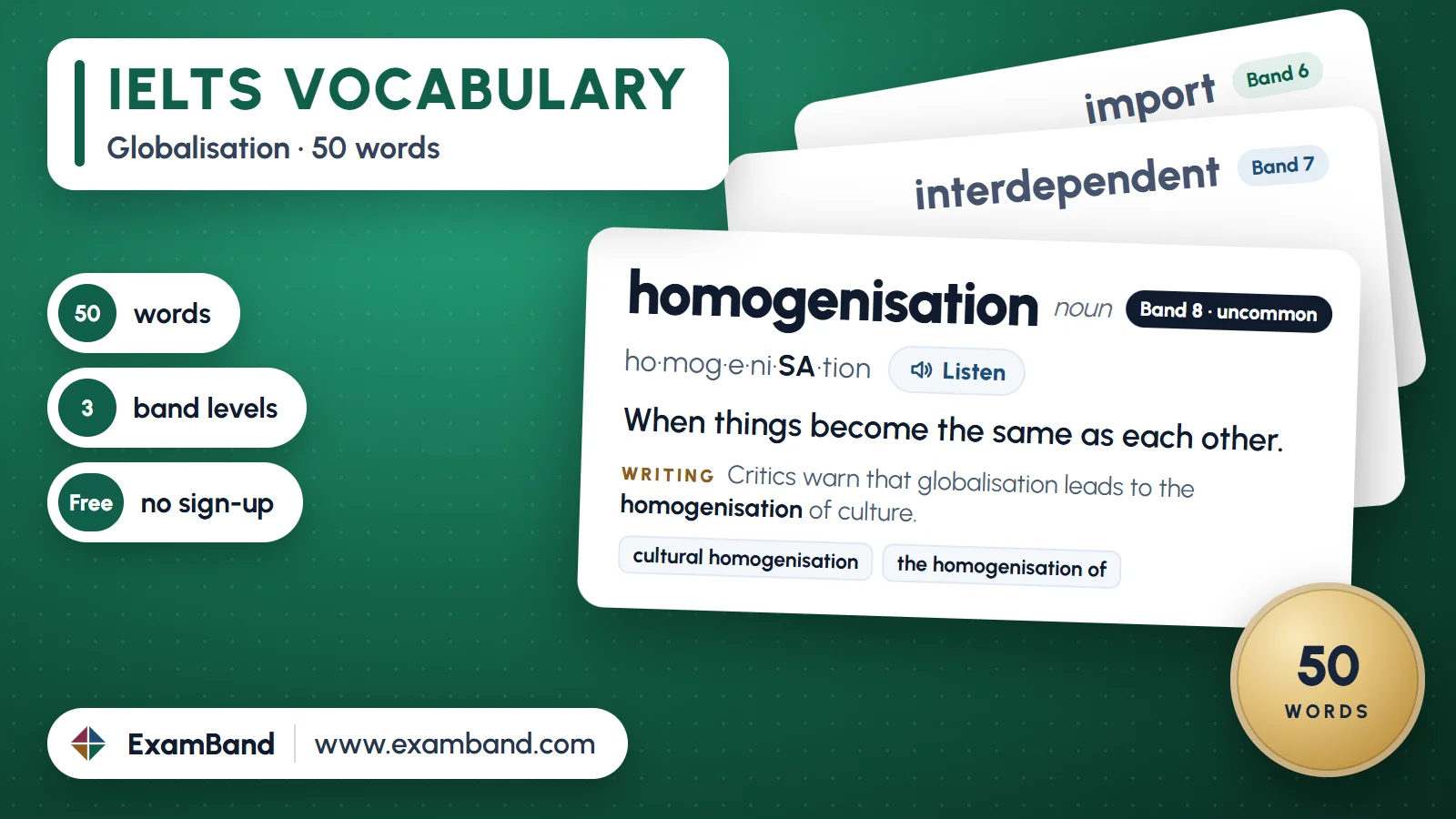
Questions about IELTS globalisation vocabulary
How do I learn IELTS globalisation vocabulary?
Learn about ten words a day. First, read the meaning, listen to the word and say it out loud with the right stress. Then test yourself with the quiz and the flashcards on this page. Finally, use five of the words in an essay and check it with our free Writing Checker.
Which words should I learn first?
Start with the band 6 words, because you need them to explain any idea clearly. After that, add the band 7 words. However, use the band 8 words only when you are sure of their meaning, because a rare word used wrongly can lower your score.
Are these official IELTS words?
No. IELTS has no official word list. Instead, our levels follow the words of the public IELTS band descriptors: band 7 asks for some “less common” words, and band 8 for “uncommon” words used with skill.