IELTS Government Vocabulary: 50 Words with Examples
These 50 words of IELTS government vocabulary come up again and again in Writing Task 2, where many questions ask what governments should do, and in Speaking Part 3. Each word has a simple meaning, its sound, a band level, examples for Writing and Speaking, and the mistake to avoid.
50 words · free quiz and flashcards · updated October 2026
tax
TAX · noun / verbMoney that people and companies must pay to the government.Band 6 · everyday
Word family: taxation (noun) · taxpayer (noun)
Collocations
- pay tax
- raise taxes
- cut taxes
Similar: duty
WritingHigher taxes on cigarettes have helped to reduce smoking.
SpeakingTax is quite high in my country, but healthcare is free.
Common mistake: Saying “pay tax for the government”. Say “pay tax to the government”.
election
e·LEC·tion · nounWhen people vote to choose a leader or government.Band 6 · everyday
Word family: elect (verb) · electoral (adjective)
Collocations
- win an election
- hold an election
- a general election
Similar: vote, poll
WritingPromises made during an election are not always kept.
SpeakingThe last election in my country was very close.
Common mistake: Saying “do an election”. Governments “hold” elections and people “vote in” them.
vote
VOTE · verb / nounTo choose someone or something officially, for example in an election.Band 6 · everyday
Word family: voter (noun) · voting (noun)
Collocations
- vote for
- the right to vote
- cast a vote
Similar: elect
WritingSome countries make it a legal duty to vote.
SpeakingI voted for the first time when I was eighteen.
Common mistake: Saying “vote to someone”. You vote “for” a person and “against” an idea.
politician
pol·i·TI·cian · nounA person whose job is in politics, often as an elected member of a parliament.Band 6 · everyday
Word family: politics (noun) · political (adjective)
Collocations
- a local politician
- a senior politician
- trust politicians
Similar: lawmaker
WritingMany young people feel that politicians do not listen to them.
SpeakingI don’t really trust politicians, to be honest.
Common mistake: Saying “a politic”. The person is “a politician”; the subject is “politics”.
policy
POL·i·cy · nounA plan of action agreed by a government or organisation.Band 6 · everyday
Word family: policymaker (noun)
Collocations
- government policy
- introduce a policy
- a policy on
Similar: plan, strategy
WritingThe government introduced a new policy to reduce plastic waste.
SpeakingI agree with the new policy on free school meals.
Common mistake: Mixing it up with “politics”. A policy is a plan; politics is the activity of government.
public services
PUB·lic SER·vi·ces · noun, pluralServices paid for by the government, like hospitals, schools and the police.Band 6 · everyday
Collocations
- fund public services
- cuts to public services
- improve public services
Similar: state services
WritingHigher taxes are acceptable if they pay for better public services.
SpeakingPublic services in my city are good; the buses are always on time.
Common mistake: Saying “public service” for all of them. Use the plural: “public services”.
citizen
CIT·i·zen · nounA person who has the legal right to live in a country.Band 6 · everyday
Word family: citizenship (noun)
Collocations
- ordinary citizens
- senior citizens
- a citizen of
Similar: national, resident
WritingEvery citizen should have equal access to healthcare.
SpeakingI’m a citizen of two countries, which is useful for travel.
Common mistake: Spelling it “citizien”. Write “citizen”.
democracy
de·MOC·ra·cy · nounA system where people choose their government by voting.Band 6 · everyday
Word family: democratic (adjective) · democrat (noun)
Collocations
- live in a democracy
- a healthy democracy
- support democracy
WritingA free press is essential in a democracy.
SpeakingI think democracy only works if people take part.
Common mistake: Saying “de-mo-CRA-cy”. The stress is “de-MOC-ra-cy”.
parliament
PAR·lia·ment · nounThe group of elected people who make the laws of a country.Band 6 · everyday
Word family: parliamentary (adjective)
Collocations
- a member of parliament
- pass through parliament
- in parliament
Similar: assembly
WritingThe new law was approved by parliament after a long debate.
SpeakingMy cousin works for a member of parliament.
Common mistake: Spelling it “parliment” or “parlament”. Write “parliament”, with -lia-.
budget
BUDG·et · nounThe amount of money a government or person plans to spend.Band 6 · everyday
Word family: budgetary (adjective)
Collocations
- the education budget
- a tight budget
- cut the budget
Similar: spending plan
WritingThe health budget should rise as the population ages.
SpeakingI travel on a tight budget, so I stay in hostels.
Common mistake: Saying “a cheap budget”. A budget is “small”, “tight” or “limited”.
taxpayers’ money
TAX·pay·ers’ MON·ey · nounMoney the government gets from taxes.Band 6 · everyday
Word family: taxpayer (noun)
Collocations
- waste taxpayers’ money
- spend taxpayers’ money
- a waste of taxpayers’ money
Similar: public money
WritingSpending taxpayers’ money on an expensive stadium is hard to justify.
SpeakingIt’s taxpayers’ money, so it should be spent carefully.
Common mistake: Leaving out the apostrophe. Write “taxpayers’ money”: the money belongs to the taxpayers.
ban
BAN · verb / nounTo say officially that something is not allowed.Band 6 · everyday
Collocations
- ban smoking
- a ban on
- impose a ban
Similar: prohibit, forbid
WritingMany cities have banned cars from their historic centres.
SpeakingI think they should ban fireworks; my dog hates them.
Common mistake: Saying “ban to do”. Say “ban something” or “ban people from doing something”.
human rights
HU·man RIGHTS · noun, pluralThe basic rights that every person should have, like freedom and safety.Band 6 · everyday
Collocations
- protect human rights
- human rights abuses
- respect human rights
Similar: civil rights
WritingGovernments must protect human rights, even in times of crisis.
SpeakingLearning about human rights at school really opened my eyes.
Common mistake: Saying “human right” for the general idea. Use the plural: “human rights”.
pass a law
PASS a LAW · phraseTo make a new law officially.Band 6 · everyday
Collocations
- pass a law against
- pass a law to
- new laws are passed
Similar: introduce legislation
WritingThe government should pass a law to protect workers from long hours.
SpeakingThey passed a law banning plastic bags here a few years ago.
Common mistake: Saying “make a law come out”. Parliaments “pass” laws.
welfare
WEL·fare · nounHelp from the government for people who are poor, ill or without a job; also, health and happiness.Band 6 · everyday
Collocations
- the welfare system
- welfare benefits
- animal welfare
Similar: social security, benefits
WritingA strong welfare system protects people who lose their jobs.
SpeakingI care a lot about animal welfare.
Common mistake: Spelling it “wellfare”. Write “welfare”, with one l.
pension
PEN·sion · nounMoney paid regularly to people who have stopped working because of their age.Band 6 · everyday
Word family: pensioner (noun)
Collocations
- a state pension
- receive a pension
- the pension age
Similar: retirement income
WritingAs people live longer, the state pension is becoming harder to pay for.
SpeakingMy grandparents live on a small pension.
Common mistake: Using it for a small hotel, as in some languages. In English, a pension is money for retired people.
political party
po·LIT·i·cal PAR·ty · nounAn organised group of people with the same political aims.Band 6 · everyday
Word family: politics (noun)
Collocations
- join a political party
- the main political parties
- a party leader
WritingYoung people rarely join a political party today.
SpeakingI’m not a member of any political party.
Common mistake: Saying “politic party”. Use the adjective: “political party”.
minister
MIN·is·ter · nounA senior member of a government who is in charge of one area, like health.Band 6 · everyday
Word family: ministry (noun) · ministerial (adjective)
Collocations
- the health minister
- the prime minister
- appoint a minister
Similar: secretary
WritingThe education minister promised more money for schools.
SpeakingThe minister visited our hospital last month.
Common mistake: Saying “ministry” for the person. The person is a “minister”; the department is a “ministry”.
regulation
reg·u·LA·tion · nounAn official rule, or the control of something by rules.Band 7 · less common
Word family: regulate (verb) · regulatory (adjective)
Collocations
- strict regulations
- government regulation
- safety regulations
Similar: rule, control
WritingStricter regulation of social media could protect children online.
SpeakingThere are a lot of regulations for opening a café here.
Common mistake: Spelling it “regulasion”. Write “regulation”, with -tion.
subsidise
SUB·si·dise · verbTo pay part of the cost of something so that it is cheaper.Band 7 · less common
Word family: subsidy (noun)
Collocations
- subsidise public transport
- heavily subsidised
- subsidise farmers
Similar: fund, support
WritingGovernments should subsidise public transport to get people out of their cars.
SpeakingUniversity is heavily subsidised in my country.
Common mistake: Spelling it “subsidize” in a British essay. UK: “subsidise”; US: “subsidize”.
allocate
AL·lo·cate · verbTo decide officially how money or time will be used.Band 7 · less common
Word family: allocation (noun)
Collocations
- allocate funds
- allocate resources
- allocate money to
Similar: assign, set aside
WritingMore funds should be allocated to mental health services.
SpeakingOur school allocated more money to sport this year.
Common mistake: Spelling it “alocate”. Write “allocate”, with double l.
accountable
ac·COUNT·a·ble · adjectiveResponsible for your decisions and expected to explain them.Band 7 · less common
Word family: accountability (noun)
Collocations
- hold someone accountable
- accountable to the public
- be held accountable
Similar: responsible, answerable
WritingLeaders must be held accountable for how they spend public money.
SpeakingPoliticians should be accountable to the people who elected them.
Common mistake: Saying “accountable of”. Say “accountable for” a decision and “accountable to” people.
bureaucracy
bu·REAUC·ra·cy · nounA system with too many rules and too much paperwork.Band 7 · less common
Word family: bureaucratic (adjective) · bureaucrat (noun)
Collocations
- cut bureaucracy
- layers of bureaucracy
- government bureaucracy
Similar: red tape, paperwork
WritingToo much bureaucracy can stop small businesses from growing.
SpeakingGetting a visa was a nightmare of bureaucracy.
Common mistake: Spelling it “beurocracy”. Write “bureaucracy”.
campaign
cam·PAIGN · noun / verbA planned set of actions to achieve something, such as winning an election or changing a law.Band 7 · less common
Word family: campaigner (noun)
Collocations
- launch a campaign
- an election campaign
- campaign for
Similar: drive, crusade
WritingA national campaign helped to reduce drink-driving.
SpeakingI joined a campaign to save our local library.
Common mistake: Saying the g. It is silent: “cam-PAIN”.
policymaker
POL·i·cy·mak·er · nounA person who decides government policy.Band 7 · less common
Word family: policy (noun) · policymaking (noun)
Collocations
- advise policymakers
- local policymakers
- policymakers must
Similar: decision-maker
WritingPolicymakers must listen to scientists when planning for the future.
SpeakingI think policymakers should ask young people what they need.
Common mistake: Saying “politicmaker”. The word is “policymaker”, from “policy”.
public spending
PUB·lic SPEND·ing · nounMoney the government spends on services and projects.Band 7 · less common
Collocations
- increase public spending
- cuts in public spending
- levels of public spending
Similar: government spending
WritingCuts in public spending have led to longer hospital waiting lists.
SpeakingPublic spending on parks has really improved my area.
Common mistake: Saying “public spendings”. It is uncountable: “public spending”.
transparency
trans·PAR·en·cy · nounBeing open and honest, so people can see how decisions are made.Band 7 · less common
Word family: transparent (adjective)
Collocations
- greater transparency
- a lack of transparency
- transparency in government
Similar: openness
WritingGreater transparency would make citizens trust their leaders more.
SpeakingI like the transparency of my local council; they publish everything online.
Common mistake: Spelling it “transparancy”. Write “transparency”, with -ency.
intervene
in·ter·VENE · verbTo become involved in a situation to change it.Band 7 · less common
Word family: intervention (noun)
Collocations
- intervene in
- the government should intervene
- intervene to stop
Similar: step in, get involved
WritingThe government should intervene when prices rise too fast.
SpeakingMy parents never intervene in our arguments.
Common mistake: Saying “intervene to the market”. Say “intervene in the market”.
tax revenue
TAX REV·e·nue · nounThe money a government receives from taxes.Band 7 · less common
Collocations
- raise tax revenue
- a loss of tax revenue
- tax revenue from
Similar: income
WritingTourism brings in large amounts of tax revenue.
SpeakingTax revenue from oil pays for a lot of things in my country.
Common mistake: Saying “tax revenues money”. Just say “tax revenue”.
national debt
NA·tion·al DEBT · nounAll the money a country’s government owes.Band 7 · less common
Word family: debtor (noun)
Collocations
- reduce the national debt
- a huge national debt
- pay off the national debt
Similar: public debt
WritingBorrowing for big projects adds to the national debt.
SpeakingOur national debt is huge, so taxes might go up.
Common mistake: Saying the b in “debt”. It is silent: “det”.
initiative
i·NI·tia·tive · nounA new plan to solve a problem; also, the ability to act without being told.Band 7 · less common
Word family: initiate (verb)
Collocations
- a government initiative
- launch an initiative
- take the initiative
Similar: scheme, plan
WritingA new initiative gives free bikes to students.
SpeakingMy manager likes it when I take the initiative.
Common mistake: Spelling it “initative”. Write “initiative”, with -tia-.
mandatory
MAN·da·to·ry · adjectiveRequired by law or by a rule.Band 7 · less common
Word family: mandate (noun, verb)
Collocations
- mandatory for
- make something mandatory
- mandatory testing
Similar: compulsory, obligatory
WritingSeat belts were made mandatory to save lives on the roads.
SpeakingMilitary service is mandatory for men in some countries.
Common mistake: Using “mandatory” for advice. It means something you must do by law or rule.
lobby
LOB·by · verb / nounTo try to persuade politicians to support or change a law.Band 7 · less common
Word family: lobbyist (noun) · lobbying (noun)
Collocations
- lobby the government
- a powerful lobby
- lobby for
Similar: pressure, campaign
WritingLarge companies lobby governments to protect their profits.
SpeakingOur group lobbied the council for a new cycle lane.
Common mistake: Using it only for the hall of a hotel. In politics, to lobby is to try to influence lawmakers.
civil servant
CIV·il SER·vant · nounA person who works for a government department.Band 7 · less common
Word family: civil service (noun)
Collocations
- a senior civil servant
- work as a civil servant
Similar: government official
WritingCivil servants should be chosen for their skills, not their connections.
SpeakingMy mum is a civil servant at the Ministry of Education.
Common mistake: Saying “government servant” or “civil worker”. The term is “civil servant”.
voter turnout
VOT·er TURN·out · nounThe number of people who vote in an election.Band 7 · less common
Collocations
- low voter turnout
- high voter turnout
- boost voter turnout
Similar: participation
WritingOnline voting might increase voter turnout among young people.
SpeakingVoter turnout was really low in the last local election.
Common mistake: Writing “turn out” as two words for the noun. The noun is one word: “turnout”.
manifesto
man·i·FES·to · nounA written list of what a political party promises to do.Band 7 · less common
Collocations
- an election manifesto
- a manifesto promise
- publish a manifesto
Similar: platform
WritingFree university places were a key promise in the party’s manifesto.
SpeakingI read each party’s manifesto before I voted.
Common mistake: Saying “manifest”. The list of promises is a “manifesto”.
impose
im·POSE · verbTo make a rule, tax or punishment start, which people must accept.Band 7 · less common
Word family: imposition (noun)
Collocations
- impose a tax
- impose a ban
- impose restrictions on
Similar: introduce, enforce
WritingGovernments could impose a tax on frequent flyers.
SpeakingThey imposed a curfew during the protests.
Common mistake: Leaving out “on”. Say “impose a tax on something”.
public sector
PUB·lic SEC·tor · nounThe part of the economy controlled or paid for by the government.Band 7 · less common
Collocations
- work in the public sector
- public sector workers
- the public and private sectors
Similar: state sector
WritingNurses and teachers make up a large part of the public sector.
SpeakingI’d like to work in the public sector; the jobs are safer.
Common mistake: Saying “the public section”. The term is “public sector”.
austerity
aus·TER·i·ty · nounStrong cuts in government spending to reduce debt.Band 8 · uncommon
Word family: austere (adjective)
Collocations
- austerity measures
- years of austerity
- a policy of austerity
Similar: spending cuts
WritingAusterity measures often hurt the poorest people the most.
SpeakingLife was hard for everyone during the years of austerity.
Common mistake: Using it for one person who saves money. It is mostly used for government cuts.
nanny state
NAN·ny STATE · nounA government that tries to control people’s lives too much.Band 8 · uncommon
Collocations
- a nanny state
- accuse the government of being a nanny state
Similar: over-regulation
WritingCritics call taxes on sugar a sign of the nanny state.
SpeakingSome people say banning junk food ads is the nanny state gone mad.
Common mistake: Using it as praise. It is a critical phrase.
fiscal
FIS·cal · adjectiveConnected with government money, taxes and spending.Band 8 · uncommon
Word family: fiscally (adverb)
Collocations
- fiscal policy
- the fiscal year
- fiscal responsibility
Similar: financial, budgetary
WritingTight fiscal policy left little money for new hospitals.
SpeakingThe fiscal year in my country starts in April.
Common mistake: Mixing it up with “physical”. Fiscal is about public money.
electorate
e·LEC·tor·ate · nounAll the people in a country who can vote.Band 8 · uncommon
Word family: elector (noun) · electoral (adjective)
Collocations
- the electorate
- win over the electorate
- a young electorate
Similar: voters
WritingParties often make promises that please older members of the electorate.
SpeakingThe electorate here is getting younger and more online.
Common mistake: Using it for one voter. The electorate is all the voters together.
legitimacy
le·GIT·i·ma·cy · nounBeing fair, legal and accepted by the people.Band 8 · uncommon
Word family: legitimate (adjective)
Collocations
- democratic legitimacy
- lack legitimacy
- question the legitimacy of
Similar: lawfulness, authority
WritingA government that ignores the courts loses its legitimacy.
SpeakingPeople questioned the legitimacy of that election.
Common mistake: Spelling it “legitamacy”. Write “legitimacy”.
sovereignty
SOV·er·eign·ty · nounThe power of a country to govern itself.Band 8 · uncommon
Word family: sovereign (adjective, noun)
Collocations
- national sovereignty
- protect sovereignty
- a loss of sovereignty
Similar: independence, self-rule
WritingSome argue that global trade deals weaken national sovereignty.
SpeakingPeople in my country care a lot about sovereignty.
Common mistake: Spelling it “sovereignity”. Write “sovereignty”.
populism
POP·u·lism · nounPolitics that claims to fight for ordinary people against an elite.Band 8 · uncommon
Word family: populist (noun, adjective)
Collocations
- the rise of populism
- populist leaders
WritingThe rise of populism has changed politics in many countries.
SpeakingI think populism grows when people feel ignored.
Common mistake: Mixing it up with “popularity”. Populism is a kind of politics, not being liked.
red tape
RED TAPE · nounOfficial rules and paperwork that slow things down.Band 8 · uncommon
Collocations
- cut red tape
- bureaucratic red tape
- tied up in red tape
Similar: bureaucracy
WritingCutting red tape would help new businesses to grow.
SpeakingThere was so much red tape when I applied for my visa.
Common mistake: Saying “red tapes”. It is uncountable: “a lot of red tape”.
deregulation
de·reg·u·LA·tion · nounRemoving government rules from an industry.Band 8 · uncommon
Word family: deregulate (verb)
Collocations
- the deregulation of
- financial deregulation
- push for deregulation
Similar: liberalisation
WritingSome economists blame the 2008 financial crisis partly on banking deregulation.
SpeakingDeregulation made flights much cheaper here.
Common mistake: Spelling it “disregulation”. The prefix is “de-”: “deregulation”.
levy
LEV·y · noun / verbA tax for a special purpose; to charge such a tax.Band 8 · uncommon
Collocations
- impose a levy
- a levy on
- levy a tax
Similar: tax, charge
WritingA levy on plastic bags cut their use dramatically.
SpeakingThere’s a tourist levy on hotel rooms in my city.
Common mistake: Using “levy” for the money you earn. It is money you must pay.
the common good
the COM·mon GOOD · nounWhat is best for everyone in a society.Band 8 · uncommon
Collocations
- for the common good
- serve the common good
- act for the common good
Similar: public interest
WritingTaxes are the price we pay for the common good.
SpeakingEveryone should give up a little for the common good.
Common mistake: Saying “the common goods”. The phrase is singular: “the common good”.
partisan
par·ti·SAN · adjectiveStrongly supporting one political party and ignoring other views.Band 8 · uncommon
Word family: partisanship (noun) · bipartisan (adjective)
Collocations
- partisan politics
- deeply partisan
- partisan media
Similar: biased, one-sided
WritingPartisan politics often blocks sensible long-term plans.
SpeakingNews here is so partisan that I read several sources.
Common mistake: Using it as praise. It usually means unfair support for one side.
Government vocabulary in IELTS Writing and Speaking
Here is how IELTS government vocabulary can come up in the test, with our own practice questions. So, try to answer them with words from the list above.
Writing Task 2
Some people think governments should spend more on public services, such as hospitals and schools, even if this means higher taxes. To what extent do you agree or disagree?
Speaking
- Part 1: Do public services work well in your town?
- Part 1: Would you like to work for the government?
- Part 2: Describe a law or rule in your country that you think is a good idea.
- Part 3: Should the government pay for university education?
- Part 3: How can governments encourage people to live more healthily?
Our free tests on this topic
- Writing Practice Test 4, Task 2a tax on sugary drinks
- Writing Practice Test 9, Task 2what countries can do when skilled workers leave
- Reading Practice Test 2, Passage 1how a hot summer gave London a new sewer system
- Reading Practice Test 10, Passage 3when paying people to do the right thing backfires
A model paragraph with IELTS government vocabulary
Raising taxes is never popular, but public services such as hospitals cannot run without tax revenue. The key is transparency: if taxpayers can see how their money is allocated, they are more likely to accept higher taxes. Governments must also cut red tape, so that money reaches services rather than offices.
Practise this IELTS government vocabulary
Take the 10-question quiz on this IELTS government vocabulary, or go through every word with the flashcards.
Question 1 of 10
Which word means “to choose someone or something officially, for example in an election”?
Now use the words
Write a Task 2 essay with five of these words. Then our free Writing Checker gives you a band for vocabulary and for the other three criteria.
Open the Writing Checker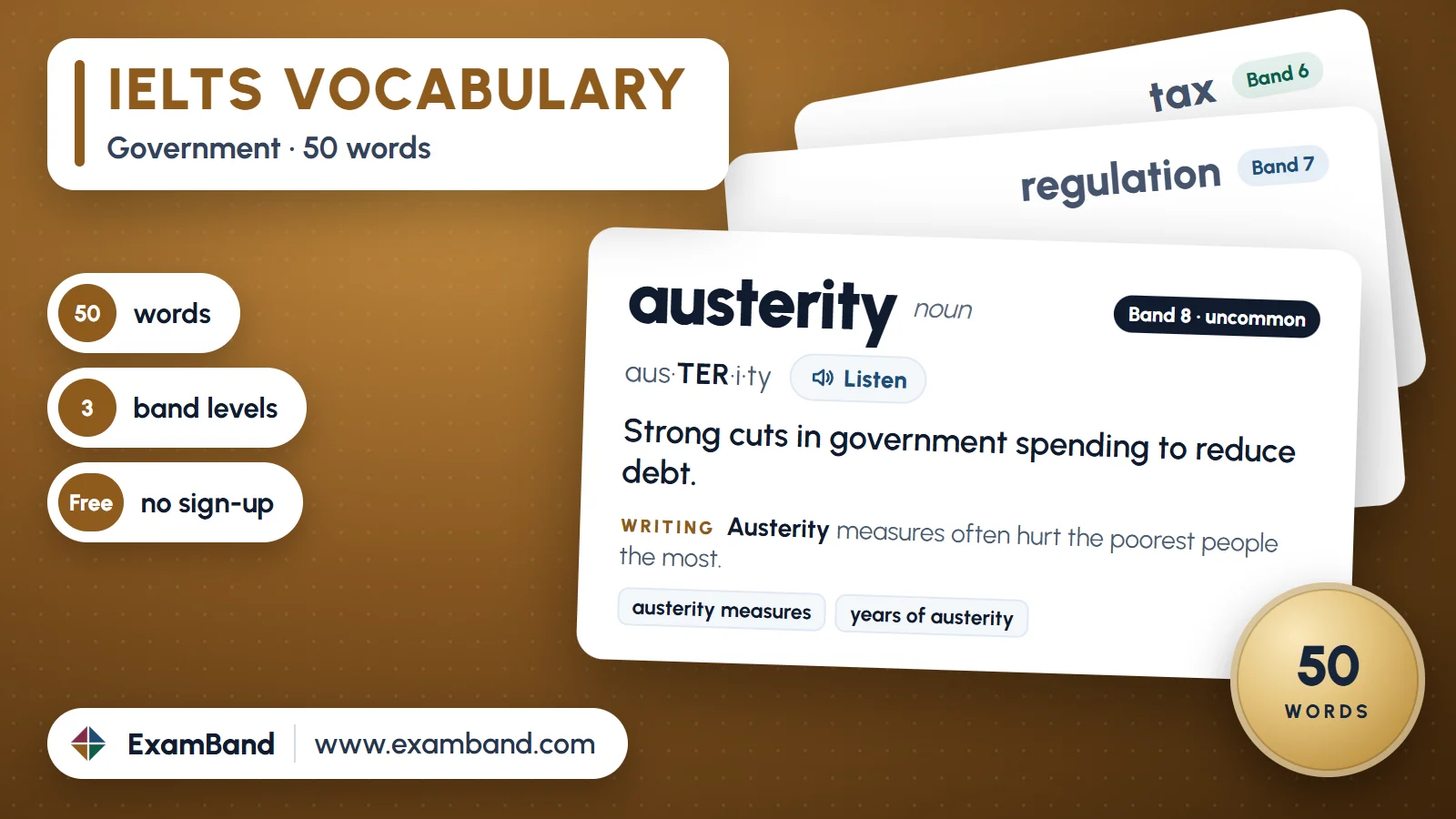
Questions about IELTS government vocabulary
How do I learn IELTS government vocabulary?
Learn about ten words a day. First, read the meaning, listen to the word and say it out loud with the right stress. Then test yourself with the quiz and the flashcards on this page. Finally, use five of the words in an essay and check it with our free Writing Checker.
Which words should I learn first?
Start with the band 6 words, because you need them to explain any idea clearly. After that, add the band 7 words. However, use the band 8 words only when you are sure of their meaning, because a rare word used wrongly can lower your score.
Are these official IELTS words?
No. IELTS has no official word list. Instead, our levels follow the words of the public IELTS band descriptors: band 7 asks for some “less common” words, and band 8 for “uncommon” words used with skill.