IELTS Reading Practice Test 10 · Passage 1
Lighter than air
The invention of the hot-air balloon, and how it works today
On 21 November 1783, a large crowd in Paris watched two men rise into the sky beneath an enormous decorated balloon. Jean-François Pilâtre de Rozier, a young teacher of science, and the Marquis d'Arlandes, an army officer, remained in the air for about 25 minutes. They reached a height of roughly 900 metres and travelled some nine kilometres across the city before landing safely. It was the first time that human beings had been carried aloft in a free-flying craft, and the balloon that made it possible had been designed not by scientists but by two brothers who ran a paper business.
Joseph-Michel and Jacques-Étienne Montgolfier came from a family of paper manufacturers in the town of Annonay, in southern France. According to one story, Joseph became interested in the idea after noticing that clothes drying above a fire were lifted by the rising air, and the brothers began experimenting with bags of paper and fabric held over flames. Like most people of their time, however, they misunderstood what they had discovered. Believing that the smoke itself contained a special lifting gas, they deliberately burned materials that produced thick smoke, such as damp straw and wool. In reality, their balloons rose because the air inside was heated, and hot air is less dense than the cooler air surrounding it.
Their first public demonstration took place in Annonay on 4 June 1783. An unmanned balloon made of fabric lined with paper rose to an estimated height of between 1,600 and 2,000 metres and stayed aloft for about ten minutes. News of the event spread rapidly. In September, the brothers were invited to repeat it at the palace of Versailles, in front of King Louis XVI. Since nobody knew whether a living creature could survive at such heights, the passengers on this occasion were a sheep, a duck and a rooster. The flight lasted around eight minutes, and all three animals landed unharmed, which encouraged plans for a flight with human passengers. Before attempting a free flight, the Montgolfiers carried out a series of tests in which the balloon was tethered to the ground by ropes.
Just ten days after the flight over Paris, on 1 December 1783, the scientist Jacques Charles took off in a quite different kind of balloon, filled with hydrogen, a gas lighter than air that could be produced by pouring acid onto iron. Hydrogen balloons did not need to be heated and could therefore remain aloft for much longer. For most of the following century, they were the preferred choice of scientists and adventurers alike. Hot-air balloons, which required a constant fire, were difficult and dangerous to manage, and they almost disappeared.
Their revival came in 1960, when the American engineer Ed Yost made the first free flight in a modern hot-air balloon, near the town of Bruning in the state of Nebraska. Yost replaced the open fire with a burner fuelled by propane, a gas stored as a liquid under pressure, and made the envelope, the fabric bag that holds the hot air, from nylon. His design, refined by later manufacturers, remains the basis of almost every balloon flying today.
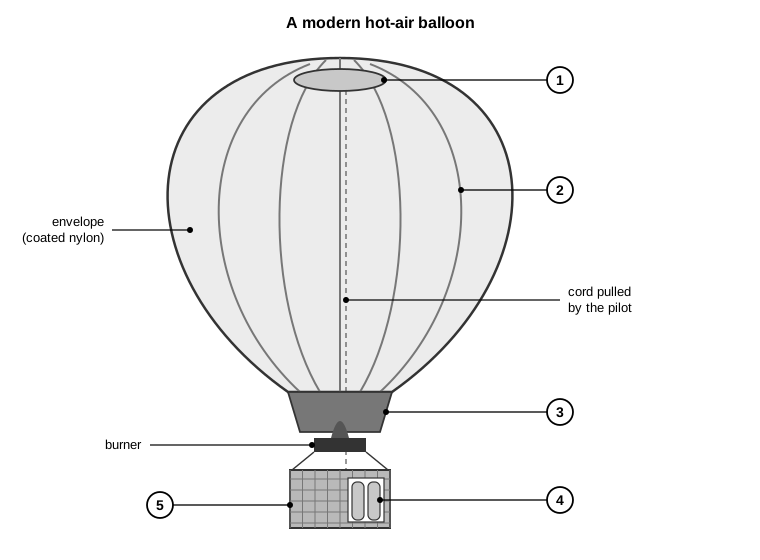
A modern hot-air balloon consists of three main parts. The envelope is made of long panels of coated nylon, sewn between strong vertical straps called load tapes, which carry the weight of the basket. At the base of the envelope is the skirt, made of a fire-resistant material to protect the fabric from the flame. Directly beneath it, the burner is mounted on a metal frame above the basket, and the propane is carried in cylinders inside the basket itself. Baskets are still usually made of wicker, a material that has been used since the earliest balloons because it is light, strong and flexible enough to absorb the shock of a heavy landing. To climb, the pilot operates the burner, heating the air inside the envelope; to descend, the pilot pulls a cord that opens a large circular flap at the top of the envelope, known as the parachute valve, allowing some of the hot air to escape.
What the pilot cannot do is steer. A balloon simply travels with the wind, and the only way to change direction is to rise or descend to a height at which the wind is blowing in a different direction. Experienced pilots therefore study weather forecasts with great care before every flight, and most flights take place shortly after sunrise or in the early evening, when winds are usually light and steady. Because the landing place cannot be known in advance, a vehicle usually follows the balloon by road to collect the passengers and equipment.