IELTS Reading Practice Test 4 · Passage 1
The Vasa
A warship's short voyage and long afterlife
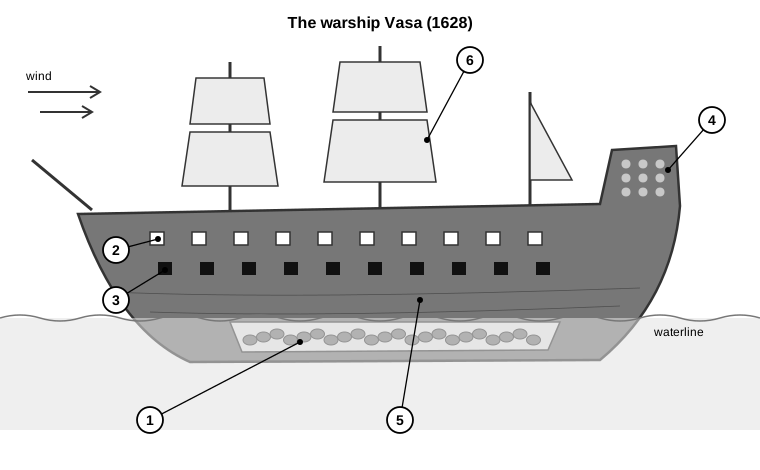
On the afternoon of 10 August 1628, crowds gathered along the waterfront in Stockholm to watch the new warship Vasa set out on her first voyage. Ordered by King Gustav II Adolf, whose armies were then fighting in what is now Poland, she was intended to be one of the most powerful warships in the Baltic. She carried 64 guns, most of them heavy cannon arranged on two separate decks, but her first voyage turned out to be remarkably short. After sailing little more than a kilometre, the ship was struck by a sudden gust of wind, which pushed against her sails and forced her over onto her side. Water poured in through the open gunports, and within minutes the Vasa had sunk in the harbour, about 120 metres from the shore. Around thirty of the people on board lost their lives.
The ship had been built at the naval shipyard in Stockholm under the direction of a Dutch master shipbuilder, Henrik Hybertsson, who died in 1627, before the work was finished. Hundreds of oak trees were cut down to build the hull, and no expense was spared on its decoration. The high stern, in particular, was covered with hundreds of carved sculptures of kings, warriors and mythical creatures, originally painted in bright colours, which were designed to impress friends and enemies alike with the power of the Swedish king.
Modern studies have shown that the Vasa was simply unstable. Too much of her weight was high up, in the upper gun deck and the heavy decorations, and too little was low down. Like all sailing ships of the time, she carried a large quantity of stones at the bottom of the hull, known as ballast, to keep her upright, but there was no room to add more without bringing the lower gunports dangerously close to the water.
The danger had in fact been noticed before she sailed. A few weeks earlier, a stability test had been carried out in front of Admiral Klas Fleming: thirty men ran back and forth across the upper deck to make the ship roll. After only three runs, the admiral stopped the test, because he feared that the ship would capsize. Nevertheless, the voyage went ahead. At the inquiry that followed the disaster, the captain and crew were questioned, but nobody was punished. The shipbuilder was dead, and the dimensions of the ship had been approved by the king himself, so it was difficult to place the blame on any one person.
Because her guns were extremely valuable, attempts to recover them began almost immediately. In the 1660s, a team of divers using a simple diving bell managed to bring up more than fifty of them, a remarkable achievement given the depth and the cold. After that, the Vasa was largely forgotten.
Her rediscovery was the work of Anders Franzén, an amateur researcher with a particular interest in old shipwrecks. Franzén knew that the Baltic Sea is unusual in one important respect: its water is only slightly salty, and the shipworm, a creature that destroys submerged wood in most of the world's oceans, cannot survive in it. He reasoned that a wreck there might still be in good condition. In 1956, using a simple device that took samples from the seabed, he found the Vasa lying in about thirty metres of water.
Raising the ship was an enormous undertaking: over a period of two years, divers dug six tunnels under the hull, working in almost complete darkness, and passed steel cables through them. The ship was then lifted in stages and moved into shallower water, and on 24 April 1961 she broke the surface for the first time in 333 years. Inside, archaeologists found thousands of objects, from tools and clothing to the skeletons of some of those who had died.
Saving the ship proved as difficult as raising it. Wood that has lain under water for centuries is full of water, and if it dries too quickly, it shrinks and cracks. To prevent this, the hull was sprayed with a water-soluble wax called polyethylene glycol for seventeen years before being allowed to dry slowly. The Vasa Museum, which opened in 1990, is now one of the most visited museums in Scandinavia, yet new problems have continued to appear. Around 2000, after a wet summer in which large numbers of visitors raised the humidity inside the museum, white and yellow patches began to appear on the wood, caused by sulphur compounds forming acid. The museum now controls its climate far more carefully, and a new support structure is being built, because the old hull is slowly changing shape under its own weight.