IELTS Science Vocabulary: 50 Words with Examples
These 50 words of IELTS science vocabulary come up again and again in Academic Reading passages, Listening Part 4 lectures and Writing Task 2 essays on research and space. Each word has a simple meaning, its sound, a band level, examples for Writing and Speaking, and the mistake to avoid.
50 words · free quiz and flashcards · updated October 2026
experiment
ex·PER·i·ment · noun / verbA careful test to find out if an idea is true.Band 6 · everyday
Word family: experimental (adjective) · experimentation (noun)
Collocations
- carry out an experiment
- conduct an experiment
- the results of an experiment
Similar: test, trial
WritingScientists must experiment carefully before a new medicine can be sold.
SpeakingWe did a fun experiment with magnets at school.
Common mistake: Saying “make an experiment”. Say “do”, “carry out” or “conduct an experiment”.
research
re·SEARCH · noun / verbCareful study to discover new facts.Band 6 · everyday
Word family: researcher (noun)
Collocations
- carry out research
- scientific research
- research into
Similar: study, investigation
WritingGovernments should fund more research into renewable energy.
SpeakingMy brother does research on plant diseases at the university.
Common mistake: Saying “researches” or “a research”. The noun is uncountable: “some research”, “a piece of research”.
laboratory
la·BOR·a·to·ry · nounA room or building where scientists do experiments.Band 6 · everyday
Word family: lab (noun, short form)
Collocations
- a research laboratory
- in the laboratory
- laboratory tests
Similar: lab
WritingNew drugs are tested in the laboratory before they are tried on people.
SpeakingOur school laboratory was old, but we loved science lessons.
Common mistake: Saying “LAB-ra-tory” in a British accent. In the UK, the stress is “la-BOR-a-tory”.
discovery
dis·COV·er·y · nounFinding something that nobody knew about before.Band 6 · everyday
Word family: discover (verb)
Collocations
- make a discovery
- a scientific discovery
- an important discovery
Similar: finding, breakthrough
WritingThe discovery of penicillin has saved millions of lives.
SpeakingI think the most important discovery ever was electricity.
Common mistake: Mixing it up with “invention”. You discover something that already exists; you invent something new.
invention
in·VEN·tion · nounA new thing that someone has made or designed for the first time.Band 6 · everyday
Word family: invent (verb) · inventor (noun) · inventive (adjective)
Collocations
- a useful invention
- the invention of
- a modern invention
Similar: creation, innovation
WritingThe invention of the printing press changed education for ever.
SpeakingThe washing machine is my favourite invention; it saves so much time.
Common mistake: Mixing it up with “discovery”. You invent something new; you discover something that was already there.
theory
THE·o·ry · nounAn idea that tries to explain why something happens.Band 6 · everyday
Word family: theoretical (adjective) · theorist (noun)
Collocations
- a scientific theory
- test a theory
- in theory
Similar: idea, hypothesis
WritingEvery scientific theory must be tested against evidence.
SpeakingIn theory, I study every evening, but in practice I don’t.
Common mistake: Writing “in theorical”. The phrase is “in theory”; the adjective is “theoretical”.
evidence
EV·i·dence · nounFacts or information that show something is true.Band 6 · everyday
Word family: evident (adjective) · evidently (adverb)
Collocations
- strong evidence
- evidence of
- scientific evidence
Similar: proof, data
WritingThere is strong evidence that smoking causes cancer.
SpeakingIs there any evidence that this diet works?
Common mistake: Saying “evidences” or “an evidence”. It is uncountable: “some evidence”, “a piece of evidence”.
scientific
sci·en·TIF·ic · adjectiveConnected with science or using its careful methods.Band 6 · everyday
Word family: science (noun) · scientist (noun) · scientifically (adverb)
Collocations
- scientific research
- scientific progress
- scientific evidence
WritingScientific progress has greatly increased human life expectancy.
SpeakingI’m not very scientific; I prefer art and music.
Common mistake: Writing “scientifical”. The adjective is “scientific”.
space exploration
SPACE ex·plo·RA·tion · nounSending people and machines to learn about space.Band 6 · everyday
Word family: explore (verb) · explorer (noun)
Collocations
- invest in space exploration
- the cost of space exploration
- the future of space exploration
WritingCritics say space exploration costs too much when people on Earth are hungry.
SpeakingSpace exploration fascinates me; I’d love to see Mars one day.
Common mistake: Saying “the space exploration” in general. Use no “the”: “Space exploration is expensive.”
astronaut
AS·tro·naut · nounA person who travels into space.Band 6 · everyday
Word family: astronautics (noun)
Collocations
- train as an astronaut
- become an astronaut
Similar: spaceman, cosmonaut
WritingAstronauts on the space station carry out hundreds of experiments.
SpeakingWhen I was a child, I wanted to be an astronaut.
Common mistake: Spelling it “astronought”. Write “astronaut”.
planet
PLAN·et · nounA large round object that moves around a star, like the Earth.Band 6 · everyday
Word family: planetary (adjective)
Collocations
- the planet Mars
- protect the planet
- other planets
Similar: world
WritingAstronomers have found thousands of planets around other stars.
SpeakingI think it’s amazing to look at planets through a telescope.
Common mistake: Saying “the Earth planet”. Say “the planet Earth” or “our planet”.
carry out
CAR·ry OUT · phrasal verbTo do a task, such as research or a test.Band 6 · everyday
Collocations
- carry out research
- carry out an experiment
- carry out a survey
Similar: conduct, do
WritingScientists carried out tests on thousands of volunteers.
SpeakingFor my project, I carried out a small survey.
Common mistake: Saying “carry on research” for doing it. “Carry on” means continue; “carry out” means do.
funding
FUND·ing · nounMoney given for a special purpose, such as research.Band 6 · everyday
Word family: fund (verb, noun)
Collocations
- government funding
- research funding
- cut funding
Similar: financing, money
WritingCuts to research funding could slow down medical progress.
SpeakingOur university gets most of its funding from the government.
Common mistake: Saying “fundings”. It is uncountable: “more funding”.
prove
PROVE · verbTo show that something is true.Band 6 · everyday
Word family: proof (noun) · proven (adjective)
Collocations
- prove a theory
- scientifically proven
- prove that
Similar: demonstrate, show
WritingNo study has proved that mobile phones cause cancer.
SpeakingI can’t prove it, but I think my phone is listening to me!
Common mistake: Saying “a prove”. The verb is “prove”; the noun is “proof”.
solar system
SO·lar SYS·tem · nounThe Sun and the planets that move around it.Band 6 · everyday
Collocations
- our solar system
- the edge of the solar system
- the planets in the solar system
WritingSpace probes have now visited every planet in our solar system.
SpeakingJupiter is the biggest planet in the solar system.
Common mistake: Writing “sun system”. The term is “solar system”.
chemical
CHEM·i·cal · noun / adjectiveA substance made by or used in chemistry.Band 6 · everyday
Word family: chemistry (noun) · chemist (noun)
Collocations
- harmful chemicals
- a chemical reaction
- chemical waste
Similar: substance
WritingSome household products contain chemicals that can harm children.
SpeakingI try to use cleaning products without strong chemicals.
Common mistake: Saying “chemistry” for the substance. Chemistry is the subject; a chemical is a substance.
engineering
en·gi·NEER·ing · nounThe work of designing and building machines, roads and bridges.Band 6 · everyday
Word family: engineer (noun, verb)
Collocations
- study engineering
- civil engineering
- an engineering degree
WritingMore women should be encouraged to study engineering.
SpeakingI chose engineering because I love building things.
Common mistake: Saying “engineer” for the subject. The person is an “engineer”; the subject is “engineering”.
satellite
SAT·el·lite · nounA machine sent into space to move around the Earth and send information.Band 6 · everyday
Collocations
- launch a satellite
- satellite images
- satellite navigation
WritingWeather forecasts depend on data from satellites.
SpeakingWithout satellites, my phone couldn’t show me where I am.
Common mistake: Spelling it “sattelite”. Write “satellite”: one t, double l.
breakthrough
BREAK·through · nounAn important new discovery or development.Band 7 · less common
Word family: break through (verb)
Collocations
- a major breakthrough
- a scientific breakthrough
- make a breakthrough
Similar: advance, discovery
WritingA breakthrough in battery technology could make electric cars much cheaper.
SpeakingI hope scientists make a breakthrough in treating cancer soon.
Common mistake: Writing the noun as two words. The noun is one word: “a breakthrough”.
hypothesis
hy·POTH·e·sis · nounAn idea that has not yet been proved, which an experiment tests.Band 7 · less common
Word family: hypothetical (adjective)
Collocations
- test a hypothesis
- support a hypothesis
- reject a hypothesis
Similar: theory, idea
WritingThe experiment was designed to test the hypothesis that music improves memory.
SpeakingMy hypothesis was wrong, but I still learned a lot.
Common mistake: Saying “hypothesises” for the plural. The plural is “hypotheses”.
findings
FIND·ings · noun, pluralThe information that a study discovers.Band 7 · less common
Word family: find (verb)
Collocations
- research findings
- publish findings
- the findings suggest
Similar: results, conclusions
WritingThe findings suggest that teenagers need more sleep than adults.
SpeakingI read about the findings of a study on sleep, and they surprised me.
Common mistake: Using the singular for results. Use the plural: “The findings show…”.
conduct
con·DUCT · verbTo organise and do something, such as research.Band 7 · less common
Word family: conduct (noun, “CON-duct”: behaviour)
Collocations
- conduct research
- conduct a study
- conduct an experiment
Similar: carry out
WritingResearchers conducted a survey of two thousand students.
SpeakingWe had to conduct a small experiment for our science class.
Common mistake: Saying the verb like the noun. The verb is “con-DUCT”; the noun “CON-duct” means behaviour.
genetic engineering
ge·NET·ic en·gi·NEER·ing · nounChanging the genes of a living thing to give it new qualities.Band 7 · less common
Word family: gene (noun) · genetically (adverb)
Collocations
- the ethics of genetic engineering
- advances in genetic engineering
Similar: genetic modification
WritingGenetic engineering could wipe out some inherited diseases.
SpeakingGenetic engineering scares me a bit, honestly.
Common mistake: Writing “genetical engineering”. The adjective is “genetic”.
cloning
CLON·ing · nounMaking an exact genetic copy of an animal or plant.Band 7 · less common
Word family: clone (verb, noun)
Collocations
- animal cloning
- human cloning
- ban cloning
WritingMany countries have banned human cloning.
SpeakingCloning pets sounds strange to me, but some people pay for it.
Common mistake: Saying “a cloning” for the copy. The copy is “a clone”; the process is “cloning”.
ethical
ETH·i·cal · adjectiveConnected with what is morally right or wrong.Band 7 · less common
Word family: ethics (noun) · ethically (adverb)
Collocations
- ethical questions
- ethical issues
- raise ethical concerns
Similar: moral
WritingTesting drugs on animals raises serious ethical questions.
SpeakingI don’t think it’s ethical to keep animals in tiny cages.
Common mistake: Saying “ethic issues”. The adjective is “ethical”: “ethical issues”.
clinical trial
CLIN·i·cal TRI·al · nounA test of a new medicine or treatment on people.Band 7 · less common
Word family: clinically (adverb)
Collocations
- take part in a clinical trial
- carry out clinical trials
Similar: drug trial
WritingEvery new medicine must pass several clinical trials.
SpeakingMy uncle took part in a clinical trial for a new heart drug.
Common mistake: Writing “clinic trial”. The adjective is “clinical”.
scientific method
sci·en·TIF·ic METH·od · nounThe careful steps scientists use: question, test, measure and check.Band 7 · less common
Collocations
- follow the scientific method
- the basis of the scientific method
WritingChildren should learn the scientific method through hands-on experiments.
SpeakingWe learned the scientific method in our first science class.
Common mistake: Saying “science method”. The phrase is “the scientific method”.
pioneer
pi·o·NEER · noun / verbOne of the first people to do or develop something.Band 7 · less common
Word family: pioneering (adjective)
Collocations
- a pioneer of
- pioneer a new technique
- pioneering research
Similar: trailblazer, innovator
WritingMarie Curie was a pioneer in the study of radioactivity.
SpeakingMy grandfather was a pioneer of computing in our country.
Common mistake: Saying “pie-O-neer”. The stress is at the end: “pie-uh-NEER”.
groundbreaking
GROUND·break·ing · adjectiveCompletely new and very important.Band 7 · less common
Collocations
- groundbreaking research
- a groundbreaking discovery
- groundbreaking work
Similar: pioneering, revolutionary
WritingHer groundbreaking research changed how doctors treat diabetes.
SpeakingThat documentary on black holes was groundbreaking.
Common mistake: Writing “ground breaking” as two words. Write “groundbreaking”.
phenomenon
phe·NOM·e·non · nounSomething that happens or exists, especially something unusual.Band 7 · less common
Word family: phenomenal (adjective)
Collocations
- a natural phenomenon
- a social phenomenon
- a global phenomenon
Similar: event, occurrence
WritingBioluminescence is a natural phenomenon found in many sea creatures.
SpeakingThe northern lights are an amazing phenomenon; I saw them in Norway.
Common mistake: Saying “phenomenons” or “a phenomena”. Singular: “phenomenon”; plural: “phenomena”.
analyse
AN·a·lyse · verbTo study something in detail to understand it.Band 7 · less common
Word family: analysis (noun) · analytical (adjective)
Collocations
- analyse data
- analyse the results
- carefully analyse
Similar: examine, study
WritingComputers can now analyse huge amounts of data in seconds.
SpeakingI like to analyse why things go wrong.
Common mistake: Spelling it “analize”. Write “analyse” (UK) or “analyze” (US), and keep one style.
observation
ob·ser·VA·tion · nounWatching something carefully to learn about it.Band 7 · less common
Word family: observe (verb) · observant (adjective)
Collocations
- careful observation
- make observations
- under observation
Similar: examination, monitoring
WritingDarwin’s theory was based on years of careful observation.
SpeakingBird-watching trains your powers of observation.
Common mistake: Mixing it up with “observance”. Watching carefully is “observation”.
conclusive
con·CLU·sive · adjectiveProving something without any doubt.Band 7 · less common
Word family: conclude (verb) · conclusion (noun) · inconclusive (adjective)
Collocations
- conclusive evidence
- conclusive proof
- far from conclusive
Similar: definite, decisive
WritingThere is no conclusive evidence that video games cause violence.
SpeakingThe tests weren’t conclusive, so I need to go back next week.
Common mistake: Mixing it up with “inclusive”. Conclusive means proving; inclusive means including everyone.
space debris
SPACE DE·bris · nounOld satellites and broken pieces of rockets that move around the Earth.Band 7 · less common
Collocations
- the problem of space debris
- clear up space debris
- pieces of space debris
Similar: space junk
WritingSpace debris could one day make some orbits too dangerous to use.
SpeakingI had no idea there’s so much space debris up there.
Common mistake: Saying the final s. In “debris”, the s is silent: “DEB-ree”.
STEM subjects
STEM SUB·jects · noun, pluralScience, technology, engineering and maths.Band 7 · less common
Collocations
- study STEM subjects
- women in STEM
- careers in STEM
Similar: science subjects
WritingGirls should be encouraged to study STEM subjects from an early age.
SpeakingMost of my friends chose STEM subjects at university.
Common mistake: Writing “stem” in small letters. It is short for four subjects, so write “STEM”.
trial and error
TRI·al and ER·ror · nounTrying different ways until you find one that works.Band 7 · less common
Collocations
- by trial and error
- a process of trial and error
- learn through trial and error
WritingMany early inventions were developed through trial and error.
SpeakingI learned to cook mostly by trial and error.
Common mistake: Saying “try and error”. The phrase is “trial and error”.
sample
SAM·ple · noun / verbA small group or amount used to test or study something larger.Band 7 · less common
Word family: sampling (noun)
Collocations
- a large sample
- a blood sample
- a sample of
Similar: specimen
WritingThe study used a sample of only fifty people, so its results are weak.
SpeakingThe nurse took a blood sample to check my iron levels.
Common mistake: Saying “example” for this meaning. A sample is a small part taken for testing.
astronomy
as·TRON·o·my · nounThe scientific study of stars, planets and space.Band 7 · less common
Word family: astronomer (noun) · astronomical (adjective)
Collocations
- a passion for astronomy
- modern astronomy
- amateur astronomy
WritingAstronomy has changed how we see our place in the universe.
SpeakingI got into astronomy after buying a cheap telescope.
Common mistake: Mixing it up with “astrology”. Astronomy is a science; astrology claims the stars control our lives.
empirical
em·PIR·i·cal · adjectiveBased on what is seen, measured or tested, not on ideas alone.Band 8 · uncommon
Word family: empirically (adverb) · empiricism (noun)
Collocations
- empirical evidence
- empirical research
- empirical data
Similar: evidence-based
WritingPolicies should be based on empirical evidence, not on opinion.
SpeakingThere’s no empirical proof for most of those health trends online.
Common mistake: Saying “empiric evidence”. The adjective is “empirical”.
peer review
PEER re·VIEW · nounWhen other experts check a study before it is published.Band 8 · uncommon
Word family: peer-reviewed (adjective)
Collocations
- undergo peer review
- a peer-reviewed journal
- pass peer review
WritingResearch should pass peer review before the media report it as fact.
SpeakingMy professor’s paper is going through peer review right now.
Common mistake: Mixing it up with “peer pressure”. Peer review is checking by experts.
replicate
REP·li·cate · verbTo repeat a study and get the same results.Band 8 · uncommon
Word family: replication (noun)
Collocations
- replicate the results
- replicate a study
- fail to replicate
Similar: reproduce, repeat
WritingMany famous psychology studies have proved hard to replicate.
SpeakingOur results were so odd that we tried to replicate the experiment.
Common mistake: Mixing it up with “reply”. To replicate is to repeat or copy exactly.
paradigm shift
PAR·a·digm SHIFT · nounA complete change in the way people think about something.Band 8 · uncommon
Collocations
- a paradigm shift in
- represent a paradigm shift
Similar: revolution
WritingThe theory of evolution caused a paradigm shift in biology.
SpeakingWorking from home was a real paradigm shift for my company.
Common mistake: Saying the g in “paradigm”. It is silent: “PA-ra-dime”.
anomaly
a·NOM·a·ly · nounSomething that is different from what is normal or expected.Band 8 · uncommon
Word family: anomalous (adjective)
Collocations
- a statistical anomaly
- a strange anomaly
- detect anomalies
Similar: irregularity, oddity
WritingOne anomaly in the data led to a major discovery.
SpeakingLast year’s cold summer was an anomaly.
Common mistake: Spelling it “anomolly”. Write “anomaly”.
quantify
QUAN·ti·fy · verbTo measure something in numbers.Band 8 · uncommon
Word family: quantity (noun) · quantifiable (adjective)
Collocations
- difficult to quantify
- quantify the impact
- quantify the risk
Similar: measure, calculate
WritingThe benefits of art are difficult to quantify.
SpeakingIt’s hard to quantify how much I learned that year.
Common mistake: Mixing it up with “qualify”. To quantify is to measure; to qualify is to reach the level needed.
speculative
SPEC·u·la·tive · adjectiveBased on guesses, not on facts.Band 8 · uncommon
Word family: speculate (verb) · speculation (noun)
Collocations
- highly speculative
- speculative research
- purely speculative
Similar: uncertain, theoretical
WritingClaims about life on other planets remain largely speculative.
SpeakingMost theories about aliens are speculative, but I find them fun.
Common mistake: Mixing it up with “spectacular”. Speculative means based on guesses.
far-reaching
far-REACH·ing · adjectiveHaving a big effect on many things or people.Band 8 · uncommon
Collocations
- far-reaching consequences
- far-reaching effects
- far-reaching changes
Similar: wide-ranging, sweeping
WritingThe internet has had far-reaching effects on every part of society.
SpeakingThat law had far-reaching consequences for small shops.
Common mistake: Writing “far reaching” without a hyphen before a noun. Write “far-reaching effects”.
unforeseen
un·fore·SEEN · adjectiveNot expected or planned for.Band 8 · uncommon
Word family: foresee (verb) · foreseeable (adjective)
Collocations
- unforeseen consequences
- unforeseen problems
- unforeseen side effects
Similar: unexpected, unpredicted
WritingNew technologies can have unforeseen consequences for the environment.
SpeakingWe had some unforeseen problems on the trip.
Common mistake: Spelling it “unforseen”. Write “unforeseen”, with -fore-.
extraterrestrial
ex·tra·ter·RES·tri·al · adjective / nounFrom somewhere other than the Earth.Band 8 · uncommon
Collocations
- extraterrestrial life
- search for extraterrestrial life
Similar: alien
WritingNo evidence of extraterrestrial life has been found so far.
SpeakingI believe extraterrestrial life must exist somewhere.
Common mistake: Spelling it “extraterestrial”. It has double r: “extraterrestrial”.
placebo effect
pla·CE·bo ef·FECT · nounWhen people feel better because they believe a treatment works, even if it has no medicine in it.Band 8 · uncommon
Word family: placebo (noun)
Collocations
- the placebo effect
- a powerful placebo effect
WritingSome popular remedies may work only because of the placebo effect.
SpeakingI think my headache cure is just the placebo effect.
Common mistake: Saying “placebo” for a real medicine. A placebo has no active medicine in it.
scepticism
SCEP·ti·cism · nounDoubt about whether something is true.Band 8 · uncommon
Word family: sceptic (noun) · sceptical (adjective)
Collocations
- healthy scepticism
- public scepticism
- treat with scepticism
Similar: doubt, distrust
WritingScientists should treat surprising results with healthy scepticism.
SpeakingI treat most health advice online with scepticism.
Common mistake: Spelling it the US way in a British essay. UK: “scepticism”; US: “skepticism”. Keep one style.
Science vocabulary in IELTS Writing and Speaking
Here is how IELTS science vocabulary can come up in the test, with our own practice questions. So, try to answer them with words from the list above.
Writing Task 2
Some people think governments should spend money on scientific research that solves everyday problems, rather than on space exploration. To what extent do you agree or disagree?
Speaking
- Part 1: Did you enjoy science at school?
- Part 1: Do you like watching science programmes?
- Part 2: Describe a scientific discovery or invention that has changed your life.
- Part 3: Should scientists be allowed to do experiments on animals?
- Part 3: Why do fewer girls than boys choose to study science in some countries?
Our free tests on this topic
- Reading Practice Test 11, Passage 2the search for planets around other stars
- Reading Practice Test 3, Passage 3the puzzle of the placebo
- Listening Practice Test 2, Part 3two students planning an experiment on music and memory
- Listening Practice Test 10, Part 4a lecture on spider silk
A model paragraph with IELTS science vocabulary
Some argue that space exploration is a waste of money. Yet modern weather forecasting and satellite navigation both depend on space research, and a single breakthrough can have far-reaching effects on daily life. Governments should therefore keep funding science and make sure its findings are shared with everyone.
Practise this IELTS science vocabulary
Take the 10-question quiz on this IELTS science vocabulary, or go through every word with the flashcards.
Question 1 of 10
Which word means “a room or building where scientists do experiments”?
Now use the words
Write a Task 2 essay with five of these words. Then our free Writing Checker gives you a band for vocabulary and for the other three criteria.
Open the Writing Checker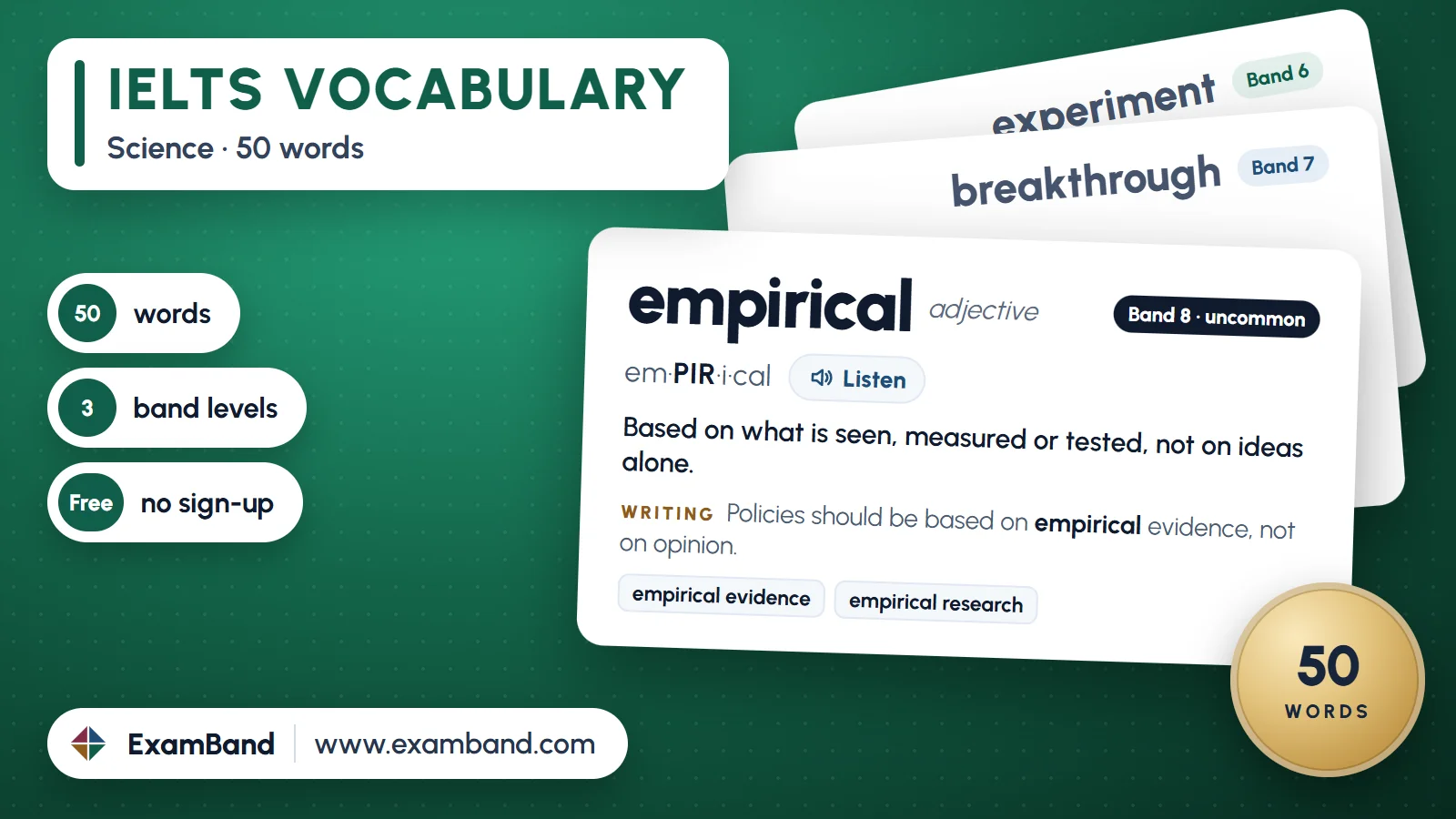
Questions about IELTS science vocabulary
How do I learn IELTS science vocabulary?
Learn about ten words a day. First, read the meaning, listen to the word and say it out loud with the right stress. Then test yourself with the quiz and the flashcards on this page. Finally, use five of the words in an essay and check it with our free Writing Checker.
Which words should I learn first?
Start with the band 6 words, because you need them to explain any idea clearly. After that, add the band 7 words. However, use the band 8 words only when you are sure of their meaning, because a rare word used wrongly can lower your score.
Are these official IELTS words?
No. IELTS has no official word list. Instead, our levels follow the words of the public IELTS band descriptors: band 7 asks for some “less common” words, and band 8 for “uncommon” words used with skill.