IELTS Work Vocabulary: 50 Words with Examples
This list of IELTS work vocabulary covers jobs, careers, pay and the future of work, which come up often in Writing Task 2 and Speaking. Each word has a simple meaning, its sound, a band level, examples for Writing and Speaking, and the mistake to avoid.
50 words · free quiz and flashcards · updated October 2026
job security
JOB se·CU·ri·ty · nounKnowing that you will not lose your job.Band 6 · everyday
Word family: secure (adjective)
Collocations
- offer job security
- a lack of job security
- good job security
Similar: a stable job
WritingMany young workers now value job security more than a high salary.
SpeakingTeaching gives you good job security in my country.
Common mistake: Saying “work security”. The term is “job security”.
workload
WORK·load · nounThe amount of work a person has to do.Band 6 · everyday
Collocations
- a heavy workload
- reduce the workload
- manage your workload
Similar: amount of work
WritingTeachers often leave the profession because of their heavy workload.
SpeakingMy workload doubles every December.
Common mistake: Saying “a lot of workloads”. It is usually singular: “a heavy workload”.
salary
SAL·a·ry · nounThe fixed money you are paid for your job, usually every month.Band 6 · everyday
Word family: salaried (adjective)
Collocations
- a high salary
- earn a salary
- a starting salary
Similar: pay, income
WritingNurses should receive a salary that reflects their important work.
SpeakingMy first salary was tiny, but I was so proud of it.
Common mistake: Saying “celery”, which is a vegetable. A salary is money: SAL-uh-ree.
promotion
pro·MO·tion · nounMoving to a higher position at work.Band 6 · everyday
Word family: promote (verb)
Collocations
- get a promotion
- be up for promotion
- promotion prospects
Similar: advancement
WritingHard work should be the main reason for promotion, not personal connections.
SpeakingI got a promotion last year, so now I manage a small team.
Common mistake: Saying “take a promotion”. You “get” or “are given” a promotion.
colleague
COL·league · nounA person you work with.Band 6 · everyday
Collocations
- a close colleague
- work colleagues
- a former colleague
Similar: co-worker
WritingGood relationships with colleagues make people happier at work.
SpeakingMy colleagues are really friendly; we have lunch together every day.
Common mistake: Spelling it “collegue”. Write “colleague”.
employer
em·PLOY·er · nounA person or company that pays people to work for them.Band 6 · everyday
Word family: employ (verb) · employment (noun)
Collocations
- a good employer
- employers and employees
- a major employer
Similar: company, boss
WritingEmployers should offer training to help staff develop new skills.
SpeakingMy employer lets me work from home on Fridays.
Common mistake: Mixing up “employer” (who pays) and “employee” (who works).
employee
em·PLOY·ee · nounA person who works for a company or for another person.Band 6 · everyday
Collocations
- full-time employees
- treat employees fairly
- employee benefits
Similar: worker, member of staff
WritingHappy employees are usually more productive.
SpeakingThe company has about two hundred employees.
Common mistake: Spelling it “employe”. Write “employee”, with double e.
unemployment
un·em·PLOY·ment · nounNot having a job, or the number of people without jobs.Band 6 · everyday
Word family: unemployed (adjective)
Collocations
- high unemployment
- youth unemployment
- unemployment rates
Similar: joblessness
WritingYouth unemployment is a serious problem in many countries.
SpeakingUnemployment is quite high in my town since the factory closed.
Common mistake: Saying “the unemployed rate”. Say “the unemployment rate”.
part-time
part-TIME · adjective / adverbWorking only some of the hours of a full working week.Band 6 · everyday
Word family: full-time (adjective)
Collocations
- a part-time job
- work part-time
- part-time staff
Similar: half-time
WritingA part-time job can teach students to manage money and time.
SpeakingI work part-time in a café at weekends.
Common mistake: Writing “part time job” without a hyphen. Write “a part-time job”.
overtime
O·ver·time · nounExtra hours worked after the normal working day.Band 6 · everyday
Collocations
- work overtime
- overtime pay
- unpaid overtime
Similar: extra hours
WritingLong hours of unpaid overtime can damage workers’ health.
SpeakingI worked a lot of overtime to save for my wedding.
Common mistake: Saying “overtimes”. It is uncountable: “a lot of overtime”.
career path
ca·REER PATH · nounThe jobs a person does over time as they move forward in their working life.Band 6 · everyday
Word family: career (noun)
Collocations
- choose a career path
- a clear career path
- change career path
Similar: career route
WritingSchools should help students choose a career path that suits their strengths.
SpeakingMy career path has been strange: from cooking to computer science.
Common mistake: Writing “carrier path”. A carrier carries things; your working life is your “career”.
apply for
ap·PLY for · phrasal verbTo formally ask for a job, usually by sending a form or a letter.Band 6 · everyday
Word family: application (noun) · applicant (noun)
Collocations
- apply for a job
- apply for a position
- apply for a visa
Similar: put in an application
WritingGraduates often apply for dozens of jobs before getting an interview.
SpeakingI applied for five jobs last month.
Common mistake: Saying “apply to a job”. You apply for a job, and apply to a company.
job interview
JOB IN·ter·view · nounA meeting where an employer asks you questions to decide if you get a job.Band 6 · everyday
Word family: interviewer (noun) · interviewee (noun)
Collocations
- have a job interview
- prepare for a job interview
- a successful job interview
Similar: interview
WritingMany candidates feel nervous in a job interview, even when they are well prepared.
SpeakingMy first job interview was a disaster; I forgot my CV!
Common mistake: Saying “make an interview”. You “have” or “attend” an interview.
retire
re·TIRE · verbTo stop working because of your age.Band 6 · everyday
Word family: retirement (noun) · retired (adjective)
Collocations
- retire early
- retire at 65
- the retirement age
Similar: stop working
WritingMany people now retire later because they live longer.
SpeakingMy dad wants to retire by the sea.
Common mistake: Saying “retire myself”. Just say “I retired”.
deadline
DEAD·line · nounThe time by which a piece of work must be finished.Band 6 · everyday
Collocations
- meet a deadline
- a tight deadline
- miss a deadline
Similar: due date
WritingConstant deadlines are one of the main causes of stress at work.
SpeakingI always finish things right before the deadline.
Common mistake: Saying “catch a deadline”. You “meet” or “miss” a deadline.
teamwork
TEAM·work · nounWorking well together as a group.Band 6 · everyday
Word family: team (noun)
Collocations
- good teamwork
- encourage teamwork
- teamwork skills
Similar: cooperation, collaboration
WritingEmployers value teamwork as much as technical skills.
SpeakingOur project worked because of great teamwork.
Common mistake: Saying “team working” as the noun. The usual word is “teamwork”.
wage
WAGE · nounMoney paid for work, usually every week or by the hour.Band 6 · everyday
Collocations
- a low wage
- earn a wage
- wage increases
Similar: pay, earnings
WritingLow wages force some people to work two jobs.
SpeakingThe wage in my first job was very low.
Common mistake: Mixing up “wage” and “salary”. A wage is often paid by the hour or week; a salary is a fixed amount for the year.
self-employed
self-em·PLOYED · adjectiveWorking for yourself, not for a company.Band 6 · everyday
Word family: self-employment (noun)
Collocations
- become self-employed
- self-employed workers
- be self-employed
Similar: freelance, working for yourself
WritingSelf-employed people often have no paid holiday or sick pay.
SpeakingMy mum is self-employed; she makes and sells cakes.
Common mistake: Saying “self-employee”. The adjective is “self-employed”.
remote work
re·MOTE WORK · nounWorking from home or another place away from the office.Band 7 · less common
Word family: remotely (adverb)
Collocations
- the rise of remote work
- remote work policies
- switch to remote work
Similar: working from home
WritingRemote work saves time, but it can make employees feel isolated.
SpeakingI love remote work because I don’t have to commute.
Common mistake: Saying “distance work”. The usual terms are “remote work” or “working from home”.
job satisfaction
JOB sat·is·FAC·tion · nounThe good feeling you get from your work.Band 7 · less common
Word family: satisfying (adjective)
Collocations
- high job satisfaction
- improve job satisfaction
- a lack of job satisfaction
Similar: fulfilment
WritingMany nurses report high job satisfaction despite low pay.
SpeakingMy job satisfaction went up when I started teaching.
Common mistake: Saying “work satisfying”. The noun phrase is “job satisfaction”.
work-life balance
WORK-LIFE BAL·ance · nounHaving enough time for both your job and your private life.Band 7 · less common
Collocations
- a good work-life balance
- achieve a work-life balance
- improve work-life balance
Similar: time for life outside work
WritingA four-day week could give employees a better work-life balance.
SpeakingMy work-life balance is terrible during exam season.
Common mistake: Writing “work life balance” without the hyphen. Write “work-life balance”.
burnout
BURN·out · nounFeeling completely tired and unable to work because of too much stress for a long time.Band 7 · less common
Word family: burn out (phrasal verb)
Collocations
- suffer from burnout
- prevent burnout
- job burnout
Similar: exhaustion
WritingLong hours and pressure have caused widespread burnout among doctors.
SpeakingI had burnout last year and needed a month off.
Common mistake: Using “burn out” as the noun. The noun is “burnout”; the verb is “burn out”.
flexible working hours
FLEX·i·ble WORK·ing HOURS · noun, pluralBeing able to choose when you start and finish work.Band 7 · less common
Word family: flexibility (noun)
Collocations
- offer flexible working hours
- enjoy flexible working hours
- the benefits of flexible working hours
Similar: flexitime
WritingFlexible working hours help parents manage childcare.
SpeakingMy company has flexible working hours, so I start at ten.
Common mistake: Saying “flexibility hours”. Use the adjective: “flexible working hours”.
freelance
FREE·lance · adjective / adverbWorking for different companies on separate jobs, not as an employee.Band 7 · less common
Word family: freelancer (noun)
Collocations
- work freelance
- a freelance designer
- freelance work
Similar: self-employed
WritingFreelance work offers freedom but rarely offers security.
SpeakingI do freelance translation in the evenings.
Common mistake: Calling the person “a freelance”. The person is “a freelancer”.
gig economy
GIG e·CON·o·my · nounWork made up of short jobs, often found through apps, like delivery driving.Band 7 · less common
Collocations
- work in the gig economy
- the rise of the gig economy
- gig economy workers
Similar: freelance economy
WritingWorkers in the gig economy often have no sick pay or pension.
SpeakingLots of students here work in the gig economy, delivering food.
Common mistake: Thinking it is about music concerts. Here “gig” means a short job.
redundant
re·DUN·dant · adjectiveLosing your job because your employer no longer needs your position.Band 7 · less common
Word family: redundancy (noun)
Collocations
- be made redundant
- redundancy pay
- face redundancy
Similar: laid off, let go
WritingThousands of workers were made redundant when the factory closed.
SpeakingMy dad was made redundant last year, but he found a new job.
Common mistake: Saying “be redundanted”. Say “be made redundant”.
productivity
pro·duc·TIV·i·ty · nounHow much work is done in a period of time.Band 7 · less common
Word family: productive (adjective)
Collocations
- increase productivity
- low productivity
- boost productivity
Similar: efficiency, output
WritingShort breaks during the day can increase productivity.
SpeakingMy productivity is much higher in the morning.
Common mistake: Saying “productiveness” in most cases. The usual noun is “productivity”.
entrepreneur
en·tre·pre·NEUR · nounSomeone who starts their own business.Band 7 · less common
Word family: entrepreneurial (adjective) · entrepreneurship (noun)
Collocations
- a successful entrepreneur
- young entrepreneurs
- become an entrepreneur
Similar: business owner
WritingGovernments can support young entrepreneurs with small loans.
SpeakingMy brother is an entrepreneur; he runs two coffee shops.
Common mistake: Spelling it “entrepeneur”. Write “entrepreneur”.
internship
IN·tern·ship · nounA short period of work, often unpaid, to get experience.Band 7 · less common
Word family: intern (noun)
Collocations
- do an internship
- a paid internship
- an internship at a bank
Similar: work placement
WritingUnpaid internships favour students whose parents can support them.
SpeakingI did a three-month internship at a newspaper.
Common mistake: Saying “make an internship”. You “do” or “complete” an internship.
skilled worker
SKILLED WORK·er · nounSomeone trained to do a job that needs special skills.Band 7 · less common
Word family: skill (noun)
Collocations
- a shortage of skilled workers
- highly skilled workers
- attract skilled workers
Similar: qualified worker
WritingMany countries face a shortage of skilled workers such as engineers.
SpeakingMy uncle is a skilled worker; he repairs aircraft engines.
Common mistake: Saying “skilful worker” for someone with training. “Skilled” means trained; “skilful” means good at something.
minimum wage
MIN·i·mum WAGE · nounThe lowest pay per hour that the law allows.Band 7 · less common
Collocations
- raise the minimum wage
- earn the minimum wage
- a national minimum wage
Similar: lowest legal pay
WritingRaising the minimum wage could reduce poverty among young workers.
SpeakingMy first job paid the minimum wage.
Common mistake: Saying “the minimal wage”. The term is “minimum wage”.
workforce
WORK·force · nounAll the people who work in a company or a country.Band 7 · less common
Collocations
- a skilled workforce
- join the workforce
- women in the workforce
Similar: staff, labour force
WritingThe number of women in the workforce has grown steadily.
SpeakingMost of the workforce in my town works in tourism.
Common mistake: Saying “workforces” for one company. It is usually singular: “the workforce”.
transferable skills
trans·FER·a·ble SKILLS · noun, pluralSkills that are useful in many different jobs, like communication.Band 7 · less common
Word family: transfer (verb)
Collocations
- develop transferable skills
- highlight transferable skills
- key transferable skills
Similar: soft skills
WritingUniversity teaches transferable skills such as research and teamwork.
SpeakingWorking in a café gave me transferable skills, like dealing with customers.
Common mistake: Spelling it “transferrable”. Write “transferable”, with one r.
career prospects
ca·REER PROS·pects · noun, pluralYour chances of success in your work in the future.Band 7 · less common
Word family: prospective (adjective)
Collocations
- good career prospects
- improve career prospects
- limited career prospects
Similar: job prospects
WritingA second language can greatly improve a graduate’s career prospects.
SpeakingCareer prospects in IT are excellent in my country.
Common mistake: Saying “career perspectives”. The term is “career prospects”.
labour market
LA·bour MAR·ket · nounAll the jobs and workers that are available in a country.Band 7 · less common
Collocations
- enter the labour market
- a competitive labour market
- changes in the labour market
Similar: job market
WritingGraduates are entering a highly competitive labour market.
SpeakingThe labour market here is tough for young people.
Common mistake: Writing “labor market” in a British English essay. British English spells it “labour”.
staff turnover
STAFF TURN·o·ver · nounHow often workers leave a company and have to be replaced.Band 7 · less common
Collocations
- high staff turnover
- reduce staff turnover
- the cost of staff turnover
Similar: employee turnover
WritingLow pay often leads to high staff turnover in restaurants.
SpeakingStaff turnover at my company is high; people leave after a year.
Common mistake: Saying “staff turnaround”. The term is “staff turnover”.
manual labour
MAN·u·al LA·bour · nounPhysical work done with the hands.Band 7 · less common
Word family: manually (adverb)
Collocations
- do manual labour
- jobs involving manual labour
- hard manual labour
Similar: physical work
WritingMachines have replaced much of the manual labour in farming.
SpeakingMy summer job was manual labour, carrying boxes all day.
Common mistake: Thinking “manual” means a book of instructions here. In “manual labour” it means done by hand.
white-collar
white-COL·lar · adjectiveDescribing office jobs, not jobs in factories or outdoors.Band 7 · less common
Word family: blue-collar (adjective)
Collocations
- white-collar jobs
- white-collar workers
- white-collar crime
Similar: office-based
WritingAutomation now threatens white-collar jobs as well as factory work.
SpeakingMost of my friends have white-collar jobs in banks or offices.
Common mistake: Mixing it up with “blue-collar”, which describes manual and factory work.
lucrative
LU·cra·tive · adjectiveMaking a lot of money.Band 8 · uncommon
Collocations
- a lucrative career
- a lucrative business
- highly lucrative
Similar: well-paid, profitable
WritingMany students choose law or medicine because they are lucrative careers.
SpeakingMy cousin has a lucrative job in finance, but he works all the time.
Common mistake: Using it for things you enjoy. Lucrative only means well-paid.
fulfilling
ful·FIL·ling · adjectiveMaking you feel happy and satisfied because it is useful or important.Band 8 · uncommon
Word family: fulfil (verb) · fulfilment (noun)
Collocations
- a fulfilling job
- a fulfilling career
- deeply fulfilling
Similar: rewarding, satisfying
WritingA fulfilling career can matter more to young people than a high salary.
SpeakingTeaching children is really fulfilling for me.
Common mistake: Spelling it “fullfilling”. Write “fulfilling”: one l after “fu”, two after “fi”.
brain drain
BRAIN DRAIN · nounWhen skilled and educated people leave their country to work abroad.Band 8 · uncommon
Collocations
- suffer from brain drain
- reverse the brain drain
- a serious brain drain
Similar: emigration of skilled workers
WritingThe brain drain of doctors leaves poorer countries short of medical staff.
SpeakingMy country has a big brain drain; many engineers move to Europe.
Common mistake: Saying “brain leak”. The fixed phrase is “brain drain”.
job-hopping
JOB-hop·ping · nounChanging jobs often.Band 8 · uncommon
Word family: job-hopper (noun)
Collocations
- frequent job-hopping
- the trend of job-hopping
- be accused of job-hopping
Similar: switching jobs
WritingJob-hopping can raise salaries, but employers may see it as disloyal.
SpeakingMy friend is always job-hopping; she’s had five jobs in three years.
Common mistake: Writing “job hopping” without the hyphen. Write “job-hopping”.
precarious
pre·CAR·i·ous · adjectiveNot safe or certain, and likely to change for the worse.Band 8 · uncommon
Word family: precariously (adverb)
Collocations
- precarious work
- a precarious situation
- financially precarious
Similar: insecure, unstable
WritingShort contracts leave many young people in precarious employment.
SpeakingLife as a musician is quite precarious; the money goes up and down.
Common mistake: Using it for something only uncomfortable. It means unstable or unsafe.
remuneration
re·mu·ner·A·tion · nounPayment for work.Band 8 · uncommon
Word family: remunerate (verb)
Collocations
- a remuneration package
- fair remuneration
- remuneration for overtime
Similar: pay, salary
WritingFair remuneration is essential to keep experienced teachers in schools.
SpeakingThe remuneration is good, but the hours are long.
Common mistake: Saying “renumeration”. The m comes before the n: “remuneration”.
menial
ME·ni·al · adjectiveBoring, needing little skill, and usually badly paid.Band 8 · uncommon
Collocations
- menial jobs
- menial tasks
- menial work
Similar: dull, unskilled
WritingRobots could take over many menial tasks in warehouses.
SpeakingMy first job was quite menial: I just folded clothes all day.
Common mistake: Saying it with a short e. It starts like “mean”: MEE-nee-ul.
outsourcing
OUT·sourc·ing · nounPaying another company, often abroad, to do work.Band 8 · uncommon
Word family: outsource (verb)
Collocations
- outsourcing jobs
- outsourcing to other countries
- the effects of outsourcing
Similar: contracting out
WritingOutsourcing has moved many factory jobs to countries with lower wages.
SpeakingMy company started outsourcing its customer service last year.
Common mistake: Saying “outside sourcing”. The word is “outsourcing”.
glass ceiling
GLASS CEIL·ing · nounA hidden barrier that stops women or minorities from reaching the top jobs.Band 8 · uncommon
Collocations
- break the glass ceiling
- hit a glass ceiling
- a glass ceiling for women
Similar: career barrier
WritingMany women still face a glass ceiling in business and politics.
SpeakingMy aunt broke the glass ceiling when she became our first female director.
Common mistake: Using it for a real ceiling. It is an idiom for an unfair barrier at work.
incentive
in·CEN·tive · nounSomething that encourages people to work harder or to do something.Band 8 · uncommon
Word family: incentivise (verb)
Collocations
- a financial incentive
- offer incentives
- an incentive to work
Similar: motivation, reward
WritingBonuses give employees an incentive to work more efficiently.
SpeakingFree lunches are a nice incentive to come into the office.
Common mistake: Putting the stress at the start. Stress “-cen-”: in-SEN-tive.
mundane
mun·DANE · adjectiveVery ordinary and boring.Band 8 · uncommon
Collocations
- mundane tasks
- a mundane job
- the mundane routine
Similar: dull, tedious
WritingAutomation frees workers from mundane tasks such as data entry.
SpeakingMy job can be mundane, but my colleagues make it fun.
Common mistake: Using it to mean “worldwide”. Mundane means boring and ordinary.
upskill
UP·skill · verbTo learn new skills for your job, or to teach workers new skills.Band 8 · uncommon
Word family: upskilling (noun)
Collocations
- upskill workers
- upskill the workforce
- a need to upskill
Similar: retrain
WritingCompanies must upskill their staff to keep up with new technology.
SpeakingI’m taking an online course to upskill in data analysis.
Common mistake: Writing “up skill” as two words. Write “upskill”.
Work vocabulary in IELTS Writing and Speaking
Here is how IELTS work vocabulary can come up in the test, with our own practice questions. So, try to answer them with words from the list above.
Writing Task 2
Some people think it is better to stay in one job for a long time, while others think changing jobs often is better for your career. Discuss both views and give your own opinion.
Speaking
- Part 1: Do you work, or are you a student?
- Part 1: What job did you want to do when you were a child?
- Part 2: Describe a job you would like to do in the future.
- Part 3: Is a high salary more important than enjoying your job?
- Part 3: How will working from home change our cities?
Our free tests on this topic
- Writing Practice Test 1, Task 2working from home instead of in an office
- Writing Practice Test 9, Task 2skilled workers who leave their country to work abroad
- Reading Practice Test 4, Passage 2whether it is time for a four-day week
- Listening Practice Test 11, Part 3a student’s report on a work placement
A model paragraph with IELTS work vocabulary
Remote work has changed what people want from a job. Many employees now value work-life balance and job satisfaction as much as a high salary. However, working from home can blur the line between office and home, which may lead to burnout. Employers who offer flexible working hours and real support are more likely to keep their best staff.
Practise this IELTS work vocabulary
Take the 10-question quiz on this IELTS work vocabulary, or go through every word with the flashcards.
Question 1 of 10
Which word means “the fixed money you are paid for your job, usually every month”?
Now use the words
Write a Task 2 essay with five of these words. Then our free Writing Checker gives you a band for vocabulary and for the other three criteria.
Open the Writing Checker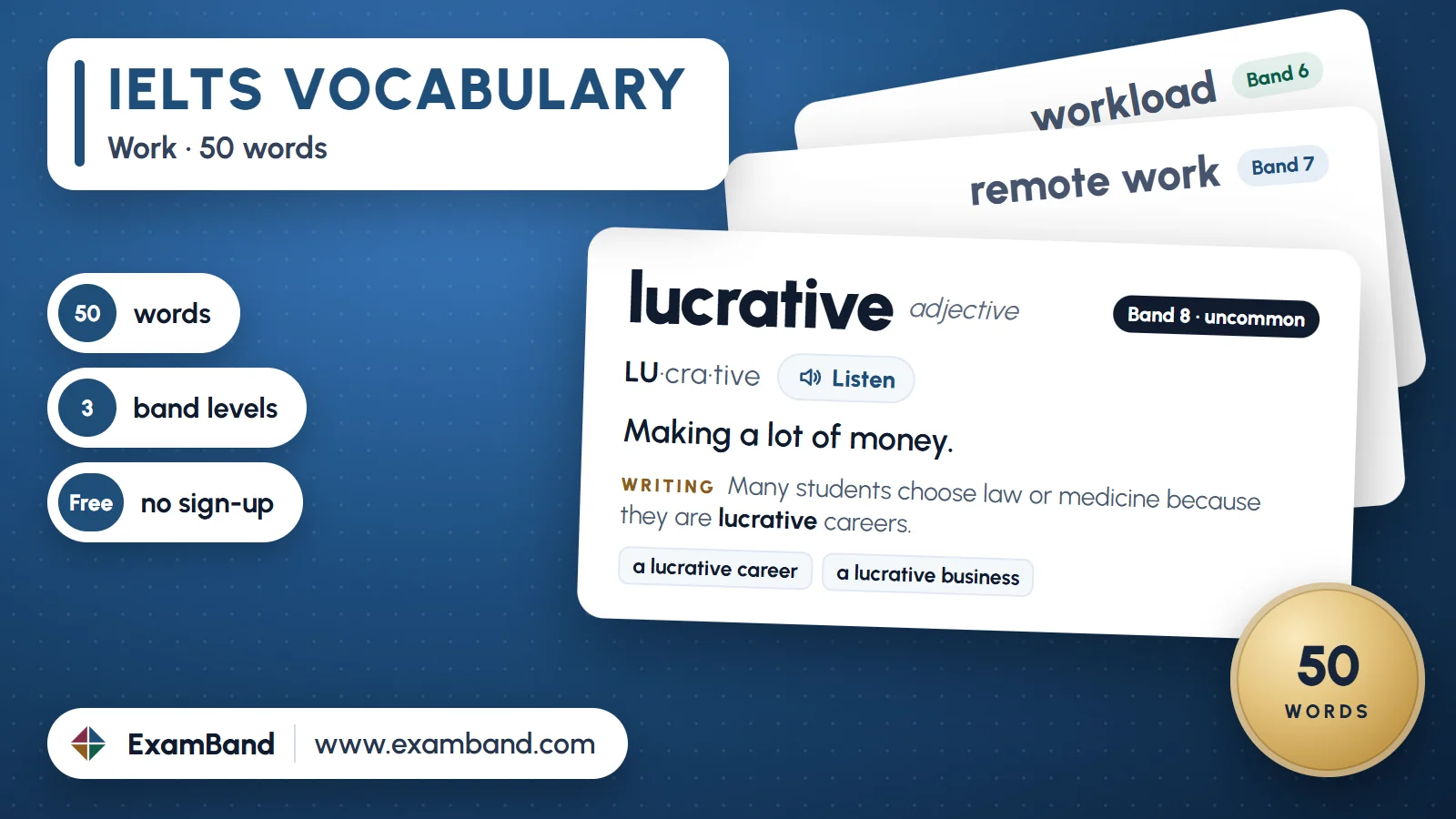
Questions about IELTS work vocabulary
How do I learn IELTS work vocabulary?
Learn about ten words a day. First, read the meaning, listen to the word and say it out loud with the right stress. Then test yourself with the quiz and the flashcards on this page. Finally, use five of the words in an essay and check it with our free Writing Checker.
Which words should I learn first?
Start with the band 6 words, because you need them to explain any idea clearly. After that, add the band 7 words. However, use the band 8 words only when you are sure of their meaning, because a rare word used wrongly can lower your score.
Are these official IELTS words?
No. IELTS has no official word list. Instead, our levels follow the words of the public IELTS band descriptors: band 7 asks for some “less common” words, and band 8 for “uncommon” words used with skill.