IELTS Sport Vocabulary: 50 Words with Examples
These 50 words of IELTS sport vocabulary come up again and again in Speaking Part 1 and Part 3, in Writing Task 2 essays on health and money, and in the Listening and Reading tests. Each word has a simple meaning, its sound, a band level, examples for Writing and Speaking, and the mistake to avoid.
50 words · free quiz and flashcards · updated October 2026
athlete
ATH·lete · nounA person who is good at sport and competes in it.Band 6 · everyday
Word family: athletic (adjective) · athletics (noun)
Collocations
- a professional athlete
- a top athlete
- a young athlete
Similar: sportsperson
WritingTop athletes can inspire children to take up sport.
SpeakingMy cousin is a real athlete; she runs every morning.
Common mistake: Saying “ath-e-lete”, with three syllables. It has two: “ATH-leet”.
team sport
TEAM SPORT · nounA sport played by groups of people, like football.Band 6 · everyday
Collocations
- play a team sport
- team sports such as football
- the benefits of team sports
Similar: group sport
WritingTeam sports teach children how to cooperate and how to lose.
SpeakingI prefer team sports because they’re more fun than running alone.
Common mistake: Saying “a team sports”. Use the singular after “a”: “a team sport”.
spectator
spec·TA·tor · nounA person who watches a sports event.Band 6 · everyday
Word family: spectate (verb) · spectacle (noun)
Collocations
- thousands of spectators
- attract spectators
- a spectator sport
Similar: fan, onlooker
WritingFootball matches can attract more than fifty thousand spectators.
SpeakingI’m more of a spectator than a player these days.
Common mistake: Saying “viewers” for people at the stadium. People at the event are “spectators”; people watching on TV are “viewers”.
stadium
STA·di·um · nounA large sports ground with seats all around it.Band 6 · everyday
Collocations
- a football stadium
- a packed stadium
- build a new stadium
Similar: arena
WritingHosting the Olympics often means building expensive new stadiums.
SpeakingThe stadium in my city holds about forty thousand people.
Common mistake: Being unsure of the plural. Both “stadiums” and “stadia” are correct; “stadiums” is more common.
coach
COACH · noun / verbA person who trains a sports player or team.Band 6 · everyday
Word family: coaching (noun)
Collocations
- a football coach
- a personal coach
- coach a team
Similar: trainer, instructor
WritingA good coach can make a huge difference to a young player’s progress.
SpeakingMy swimming coach was really strict but very kind.
Common mistake: Saying “trainer” for the person in British English. “Trainers” are sports shoes; the person is a “coach”.
fitness
FIT·ness · nounHow strong and healthy your body is.Band 6 · everyday
Word family: fit (adjective)
Collocations
- physical fitness
- improve your fitness
- a fitness centre
Similar: health, shape
WritingRegular exercise improves both physical fitness and mental health.
SpeakingI joined a gym to improve my fitness.
Common mistake: Saying “a fitness” for one exercise class. Say “a fitness class”; “fitness” itself is uncountable.
work out
work OUT · phrasal verbTo exercise to make your body stronger, often in a gym.Band 6 · everyday
Word family: workout (noun)
Collocations
- work out at the gym
- work out regularly
- a good workout
Similar: exercise, train
WritingPeople who work out regularly tend to sleep better.
SpeakingI work out three times a week before work.
Common mistake: Writing the verb as one word. The verb is “work out”; the noun is “a workout”.
tournament
TOUR·na·ment · nounA competition with many teams or players and several rounds.Band 6 · everyday
Collocations
- a tennis tournament
- win a tournament
- host a tournament
Similar: championship, competition
WritingInternational tournaments can bring tourists and money to the host city.
SpeakingWe watched every match of the tournament on TV.
Common mistake: Spelling it “turnament”. Write “tournament”, with -our-.
referee
ref·e·REE · nounThe person who makes sure players follow the rules in a match.Band 6 · everyday
Collocations
- the referee’s decision
- a football referee
- argue with the referee
Similar: umpire, official
WritingVideo technology now helps referees make fairer decisions.
SpeakingPlayers should never shout at the referee.
Common mistake: Using “referee” for every sport. In tennis and cricket, the person is called an “umpire”.
amateur
AM·a·teur · adjective / nounDoing a sport for fun, not for money.Band 6 · everyday
Word family: amateurish (adjective)
Collocations
- an amateur athlete
- amateur football
- at amateur level
Similar: non-professional
WritingAmateur sport depends heavily on volunteers.
SpeakingI play in an amateur football league on Sundays.
Common mistake: Using “amateur” only to mean “bad”. Its main meaning is “not paid”.
professional
pro·FES·sion·al · adjective / nounDoing something as a paid job.Band 6 · everyday
Word family: professionally (adverb) · profession (noun)
Collocations
- a professional footballer
- turn professional
- professional sport
Similar: pro
WritingProfessional footballers earn far more than nurses or teachers.
SpeakingI dreamed of becoming a professional tennis player.
Common mistake: Spelling it “proffesional”. Write “professional”: one f, double s.
opponent
op·PO·nent · nounThe person or team you are playing against.Band 6 · everyday
Word family: oppose (verb) · opposition (noun)
Collocations
- beat an opponent
- a strong opponent
- respect your opponent
Similar: rival
WritingChildren should learn to shake hands with their opponents after a match.
SpeakingMy opponent was much taller, but I still won.
Common mistake: Saying “my enemy” in sport. In a game, the person is your “opponent”.
keep fit
KEEP FIT · phraseTo stay healthy and strong by exercising.Band 6 · everyday
Word family: fitness (noun)
Collocations
- keep fit by swimming
- try to keep fit
- keep-fit classes
Similar: stay in shape
WritingMany older people keep fit by walking or swimming.
SpeakingI keep fit by cycling to university every day.
Common mistake: Saying “keep fitness”. Use the adjective: “keep fit”.
extreme sports
ex·TREME SPORTS · noun, pluralDangerous sports, like rock climbing or skydiving.Band 6 · everyday
Word family: extremely (adverb)
Collocations
- do extreme sports
- the popularity of extreme sports
- try extreme sports
Similar: adventure sports
WritingExtreme sports attract young people who want excitement and risk.
SpeakingI’d love to try extreme sports, especially paragliding.
Common mistake: Saying “extremely sports”. Use the adjective: “extreme sports”.
physical education
PHYS·i·cal ed·u·CA·tion · nounSport and exercise taught as a school subject; often called PE.Band 6 · everyday
Collocations
- physical education lessons
- compulsory physical education
- a PE teacher
Similar: PE
WritingPhysical education should be as important as maths in schools.
SpeakingAt school, physical education was my favourite subject.
Common mistake: Writing “physic education”. Write “physical education”, or just “PE”.
sports facilities
SPORTS fa·CIL·i·ties · noun, pluralPlaces and equipment for doing sport, like pools and courts.Band 6 · everyday
Word family: facilitate (verb)
Collocations
- public sports facilities
- improve sports facilities
- access to sports facilities
Similar: leisure centres
WritingGood sports facilities encourage local people to stay active.
SpeakingMy neighbourhood has great sports facilities, including a free pool.
Common mistake: Saying “sport facility” for the general idea. Use the plural: “sports facilities”.
compete
com·PETE · verbTo try to win against others.Band 6 · everyday
Word family: competition (noun) · competitive (adjective) · competitor (noun)
Collocations
- compete in
- compete against
- compete for a medal
Similar: take part, contend
WritingOnly a few young players will ever compete at the highest level.
SpeakingI used to compete in swimming races as a teenager.
Common mistake: Saying “compete with a race”. You compete “in” a race and “against” a person.
medal
MED·al · nounA round metal disc given to the winner of a competition.Band 6 · everyday
Word family: medallist (noun)
Collocations
- win a medal
- a gold medal
- an Olympic medal
Similar: award, prize
WritingCountries often judge their sports policy by the number of medals they win.
SpeakingI still have the medal I won at school sports day.
Common mistake: Mixing it up with “metal”. A medal is the prize; metal is the material.
physical activity
PHYS·i·cal ac·TIV·i·ty · nounMoving your body, for example walking, playing or doing sport.Band 7 · less common
Word family: physically (adverb)
Collocations
- regular physical activity
- increase physical activity
- lack of physical activity
Similar: exercise
WritingA lack of physical activity is linked to heart disease and depression.
SpeakingMy job involves almost no physical activity, so I walk in the evening.
Common mistake: Writing “physically activity”. Use the adjective: “physical activity”.
endurance
en·DUR·ance · nounThe ability to keep going for a long time, even when it is hard.Band 7 · less common
Word family: endure (verb)
Collocations
- a test of endurance
- endurance sports
- build up endurance
Similar: stamina, staying power
WritingMarathons are a real test of endurance.
SpeakingLong-distance cycling has built up my endurance.
Common mistake: Mixing it up with “insurance”. Endurance is the ability to keep going; insurance protects you against loss.
stamina
STAM·i·na · nounThe physical strength to keep doing something for a long time.Band 7 · less common
Collocations
- build up stamina
- lack stamina
- physical stamina
Similar: endurance
WritingFootballers need great stamina to run for ninety minutes.
SpeakingSwimming is great for building stamina.
Common mistake: Saying “a stamina”. It is uncountable: “a lot of stamina”.
sportsmanship
SPORTS·man·ship · nounFair, polite behaviour towards other players, even when you lose.Band 7 · less common
Word family: sportsmanlike (adjective)
Collocations
- good sportsmanship
- show sportsmanship
- a lack of sportsmanship
Similar: fair play
WritingSchool sport should teach sportsmanship as well as skill.
SpeakingI admire players who show good sportsmanship when they lose.
Common mistake: Writing “sportmanship”. It has an s: “sportsmanship”.
fair play
FAIR PLAY · nounFollowing the rules and treating other players honestly.Band 7 · less common
Collocations
- a sense of fair play
- the spirit of fair play
- encourage fair play
Similar: sportsmanship
WritingCheating scandals damage the idea of fair play in sport.
SpeakingMy dad taught me that fair play matters more than winning.
Common mistake: Writing “fairplay” as one word. Write it as two words: “fair play”.
performance-enhancing drugs
per·FOR·mance-en·HANC·ing DRUGS · noun, pluralBanned drugs that some athletes take to make themselves faster or stronger.Band 7 · less common
Word family: enhance (verb) · enhancement (noun)
Collocations
- take performance-enhancing drugs
- test for performance-enhancing drugs
Similar: doping
WritingAthletes caught using performance-enhancing drugs should be banned for life.
SpeakingIt’s sad when a star is caught taking performance-enhancing drugs.
Common mistake: Writing “performance enhancing drug” with no hyphen. Write “performance-enhancing drugs”.
sponsorship
SPON·sor·ship · nounMoney a company gives to a sports team or event, often for advertising.Band 7 · less common
Word family: sponsor (verb, noun)
Collocations
- sponsorship deals
- attract sponsorship
- corporate sponsorship
Similar: funding, backing
WritingMany sports clubs could not survive without sponsorship from big companies.
SpeakingOur local team gets sponsorship from a car dealer.
Common mistake: Mixing it up with “sponsor”. The company is a “sponsor”; the money or deal is “sponsorship”.
grassroots sport
GRASS·roots SPORT · nounSport played by ordinary people in local clubs, not professionals.Band 7 · less common
Collocations
- invest in grassroots sport
- fund grassroots sport
Similar: community sport
WritingMoney from big events should be invested in grassroots sport.
SpeakingI coach kids at a grassroots sport club on Saturdays.
Common mistake: Writing “grass roots” as two words. Before a noun it is one word: “grassroots sport”.
competitive
com·PET·i·tive · adjectiveWanting very much to win; also, a situation where people compete.Band 7 · less common
Word family: compete (verb) · competition (noun)
Collocations
- highly competitive
- a competitive spirit
- competitive sport
Similar: ambitious
WritingSome children enjoy competitive sport, while others find it stressful.
SpeakingI’m very competitive, even when I play board games.
Common mistake: Spelling it “competetive”. Write “competitive”, with -i- after pet.
hand-eye coordination
HAND-eye co·or·di·NA·tion · nounThe ability to make your hands move well with what your eyes see.Band 7 · less common
Word family: coordinate (verb)
Collocations
- improve hand-eye coordination
- good hand-eye coordination
WritingRacket sports are excellent for developing hand-eye coordination.
SpeakingVideo games actually improved my hand-eye coordination.
Common mistake: Writing “hand eye coordination” without a hyphen. Write “hand-eye coordination”.
record-breaking
REC·ord-break·ing · adjectiveBetter, faster or bigger than anything before.Band 7 · less common
Word family: break a record (phrase)
Collocations
- a record-breaking performance
- a record-breaking crowd
- record-breaking time
Similar: unprecedented
WritingHer record-breaking run made her a national hero.
SpeakingThe match drew a record-breaking crowd last year.
Common mistake: Writing “record breaking” without a hyphen before a noun. Write “a record-breaking time”.
host
HOST · verb / nounTo hold an event, such as the Olympic Games, in your city or country.Band 7 · less common
Word family: hostess (noun)
Collocations
- host the Olympics
- host the World Cup
- the host nation
Similar: stage, hold
WritingCountries that host the Olympics often spend more than they earn.
SpeakingMy country hosted the World Cup once, and everyone went crazy.
Common mistake: Saying “do the Olympics” or “make the World Cup”. The verb is “host”: “host the World Cup”.
underdog
UN·der·dog · nounThe team or player that people expect to lose.Band 7 · less common
Collocations
- the underdog
- support the underdog
- the underdogs win
Similar: outsider
WritingSport is exciting partly because the underdog sometimes wins.
SpeakingI always support the underdog; it’s more fun.
Common mistake: Using it as a rude word for someone. It just means the side that is expected to lose.
personal best
PER·son·al BEST · nounThe best result a person has ever achieved.Band 7 · less common
Collocations
- set a personal best
- beat your personal best
- a new personal best
Similar: PB
WritingEven athletes who do not win can be proud of a personal best.
SpeakingI ran a personal best in last year’s 10 km race.
Common mistake: Saying “my best personal”. The phrase is “personal best”, often written PB.
adrenaline
a·DREN·a·line · nounA chemical in your body that makes you feel excited and full of energy.Band 7 · less common
Collocations
- an adrenaline rush
- a burst of adrenaline
- an adrenaline junkie
Similar: excitement
WritingExtreme sports appeal to people who love the rush of adrenaline.
SpeakingSkydiving gave me such an adrenaline rush!
Common mistake: Spelling it “adrenline”. Write “adrenaline”, with -aline.
match-fixing
MATCH-fix·ing · nounIllegally deciding the result of a game before it is played.Band 7 · less common
Word family: fix a match (phrase)
Collocations
- a match-fixing scandal
- accused of match-fixing
Similar: cheating
WritingMatch-fixing scandals destroy fans’ trust in the sport.
SpeakingThere was a big match-fixing scandal in our league last year.
Common mistake: Saying “fixing match”. The noun is “match-fixing”.
team spirit
TEAM SPIR·it · nounThe feeling of loyalty and support among members of a team.Band 7 · less common
Collocations
- a strong team spirit
- build team spirit
- lack of team spirit
Similar: camaraderie
WritingGroup activities at school help to build team spirit.
SpeakingOur team wasn’t the best, but we had great team spirit.
Common mistake: Saying “team’s spirit”. The phrase is “team spirit”.
elite
e·LITE · adjective / nounThe best, most skilled people in a group.Band 7 · less common
Word family: elitism (noun) · elitist (adjective)
Collocations
- elite athletes
- elite sport
- at elite level
Similar: top, leading
WritingFunding for elite sport should not come at the cost of local clubs.
SpeakingOnly elite players get to train at that centre.
Common mistake: Saying “ee-LIGHT”. It is said “ay-LEET”.
recreational
rec·re·A·tion·al · adjectiveDone for fun in your free time.Band 7 · less common
Word family: recreation (noun)
Collocations
- recreational sport
- recreational activities
- recreational facilities
Similar: leisure
WritingCities need more space for recreational activities such as cycling.
SpeakingI play tennis, but only at a recreational level.
Common mistake: Spelling it “recreacional”. Write “recreational”, with -tion-.
rivalry
RI·val·ry · nounStrong competition between two people or teams over a long time.Band 7 · less common
Word family: rival (noun, adjective)
Collocations
- a fierce rivalry
- a long-standing rivalry
- the rivalry between
Similar: competition
WritingThe rivalry between the two clubs goes back more than a century.
SpeakingThere’s a huge rivalry between the two teams in my city.
Common mistake: Spelling it “rivality”. Write “rivalry”.
doping
DOP·ing · nounUsing banned drugs to improve sports performance.Band 8 · uncommon
Word family: dope (verb)
Collocations
- a doping scandal
- doping tests
- banned for doping
Similar: drug-taking
WritingDoping scandals have damaged the reputation of professional cycling.
SpeakingIt’s depressing how many doping scandals there are.
Common mistake: Thinking it only means illegal street drugs. In sport, it means banned drugs taken to perform better.
spectacle
SPEC·ta·cle · nounAn impressive event that is exciting to watch.Band 8 · uncommon
Word family: spectacular (adjective)
Collocations
- a sporting spectacle
- a great spectacle
- a global spectacle
Similar: show, display
WritingThe opening ceremony has become a global spectacle watched by billions.
SpeakingThe final was an amazing spectacle, even for people who don’t like football.
Common mistake: Confusing it with “spectacles” (glasses). In this sense it is singular: “a great spectacle”.
prowess
PROW·ess · nounGreat skill at doing something.Band 8 · uncommon
Collocations
- athletic prowess
- sporting prowess
- physical prowess
Similar: skill, expertise
WritingA nation’s sporting prowess is often a source of pride.
SpeakingI have zero athletic prowess, sadly.
Common mistake: Saying “a prowess”. It is uncountable: “his prowess on the field”.
camaraderie
cam·a·RA·de·rie · nounA feeling of friendship among people who share an experience.Band 8 · uncommon
Word family: comrade (noun)
Collocations
- a sense of camaraderie
- team camaraderie
- build camaraderie
Similar: friendship, team spirit
WritingTeam sports create a strong sense of camaraderie among young people.
SpeakingWhat I miss most about football is the camaraderie.
Common mistake: Spelling it “camarederie”. Write “camaraderie”.
gruelling
GRU·el·ling · adjectiveVery hard and tiring for a long time.Band 8 · uncommon
Collocations
- a gruelling race
- a gruelling schedule
- gruelling training
Similar: exhausting, punishing
WritingProfessional players face a gruelling schedule with little time to rest.
SpeakingThe last ten kilometres of the race were absolutely gruelling.
Common mistake: Spelling it “grueling” in a British essay. Write “gruelling”, with double l.
exertion
ex·ER·tion · nounHard physical or mental effort.Band 8 · uncommon
Word family: exert (verb)
Collocations
- physical exertion
- after exertion
- heavy exertion
Similar: effort
WritingRegular physical exertion helps people manage stress.
SpeakingAfter any exertion, my knee starts to hurt.
Common mistake: Using it as a verb. The verb is “exert yourself”; the noun is “exertion”.
tenacity
te·NAC·i·ty · nounThe quality of never giving up.Band 8 · uncommon
Word family: tenacious (adjective)
Collocations
- show tenacity
- great tenacity
- tenacity and skill
Similar: determination, perseverance
WritingSuccess in sport depends as much on tenacity as on talent.
SpeakingI admire her tenacity; she came back after two serious injuries.
Common mistake: Using it as an adjective. The adjective is “tenacious”; the noun is “tenacity”.
pinnacle
PIN·na·cle · nounThe highest point of success.Band 8 · uncommon
Collocations
- the pinnacle of sport
- reach the pinnacle
- the pinnacle of a career
Similar: peak, height
WritingFor many athletes, an Olympic gold medal is the pinnacle of their career.
SpeakingPlaying for the national team would be the pinnacle for me.
Common mistake: Spelling it “pinacle”. Write “pinnacle”, with double n.
unsportsmanlike
un·SPORTS·man·like · adjectiveUnfair or rude in sport.Band 8 · uncommon
Word family: sportsmanship (noun)
Collocations
- unsportsmanlike conduct
- unsportsmanlike behaviour
Similar: unfair
WritingUnsportsmanlike behaviour by famous players sets a bad example for children.
SpeakingDiving to win a penalty is so unsportsmanlike.
Common mistake: Writing “unsportmanlike”. It has an s: “unsportsmanlike”.
level playing field
LEV·el PLAY·ing FIELD · nounA situation where everyone has the same chance.Band 8 · uncommon
Collocations
- create a level playing field
- on a level playing field
Similar: fair competition
WritingStrict drug testing is needed to create a level playing field.
SpeakingRich clubs buy the best players, so it isn’t a level playing field.
Common mistake: Saying “an equal playing field”. The fixed phrase is “a level playing field”.
invigorating
in·VIG·or·at·ing · adjectiveMaking you feel full of energy.Band 8 · uncommon
Word family: invigorate (verb)
Collocations
- an invigorating swim
- invigorating exercise
- find something invigorating
Similar: refreshing, energising
WritingMany people find outdoor exercise more invigorating than going to a gym.
SpeakingAn early morning swim in the sea is so invigorating.
Common mistake: Mixing it up with “irritating”. Invigorating is a good feeling; irritating is annoying.
hone
HONE · verbTo make a skill better through practice.Band 8 · uncommon
Collocations
- hone your skills
- hone a technique
- finely honed
Similar: sharpen, refine
WritingYoung players need years of practice to hone their skills.
SpeakingI practise every day to hone my serve.
Common mistake: Mixing it up with “home in on”. You “hone” a skill; you “home in on” a target.
Sport vocabulary in IELTS Writing and Speaking
Here is how IELTS sport vocabulary can come up in the test, with our own practice questions. So, try to answer them with words from the list above.
Writing Task 2
Some people think governments should spend money on sports facilities for everyone, not on training top athletes. To what extent do you agree or disagree?
Speaking
- Part 1: Do you like watching sport on TV?
- Part 1: What sports did you play at school?
- Part 2: Describe a sporting event that you watched or took part in.
- Part 3: Why do some people prefer watching sport to playing it?
- Part 3: Should top athletes be paid less than they are now?
Our free tests on this topic
- Reading Practice Test 7, Passage 3whether technology has made sport fairer
- Speaking Practice Test 5, Part 1questions about sport and getting around
- Listening Practice Test 3, Part 1a call to join a gym
- Listening Practice Test 9, Part 2a radio talk about a charity fun run
A model paragraph with IELTS sport vocabulary
Professional athletes earn huge sums from sponsorship, and their success can inspire young people. However, money spent on elite sport does little for ordinary people. If councils invested in grassroots sport and better sports facilities, far more people would enjoy regular physical activity.
Practise this IELTS sport vocabulary
Take the 10-question quiz on this IELTS sport vocabulary, or go through every word with the flashcards.
Question 1 of 10
Which word means “a person who watches a sports event”?
Now use the words
Write a Task 2 essay with five of these words. Then our free Writing Checker gives you a band for vocabulary and for the other three criteria.
Open the Writing Checker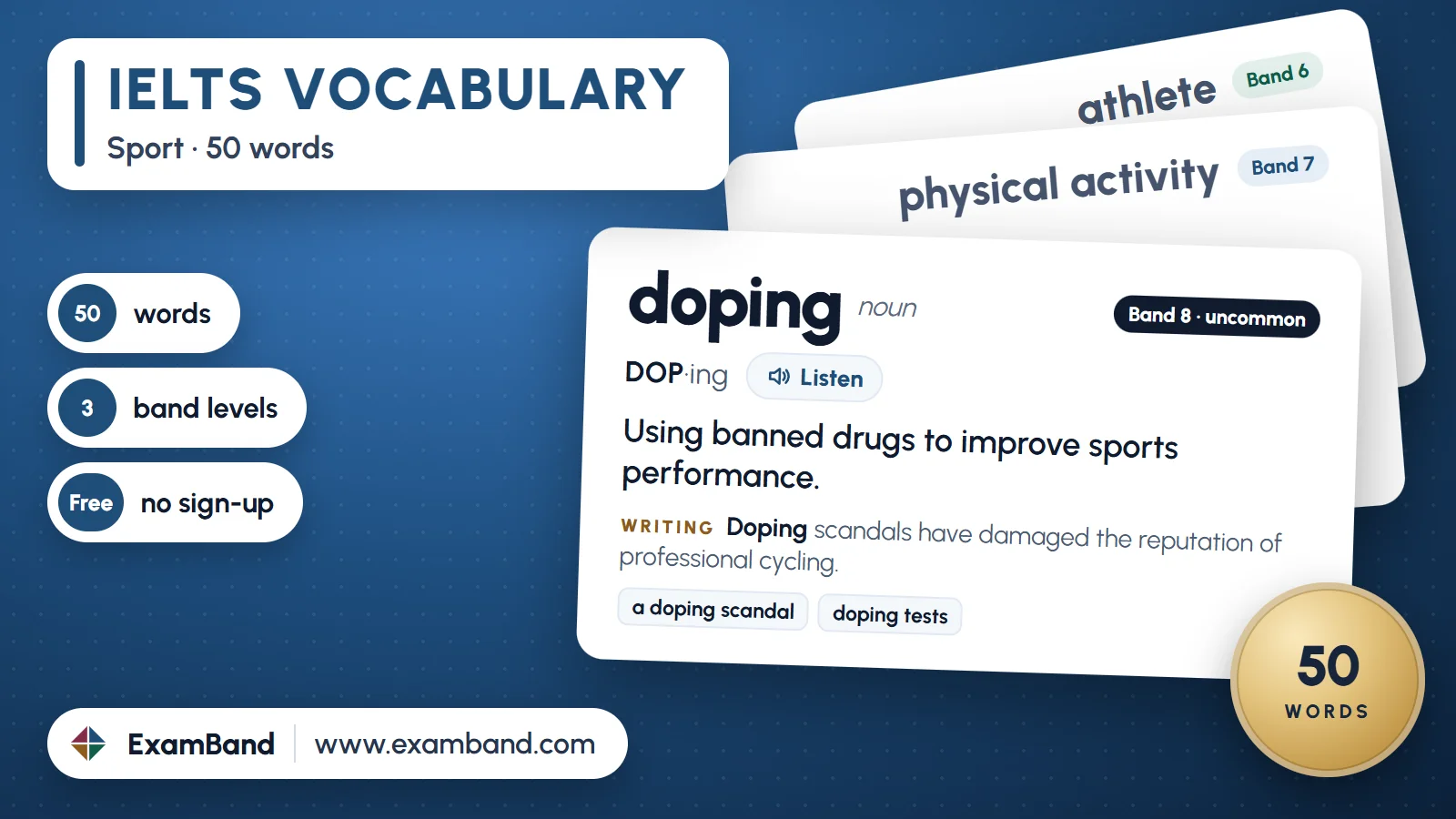
Questions about IELTS sport vocabulary
How do I learn IELTS sport vocabulary?
Learn about ten words a day. First, read the meaning, listen to the word and say it out loud with the right stress. Then test yourself with the quiz and the flashcards on this page. Finally, use five of the words in an essay and check it with our free Writing Checker.
Which words should I learn first?
Start with the band 6 words, because you need them to explain any idea clearly. After that, add the band 7 words. However, use the band 8 words only when you are sure of their meaning, because a rare word used wrongly can lower your score.
Are these official IELTS words?
No. IELTS has no official word list. Instead, our levels follow the words of the public IELTS band descriptors: band 7 asks for some “less common” words, and band 8 for “uncommon” words used with skill.