IELTS Synonyms: Better Words for Common Words, with Examples
These IELTS synonyms help you avoid repeating plain words like “important”, “big” and “show”, and help you paraphrase the question. Each word has a meaning, its sound, a band level, Writing and Speaking examples, and the mistake to avoid.
44 words · free quiz and flashcards · updated October 2026
Instead of “important”
“Important” is fine, but using it five times in one essay limits your vocabulary score.
crucial
CRU·cial · adjectiveExtremely important, because other things depend on it.Band 7 · less common
Word family: crucially (adverb)
Collocations
- play a crucial role
- crucial for
- absolutely crucial
Similar: vital, essential, key
WritingEarly education plays a crucial role in a child’s development.
SpeakingSleep is crucial for me before an exam.
Common mistake: Saying “very crucial”. It is already strong; say “absolutely crucial” or just “crucial”.
vital
VI·tal · adjectiveNecessary for something to succeed or exist.Band 7 · less common
Word family: vitally (adverb) · vitality (noun)
Collocations
- vital for
- vital to
- play a vital role
Similar: crucial, essential
WritingClean water is vital for good health.
SpeakingHaving a good internet connection is vital for my job.
Common mistake: Using it for things that are only nice to have. Vital means you cannot manage without it.
essential
es·SEN·tial · adjectiveCompletely necessary.Band 6 · everyday
Word family: essence (noun) · essentially (adverb)
Collocations
- essential for
- absolutely essential
- essential services
Similar: necessary, vital
WritingFresh fruit and vegetables are essential for a healthy diet.
SpeakingA good coat is essential in my country in winter.
Common mistake: Saying “essential to me to do it”. Say “It is essential for me to do it.”
paramount
PAR·a·mount · adjectiveMore important than anything else.Band 8 · uncommon
Collocations
- of paramount importance
- safety is paramount
Similar: supreme, foremost
WritingIn hospitals, patient safety must be paramount.
SpeakingFor me, family is paramount.
Common mistake: Saying “very paramount” or “more paramount”. It already means most important.
Instead of “big”
“Big” sounds plain in an essay. These words are more exact.
enormous
e·NOR·mous · adjectiveExtremely large.Band 6 · everyday
Word family: enormously (adverb)
Collocations
- an enormous amount
- enormous pressure
- an enormous impact
Similar: huge, immense
WritingSocial media has had an enormous impact on politics.
SpeakingMy university campus is enormous.
Common mistake: Spelling it “enourmous”. Write “enormous”.
vast
VAST · adjectiveExtremely large in size or amount.Band 7 · less common
Word family: vastly (adverb)
Collocations
- the vast majority
- a vast amount of
- vast areas
Similar: huge, extensive
WritingThe vast majority of people now own a smartphone.
SpeakingRussia is a vast country.
Common mistake: Using it for people: “a vast man”. Use it for areas, amounts and numbers.
massive
MAS·sive · adjectiveVery large or serious.Band 6 · everyday
Word family: massively (adverb)
Collocations
- a massive increase
- a massive problem
- massive changes
Similar: huge, enormous
WritingThere has been a massive increase in online shopping.
SpeakingThe concert was massive; there were thousands of people.
Common mistake: Using it in every essay. It sounds a little informal; “substantial” or “considerable” is more formal.
immense
im·MENSE · adjectiveExtremely large or great.Band 8 · uncommon
Word family: immensely (adverb)
Collocations
- immense pressure
- immense value
- of immense importance
Similar: enormous, tremendous
WritingTeachers are under immense pressure to get good results.
SpeakingI felt immense relief when the exam was over.
Common mistake: Spelling it “imense”. Write “immense”, with double m.
Instead of “good”
“Good” tells the reader little. Say how something is good.
beneficial
ben·e·FI·cial · adjectiveHaving a good effect.Band 7 · less common
Word family: benefit (noun, verb)
Collocations
- beneficial for
- beneficial to
- mutually beneficial
Similar: helpful, advantageous
WritingRegular exercise is beneficial for both body and mind.
SpeakingLiving abroad was really beneficial for my English.
Common mistake: Spelling it “benefitial”. Write “beneficial”, with -cial.
advantageous
ad·van·TA·geous · adjectiveGiving you an advantage.Band 8 · uncommon
Word family: advantage (noun)
Collocations
- advantageous for
- mutually advantageous
- financially advantageous
Similar: beneficial, favourable
WritingSpeaking two languages is advantageous in the job market.
SpeakingLiving near work is really advantageous; I save so much time.
Common mistake: Saying “ad-VAN-ta-geous”. The stress is “ad-van-TAY-jus”.
favourable
FA·vour·a·ble · adjectiveGood or helpful for something; also, showing approval.Band 7 · less common
Word family: favour (noun) · unfavourable (adjective)
Collocations
- favourable conditions
- a favourable impression
- favourable reviews
Similar: positive, good
WritingFavourable weather has helped farmers to grow more food.
SpeakingThe restaurant got very favourable reviews online.
Common mistake: Writing “favorable” in a British essay. UK: “favourable”; US: “favorable”.
superb
su·PERB · adjectiveExcellent; of very high quality.Band 7 · less common
Word family: superbly (adverb)
Collocations
- a superb view
- superb quality
- absolutely superb
Similar: excellent, outstanding
WritingThe city offers superb public transport.
SpeakingThe food in that little restaurant was superb.
Common mistake: Saying “very superb”. It is already strong: “absolutely superb”.
Instead of “bad”
“Bad” is vague. These words say what kind of bad.
harmful
HARM·ful · adjectiveCausing damage or injury.Band 6 · everyday
Word family: harm (noun, verb) · harmless (adjective)
Collocations
- harmful to
- harmful effects
- potentially harmful
Similar: damaging, detrimental
WritingToo much screen time can be harmful to children’s eyes.
SpeakingI think energy drinks are really harmful.
Common mistake: Writing “harmful for” in a formal essay. “Harmful to” is more common.
damaging
DAM·ag·ing · adjectiveCausing harm, often to a reputation, the economy or nature.Band 7 · less common
Word family: damage (noun, verb)
Collocations
- damaging to
- a damaging effect
- environmentally damaging
Similar: harmful, destructive
WritingFake news can be very damaging to democracy.
SpeakingThat scandal was really damaging for the company.
Common mistake: Saying “damageful”. The adjective is “damaging”.
appalling
ap·PAL·ling · adjectiveExtremely bad or shocking.Band 8 · uncommon
Word family: appal (verb) · appalled (adjective)
Collocations
- appalling conditions
- an appalling crime
- absolutely appalling
Similar: dreadful, terrible
WritingWorkers in some factories face appalling conditions.
SpeakingThe service at that hotel was appalling.
Common mistake: Spelling it “apalling”. Write “appalling”: double p, double l.
inferior
in·FE·ri·or · adjectiveNot as good as something else.Band 7 · less common
Word family: inferiority (noun)
Collocations
- inferior to
- inferior quality
- feel inferior
Similar: worse, poorer
WritingSome people believe online degrees are inferior to traditional ones.
SpeakingCheap copies are usually inferior to the real thing.
Common mistake: Saying “inferior than”. Use “to”: “inferior to”.
Instead of “show”
Useful for Writing Task 1 (“the chart shows”) and for giving evidence in Task 2.
demonstrate
DEM·on·strate · verbTo show clearly that something is true.Band 7 · less common
Word family: demonstration (noun)
Collocations
- demonstrate that
- clearly demonstrate
- demonstrate the need for
Similar: prove, show
WritingResearch demonstrates that reading to children improves their vocabulary.
SpeakingMy teacher demonstrated the experiment first.
Common mistake: Mixing it up with “protest”. A demonstration can be a protest, but “demonstrate that” means show.
illustrate
IL·lus·trate · verbTo show or explain something, often with an example or a picture.Band 7 · less common
Word family: illustration (noun)
Collocations
- illustrate how
- as illustrated by
- illustrate the point
Similar: show, depict
WritingThe bar chart illustrates how energy use changed between 1990 and 2020.
SpeakingLet me illustrate with an example from my own life.
Common mistake: Saying “il-LUS-trate”. The stress is at the start: “IL-lus-trate”.
reveal
re·VEAL · verbTo show something that was hidden or not known.Band 7 · less common
Word family: revelation (noun) · revealing (adjective)
Collocations
- reveal that
- the survey reveals
- reveal the truth
Similar: disclose, show
WritingThe survey reveals that most students work part-time.
SpeakingThe film reveals the twist only at the very end.
Common mistake: Saying “reveal about”. Say “reveal that…” or “reveal something”.
indicate
IN·di·cate · verbTo show that something is probably true.Band 7 · less common
Word family: indication (noun) · indicator (noun)
Collocations
- indicate that
- figures indicate
- clearly indicate
Similar: suggest, signal
WritingThese figures indicate that the population is ageing.
SpeakingThe sign indicates where the exit is.
Common mistake: Saying “indicate to” before the idea. Use “indicate that…”.
Instead of “think”
Verbs for reporting opinions, useful in “Discuss both views” essays.
argue
AR·gue · verbTo give reasons for an opinion.Band 7 · less common
Word family: argument (noun)
Collocations
- argue that
- some argue
- argue for
Similar: claim, contend
WritingSome people argue that zoos protect endangered animals.
SpeakingI’d argue that cities are better for young people.
Common mistake: Thinking it only means to fight with words. In essays, “argue that” means give reasons for an opinion.
maintain
main·TAIN · verbTo keep saying something is true, even when others disagree.Band 8 · uncommon
Word family: maintenance (noun)
Collocations
- maintain that
- firmly maintain
Similar: insist, claim
WritingCritics maintain that tests do not measure real intelligence.
SpeakingMy dad maintains that his town has the best food in the country.
Common mistake: Using it only for repairs. “Maintain that” means keep saying something is true.
claim
CLAIM · verb / nounTo say something is true, although it may not be.Band 7 · less common
Collocations
- claim that
- make a claim
- it is claimed that
Similar: assert, allege
WritingAdvertisers often claim that their products are healthy.
SpeakingMy brother claims he can speak five languages.
Common mistake: Using “claim” for facts you agree with. It suggests some doubt; use “show” for proven facts.
consider
con·SID·er · verbTo believe or have an opinion about something.Band 7 · less common
Word family: consideration (noun) · considerate (adjective)
Collocations
- consider it important
- be considered
- consider whether
Similar: regard, believe
WritingMany people consider free healthcare a basic right.
SpeakingI consider myself lucky to have such good friends.
Common mistake: Saying “consider as”. Say “consider it a right”, without “as”.
Instead of “problem”
Different words for different kinds of problem.
issue
IS·sue · nounAn important subject or problem that people discuss.Band 6 · everyday
Collocations
- a key issue
- a serious issue
- raise an issue
Similar: problem, matter
WritingHousing is a key issue for young people in big cities.
SpeakingTraffic is a big issue in my city.
Common mistake: Saying “a problem issue”. Use one word: “an issue” or “a problem”.
challenge
CHAL·lenge · noun / verbSomething difficult that needs effort to deal with.Band 6 · everyday
Word family: challenging (adjective)
Collocations
- face a challenge
- a major challenge
- meet a challenge
Similar: difficulty, test
WritingAgeing populations are a major challenge for governments.
SpeakingLearning Chinese was a real challenge for me.
Common mistake: Using it only for a contest between friends. In essays, it means a difficult problem.
drawback
DRAW·back · nounA disadvantage.Band 7 · less common
Collocations
- a major drawback
- the main drawback
- drawbacks of
Similar: disadvantage, downside
WritingThe main drawback of online learning is the lack of contact with others.
SpeakingThe only drawback of my flat is the noise.
Common mistake: Writing “draw back” as two words for the noun. The noun is one word: “drawback”.
obstacle
OB·sta·cle · nounSomething that stops you from making progress.Band 7 · less common
Collocations
- an obstacle to
- overcome obstacles
- a major obstacle
Similar: barrier, hurdle
WritingCost is the biggest obstacle to higher education for many families.
SpeakingMy main obstacle to learning the guitar is time.
Common mistake: Saying “an obstacle for”. Use “to”: “an obstacle to success”.
Instead of “help”
More exact verbs for helping.
assist
as·SIST · verbTo help someone, often in a practical way.Band 7 · less common
Word family: assistance (noun) · assistant (noun)
Collocations
- assist with
- assist in
- assist someone to
Similar: help, aid
WritingRobots could assist nurses with heavy lifting.
SpeakingI assist my mum with her online banking.
Common mistake: Saying “assist the meeting” for being there. “Assist” means help; to be there is “attend”.
facilitate
fa·CIL·i·tate · verbTo make something easier.Band 8 · uncommon
Word family: facility (noun) · facilitator (noun)
Collocations
- facilitate learning
- facilitate communication
- facilitate trade
Similar: ease, enable
WritingTechnology can facilitate communication between teachers and parents.
SpeakingOur teacher facilitates the discussion but lets us talk.
Common mistake: Using a person as the object: “facilitate the students”. You facilitate a process: “facilitate learning”.
enable
en·A·ble · verbTo make it possible for someone to do something.Band 7 · less common
Word family: able (adjective)
Collocations
- enable someone to
- enable people to work from home
Similar: allow, let
WritingThe internet enables people to work from anywhere.
SpeakingMy scholarship enabled me to study abroad.
Common mistake: Saying “enable to do”. You need a person: “enable people to do it”.
aid
AID · noun / verbHelp, often money or food given to people in need.Band 7 · less common
Collocations
- foreign aid
- humanitarian aid
- aid workers
Similar: assistance, support
WritingRich countries should give more aid to poorer nations.
SpeakingMy cousin works for an aid organisation in Africa.
Common mistake: Saying “an aid” for help in general. It is usually uncountable: “aid”.
Instead of “change”
Words that say how much something changes.
transform
trans·FORM · verbTo change something completely, usually for the better.Band 7 · less common
Word family: transformation (noun)
Collocations
- transform the way
- completely transform
- transform into
Similar: revolutionise, overhaul
WritingSmartphones have transformed the way we communicate.
SpeakingThe new park has transformed my neighbourhood.
Common mistake: Using it for small changes. It means a complete change.
alter
AL·ter · verbTo change something slightly.Band 7 · less common
Word family: alteration (noun)
Collocations
- alter the way
- slightly alter
- alter your behaviour
Similar: adjust, modify
WritingSmall taxes on sugar can alter how people shop.
SpeakingI had to alter my plans because of the rain.
Common mistake: Mixing it up with “altar” (a table in a church). The verb is “alter”.
modify
MOD·i·fy · verbTo change something a little to improve it.Band 7 · less common
Word family: modification (noun)
Collocations
- modify behaviour
- slightly modify
- modify a design
Similar: adjust, alter
WritingSchools may need to modify their timetables for older students.
SpeakingI modified my diet when I started training.
Common mistake: Saying “modificate”. The verb is “modify”.
adapt
a·DAPT · verbTo change to suit a new situation.Band 7 · less common
Word family: adaptation (noun) · adaptable (adjective)
Collocations
- adapt to
- adapt quickly
- adapt to change
Similar: adjust, get used to
WritingOlder workers may find it harder to adapt to new technology.
SpeakingIt took me a few months to adapt to life in Canada.
Common mistake: Mixing it up with “adopt”. Adapt means change to fit; adopt means take as your own.
Instead of “many” and “a lot of”
Formal ways to talk about large numbers and amounts.
numerous
NU·mer·ous · adjectiveMany.Band 7 · less common
Collocations
- numerous studies
- on numerous occasions
- numerous reasons
Similar: many, countless
WritingNumerous studies have linked sugar to heart disease.
SpeakingI’ve visited Paris on numerous occasions.
Common mistake: Using it with uncountable nouns: “numerous information”. It goes with plurals: “numerous studies”.
countless
COUNT·less · adjectiveToo many to count.Band 7 · less common
Word family: count (verb)
Collocations
- countless times
- countless people
- countless hours
Similar: innumerable, numerous
WritingCountless hours are lost in traffic every year.
SpeakingI’ve watched that film countless times.
Common mistake: Writing “count less” as two words. It is one word: “countless”.
a great deal of
a GREAT DEAL of · phraseA large amount of.Band 7 · less common
Collocations
- a great deal of time
- a great deal of money
- a great deal of attention
Similar: a lot of, much
WritingRaising children takes a great deal of time and money.
SpeakingI’ve learned a great deal of English from films.
Common mistake: Using it with plural nouns: “a great deal of people”. It goes with uncountable nouns: “a great deal of time”.
a multitude of
a MUL·ti·tude of · phraseA very large number of.Band 8 · uncommon
Collocations
- a multitude of reasons
- a multitude of problems
Similar: numerous, countless
WritingCities offer a multitude of opportunities for young people.
SpeakingThere are a multitude of reasons why I love my hometown.
Common mistake: Overusing it. It is very formal; use it once in an essay at most.
Instead of “get”
“Get” has many meanings. In essays, choose the exact one.
obtain
ob·TAIN · verbTo get something, often with effort.Band 7 · less common
Word family: obtainable (adjective)
Collocations
- obtain information
- obtain permission
- obtain a visa
Similar: acquire, gain
WritingStudents must obtain a visa before they can study abroad.
SpeakingIt took me months to obtain my work permit.
Common mistake: Using it in casual Speaking. It is formal; “get” is fine when you talk.
gain
GAIN · verb / nounTo get something useful, like skills, knowledge or money.Band 6 · everyday
Collocations
- gain knowledge
- gain access
- gain popularity
Similar: acquire, get
WritingTravelling helps young people gain confidence.
SpeakingI gained a lot of confidence from public speaking.
Common mistake: Saying “gain a prize”. You “win” a prize; you “gain” skills or experience.
receive
re·CEIVE · verbTo be given or sent something.Band 6 · everyday
Word family: receipt (noun) · recipient (noun)
Collocations
- receive an email
- receive support
- receive treatment
Similar: get, be given
WritingEvery patient should receive treatment quickly.
SpeakingI receive about fifty emails a day.
Common mistake: Spelling it “recieve”. Write “receive”: e before i after c.
attain
at·TAIN · verbTo reach a goal or a level after effort.Band 8 · uncommon
Word family: attainment (noun) · attainable (adjective)
Collocations
- attain a goal
- attain a high level
- attain success
Similar: achieve, reach
WritingFew athletes ever attain Olympic level.
SpeakingI hope to attain band 7 in my next test.
Common mistake: Mixing it up with “obtain”. You attain a level or a goal; you obtain a thing or a document.
How to use IELTS synonyms
Paraphrase the question
In Writing Task 2, rewrite the question in your own words in your first sentence. Swap its plain words for the synonyms here.
Copy the grammar too
Synonyms rarely work in exactly the same way: “an obstacle to”, “beneficial for”, “inferior to”. Copy the pattern from the example.
Listen and read for them
Reading and Listening answers often use a synonym of the word in the question. Knowing these pairs helps you spot the answer.
A model paragraph with IELTS synonyms
Numerous studies indicate that regular exercise is beneficial for mental health. However, cost remains a major obstacle, as gym fees are high in many cities. Since exercise is so vital, governments could facilitate healthier lives by building free sports facilities in local parks.
Practise IELTS synonyms
Take the 10-question quiz on this list, or go through every word with the flashcards.
Question 1 of 10
Which word means “completely necessary”?
Now use the words
Write a Task 2 essay with five of these words. Then our free Writing Checker gives you a band for vocabulary and for the other three criteria.
Open the Writing Checker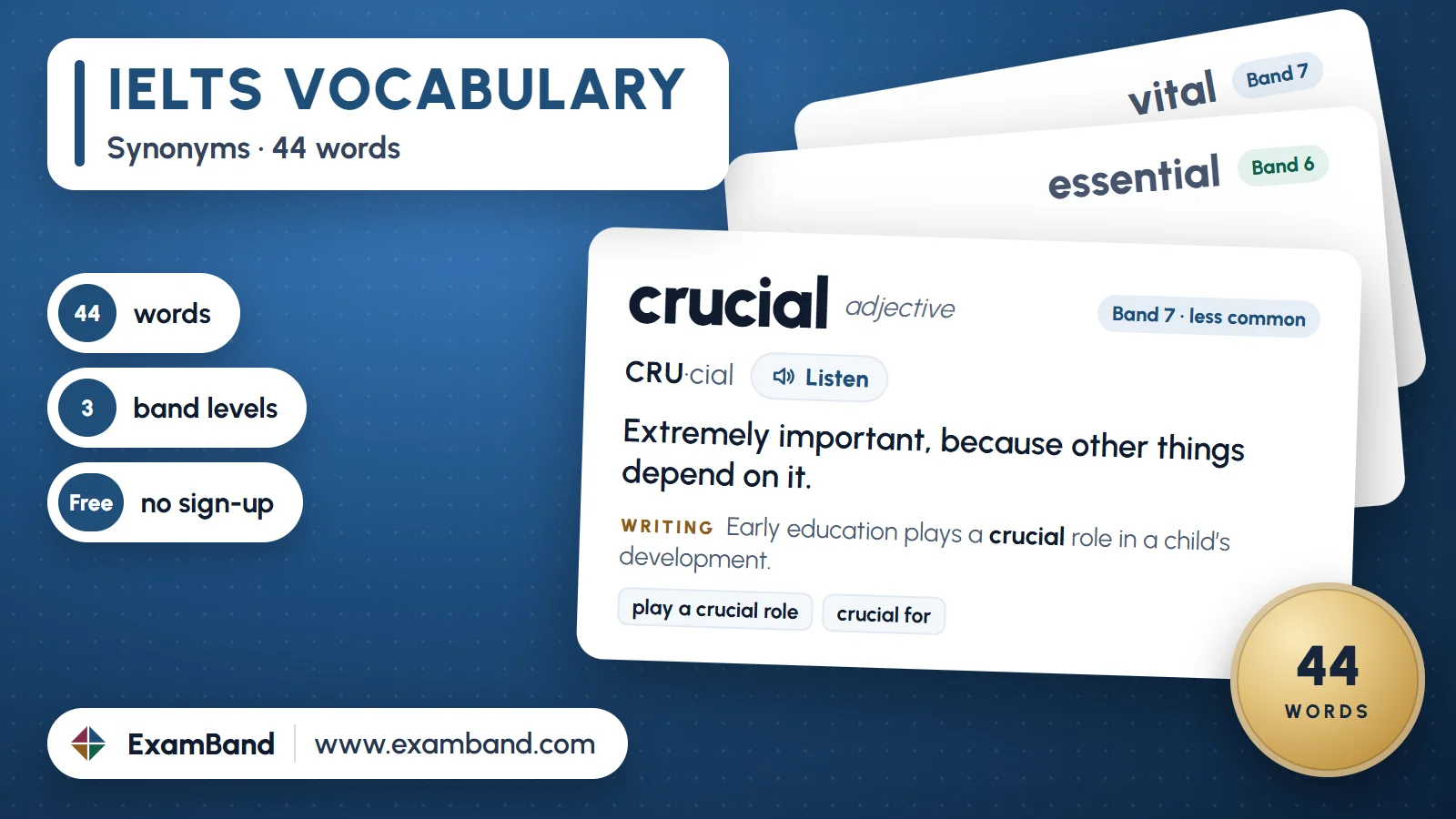
Questions about IELTS synonyms
How do I learn these synonyms?
Learn about ten words a day. First, read the meaning, listen to the word and say it out loud with the right stress. Then test yourself with the quiz and the flashcards on this page. Finally, use five of the words in an essay and check it with our free Writing Checker.
Which words should I learn first?
Start with the band 6 words, because you need them to explain any idea clearly. After that, add the band 7 words. However, use the band 8 words only when you are sure of their meaning, because a rare word used wrongly can lower your score.
Are these official IELTS words?
No. IELTS has no official word list. Instead, our levels follow the words of the public IELTS band descriptors: band 7 asks for some “less common” words, and band 8 for “uncommon” words used with skill.