Words to Avoid in IELTS Writing: What to Write Instead
These are the words to avoid in IELTS Writing, because they are too informal, too vague or too often memorised. Each one shows what to write instead, an example for an essay, when it is fine in Speaking, and why it can cost you marks. The band level is the level of the better choice.
40 words · free quiz and flashcards · updated October 2026
Informal words
Fine when you talk with friends, but too casual for an essay.
kids
KIDS · noun, pluralAn informal word for children.Band 6 · everyday
Write instead
- children
- young people
- pupils
WritingIn an essay, write “children” instead of kids.
SpeakingIn Speaking, kids is fine, as in “I love playing with my cousin’s kids”.
Common mistake: Writing “kids” in Task 2. It is too informal and can lower your vocabulary score.
stuff
STUFF · nounAn informal word for things, when you do not say exactly what they are.Band 7 · less common
Write instead
- belongings
- items
- equipment
- things
WritingWrite “belongings” or “items” instead of stuff in an essay.
SpeakingStuff is fine when you talk: “I keep all my stuff in one bag”.
Common mistake: Writing “stuffs”. It is uncountable, and it is too vague for an essay.
a lot of
a LOT of · phraseAn informal way to say many or much.Band 7 · less common
Write instead
- many
- much
- a great deal of
- a large number of
WritingIn essays, write “many” or “a large number of” instead of a lot of.
SpeakingA lot of is perfect in Speaking: it sounds natural and relaxed.
Common mistake: Using “a lot of” in every paragraph. It is not wrong, but it repeats; vary it.
guys
GUYS · noun, pluralAn informal word for men, or for a group of people.Band 6 · everyday
Write instead
- people
- individuals
- men
WritingNever write guys in an essay; write “people” or “men”.
SpeakingWith friends, guys is fine, but say “people” when you answer the examiner.
Common mistake: Using “guys” for people in general in Writing. It is slang.
okay
o·KAY · adjective / adverbAn informal word meaning acceptable or fine.Band 6 · everyday
Write instead
- acceptable
- satisfactory
- reasonable
WritingIn an essay, write “acceptable” instead of okay.
SpeakingOkay is natural in Speaking: “The food was okay, but not great”.
Common mistake: Writing “OK” or “okay” in Task 2. Choose “acceptable” or “reasonable”.
boss
BOSS · nounAn informal word for the person you work for.Band 6 · everyday
Write instead
- employer
- manager
- line manager
WritingIn an essay, write “employer” or “manager” instead of boss.
SpeakingBoss is fine in Speaking: “My boss lets me work from home”.
Common mistake: Writing “boss” in a formal essay. It sounds too casual.
really
RE·al·ly · adverbAn informal word meaning very or truly.Band 7 · less common
Write instead
- extremely
- highly
- particularly
WritingWrite “extremely” or “particularly” instead of really in an essay.
SpeakingReally is fine when you talk, but don’t use it in every sentence.
Common mistake: Writing “really really important”. Use one strong word: “crucial”.
totally
TO·tal·ly · adverbAn informal word meaning completely.Band 6 · everyday
Write instead
- completely
- entirely
- wholly
WritingIn an essay, write “completely” instead of totally.
SpeakingTotally is fine in Speaking: “I totally agree”.
Common mistake: Writing “I totally disagree” in Task 2. Write “I completely disagree”.
maybe
MAY·be · adverbAn informal word meaning perhaps.Band 6 · everyday
Write instead
- perhaps
- possibly
- it is possible that
WritingIn an essay, write “perhaps” or “possibly” instead of maybe.
SpeakingMaybe is perfectly natural when you speak.
Common mistake: Starting essay sentences with “Maybe”. Use “Perhaps” or “It is possible that”.
pretty
PRET·ty · adverbAn informal word meaning quite or fairly, as in “pretty good”.Band 7 · less common
Write instead
- fairly
- quite
- rather
WritingIn an essay, write “fairly” or “quite” instead of pretty.
SpeakingPretty is natural in Speaking: “It’s pretty cheap”.
Common mistake: Writing “pretty good results” in Task 1 or 2. Use “fairly good”, or give a number.
cheap
CHEAP · adjectiveLow in price; also, low in quality.Band 7 · less common
Write instead
- affordable
- inexpensive
- low-cost
WritingWrite “affordable” instead of cheap when you mean good value.
SpeakingCheap is fine in Speaking: “The buses here are really cheap”.
Common mistake: Writing “cheap” when you mean good value. It can also mean poor quality, so use “affordable” or “low-cost”.
a bit
a BIT · phraseAn informal way to say slightly.Band 7 · less common
Write instead
- slightly
- somewhat
- to some extent
WritingIn an essay, write “slightly” instead of a bit.
SpeakingA bit is natural when you speak: “I’m a bit tired today”.
Common mistake: Writing “a bit expensive” in Task 2. Write “slightly expensive” or “rather expensive”.
Phrasal verbs with a formal partner
Phrasal verbs are not wrong in essays, but a one-word verb often sounds more academic.
find out
find OUT · phrasal verbTo discover a fact or information.Band 6 · everyday
Write instead
- discover
- learn
- establish
WritingIn an essay, find out is acceptable, but “discover” sounds more academic.
SpeakingFind out is perfect in Speaking: “I found out about it online”.
Common mistake: Using phrasal verbs in every sentence of an essay. Mix them with one-word verbs like “discover”.
look into
look IN·to · phrasal verbTo examine a problem or situation.Band 7 · less common
Write instead
- investigate
- examine
- explore
WritingWrite “investigate” instead of look into in a formal essay.
SpeakingLook into is natural when you talk: “I’ll look into it”.
Common mistake: Writing “the government should look into this”. “Investigate” is clearer and more formal.
put up with
put UP with · phrasal verbTo accept something unpleasant without complaining.Band 7 · less common
Write instead
- tolerate
- endure
- accept
WritingIn an essay, write “tolerate” instead of put up with.
SpeakingPut up with is great in Speaking: “I can’t put up with noise”.
Common mistake: Writing “residents put up with pollution”. “Tolerate” sounds more academic.
give up
give UP · phrasal verbTo stop doing or trying something.Band 7 · less common
Write instead
- abandon
- quit
- stop
WritingWrite “abandon” or “stop” instead of give up in a formal essay.
SpeakingGive up is natural in Speaking: “I gave up sugar last year”.
Common mistake: Writing “people should give up their cars”. “Stop using” or “abandon” sounds more formal.
set up
set UP · phrasal verbTo start a business or organisation.Band 7 · less common
Write instead
- establish
- found
- create
WritingIn an essay, write “establish” instead of set up.
SpeakingSet up is fine when you speak: “My friend set up a café”.
Common mistake: Writing “set up” for every new thing. “Establish” suits organisations and rules.
go up
go UP · phrasal verbTo become higher, for example in price or number.Band 6 · everyday
Write instead
- rise
- increase
- climb
WritingIn Task 1, write “rise” or “increase” instead of go up.
SpeakingGo up is fine in Speaking: “Prices keep going up”.
Common mistake: Writing “went up” in every Task 1 sentence. Use “rose”, “increased” and “climbed”.
get rid of
get RID of · phrasal verbTo throw away or remove something you do not want.Band 7 · less common
Write instead
- eliminate
- remove
- dispose of
WritingWrite “eliminate” or “remove” instead of get rid of in an essay.
SpeakingGet rid of is natural when you talk: “I got rid of my old car”.
Common mistake: Writing “we must get rid of poverty”. “Eliminate poverty” is the academic choice.
come up with
come UP with · phrasal verbTo think of an idea or a plan.Band 8 · uncommon
Write instead
- devise
- propose
- develop
WritingIn an essay, write “devise” or “propose” instead of come up with.
SpeakingCome up with is great in Speaking: “I came up with a plan”.
Common mistake: Writing “governments should come up with solutions”. “Devise solutions” sounds more formal.
Vague words
These words say very little. Replace them with something exact.
thing
THING · nounA word for any object, idea or fact, when you do not name it.Band 7 · less common
Write instead
- factor
- aspect
- issue
- item
WritingReplace thing with an exact word, such as “factor” or “issue”.
SpeakingIn Speaking, thing is natural: “The best thing about my town is the beach”.
Common mistake: Writing “another thing is…” in an essay. Say “another factor is…” or “another reason is…”.
nice
NICE · adjectivePleasant or kind; it says very little.Band 6 · everyday
Write instead
- pleasant
- attractive
- welcoming
- enjoyable
WritingIn an essay, replace nice with an exact word, like “pleasant” or “attractive”.
SpeakingNice is fine in Speaking, but try a more exact word sometimes.
Common mistake: Using “nice” for everything. Say what kind of nice: “a welcoming town”, “an attractive park”.
very
VER·y · adverbUsed to make an adjective stronger.Band 7 · less common
Write instead
- extremely
- highly
- a stronger single word
WritingInstead of very important, write a strong word such as “crucial”.
SpeakingVery is fine when you speak, but don’t use it in every sentence.
Common mistake: Writing “very” in every sentence. Use stronger single words: “crucial”, “enormous”.
and so on
and SO on · phraseUsed at the end of a list to mean “and other things like these”.Band 6 · everyday
Write instead
- such as
- for example
- including
WritingDo not end a list with and so on; give two clear examples with “such as”.
SpeakingAnd so on is fine when you talk, after one or two examples.
Common mistake: Ending lists with “and so on” or “etc.” in Task 2. Examiners want complete ideas, not unfinished lists.
people
PEO·ple · noun, pluralMen, women and children; a word many essays repeat.Band 7 · less common
Write instead
- individuals
- citizens
- the public
- residents
WritingInstead of repeating people, use exact words like “residents” or “the public”.
SpeakingPeople is fine in Speaking, of course.
Common mistake: Writing “people” ten times in one essay. Name the group: “employees”, “young adults”, “drivers”.
Overused and memorised phrases
Examiners see these in thousands of essays. Memorised phrases do not show your real vocabulary.
in a nutshell
in a NUT·shell · phraseAn idiom meaning in a few words.Band 6 · everyday
Write instead
- in conclusion
- overall
- to sum up
WritingDo not end an essay with in a nutshell; write “In conclusion”.
SpeakingIn a nutshell is fine in Speaking to sum up a long answer.
Common mistake: Starting the conclusion with “In a nutshell”. It is an idiom, too informal for Writing.
every coin has two sides
EV·ery COIN has TWO SIDES · phraseA saying meaning everything has good and bad points.Band 7 · less common
Write instead
- there are arguments on both sides
- this has both benefits and drawbacks
WritingInstead of every coin has two sides, write “There are strong arguments on both sides”.
SpeakingIn Speaking, every coin has two sides sounds memorised; say “it has pros and cons”.
Common mistake: Using memorised sayings in an introduction. Examiners see them in thousands of essays.
as we all know
as we ALL KNOW · phraseA phrase that claims everyone already agrees with you.Band 7 · less common
Write instead
- it is widely accepted that
- it is often argued that
WritingInstead of as we all know, write “It is widely accepted that”.
SpeakingIn Speaking, as we all know sounds odd; just say what you think.
Common mistake: Using it before an opinion. Not everyone knows or agrees, so the phrase weakens your argument.
nowadays
NOW·a·days · adverbAt the present time; a word that starts too many essays.Band 6 · everyday
Write instead
- today
- currently
- at present
- in recent years
WritingStart your essay with the topic, not with nowadays.
SpeakingNowadays is fine in Speaking: “Nowadays I cycle to work”.
Common mistake: Starting every essay with “Nowadays,”. It is a cliché; begin with the topic itself.
last but not least
LAST but NOT LEAST · phraseA phrase used before the final point in a list.Band 6 · everyday
Write instead
- finally
- lastly
- a final point is
WritingIn an essay, write “Finally” instead of last but not least.
SpeakingLast but not least suits a speech, but it is rare in IELTS Speaking.
Common mistake: Using it in a short essay with only two points. It sounds memorised; “Finally” is enough.
in this day and age
in THIS DAY and AGE · phraseA phrase meaning in modern times.Band 7 · less common
Write instead
- today
- in the modern world
- at present
WritingWrite “today” or “in the modern world” instead of in this day and age.
SpeakingIn this day and age can sound natural in Speaking if you use it once.
Common mistake: Using long, memorised phrases to fill space. Examiners reward clear, exact language.
Words that are too strong
Words like “always” and “everyone” are rarely true. Careful words make your argument sound reasonable.
always
AL·ways · adverbEvery time, with no exceptions.Band 7 · less common
Write instead
- usually
- often
- tend to
- in most cases
WritingInstead of always, write “usually” or “tend to” unless something is really always true.
SpeakingIn Speaking, always is fine for your own habits: “I always walk to work”.
Common mistake: Writing “children always copy their parents”. Few things are always true; “often” is safer.
never
NEV·er · adverbAt no time.Band 7 · less common
Write instead
- rarely
- seldom
- hardly ever
WritingInstead of never, write “rarely” unless something is really never true.
SpeakingNever is fine for your own life: “I never drink coffee at night”.
Common mistake: Writing “older people never use technology”. It is untrue; write “rarely” or “are less likely to”.
everyone
EV·ery·one · pronounAll people, with no exceptions.Band 6 · everyday
Write instead
- most people
- the majority of people
- many people
WritingInstead of everyone, write “most people” or “the majority of people”.
SpeakingIn Speaking, everyone is fine for small groups: “Everyone in my family loves football”.
Common mistake: Writing “everyone agrees that…”. Very few things are true of everyone.
definitely
DEF·i·nite·ly · adverbCertainly, with no doubt.Band 7 · less common
Write instead
- probably
- likely
- arguably
WritingInstead of definitely, write “probably” or “it is likely that” about the future.
SpeakingDefinitely is natural in Speaking: “I’d definitely go back”.
Common mistake: Writing “this will definitely solve the problem”. Careful words like “could help to” sound more academic.
obviously
OB·vi·ous·ly · adverbUsed to say something is clear to everyone.Band 7 · less common
Write instead
- clearly
- evidently
- it is clear that
WritingAvoid obviously in essays; if a point is obvious, you do not need to say so.
SpeakingObviously is fine in Speaking, but don’t use it before every answer.
Common mistake: Writing “obviously” before an opinion. It can sound rude to readers who disagree.
Spoken habits
Short forms and spoken words that belong in Speaking only.
gonna
GON·na · spoken formA spoken form of “going to”.Band 6 · everyday
Write instead
- going to
- will
WritingNever write gonna; always write “going to”.
SpeakingGonna is common in fast speech, but a clear “going to” is better in the test.
Common mistake: Writing “gonna” or “wanna”. They are spoken forms, never used in an essay.
don’t
DON’T · short formThe short form of “do not”.Band 6 · everyday
Write instead
- do not
- does not
- did not
WritingIn a formal essay, write “do not” instead of don’t.
SpeakingDon’t is normal in Speaking; full forms would sound strange.
Common mistake: Using short forms like “don’t” and “it’s” in Task 2. Formal essays use full forms.
you
YOU · pronounThe person you are talking or writing to.Band 7 · less common
Write instead
- people
- one
- the passive
WritingInstead of “you can see”, write “it can be seen” in an essay.
SpeakingIn Speaking, you is natural: “You can get anywhere by metro”.
Common mistake: Writing “you” to mean people in general. In an academic essay, use “people” or the passive.
like
LIKE · filler wordA word some speakers add while thinking, as in “it was, like, huge”.Band 6 · everyday
Write instead
- for example
- such as
- (nothing at all)
WritingNever use like as a filler in an essay; write “for example” to give an example.
SpeakingUsing like as a filler too often in Speaking makes you sound less fluent.
Common mistake: Writing “like” to give examples: “sports like football”. In formal writing, “such as” is safer.
How to avoid these words
Check before you finish
Leave three minutes at the end of Writing to look for the words on this page and swap them for better choices.
Phrasal verbs are not banned
You can use phrasal verbs in an essay. Just mix them with one-word verbs so your writing sounds academic.
Speaking is different
Most of these words are fine when you speak. In Speaking, natural words like “a lot of” and “kids” are not a problem.
A weak paragraph: spot the words to avoid
Nowadays, a lot of kids spend hours online, and as we all know, this is really bad for them. Parents should come up with rules and get rid of phones at dinner. In a nutshell, screens are definitely harmful.
A better version
Today, many children spend hours online, and this is widely believed to harm their health. Parents should devise clear rules and remove phones from the dinner table. In conclusion, too much screen time is likely to be harmful.
Practise the words to avoid
Take the 10-question quiz on this list, or go through every word with the flashcards.
Question 1 of 10
Which word means “an informal way to say many or much”?
Now use the words
Write a Task 2 essay with five of these words. Then our free Writing Checker gives you a band for vocabulary and for the other three criteria.
Open the Writing Checker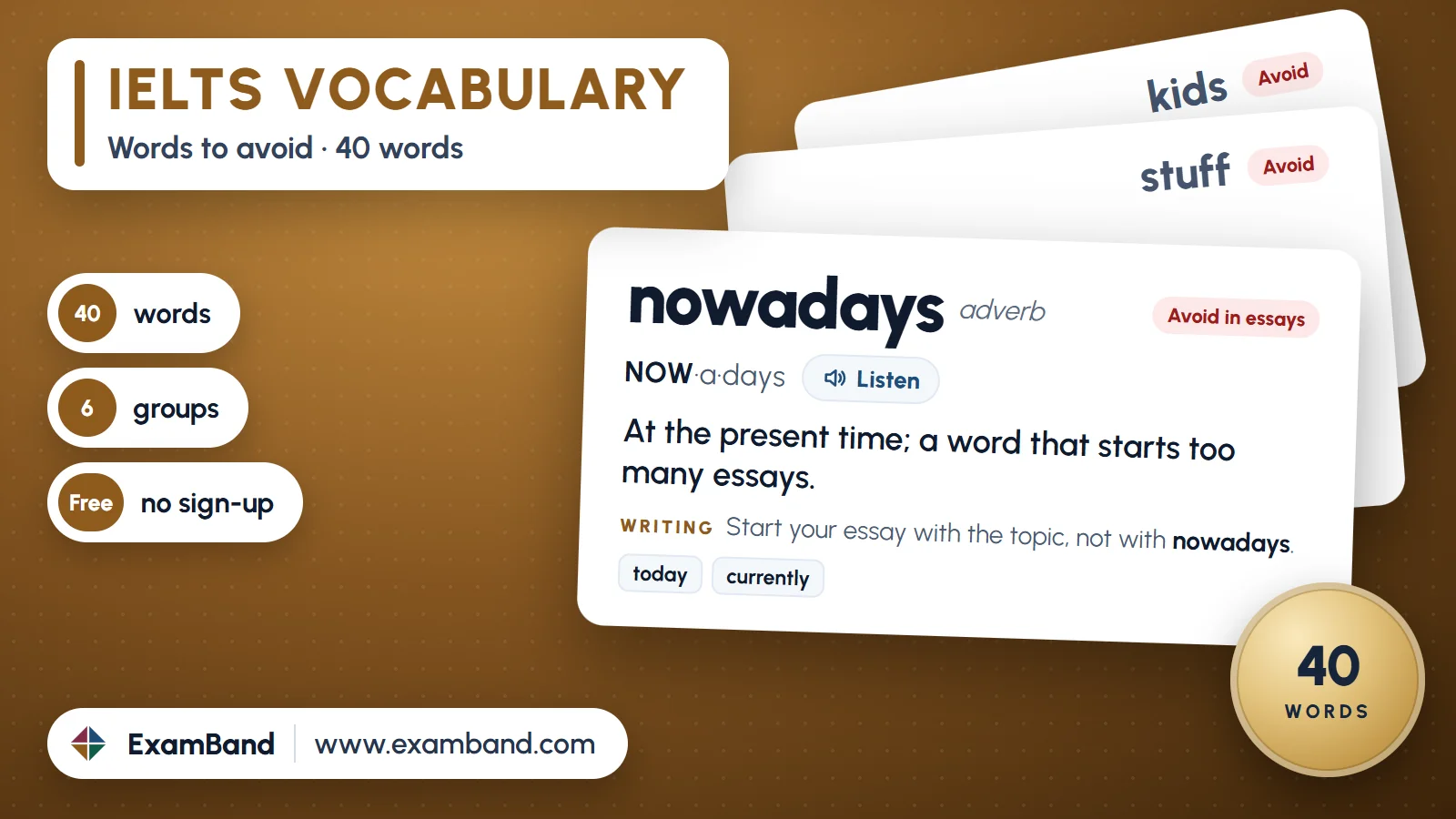
Questions about words to avoid in IELTS
How do I learn these words to avoid?
Learn about ten words a day. First, read the meaning, listen to the word and say it out loud with the right stress. Then test yourself with the quiz and the flashcards on this page. Finally, use five of the words in an essay and check it with our free Writing Checker.
Which words should I learn first?
Start with the band 6 words, because you need them to explain any idea clearly. After that, add the band 7 words. However, use the band 8 words only when you are sure of their meaning, because a rare word used wrongly can lower your score.
Are these official IELTS words?
No. IELTS has no official word list. Instead, our levels follow the words of the public IELTS band descriptors: band 7 asks for some “less common” words, and band 8 for “uncommon” words used with skill.