Linking Words for IELTS Writing and Speaking, with Examples
These linking words for IELTS help you join your ideas in Writing Task 2, Task 1 and Speaking. Each one has a simple meaning, its sound, a band level, a Writing and a Speaking example, and the common mistake to avoid.
47 words · free quiz and flashcards · updated October 2026
Adding an idea
Words to add another point that agrees with the one before.
also
AL·so · adverbUsed to add another fact or idea.Band 6 · everyday
Collocations
- also + verb
- can also
- is also
Similar: too, as well
WritingCars cause pollution and also make cities noisy.
SpeakingI also like cooking, especially Italian food.
Common mistake: Starting a formal sentence with “Also,”. In essays, put it in the middle: “It also reduces costs.”
in addition
in ad·DI·tion · phraseUsed to add another point.Band 6 · everyday
Word family: additional (adjective)
Collocations
- In addition, …
- in addition to + noun or -ing
Similar: also, besides
WritingExercise improves physical health. In addition, it reduces stress.
SpeakingI study at home; in addition, I go to a weekly class.
Common mistake: Writing “in addition to improve”. After “in addition to”, use a noun or -ing: “in addition to improving”.
as well as
as WELL as · phraseAnd also; in addition to.Band 6 · everyday
Collocations
- as well as + noun
- as well as + -ing
Similar: in addition to
WritingThe scheme helps older people as well as students.
SpeakingI play tennis as well as football.
Common mistake: Writing “as well as to help”. After “as well as”, use a noun or -ing: “as well as helping”.
furthermore
fur·ther·MORE · adverbUsed to add another point that supports what you have said.Band 7 · less common
Collocations
- Furthermore, + new point
- at the start of a sentence
Similar: moreover, in addition
WritingPublic transport reduces pollution. Furthermore, it saves people money.
SpeakingIn speaking, furthermore can sound too formal; “also” or “and another thing” is more natural.
Common mistake: Using it to add an opposite idea. It only adds a point that agrees with the one before.
moreover
more·O·ver · adverbUsed to add a stronger or more important point.Band 7 · less common
Collocations
- Moreover, + new point
- used in formal writing
Similar: furthermore, what is more
WritingThe plan is too expensive. Moreover, it would take ten years to complete.
SpeakingMoreover sounds very formal when you speak; most people say “what’s more”.
Common mistake: Writing it as two words: “more over”. Write “moreover”.
what is more
WHAT is MORE · phraseUsed to add a point that is even more important.Band 7 · less common
Collocations
- What is more, …
- what’s more (in speaking)
Similar: moreover
WritingOnline courses are cheaper. What is more, students can study at any time.
SpeakingThe flat is cheap and, what’s more, it’s near the beach.
Common mistake: Writing “what is more important” when you only want to add a point. “What is more,” works on its own.
not only … but also
NOT ON·ly … but AL·so · phraseUsed to show that two things are true, often making the second one stronger.Band 7 · less common
Collocations
- not only A but also B
- Not only does …, but …
Similar: both … and
WritingCycling is not only cheaper but also healthier than driving.
SpeakingMy teacher was not only kind but also really funny.
Common mistake: Leaving out “also”, or putting the two parts in different forms: “not only cheap but also it is healthy”. Keep both parts the same form.
Showing a contrast
Words to show that two ideas are different, or that something is surprising.
however
how·EV·er · adverbUsed to show a contrast with the sentence before.Band 6 · everyday
Collocations
- However, …
- …; however, …
Similar: but, nevertheless
WritingMany people enjoy city life. However, it can be stressful and expensive.
SpeakingI love summer. However, I hate the heat in August.
Common mistake: Joining two sentences with only a comma: “It is cheap, however it is slow.” Use a full stop or a semicolon before “however”.
although
al·THOUGH · conjunctionUsed to introduce an idea that makes the main idea seem surprising.Band 6 · everyday
Collocations
- Although + clause, …
- although it is …
Similar: even though, though
WritingAlthough online learning is flexible, many students miss face-to-face contact.
SpeakingAlthough I live in the city, I prefer the countryside.
Common mistake: Using “although” and “but” together: “Although it rained, but we went.” Use only one.
on the other hand
on the OTH·er HAND · phraseUsed to give the opposite point of view.Band 6 · everyday
Collocations
- On the other hand, …
- On the one hand …, on the other hand …
Similar: however, by comparison
WritingCars are convenient. On the other hand, they cause pollution.
SpeakingCity life is exciting. On the other hand, it’s very expensive.
Common mistake: Saying “in the other hand”. The phrase is “on the other hand”.
whereas
where·AS · conjunctionUsed to compare two facts that are different.Band 7 · less common
Collocations
- …, whereas …
- Whereas A, B
Similar: while, but
WritingOlder people often prefer newspapers, whereas young people read the news online.
SpeakingMy brother loves sport, whereas I prefer reading.
Common mistake: Writing it as two words: “where as”. Write “whereas”.
while
WHILE · conjunctionUsed to compare two different things, like “whereas”.Band 7 · less common
Collocations
- while + clause
- While A, B
Similar: whereas
WritingWhile some countries invest in rail, others spend more on roads.
SpeakingWhile my sister is quiet, I talk all the time.
Common mistake: Forgetting that it can also mean “during the time that”. Make the meaning clear from the sentence.
despite
de·SPITE · prepositionWithout being stopped by; used before a noun or -ing.Band 7 · less common
Collocations
- despite + noun
- despite + -ing
- despite the fact that
Similar: in spite of
WritingDespite the high cost, many families choose private schools.
SpeakingDespite the rain, we had a great day.
Common mistake: Saying “despite of”. “Despite” has no “of”; “in spite of” does.
even though
E·ven THOUGH · conjunctionLike “although”, but stronger.Band 7 · less common
Collocations
- even though + clause
- Even though …, …
Similar: although
WritingEven though recycling is free, many people still do not do it.
SpeakingI went to work even though I felt ill.
Common mistake: Writing “even thought”. The word is “though”.
nevertheless
nev·er·the·LESS · adverbUsed to say that something is true despite what you have just said.Band 8 · uncommon
Collocations
- Nevertheless, …
- but nevertheless
Similar: however, even so
WritingThe plan is expensive. Nevertheless, it is the only way to reduce traffic.
SpeakingNevertheless sounds formal in speaking; “but still” is more natural.
Common mistake: Writing it as three words: “never the less”. Write “nevertheless”.
conversely
CON·verse·ly · adverbUsed to introduce an idea that is the opposite of the one before.Band 8 · uncommon
Collocations
- Conversely, …
- and conversely
Similar: on the other hand
WritingHigher prices reduce demand; conversely, lower prices increase it.
SpeakingConversely is very formal; in speaking, “on the other hand” sounds more natural.
Common mistake: Using it for any contrast. It means the exact opposite situation.
Giving a reason or a result
Words to explain why something happens, and what happens because of it.
because
be·CAUSE · conjunctionUsed to give the reason for something.Band 6 · everyday
Collocations
- because + clause
- just because
Similar: as, since
WritingMany people move to cities because there are more jobs.
SpeakingI love my town because it’s so friendly.
Common mistake: Writing “Because it is cheap.” as a sentence on its own. Finish it: “Because it is cheap, many people use it.”
because of
be·CAUSE of · prepositionUsed before a noun to give the reason.Band 6 · everyday
Collocations
- because of + noun
- because of the weather
Similar: due to, owing to
WritingMany flights were cancelled because of the storm.
SpeakingI was late because of the traffic.
Common mistake: Using “because of” before a clause: “because of it rained”. Use “because” before a clause.
as a result
as a re·SULT · phraseUsed to show what happened because of something.Band 6 · everyday
Collocations
- As a result, …
- as a result of + noun
Similar: consequently, so
WritingRents have risen sharply. As a result, many young people live with their parents.
SpeakingI practised every day and, as a result, my English improved.
Common mistake: Mixing up “as a result” (then a clause) and “as a result of” (then a noun).
due to
DUE to · prepositionBecause of; used in more formal writing.Band 7 · less common
Collocations
- due to + noun
- due to the fact that
Similar: because of, owing to
WritingThe rise in obesity is partly due to less physical activity.
SpeakingThe match was cancelled due to rain.
Common mistake: Using “due to” before a clause: “due to people drive more”. Write “due to the fact that people drive more”.
since
SINCE · conjunctionBecause; used to give a reason that the reader already knows.Band 7 · less common
Collocations
- since + clause
- Since …, …
Similar: as, because
WritingSince public transport is cheap, most students use it.
SpeakingSince I live near the sea, I swim a lot.
Common mistake: Forgetting that it also means “from a time”. Make the meaning clear: “since 2010” (time) or “since it is cheap” (reason).
therefore
THERE·fore · adverbAs a result; for this reason.Band 7 · less common
Collocations
- Therefore, …
- and therefore
- …; therefore, …
Similar: so, consequently
WritingCars produce emissions. Therefore, cities should improve public transport.
SpeakingTherefore is fine in speaking, but “so” sounds more natural.
Common mistake: Joining sentences with only a comma: “It is cheap, therefore it is popular.” Use a full stop or a semicolon, or use “so”.
consequently
CON·se·quent·ly · adverbAs a result.Band 7 · less common
Word family: consequence (noun)
Collocations
- Consequently, …
- and consequently
Similar: therefore, as a result
WritingFewer people own cars; consequently, sales of bicycles have risen.
SpeakingConsequently sounds formal in speaking; “so” is more natural.
Common mistake: Mixing it up with “subsequently”, which means later.
thus
THUS · adverbAs a result; in this way.Band 8 · uncommon
Collocations
- thus + -ing
- and thus
Similar: therefore, hence
WritingTrees absorb carbon dioxide, thus reducing pollution.
SpeakingThus is too formal for speaking; say “so” instead.
Common mistake: Using it too often. Once or twice in an essay is enough.
hence
HENCE · adverbFor this reason; that is why.Band 8 · uncommon
Collocations
- hence + noun
- and hence
Similar: therefore, that is why
WritingThe city has few parks, hence the need for more green space.
SpeakingHence is very formal; in speaking, say “that’s why”.
Common mistake: Putting a full clause after it. It is often followed by a noun: “hence the need for parks”.
Giving examples
Words to support your ideas with examples, which examiners look for in Task 2.
for example
for ex·AM·ple · phraseUsed to give an example.Band 6 · everyday
Collocations
- For example, …
- …, for example, …
Similar: for instance
WritingSome sports, for example football, are popular all over the world.
SpeakingI like water sports, for example surfing.
Common mistake: Using “for example” before a short list of nouns inside a sentence. “Such as” is often better: “sports such as football”.
such as
SUCH as · phraseUsed before examples in the middle of a sentence.Band 6 · everyday
Collocations
- such as + noun
- things such as
Similar: like, including
WritingCities need services such as hospitals and schools.
SpeakingI like sports such as tennis and swimming.
Common mistake: Putting a full sentence after it: “such as people like tennis”. Use nouns: “such as tennis”.
for instance
for IN·stance · phraseUsed to give an example; the same as “for example”.Band 7 · less common
Collocations
- For instance, …
- …, for instance, …
Similar: for example
WritingMany jobs, for instance in banking, can now be done from home.
SpeakingSome foods, for instance chocolate, I just can’t resist.
Common mistake: Saying “for an instance”. The phrase has no “an”: “for instance”.
in particular
in par·TIC·u·lar · phraseEspecially.Band 7 · less common
Word family: particularly (adverb)
Collocations
- in particular + noun
- …, in particular, …
Similar: especially
WritingYoung people, in particular, are affected by rising rents.
SpeakingI love Italian food, pizza in particular.
Common mistake: Writing “in particularly”. The phrase is “in particular”, or the adverb “particularly”.
namely
NAME·ly · adverbUsed to name exactly the things you mean.Band 8 · uncommon
Collocations
- namely + noun
- two reasons, namely …
Similar: that is, specifically
WritingThere are two main causes, namely poverty and poor education.
SpeakingNamely is quite formal; in speaking, say “I mean” or “which are”.
Common mistake: Using it to give just any example. It names exactly the things you mean.
Giving your opinion
Words to state your position clearly, which Task 2 asks for.
in my view
in my VIEW · phraseUsed to give your opinion.Band 6 · everyday
Collocations
- In my view, …
- in my view, the best way …
Similar: in my opinion, I believe
WritingIn my view, governments should invest more in public transport.
SpeakingIn my view, summer is the best season.
Common mistake: Writing “in my point of view”. Write “from my point of view” or “in my view”.
I firmly believe
I FIRM·ly be·LIEVE · phraseUsed to give a strong opinion.Band 7 · less common
Collocations
- I firmly believe that …
- firmly believe in
Similar: I strongly believe
WritingI firmly believe that education should be free.
SpeakingI firmly believe everyone should learn to cook.
Common mistake: Writing “I am firmly believing”. Use the simple form: “I firmly believe”.
from my perspective
from my per·SPEC·tive · phraseFrom my point of view.Band 7 · less common
Collocations
- From my perspective, …
- from a student’s perspective
Similar: from my point of view
WritingFrom my perspective, the advantages clearly outweigh the disadvantages.
SpeakingFrom my perspective, living abroad is a great experience.
Common mistake: Saying “in my perspective”. Use “from”: “from my perspective”.
it could be argued that
it could be AR·gued that · phraseUsed to give an opinion carefully, often one you will then discuss.Band 8 · uncommon
Collocations
- It could be argued that …
- it is often argued that
Similar: some people argue that
WritingIt could be argued that zoos protect rare animals.
SpeakingIt could be argued that is too formal for speaking; say “some people say”.
Common mistake: Using it for your own firm opinion. It is for an idea you may not fully agree with.
Putting ideas in order
Words to show the order of your points or of events.
firstly
FIRST·ly · adverbUsed to introduce the first point.Band 6 · everyday
Collocations
- Firstly, …
- Firstly …, secondly …
Similar: first, to begin with
WritingFirstly, public transport reduces pollution.
SpeakingFirstly, I’d say the weather is great.
Common mistake: Mixing styles: “Firstly … second … third”. Keep one style: “firstly, secondly, thirdly” or “first, second, third”.
afterwards
AF·ter·wards · adverbLater; after something else has happened.Band 6 · everyday
Collocations
- shortly afterwards
- soon afterwards
Similar: later, then
WritingThe factory closed in 2010, and shortly afterwards the town lost its school.
SpeakingWe had dinner and afterwards we went for a walk.
Common mistake: Using “after” alone at the end: “We ate, then we walked after.” Use “afterwards”.
to begin with
to be·GIN with · phraseUsed to introduce the first point, especially when you speak.Band 7 · less common
Collocations
- To begin with, …
- to begin with, I …
Similar: firstly, first of all
WritingTo begin with, the plan is far too expensive.
SpeakingTo begin with, I didn’t like my job, but now I love it.
Common mistake: Saying “for begin”. The phrase is “to begin with”.
meanwhile
MEAN·while · adverbAt the same time; used to compare two situations.Band 7 · less common
Collocations
- Meanwhile, …
- in the meantime
Similar: at the same time
WritingCar use fell. Meanwhile, cycling became more popular.
SpeakingI was cooking; meanwhile, my brother was watching TV.
Common mistake: Writing it as two words: “mean while”. Write “meanwhile”.
Ending and summing up
Words for your conclusion in Task 2, and for the overview in Task 1.
in conclusion
in con·CLU·sion · phraseUsed to start the last paragraph of an essay.Band 6 · everyday
Word family: conclude (verb)
Collocations
- In conclusion, …
- in conclusion, I believe
Similar: to conclude
WritingIn conclusion, the benefits of tourism outweigh its problems.
SpeakingIn conclusion sounds like an essay, so avoid it in the Speaking test.
Common mistake: Using it in Speaking. In conversation, say “so, overall …” instead.
to sum up
to SUM UP · phraseUsed to give a short summary at the end.Band 6 · everyday
Collocations
- To sum up, …
- to sum up the main points
Similar: in summary
WritingTo sum up, both views have some merit.
SpeakingTo sum up, I’d say my hometown is a great place to grow up.
Common mistake: Saying “to summary”. The phrase is “to sum up” or “in summary”.
overall
o·ver·ALL · adverbUsed to give a general summary; in Task 1, for the main trends.Band 6 · everyday
Collocations
- Overall, …
- the overall trend
Similar: in general
WritingOverall, car use increased while bus use declined.
SpeakingOverall, I really enjoyed the trip.
Common mistake: Leaving out the overview in Task 1. A sentence starting “Overall, …” that gives the main trends is needed for a good band.
on balance
on BAL·ance · phraseAfter thinking about all the points.Band 8 · uncommon
Collocations
- On balance, …
- on balance, I think
Similar: all things considered
WritingOn balance, the advantages of working from home are greater.
SpeakingOn balance, I’d rather live in the city.
Common mistake: Using it before you have given both sides. It sums up after you have weighed the arguments.
For Speaking
Natural spoken phrases. Use them now and then, not in every answer.
to be honest
to be HON·est · phraseUsed before you say what you really think.Band 6 · everyday
Collocations
- To be honest, …
- to be honest with you
Similar: honestly, frankly
WritingTo be honest is too informal for an essay, so avoid it in Writing.
SpeakingTo be honest, I’m not a big fan of sport.
Common mistake: Using it in every answer. Once or twice in the test is natural; more sounds memorised.
I’d say
I’d SAY · phraseA soft way to give your opinion or a guess.Band 6 · everyday
Collocations
- I’d say that …
- I’d say about …
Similar: I think
WritingI’d say is a spoken phrase; in essays, write “I believe”.
SpeakingI’d say I spend about two hours a day online.
Common mistake: Writing “I’d say” in Task 2. It belongs in Speaking.
it depends on
it de·PENDS on · phraseUsed to say that the answer changes with the situation.Band 6 · everyday
Collocations
- it depends on + noun
- it depends on whether …
Similar: it varies
WritingThe best choice depends on the age of the child.
SpeakingIt depends on the weather, really.
Common mistake: Saying “it depends of”. Use “on”: “it depends on”.
the thing is
the THING is · phraseUsed to introduce a problem or an important point.Band 7 · less common
Collocations
- The thing is, …
- the thing is that …
Similar: the problem is
WritingIn essays, write “the main problem is” instead of the thing is.
SpeakingI’d love to travel more. The thing is, flights are so expensive.
Common mistake: Using it in formal writing. It is a spoken phrase.
as far as I know
as FAR as I KNOW · phraseUsed when you think something is true but you are not sure.Band 7 · less common
Collocations
- as far as I know
- as far as I can tell
Similar: I think, I believe
WritingIn essays, write “evidence suggests” rather than as far as I know.
SpeakingAs far as I know, the museum is free on Sundays.
Common mistake: Saying “as far as I concern”. That is a different phrase: “as far as I’m concerned” means in my opinion.
How to use linking words for IELTS
Don’t overuse them
Examiners look for linking words that fit, not for lots of them. A “moreover” in every sentence can lower your Coherence and Cohesion band.
Check the punctuation
“However”, “therefore” and “moreover” start a new sentence or follow a semicolon. They cannot join two sentences with just a comma.
Match the style
Formal words like “furthermore” and “hence” suit essays. In Speaking, short words like “so”, “but” and “also” sound more natural.
A model paragraph with linking words for IELTS
Many people believe that cities offer a better life. However, city life has clear disadvantages. Firstly, housing is expensive; as a result, many young people cannot afford to live alone. In addition, traffic and pollution can harm residents’ health. On balance, I believe the countryside offers a calmer and healthier way of life.
Practise linking words for IELTS
Take the 10-question quiz on this list, or go through every word with the flashcards.
Question 1 of 10
Which word means “and also; in addition to”?
Now use the words
Write a Task 2 essay with five of these words. Then our free Writing Checker gives you a band for vocabulary and for the other three criteria.
Open the Writing Checker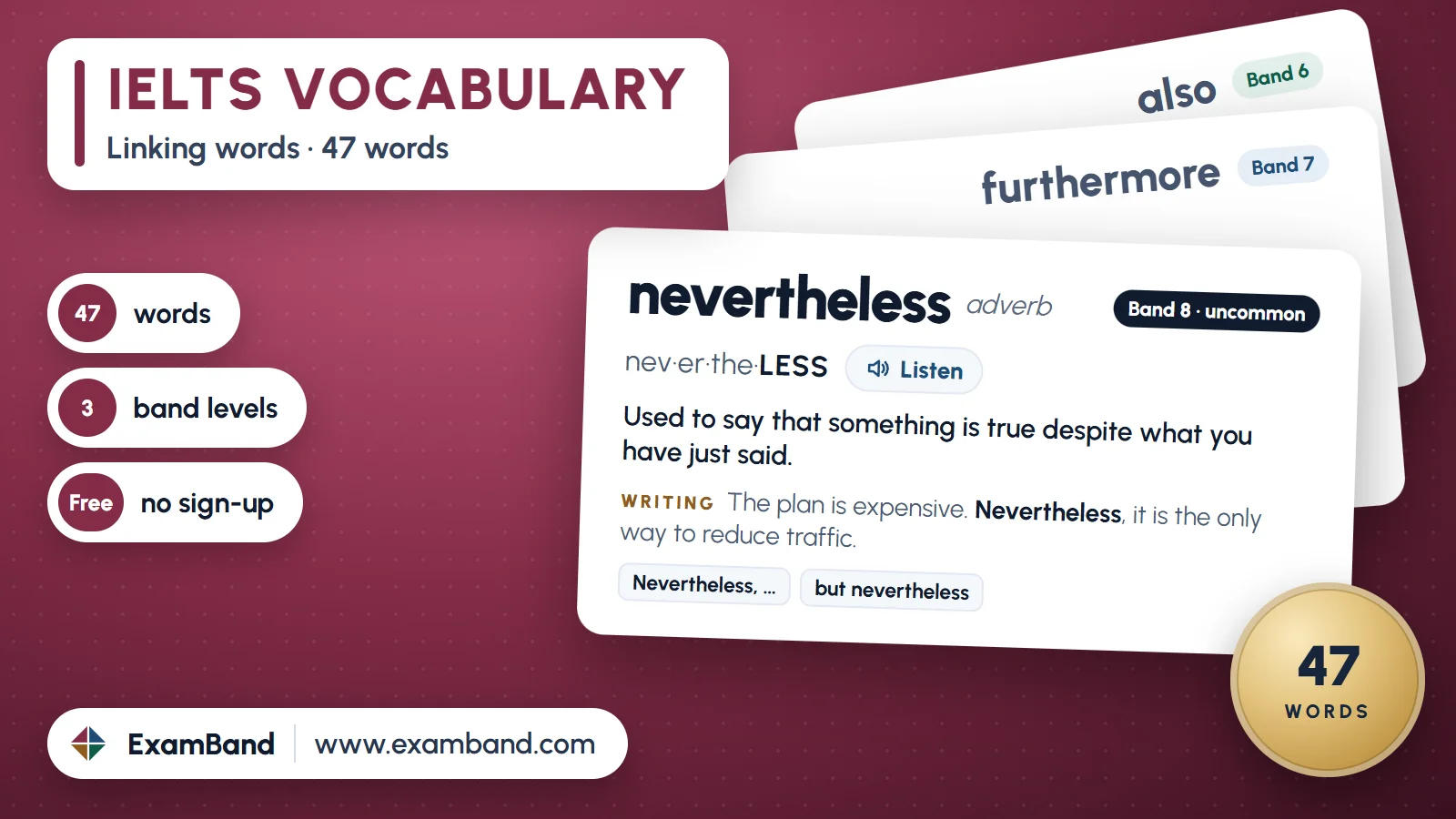
Questions about linking words for IELTS
How do I learn these linking words?
Learn about ten words a day. First, read the meaning, listen to the word and say it out loud with the right stress. Then test yourself with the quiz and the flashcards on this page. Finally, use five of the words in an essay and check it with our free Writing Checker.
Which words should I learn first?
Start with the band 6 words, because you need them to explain any idea clearly. After that, add the band 7 words. However, use the band 8 words only when you are sure of their meaning, because a rare word used wrongly can lower your score.
Are these official IELTS words?
No. IELTS has no official word list. Instead, our levels follow the words of the public IELTS band descriptors: band 7 asks for some “less common” words, and band 8 for “uncommon” words used with skill.