IELTS Media Vocabulary: 50 Words with Examples
This list of IELTS media vocabulary covers news, social media and advertising, which are common topics in Writing Task 2 and Speaking Part 3. Each word has a simple meaning, its sound, a band level, examples for Writing and Speaking, and the mistake to avoid.
50 words · free quiz and flashcards · updated October 2026
advertisement
ad·VER·tise·ment · nounA picture, video or text that tries to make people buy something.Band 6 · everyday
Word family: advertise (verb) · advertising (noun) · ad, advert (short forms)
Collocations
- TV advertisements
- an advertisement for
- online advertisements
Similar: ad, advert, commercial
WritingAdvertisements aimed at children should be strictly controlled.
SpeakingI always skip the advertisements before videos.
Common mistake: Putting the stress on “-tise-” in British English. Say ad-VER-tis-ment.
newspaper
NEWS·pa·per · nounPrinted pages of news, published every day or every week.Band 6 · everyday
Collocations
- read a newspaper
- a national newspaper
- newspaper articles
Similar: paper, the press
WritingFewer young people buy printed newspapers than in the past.
SpeakingMy grandfather still reads a newspaper every morning.
Common mistake: Writing “news paper” as two words. Write “newspaper”.
journalist
JOUR·nal·ist · nounA person who writes or reports the news.Band 6 · everyday
Word family: journalism (noun)
Collocations
- an investigative journalist
- a freelance journalist
- journalists report
Similar: reporter, correspondent
WritingJournalists play a key role in holding governments to account.
SpeakingI wanted to be a journalist when I was younger.
Common mistake: Saying “journalier”. The person is “a journalist”.
headline
HEAD·line · nounThe title of a news story, printed in large letters.Band 6 · everyday
Collocations
- make the headlines
- front-page headlines
- a shocking headline
Similar: title
WritingDramatic headlines are designed to attract readers, not to inform them.
SpeakingI usually just read the headlines on my phone.
Common mistake: Saying “make the headline” for big news. The phrase is “make (the) headlines”.
celebrity
ce·LEB·ri·ty · nounA famous person, especially in entertainment.Band 6 · everyday
Word family: celebrated (adjective)
Collocations
- a famous celebrity
- celebrity culture
- celebrity gossip
Similar: star, famous person
WritingYoung people often copy the lifestyles of celebrities they see online.
SpeakingI once met a celebrity at the airport; she was so friendly.
Common mistake: Putting the stress at the start. Stress “-leb-”: se-LEB-ri-ty.
influencer
IN·flu·en·cer · nounA person who earns money by promoting products on social media.Band 6 · everyday
Word family: influence (noun / verb)
Collocations
- a social media influencer
- follow influencers
- paid influencers
Similar: content creator
WritingInfluencers should clearly say when a post is paid advertising.
SpeakingMy little sister wants to be an influencer when she grows up.
Common mistake: Putting the stress in the middle. Stress the first part: IN-flu-en-cer.
brand
BRAND · nounA company’s name for its products.Band 6 · everyday
Word family: branding (noun)
Collocations
- a global brand
- brand loyalty
- a well-known brand
Similar: label, make
WritingTeenagers often feel pressure to wear expensive brands.
SpeakingI don’t care about brands; I buy whatever is comfortable.
Common mistake: Using “mark” to mean a brand. In English, the word is “brand”.
audience
AU·di·ence · nounThe people who watch, read or listen to something.Band 6 · everyday
Collocations
- a large audience
- a young audience
- reach an audience
Similar: viewers, readers
WritingOnline news can reach a global audience in seconds.
SpeakingThe audience at the concert was amazing.
Common mistake: Thinking it is only plural. It can be singular: “The audience was huge.”
broadcast
BROAD·cast · verb / nounTo send out a programme on TV or radio.Band 6 · everyday
Word family: broadcaster (noun)
Collocations
- broadcast live
- a news broadcast
- broadcast on television
Similar: air, transmit
WritingPublic channels should broadcast more educational programmes.
SpeakingThe final was broadcast live, so everyone watched it.
Common mistake: Saying “broadcasted”. The past form is usually “broadcast”.
commercial
com·MER·cial · nounAn advertisement on TV or radio.Band 6 · everyday
Word family: commerce (noun)
Collocations
- TV commercials
- a commercial break
- show commercials
Similar: advert, ad
WritingChildren’s programmes should not be interrupted by commercials for junk food.
SpeakingThere are so many commercials during films on TV.
Common mistake: Using it only as an adjective. As a noun, “a commercial” is a TV or radio advert.
entertainment
en·ter·TAIN·ment · nounFilms, music, shows and games that people enjoy.Band 6 · everyday
Word family: entertain (verb) · entertaining (adjective)
Collocations
- the entertainment industry
- a form of entertainment
- for entertainment
Similar: amusement, fun
WritingTelevision should educate as well as provide entertainment.
SpeakingMy main entertainment at the weekend is watching films.
Common mistake: Saying “entertainments” in general. It is usually uncountable.
documentary
doc·u·MEN·ta·ry · nounA film or TV programme about real events or facts.Band 6 · everyday
Word family: document (noun / verb)
Collocations
- a nature documentary
- watch a documentary
- a documentary about
Similar: factual programme
WritingNature documentaries have raised awareness of plastic pollution.
SpeakingI watched a great documentary about space last night.
Common mistake: Saying “documentation” for the film. A film about real facts is “a documentary”.
fake news
FAKE NEWS · nounFalse stories made to look like real news.Band 6 · everyday
Collocations
- spread fake news
- fight fake news
- a fake news story
Similar: false news
WritingFake news spreads faster than corrections on social media.
SpeakingMy uncle shares a lot of fake news without checking it.
Common mistake: Saying “a fake news”. It is uncountable: “a piece of fake news”.
viewer
VIEW·er · nounA person who watches TV or a video.Band 6 · everyday
Word family: view (noun / verb)
Collocations
- millions of viewers
- attract viewers
- viewers complained
Similar: audience
WritingReality shows attract millions of viewers every week.
SpeakingMy cousin’s cooking channel has thousands of viewers.
Common mistake: Mixing up “viewers” (people) and “views” (the number of times a video is watched).
subscribe
sub·SCRIBE · verbTo pay or sign up to get something regularly, like a magazine or a channel.Band 6 · everyday
Word family: subscription (noun) · subscriber (noun)
Collocations
- subscribe to a channel
- subscribe to a newspaper
- a paid subscription
Similar: sign up
WritingMany newspapers now ask readers to subscribe before they can read articles online.
SpeakingI subscribe to three cooking channels.
Common mistake: Saying “subscribe a channel”. Use “to”: “subscribe to a channel”.
news coverage
NEWS COV·er·age · nounThe way the news reports an event, and how much it reports.Band 6 · everyday
Word family: cover (verb)
Collocations
- media coverage
- news coverage of
- wide coverage
Similar: reporting
WritingNews coverage of crime can make people feel less safe than they really are.
SpeakingThe news coverage of the election was non-stop.
Common mistake: Saying “news covering”. The noun is “coverage”.
front page
FRONT PAGE · nounThe first page of a newspaper, with the most important news.Band 6 · everyday
Word family: front-page (adjective)
Collocations
- on the front page
- front-page news
- make the front page
Similar: cover
WritingStories about celebrities often appear on the front page instead of serious news.
SpeakingMy school was on the front page of the local paper once!
Common mistake: Saying “first page” for a newspaper. The usual term is “front page”.
misinformation
mis·in·for·MA·tion · nounWrong information, often spread by mistake.Band 7 · less common
Word family: misinform (verb)
Collocations
- spread misinformation
- tackle misinformation
- health misinformation
Similar: false information
WritingMisinformation about vaccines spreads quickly online.
SpeakingThere’s so much misinformation on social media these days.
Common mistake: Saying “misinformations”. It is uncountable.
consumerism
con·SUM·er·ism · nounA way of life that is focused on buying things.Band 7 · less common
Word family: consumer (noun) · consume (verb)
Collocations
- a culture of consumerism
- the rise of consumerism
- modern consumerism
Similar: materialism
WritingAdvertising encourages consumerism, which harms the environment.
SpeakingI think consumerism makes people unhappy; we always want more.
Common mistake: Saying “consumism”. The word is “consumerism”.
target audience
TAR·get AU·di·ence · nounThe group of people an advert or a programme is made for.Band 7 · less common
Collocations
- reach a target audience
- the target audience for
- a young target audience
Similar: target market
WritingChildren are often the target audience for unhealthy food adverts.
SpeakingThe target audience for that show is clearly teenagers.
Common mistake: Saying “target public”. The term is “target audience”.
mass media
MASS ME·di·a · nounTV, radio, newspapers and the internet, which reach large numbers of people.Band 7 · less common
Collocations
- the mass media
- the influence of the mass media
- mass media coverage
Similar: the media
WritingThe mass media have a powerful influence on public opinion.
SpeakingMass media in my country is mostly owned by a few companies.
Common mistake: Saying “mass medias”. “Media” is already plural.
freedom of the press
FREE·dom of the PRESS · nounThe right of journalists to report the news without government control.Band 7 · less common
Collocations
- protect freedom of the press
- threats to freedom of the press
- limits on freedom of the press
Similar: press freedom
WritingFreedom of the press is essential for a healthy democracy.
SpeakingFreedom of the press isn’t the same in every country.
Common mistake: Saying “the press’s freedom”. The usual phrases are “freedom of the press” and “press freedom”.
biased
BI·ased · adjectiveUnfairly supporting one side.Band 7 · less common
Word family: bias (noun)
Collocations
- biased reporting
- politically biased
- biased against
Similar: one-sided, partial
WritingSome news channels are clearly biased towards one political party.
SpeakingI think that newspaper is a bit biased.
Common mistake: Using “bias” as the adjective: “a bias report”. Say “a biased report”.
persuasive
per·SUA·sive · adjectiveAble to make people believe or do something.Band 7 · less common
Word family: persuade (verb) · persuasion (noun)
Collocations
- persuasive techniques
- highly persuasive
- a persuasive argument
Similar: convincing
WritingAdvertisers use persuasive techniques that children cannot recognise.
SpeakingMy best friend is really persuasive; she always gets her way.
Common mistake: Saying “persuasing”. The adjective is “persuasive”.
censorship
CEN·sor·ship · nounControlling what can be published or shown, often by a government.Band 7 · less common
Word family: censor (verb / noun)
Collocations
- internet censorship
- strict censorship
- government censorship
Similar: suppression
WritingStrict censorship stops citizens from hearing different opinions.
SpeakingThere’s some censorship of films in my country.
Common mistake: Mixing up “censor” (to control what is shown) and “sensor” (a device that detects things).
mainstream media
MAIN·stream ME·di·a · nounThe big, well-known TV channels and newspapers.Band 7 · less common
Collocations
- the mainstream media
- distrust of the mainstream media
- mainstream media outlets
Similar: traditional media
WritingMany young people get their news from social media rather than the mainstream media.
SpeakingI trust the mainstream media more than random websites.
Common mistake: Saying “main media”. The term is “mainstream media”.
word of mouth
WORD of MOUTH · nounWhen people tell each other about something.Band 7 · less common
Collocations
- by word of mouth
- spread by word of mouth
- word-of-mouth recommendations
Similar: personal recommendation
WritingSmall businesses often rely on word of mouth rather than expensive advertising.
SpeakingI found my dentist by word of mouth; a friend recommended him.
Common mistake: Saying “mouth to mouth”, which is a way of helping someone breathe. The phrase is “word of mouth”.
endorse
en·DORSE · verbTo say publicly that you support a product or a person, often for money.Band 7 · less common
Word family: endorsement (noun)
Collocations
- endorse a product
- celebrity endorsements
- be endorsed by
Similar: promote, back
WritingSports stars who endorse junk food send the wrong message to children.
SpeakingThat footballer endorses a lot of brands.
Common mistake: Saying “endorse for”. Endorse needs no preposition: “endorse a product”.
clickbait
CLICK·bait · nounExciting headlines made to make you click, which are often misleading.Band 7 · less common
Collocations
- clickbait headlines
- a clickbait article
- avoid clickbait
Similar: sensational headlines
WritingClickbait headlines reduce public trust in online news.
SpeakingI hate clickbait; the story is never as exciting as the title.
Common mistake: Writing “click bait” as two words. Write “clickbait”.
paparazzi
pa·pa·RAZ·zi · noun, pluralPhotographers who follow famous people to take photos of them.Band 7 · less common
Collocations
- hounded by paparazzi
- paparazzi photos
- avoid the paparazzi
Similar: photographers
WritingCelebrities argue that the paparazzi invade their privacy.
SpeakingThe paparazzi were waiting outside the hotel.
Common mistake: Saying “a paparazzi” for one person. “Paparazzi” is plural; for one, say “a paparazzi photographer”.
impartial
im·PAR·tial · adjectiveFair, and not supporting any side.Band 7 · less common
Word family: impartiality (noun)
Collocations
- impartial reporting
- remain impartial
- an impartial judge
Similar: neutral, unbiased
WritingPublic broadcasters must remain impartial in their news coverage.
SpeakingI try to read impartial news, but it’s not easy.
Common mistake: Saying “unpartial”. The opposite of “partial” is “impartial”.
media literacy
ME·di·a LIT·er·a·cy · nounThe ability to judge whether news and information are true.Band 7 · less common
Collocations
- teach media literacy
- improve media literacy
- media literacy skills
Similar: news literacy
WritingSchools should teach media literacy so that pupils can spot fake news.
SpeakingMy teacher gave us media literacy lessons on checking sources.
Common mistake: Saying “media literature”. The word is “literacy”.
slogan
SLO·gan · nounA short phrase that is easy to remember, used in advertising.Band 7 · less common
Collocations
- a catchy slogan
- an advertising slogan
- a political slogan
Similar: catchphrase, tagline
WritingA catchy slogan can make a product famous.
SpeakingI still remember a slogan from an advert I saw as a child.
Common mistake: Saying “a slogan of” the product. Use “for”: “a slogan for a car”.
tabloid
TAB·loid · nounA newspaper with short stories, big pictures and gossip about famous people.Band 7 · less common
Collocations
- tabloid newspapers
- the tabloid press
- tabloid journalism
Similar: gossip paper
WritingTabloid newspapers focus on scandal rather than serious news.
SpeakingMy dad reads a tabloid for the football news.
Common mistake: Using it for any newspaper. A tabloid is popular and gossip-focused; a serious paper is a “broadsheet”.
materialistic
ma·te·ri·a·LIS·tic · adjectiveCaring too much about money and possessions.Band 7 · less common
Word family: materialism (noun)
Collocations
- a materialistic society
- become materialistic
- materialistic values
Similar: consumerist
WritingAdvertising may make children more materialistic.
SpeakingI don’t think I’m very materialistic; I prefer experiences.
Common mistake: Saying “materialist” as the adjective. The usual adjective is “materialistic”.
product placement
PROD·uct PLACE·ment · nounShowing a brand’s product in a film or TV show, as hidden advertising.Band 7 · less common
Collocations
- product placement in films
- paid product placement
- use product placement
Similar: hidden advertising
WritingProduct placement makes it hard for viewers to know when they are watching an advert.
SpeakingThat film had so much product placement; the phone was in every scene.
Common mistake: Saying “product placing”. The term is “product placement”.
sensationalism
sen·SA·tion·al·ism · nounMaking news more shocking than it really is, to attract readers.Band 8 · uncommon
Word family: sensational (adjective)
Collocations
- media sensationalism
- accuse the press of sensationalism
- avoid sensationalism
Similar: exaggeration
WritingSensationalism in crime reporting makes people more afraid than they need to be.
SpeakingI’m tired of the sensationalism on the evening news.
Common mistake: Thinking “sensational” is always praise. It can also mean exaggerated and shocking.
manipulate
ma·NIP·u·late · verbTo control or influence people in a clever and unfair way.Band 8 · uncommon
Word family: manipulation (noun) · manipulative (adjective)
Collocations
- manipulate public opinion
- manipulate consumers
- be easily manipulated
Similar: influence, exploit
WritingPolitical adverts can manipulate voters with half-truths.
SpeakingSome apps manipulate you into buying things you don’t need.
Common mistake: Spelling it “manupulate”. Write “manipulate”.
propaganda
prop·a·GAN·da · nounFalse or one-sided information used to support a political idea.Band 8 · uncommon
Word family: propagandist (noun)
Collocations
- government propaganda
- spread propaganda
- political propaganda
Similar: one-sided information
WritingGovernments have long used propaganda to win support for wars.
SpeakingWe studied wartime propaganda posters in history class.
Common mistake: Using it for any advertising. Propaganda is usually political.
disinformation
dis·in·for·MA·tion · nounFalse information spread on purpose to trick people.Band 8 · uncommon
Collocations
- a disinformation campaign
- spread disinformation
- tackle disinformation
Similar: lies, deception
WritingSome states run disinformation campaigns to influence foreign elections.
SpeakingFake accounts are used to spread disinformation.
Common mistake: Mixing it up with “misinformation”. Disinformation is false on purpose; misinformation can be a mistake.
gullible
GUL·li·ble · adjectiveToo willing to believe what people tell you.Band 8 · uncommon
Word family: gullibility (noun)
Collocations
- gullible consumers
- too gullible
- easily fooled
Similar: naive, easily fooled
WritingYoung children are especially gullible when it comes to advertising.
SpeakingI was so gullible as a child; I believed everything on TV.
Common mistake: Spelling it “gullable”. It ends in “-ible”.
echo chamber
ECH·o CHAM·ber · nounA place online where people only see opinions like their own.Band 8 · uncommon
Collocations
- live in an echo chamber
- social media echo chambers
- create an echo chamber
Similar: filter bubble
WritingAlgorithms can trap users in an echo chamber of similar opinions.
SpeakingI try to avoid an echo chamber by following people I disagree with.
Common mistake: Saying “echo room”. The term is “echo chamber”.
scrutiny
SCRU·ti·ny · nounVery careful examination.Band 8 · uncommon
Word family: scrutinise (verb)
Collocations
- public scrutiny
- come under scrutiny
- close scrutiny
Similar: examination, inspection
WritingPoliticians’ private lives are under constant scrutiny from the press.
SpeakingCelebrities live under so much scrutiny; I’d hate that.
Common mistake: Spelling it “scrutinity”. Write “scrutiny”.
deceptive
de·CEP·tive · adjectiveTrying to make people believe something that is not true.Band 8 · uncommon
Word family: deceive (verb) · deception (noun)
Collocations
- deceptive advertising
- deceptive claims
- highly deceptive
Similar: misleading
WritingCompanies that use deceptive advertising should face heavy fines.
SpeakingThe photos of the hotel were deceptive; it was much smaller.
Common mistake: Mixing it up with “disappointing”. Deceptive means misleading.
objectivity
ob·jec·TIV·i·ty · nounBeing fair and based on facts, not on personal feelings.Band 8 · uncommon
Word family: objective (adjective)
Collocations
- journalistic objectivity
- lack objectivity
- maintain objectivity
Similar: neutrality, fairness
WritingJournalists must maintain objectivity, even on topics they care about.
SpeakingComplete objectivity is hard; every newspaper has some bias.
Common mistake: Saying “objectiveness”. The usual noun is “objectivity”.
intrusive
in·TRU·sive · adjectiveGetting too involved in someone’s private life.Band 8 · uncommon
Word family: intrude (verb) · intrusion (noun)
Collocations
- intrusive journalists
- intrusive advertising
- highly intrusive
Similar: invasive
WritingIntrusive reporting can cause great distress to victims’ families.
SpeakingPop-up adverts are so intrusive.
Common mistake: Spelling it “intrussive”. Write “intrusive”, with one s.
subliminal
sub·LIM·i·nal · adjectiveAffecting your mind without you noticing.Band 8 · uncommon
Collocations
- subliminal messages
- subliminal advertising
- a subliminal effect
Similar: hidden, subconscious
WritingSubliminal messages in adverts are banned in many countries.
SpeakingI wonder if the music in shops has a subliminal effect on what we buy.
Common mistake: Saying “sublimal”. Write “subliminal”.
conspicuous consumption
con·SPIC·u·ous con·SUMP·tion · nounBuying expensive things to show other people how rich you are.Band 8 · uncommon
Collocations
- a culture of conspicuous consumption
- criticise conspicuous consumption
- conspicuous consumption online
Similar: showing off wealth
WritingSocial media encourages conspicuous consumption, as people show off what they buy.
SpeakingPosting photos of designer bags is really conspicuous consumption.
Common mistake: Mixing up “conspicuous” (easy to see) and “conscious” (aware).
Media vocabulary in IELTS Writing and Speaking
Here is how IELTS media vocabulary can come up in the test, with our own practice questions. So, try to answer them with words from the list above.
Writing Task 2
Some people think advertising aimed at children should be banned. To what extent do you agree or disagree?
Speaking
- Part 1: How do you usually get the news?
- Part 1: Do you enjoy watching adverts?
- Part 2: Describe an advertisement that you remember well.
- Part 3: Can people trust the news they read on social media?
- Part 3: Why do so many young people want to become famous online?
Our free tests on this topic
- Writing Practice Test 5, Task 2why the news focuses on negative stories
- Writing Practice Test 10, Task 2young people who dream of fame on social media
- Listening Practice Test 7, Part 4a lecture on colour in marketing
- Listening Practice Test 8, Part 2a visit to a TV studio
A model paragraph with IELTS media vocabulary
Social media has changed the way news reaches us. Stories can go viral within minutes, but so can misinformation and clickbait. Many users live in an echo chamber and rarely meet opinions that challenge their own. For this reason, schools should teach media literacy, so that young people learn to question what they read and to look for impartial sources.
Practise this IELTS media vocabulary
Take the 10-question quiz on this IELTS media vocabulary, or go through every word with the flashcards.
Question 1 of 10
Which word means “printed pages of news, published every day or every week”?
Now use the words
Write a Task 2 essay with five of these words. Then our free Writing Checker gives you a band for vocabulary and for the other three criteria.
Open the Writing Checker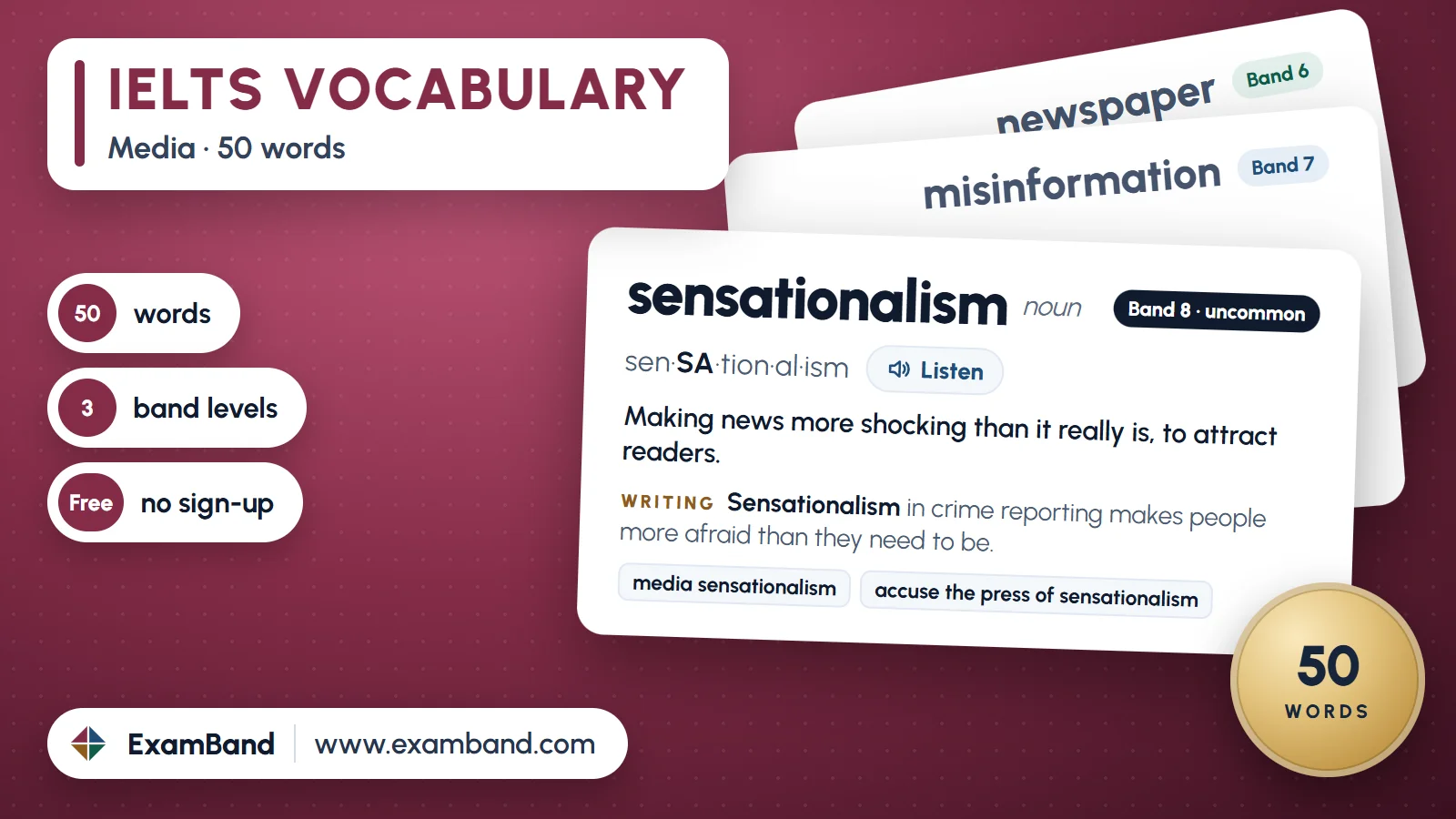
Questions about IELTS media vocabulary
How do I learn IELTS media vocabulary?
Learn about ten words a day. First, read the meaning, listen to the word and say it out loud with the right stress. Then test yourself with the quiz and the flashcards on this page. Finally, use five of the words in an essay and check it with our free Writing Checker.
Which words should I learn first?
Start with the band 6 words, because you need them to explain any idea clearly. After that, add the band 7 words. However, use the band 8 words only when you are sure of their meaning, because a rare word used wrongly can lower your score.
Are these official IELTS words?
No. IELTS has no official word list. Instead, our levels follow the words of the public IELTS band descriptors: band 7 asks for some “less common” words, and band 8 for “uncommon” words used with skill.