IELTS Listening / Practice Test 7
IELTS Listening Practice Test 7: Free, with Answers
This free IELTS Listening Practice Test 7 has 4 parts and 40 questions. Play each part, answer the questions, and see at once if you are right.
0 of 40 checked · 0 right
IELTS Listening Practice Test 7 · Part 1
A father phoning a leisure centre about swimming lessons for his daughter
Here you can stop and play again. In the real test you hear it once.
Part 1 transcript
Megan:Good afternoon, Kingsway Leisure Centre, Megan speaking. How can I help?
Greg:Hi there. I'm ringing about swimming lessons for my daughter. A friend told me you've got some new classes starting next month.
Megan:That's right, our new term starts on the fifth, and the courses run for ten weeks. Let me take a few details first. What's your daughter's first name?
Greg:It's Ffion. It's a Welsh name, my wife's from Cardiff, so I'd better spell it for you. It's F-F-I-O-N.
Megan:Two Fs at the beginning?
Greg:That's right. F, F, I, O, N.
Megan:Lovely. And how old is she?
Greg:She's seven. She'll be eight in March, but that's a while away yet.
Megan:OK, so she'd be in our junior section for now. Can she swim at all?
Greg:A little. She can manage about ten metres on her own, as long as she's not too tired. She's desperate to get her twenty-five metre badge, like her cousin, but she's not there yet.
Megan:Ten metres is a very good start. Has she had any lessons before?
Greg:Only at school. They had a term of lessons last year, but the groups were very big, so she didn't get much individual attention.
Megan:I see. That's quite common, unfortunately. Is there anything we should know about her health?
Greg:She has asthma, but it's very mild. She's got an inhaler, which she always keeps in her bag. Her doctor says swimming is actually good for it, which is one reason we want her to learn properly.
Megan:That's fine. All our instructors are trained in first aid, so they'll just need to know where she keeps it. And could I have a contact number for you?
Greg:Sure. It's oh-seven-seven-eight-one, three-four-nine, six-two-seven.
Megan:Oh-seven-seven-eight-one, three-four-nine, six-two-seven. Thank you.
Greg:Do you need an email address as well?
Megan:No, the booking form will ask for that.
Greg:And can parents watch the lessons?
Megan:Yes, there's a viewing gallery upstairs, with a café, so you can have a coffee while you wait. We do ask parents not to come down to the poolside during the lesson, though, because the children get distracted.
Greg:That's fair enough. She'd only start showing off.
Megan:Most of them do, in my experience!
Megan:Now, for her age group, there are three classes she could join. The Starfish class is on Mondays at half past four. That one's for complete beginners, and it's taught in the learner pool, which is shallower and a bit warmer than the main pool.
Greg:I think she's past the beginner stage. She'd find it a bit too easy.
Megan:Probably, yes. Then there's the Dolphins class. That's for children who can already swim a short distance, so it would suit Ffion very well. It used to be on Tuesdays, but we've moved it to Wednesdays, at quarter past five, because the diving club uses the pool on Tuesday evenings now.
Greg:Wednesdays would be fine. What does she need to bring?
Megan:Swimming hats aren't compulsory any more for that class, but all the children must bring goggles, because that's when they start learning to swim with their faces in the water.
Greg:She's got some already, luckily. What happens if she's ill and misses a lesson?
Megan:I'm afraid we can't refund individual lessons, but if there's space in another class that week, she's welcome to join it instead.
Greg:That seems reasonable. And the third class?
Megan:That's the Sharks class, on Saturday mornings at nine. It's for stronger swimmers, and as well as improving their strokes, the children learn basic lifesaving skills, like how to help someone who's in difficulty in the water.
Greg:That sounds great for later on. I think we'll start with the Dolphins, though.
Megan:Good choice. Classes are limited to eight children, so I'd recommend booking soon. I'll send you a booking form by email this afternoon.
Greg:Brilliant. And should she arrive early for the first lesson?
Megan:About ten minutes early would be ideal, so she has time to get changed and meet the instructor.
Greg:Great. Thanks for all your help.
Part 2 transcript
Guide:Good morning, everyone, and welcome to Haverton. My name's Martin, and I'll be your guide on this morning's walking tour of the old town. We're starting here, outside the tourist information office at the southern end of the High Street, and you should all have a copy of the map. Haverton grew rich in the fifteenth century on the wool trade, and many of the buildings we'll see this morning date from that time. When the trade moved north, the town's growth slowed dramatically, which is why so much of the old centre has survived almost unchanged.
Guide:We'll begin by walking north up the High Street to the Market Square, which has been the heart of the town for about seven hundred years. The first building I'd like you to notice there is the Guildhall, where the town's merchants used to meet. Its upper floor is still used for council meetings, and on Saturdays the ground floor becomes a craft market. You'll find it on the north side of the square, on the right of the High Street as you look towards the river.
Guide:Most visitors expect the clock tower to stand in the middle of the square, but in fact it's in one of the corners. As you come into the square from the High Street, it's in the corner on your left, where Castle Street begins.
Guide:From there, we'll walk west along Castle Street. The row of little stone cottages on your right as you walk along was built for the weavers who made Haverton rich. The houses on the other side of the road are much newer; they were built in the nineteen-thirties.
Guide:At the far end of Castle Street, you'll see the castle ruins on your right, and directly opposite them, on the other side of the road, is the old prison, which is now a small museum. The cells are surprisingly small, so if you don't like enclosed spaces, you might prefer to wait outside.
Guide:Then we'll come back to the square and head east along Mill Lane. The corn exchange, where farmers used to sell their grain, is on the left-hand side, about halfway along. Don't confuse it with the large building on the right, which was the town's first post office. The corn exchange itself was converted into an arts centre about twenty years ago, and it now holds concerts most weekends.
Guide:At the end of Mill Lane, a path on the right leads down to St Mary's Church. Just beyond the church, on the side furthest from the High Street, you'll find the almshouses, which were built in fifteen-twenty to provide homes for elderly people in the town.
Guide:And finally, we'll walk back up the High Street almost as far as the Old Bridge. Just before the bridge, a narrow lane on the left, called Water Lane, leads down to the river, and at the bottom of it stands the Watergate, the only one of the town's medieval gates that still survives.
Guide:Before we set off, a few practical points. You'll notice that Castle Street is closed to cars. People often assume that's because of building work, or because of the market, which actually takes place in the square on Thursdays. In fact, the street still has its original cobblestones, some of them five hundred years old, and the council closed it to traffic to stop them being damaged.
Guide:As for timing, the castle tour that some of you may have done yesterday takes about an hour, and some groups ask me to stretch this tour to two hours. This morning, though, we'll keep to the usual length, which is an hour and a half, including a short break for refreshments.
Guide:And at the end of the tour, I'll give each of you a card that entitles you to ten per cent off in most of the independent shops in the town for the rest of the day. I'm afraid entry to the castle ruins isn't included, although children under twelve get in free anyway. And if you'd like to read more about the buildings we've seen, there's an excellent guidebook on sale at the tourist information office. Right, if you'd like to follow me, we'll make a start.
Part 3 transcript
Zoe:OK, Nathan, I've read through what we've written so far, and I think the first section works well. We've explained the idea clearly: a café where students can study, with long opening hours, plenty of power sockets and a quiet area upstairs.
Nathan:I'm glad you think so. I was worried that the section on our target customers was a bit thin.
Zoe:It could use some figures, but it's fine for now. The real problem is that, before we write the next section, we need to decide where the café's going to be. We looked at five possible locations, didn't we?
Nathan:Yes. Let's go through them one by one. First, the empty unit near the railway station.
Zoe:Well, it's busy in the mornings, with commuters grabbing a coffee on their way to work, but after about six o'clock it's completely dead. Hardly anyone walks past in the evenings, and we wanted to stay open late for students.
Nathan:Couldn't we just close earlier there?
Zoe:We could, but then we wouldn't really be a study café, would we?
Nathan:Right. Then there's the shopping centre. There are plenty of people around, and there's lots of space. More seating than we'd need, actually.
Zoe:But have you seen what they charge? The rent there is more than twice what we'd pay anywhere else. Even if the place was full every day, we'd never make a profit.
Nathan:True. What about the unit opposite the university library? That was my favourite.
Zoe:Mine too. The size is fine; we could fit about thirty seats in there. The only thing is that it would depend completely on the students. During term it would be packed, but in the summer holidays the campus is almost empty.
Nathan:We could run events in the summer, I suppose, or open for language-school students.
Zoe:Maybe, but that's a risk we'd have to explain in the plan.
Nathan:Hmm. And the one on the high street?
Zoe:It's a good position, but there are already five cafés within two hundred metres of it, including two of the big chains. We'd really struggle to compete with them.
Nathan:Although the chains are always full, which shows there's plenty of demand.
Zoe:Demand for them, maybe, not necessarily for us.
Nathan:And finally, the old kiosk in Victoria Park. Families would love it at the weekends.
Zoe:They would, but apparently we couldn't change the building or put any tables outside without planning permission from the council, and that can take months.
Nathan:That's a shame. It's such a lovely spot, and there's no café in the park at the moment.
Zoe:I know. Maybe we could mention it in the plan as a possible second site, if the first one does well.
Nathan:Good idea. Investors like to see that kind of ambition.
Nathan:So, assuming we go for the site opposite the library, what do we need to do next?
Zoe:Let's write the steps down as a list, so we can tick them off as we go. First, prices. We need quotes from at least three suppliers for the coffee and the food. Our tutor said one quote isn't enough to show we've looked for the best deal.
Nathan:I can do that. I've already found two companies that deliver to the campus, and I'll look for a third this week. Then the menu. She also said that most new cafés offer far too many things, so we should design a short menu, with fewer than twenty items.
Zoe:Agreed. A short menu also means less waste and fewer things that can go wrong in the kitchen. After that, we've got to work out the monthly costs. We already have figures for the rent and the staff, but the one we keep forgetting is insurance. We left it out completely in the first draft.
Nathan:Don't remind me. The tutor circled it in red. And then we present the whole plan to the bank, was it?
Zoe:No, that was last year's group. The tutor has arranged for us to present it to a panel of local business owners. They'll give us comments, not money, unfortunately. And they're very direct, apparently. Last year one of them told a group that their whole idea would never work.
Nathan:Ha. Still, it'll be good practice. Most of them have started their own businesses, so they'll know exactly what to look for. And then we revise the plan.
Zoe:Yes. And I suspect they'll have most to say about our prices. Some of the figures we've used for coffee are lower than anyone else in town, so we should be ready to change those.
Nathan:Fair enough. I'd rather change them now than have someone tell us we've got our sums wrong. When's the final deadline, by the way?
Zoe:The end of next month, so we've got about five weeks. That should be plenty, as long as we don't leave everything until the last minute, like last time.
Nathan:All right, all right. Let's get started.
Part 4 transcript
Lecturer:Good morning. Today's lecture is about one of the most powerful and least understood tools in marketing: colour. In 2006, a widely cited review of research on colour and marketing concluded that people make up their minds about a product within about ninety seconds of seeing it, and that somewhere between sixty-two and ninety per cent of that first judgement is based on colour alone. Whatever the exact figure, few marketers doubt that colour matters. The more interesting questions are how it works, and how easily it can go wrong. Over the next hour, we'll look at four areas: colour and the senses, the legal protection of colours, some famous failures, and accessibility.
Lecturer:Let's start with the effect of colour on our senses. You might assume that the colour of a cup has nothing to do with the taste of what's in it. Yet in one study, people were given the same coffee in a white mug and in a clear glass mug. When they drank from the white mug, they rated the coffee as more intense and less sweet. The researchers believe that the white background makes the brown of the coffee look darker, and our brains connect darker coffee with a stronger flavour. Findings like this explain why food and drink companies spend so much time choosing the colour of their packaging. Similar effects have been reported for plates, bowls and even the lighting in restaurants, although not every study has produced the same results, so we should treat individual findings with some caution.
Lecturer:Because colours are so valuable, companies try hard to protect them. The jewellery company Tiffany registered its particular shade of blue as a trademark in 1998, which means that no competitor can use that colour on similar products. This is unusual, because a colour can't be owned in general; it can only be protected in a particular commercial context. Other attempts have been less successful. The chocolate maker Cadbury spent years trying to register its purple as a trademark. In 2013, however, a British court ruled against the company, because its application described purple as the 'predominant' colour of its packaging, and the judges decided that this description was too vague: it didn't say exactly how, or how much, the colour would be used. Registering a colour, in other words, is possible, but only if a company can define precisely what it is claiming, and many fail at that hurdle.
Lecturer:Colour can also produce spectacular failures. In 2000, the food company Heinz launched green ketchup, squeezed from a bottle designed for small hands. It was aimed at children, and at first it was a great success: more than ten million bottles were sold in the first seven months. But once the novelty wore off, sales fell steadily, and the product was withdrawn in 2006. An even quicker failure was Crystal Pepsi, a completely clear cola launched in 1992. Although its flavour was similar to ordinary Pepsi, many customers complained that it simply didn't taste of cola. Without the familiar dark brown colour, their brains seem to have expected something different, and the drink disappeared within two years. Both cases show that a colour can attract attention very effectively, but if it conflicts with what people expect from a product, the attention doesn't last.
Lecturer:There's another reason to be careful with colour, and it's one that designers often forget. Around one in twelve men, and a much smaller proportion of women, have some form of colour blindness, most commonly a difficulty in telling red from green. A website that shows items in stock in green and those that are sold out in red may be confusing for a large number of its customers. The solution is simple: never rely on colour alone to carry information, but combine it with symbols, such as a tick or a cross, or with words. This costs almost nothing, and it makes a product or a website easier to use for everyone, not only for people with colour blindness.
Lecturer:So what can we conclude? First, consistency matters. When customers are faced with a crowded shelf, a familiar colour helps them find the brand they're looking for in a fraction of a second, which is why companies rarely change their colours. Second, colour is never neutral: it affects what people expect, and even what they taste. Third, it has to work for everyone, including people who see colours differently. And finally, because the effects are so hard to predict, any change of colour should be tested with real customers before it's introduced, not simply decided in a meeting room. Next week, we'll look at the role of sound in advertising.
Questions 1–6
Complete the form. Write ONE WORD AND/OR A NUMBER for each answer.
KINGSWAY LEISURE CENTRE – Swimming lessons
• Child's first name: 1
• Age: 2
• Can swim about 3 metres without help
• Previous lessons: at 4
• Problem with those lessons: the groups were too 5
• Contact number: 07781 6
The answer is Ffion.
In the recording: “It's Ffion.”
The answer is 7.
In the recording: “She's seven.”
The answer is 10.
In the recording: “She can manage about ten metres on her own, as long as she's not too tired.”
The answer is school.
In the recording: “Only at school.”
The answer is big.
In the recording: “They had a term of lessons last year, but the groups were very big, so she didn't get much individual attention.”
The answer is 349627.
In the recording: “It's oh-seven-seven-eight-one, three-four-nine, six-two-seven.”
Questions 7–10
Complete the table. Write ONE WORD ONLY for each answer.
Classes for children aged 7–9
| Class | Day and time | Other information |
|---|---|---|
| Starfish | Monday, 4.30 p.m. | for beginners; taught in the 7 pool |
| Dolphins | 8, 5.15 p.m. | children start swimming with their 9 in the water |
| Sharks | Saturday, 9.00 a.m. | includes basic 10 skills |
The answer is learner.
In the recording: “That one's for complete beginners, and it's taught in the learner pool, which is shallower and a bit warmer than the main pool.”
The answer is Wednesday.
In the recording: “It used to be on Tuesdays, but we've moved it to Wednesdays, at quarter past five, because the diving club uses the pool on Tuesday evenings now.”
The answer is faces.
In the recording: “Swimming hats aren't compulsory any more for that class, but all the children must bring goggles, because that's when they start learning to swim with their faces in the water.”
The answer is lifesaving.
In the recording: “It's for stronger swimmers, and as well as improving their strokes, the children learn basic lifesaving skills, like how to help someone who's in difficulty in the water.”
Questions 11–17
Label the map. Choose the correct letter, A–J, for each label.
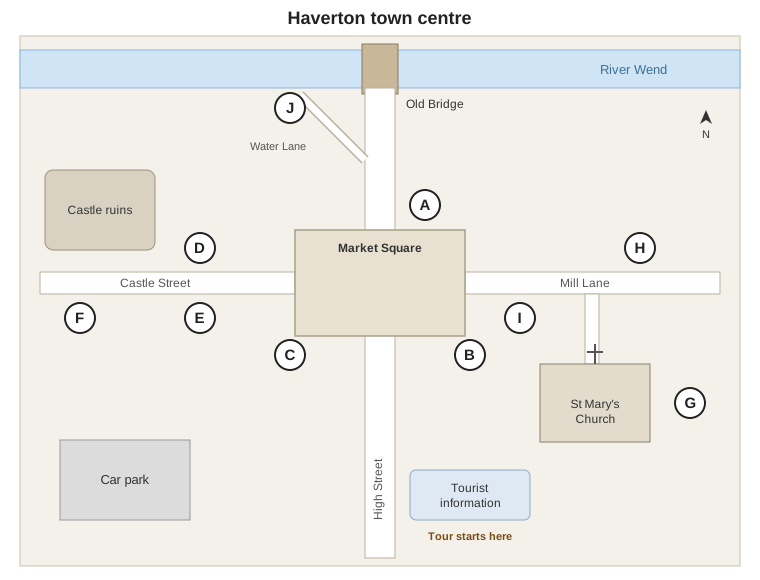
11Guildhall
The answer is A.
In the recording: “The first building I'd like you to notice there is the Guildhall, where the town's merchants used to meet.”
12Clock tower
The answer is C.
In the recording: “As you come into the square from the High Street, it's in the corner on your left, where Castle Street begins.”
13Weavers' cottages
The answer is D.
In the recording: “The row of little stone cottages on your right as you walk along was built for the weavers who made Haverton rich.”
14Old prison
The answer is F.
In the recording: “At the far end of Castle Street, you'll see the castle ruins on your right, and directly opposite them, on the other side of the road, is the old prison, which is now a small museum.”
15Corn exchange
The answer is H.
In the recording: “The corn exchange, where farmers used to sell their grain, is on the left-hand side, about halfway along.”
16Almshouses
The answer is G.
In the recording: “Just beyond the church, on the side furthest from the High Street, you'll find the almshouses, which were built in fifteen-twenty to provide homes for elderly people in the town.”
17Watergate
The answer is J.
In the recording: “Just before the bridge, a narrow lane on the left, called Water Lane, leads down to the river, and at the bottom of it stands the Watergate, the only one of the town's medieval gates that still survives.”
Questions 18–20
Choose the correct answer.
18Why is Castle Street closed to cars?
The answer is C.
In the recording: “In fact, the street still has its original cobblestones, some of them five hundred years old, and the council closed it to traffic to stop them being damaged.”
19How long will this morning's tour last?
The answer is B.
In the recording: “This morning, though, we'll keep to the usual length, which is an hour and a half, including a short break for refreshments.”
20What will each visitor receive at the end of the tour?
The answer is A.
In the recording: “And at the end of the tour, I'll give each of you a card that entitles you to ten per cent off in most of the independent shops in the town for the rest of the day.”
Questions 21–25
Choose the correct answer for each gap.
Drawbacks
- AThe rent is too expensive.
- BFew people pass by in the evening.
- COfficial permission would be needed.
- DThere are too many competitors nearby.
- EThere is not enough room for seating.
- FIt is too far from the university.
- GBusiness would vary at different times of year.
21near the railway station
The answer is B.
In the recording: “Well, it's busy in the mornings, with commuters grabbing a coffee on their way to work, but after about six o'clock it's completely dead.”
22in the shopping centre
The answer is A.
In the recording: “The rent there is more than twice what we'd pay anywhere else.”
23opposite the university library
The answer is G.
In the recording: “During term it would be packed, but in the summer holidays the campus is almost empty.”
24on the high street
The answer is D.
In the recording: “We'd really struggle to compete with them.”
25in Victoria Park
The answer is C.
In the recording: “They would, but apparently we couldn't change the building or put any tables outside without planning permission from the council, and that can take months.”
Questions 26–30
Complete the flow-chart. Write ONE WORD ONLY for each answer.
Next steps for the business plan
Get quotes from at least three 26.
Design a short 27 with fewer than twenty items.
Calculate the monthly costs, remembering to include 28.
Present the plan to a panel of local business 29.
Revise the plan, especially the 30.
The answer is suppliers.
In the recording: “We need quotes from at least three suppliers for the coffee and the food.”
The answer is menu.
In the recording: “She also said that most new cafés offer far too many things, so we should design a short menu, with fewer than twenty items.”
The answer is insurance.
In the recording: “We already have figures for the rent and the staff, but the one we keep forgetting is insurance.”
The answer is owners.
In the recording: “The tutor has arranged for us to present it to a panel of local business owners.”
The answer is prices.
In the recording: “And I suspect they'll have most to say about our prices.”
Questions 31–36
Complete the notes. Write ONE WORD ONLY for each answer.
Colour in marketing
Colour and the senses
• coffee drunk from a white mug was judged to be more 31
Protecting colours
• Tiffany: its blue was registered as a 32 in 1998
• Cadbury: its description of how purple would be used was too 33
Failures
• Heinz green ketchup was aimed at 34
• sales fell when the 35 had worn off
• Crystal Pepsi: many people felt it did not taste of 36
The answer is intense.
In the recording: “When they drank from the white mug, they rated the coffee as more intense and less sweet.”
The answer is trademark.
In the recording: “The jewellery company Tiffany registered its particular shade of blue as a trademark in 1998, which means that no competitor can use that colour on similar products.”
The answer is vague.
In the recording: “In 2013, however, a British court ruled against the company, because its application described purple as the 'predominant' colour of its packaging, and the judges decided that this description was too vague: it didn't say exactly how, or how much, the colour would be used.”
The answer is children.
In the recording: “It was aimed at children, and at first it was a great success: more than ten million bottles were sold in the first seven months.”
The answer is novelty.
In the recording: “But once the novelty wore off, sales fell steadily, and the product was withdrawn in 2006.”
The answer is cola.
In the recording: “Although its flavour was similar to ordinary Pepsi, many customers complained that it simply didn't taste of cola.”
Questions 37–40
Complete the sentences. Write NO MORE THAN TWO WORDS for each answer.
About one in twelve 37 have some form of colour blindness.
Information should be shown with 38 or words as well as colour.
A familiar colour helps people find a brand quickly on a 39.
Any change of colour should first be tested with 40.
The answer is men.
In the recording: “Around one in twelve men, and a much smaller proportion of women, have some form of colour blindness, most commonly a difficulty in telling red from green.”
The answer is symbols.
In the recording: “The solution is simple: never rely on colour alone to carry information, but combine it with symbols, such as a tick or a cross, or with words.”
The answer is crowded shelf.
In the recording: “When customers are faced with a crowded shelf, a familiar colour helps them find the brand they're looking for in a fraction of a second, which is why companies rarely change their colours.”
The answer is real customers.
In the recording: “And finally, because the effects are so hard to predict, any change of colour should be tested with real customers before it's introduced, not simply decided in a meeting room.”
Answer key for IELTS Listening Practice Test 7
All 40 answers. Try the questions first, then check here.
- 1 Ffion
- 2 7
- 3 10
- 4 school
- 5 big
- 6 349627
- 7 learner
- 8 Wednesday
- 9 faces
- 10 lifesaving
- 11 A
- 12 C
- 13 D
- 14 F
- 15 H
- 16 G
- 17 J
- 18 C
- 19 B
- 20 A
- 21 B
- 22 A
- 23 G
- 24 D
- 25 C
- 26 suppliers
- 27 menu
- 28 insurance
- 29 owners
- 30 prices
- 31 intense
- 32 trademark
- 33 vague
- 34 children
- 35 novelty
- 36 cola
- 37 men
- 38 symbols
- 39 crowded shelf
- 40 real customers
Ready for the real test?
40 questions in about 30 minutes, on a screen like the computer test. You hear each part once and get your band at the end.
About the real test: ielts.org