IELTS Listening / Practice Test 8
IELTS Listening Practice Test 8: Free, with Answers
This free IELTS Listening Practice Test 8 has 4 parts and 40 questions. Play each part, answer the questions, and see at once if you are right.
0 of 40 checked · 0 right
IELTS Listening Practice Test 8 · Part 1
A woman phoning a car hire company to book a car for her holiday
Here you can stop and play again. In the real test you hear it once.
Part 1 transcript
Simon:Good morning, Dalesway Car Hire, Simon speaking. How can I help you?
Karen:Oh, hi there. I'd like to book a car for our holiday, if that's possible. We're coming over from Australia in the summer.
Simon:Of course. Could I start with your name?
Karen:Sure, it's Karen Mitchell.
Simon:Thank you, Ms Mitchell. And where will you be staying while you're here?
Karen:We've rented a cottage in a little village called Thwaite. At least, I think that's how you say it. It's spelt T-H-W-A-I-T-E.
Simon:T-H-W-A-I-T-E. Yes, that's exactly how we say it. It's a lovely spot, right at the top of the valley.
Karen:So we'd need the car from the day we arrive in the area.
Simon:And when would that be?
Karen:Well, our flight lands in Manchester on the thirteenth of August, but we're spending that night in the city and coming up by train the next morning. So, the fourteenth.
Simon:The fourteenth of August. And would you like to collect the car from our office, or shall we deliver it to the cottage? There's a small charge for delivery.
Karen:We'll collect it. Where are you, exactly?
Simon:We're right in the centre of the town, opposite the church. The railway station's only about five minutes' walk away, so it's very convenient if you're arriving by train.
Karen:Opposite the church. Perfect. Now, I wasn't sure what size of car to ask for. I was thinking of a small one, because people have told me the roads up there are really narrow.
Simon:They certainly are. How many of you will there be?
Karen:Two adults and two kids, and we'll have quite a bit of luggage, I'm afraid.
Simon:In that case, I'd really recommend a medium-sized car. A small one would be easier to park, but you'd never get four people and all their cases into it.
Karen:Medium it is, then. Oh, and it needs to be an automatic. I've never driven a manual car, and I don't think my holiday's the time to start learning.
Simon:That's no problem at all. Most of our medium cars are automatic anyway. Will you be carrying anything else, apart from your cases?
Karen:Yes, our youngest is only two, so we'll bring a stroller. Sorry, I think you call it a pushchair over here.
Simon:That's right, a pushchair. I'll make a note of that, so we give you a car with a decent-sized boot.
Simon:Now, for your youngest, you'll need a child's seat. It's the law here for children of that age.
Karen:Yes, please. Our older girl's nine, so she can just use a normal seat belt.
Simon:One child's seat, then. That's included in the price, so there's nothing extra to pay.
Karen:Oh, that's good. Speaking of the price, how much is it going to come to?
Simon:For a medium automatic in August, our standard rate is fifty-two pounds a day. But that's for rentals of less than a week. How long will you need it?
Karen:Eleven days. We fly home on the twenty-fifth.
Simon:Then you qualify for our long-hire rate, which brings it down to forty-six pounds a day.
Karen:Forty-six pounds. That's not too bad at all.
Simon:The car will have a full tank of fuel when you collect it, and we ask you to bring it back with a full tank as well.
Karen:Fair enough. Now, would it be possible for someone else to drive as well? It's a long way to some of the places we want to see.
Simon:Of course. Will that be your husband?
Karen:No, he can't come this time, unfortunately. He couldn't get the time off work. It's my sister who's coming with me and the girls.
Simon:So your sister will be the second driver. There's normally a charge for that, but we're not charging for extra drivers this summer, so she can drive at no extra cost. She'll just need to bring her own driving licence when you collect the car.
Karen:Brilliant. One last thing. What happens if we break down? Some of the places we're planning to go to look pretty remote.
Simon:All our cars have breakdown cover, so you just phone the emergency number. We used to put it on a sticker on the windscreen, but people kept peeling them off. So now it's in a folder, together with the insurance papers, and the folder's kept in the glovebox.
Karen:A folder in the glovebox. Got it.
Karen:Great. Well, thanks so much for all your help.
Simon:You're very welcome. I'll email you a confirmation this afternoon.
Part 2 transcript
Presenter:Good morning, everyone, and thank you for coming to this briefing. My name's Helen Shaw, and I'm the education officer here at Riverside Television Studios. You're all teachers or youth leaders who'll be bringing groups to visit us over the next few months, so I'd like to explain how the visits work and what you'll need to do before you come. The studios were built in the nineteen-sixties, and for many years they were used mainly for news programmes. These days, we also make children's programmes and a very popular cookery show, so you may well see some familiar faces in the corridors.
Presenter:Let me start with what we need from you beforehand. The most important thing is a list of everyone who's coming, including the adults. Please send it to us at least a week before your visit, because our security staff check every name on the day, and anyone who isn't on the list can't come in. You don't need to send us permission forms from parents. Your school may want you to collect them, of course, but that's up to you. As for payment, you don't pay anything in advance; we send the invoice to your school after the visit. One more thing: some of the older parts of the building have steps and narrow doorways, so if anyone in your group uses a wheelchair or has difficulty with stairs, please let us know when you book, and we'll plan a route that works for everyone. And there's no need for students to wear school uniform, although we do ask them not to wear clothes with large logos, as these can cause problems if they appear on camera.
Presenter:Now, what will your students actually do? A lot of people ask whether they'll be able to watch a live news programme. I'm afraid that hasn't been possible since the news team moved to our new building across the river, where visitors aren't allowed. But there's still plenty to do. Every student will have the chance to stand in front of our green screen and present the weather forecast, and they'll see themselves on a monitor with the weather map behind them. They always love that. They'll also try reading the news from an autocue, which is much harder than it looks, because you have to read and look natural at the same time. We're often asked whether students can use the cameras, but for insurance reasons, only our own staff are allowed to operate them. And although they'll see some wonderful costumes from our drama productions, they won't be able to try them on, I'm afraid, because many of them are extremely valuable.
Presenter:Right, if you look at the plan, I'll show you the route that the tour follows. You'll come in through the main entrance, at the bottom of the plan, and reception is on your left as you come in. From there, you walk north along the main corridor. The first room you pass on your left is the make-up room, where presenters get ready before they go on air. Next to that, also on your left, is the green room, which is where guests wait before they're called into the studio. Despite its name, it's actually painted a rather dull shade of grey. The room at the end of the corridor, in the corner, is the producers' office, which isn't part of the tour.
Presenter:At the end of the corridor, you turn right, and Studio One, our biggest studio, is on your right-hand side. Just past the stairs, the first room on your left is the control gallery, where the director sits in front of a whole wall of screens. Students usually find it fascinating. The next room along has a sign on the door saying 'Newsroom', but don't be misled. When the news team moved out, that room became our costume store, and we just never took the sign down. The room straight ahead of you, in the far corner, is used for rehearsals, and we won't be going in there.
Presenter:Then you turn right again into the last corridor. Now, last year the weather studio was the second room on your left, but we've swapped it with one of the editing suites, so it's now the first room on your left after the rehearsal room. The second room is the editing suite, where programmes are put together. And finally, at the very end of the corridor, on the left, is the café, where you can have something to eat before you leave. Some groups bring packed lunches, which is absolutely fine; students can eat those in the café too.
Part 3 transcript
Fleming:Come in, Jack, and have a seat. So, I've read the draft of your essay on the Penny Post. How did you find writing it?
Jack:I really enjoyed it, actually. I spent a lot of time in the Post Office archive, which was fascinating, although it was hard work.
Fleming:In what way?
Jack:Well, getting permission was easy, and the staff were really helpful. But most of the documents are handwritten, and some of the clerks had terrible handwriting. It sometimes took me twenty minutes to get through a single page.
Fleming:That's the reality of working with original sources, I'm afraid. And it was worth it, because the material you found adds a great deal. Let's start at the beginning, though, with your introduction.
Jack:I wasn't sure about that. Is it too long?
Fleming:The length is fine. The problem is that I got to the end of it without knowing what you were going to argue. You describe the reform very clearly, but you don't tell the reader what your position is. Was it a success? A failure? Something more complicated? That needs to be there in the first paragraph.
Jack:OK. I think I was trying to stay neutral until the end.
Fleming:That works in a detective story, but not in an essay. Now, the second section, on how letters were paid for before 1840.
Jack:I was worried that it might need more figures. I only gave three or four examples of what letters cost.
Fleming:The examples are fine, and they're accurate. It's interesting that the person receiving a letter usually paid for it, and that the price depended on the distance and on the number of sheets of paper. But you spend nearly three pages on it, and it's only background. Half a page would be plenty.
Jack:Right. I think I got a bit carried away.
Fleming:It happens to everyone. Now, the central part of the essay. You say that the Penny Post, which began in January 1840, was an immediate and complete success.
Jack:Well, the number of letters more than doubled in the first year. That seems pretty successful.
Fleming:It does, and you're right to include that figure. But think about it from the government's point of view. The Post Office's income fell dramatically, and it was more than thirty years before it got back to where it had been before the reform. So it was a success for the public, but certainly not for the Treasury. You need to acknowledge that, or your argument looks one-sided.
Jack:I hadn't really thought about the income. OK.
Fleming:And then there's the story about the poet Coleridge.
Jack:The woman who refused to pay for her brother's letter? I love that story.
Fleming:So do I, and it's been repeated in a lot of books. The trouble is that there's no reliable evidence that it ever happened. I'm not saying you should take it out, because it illustrates the problem very well. But you should make it clear that it's an anecdote which may not be true, rather than presenting it as a fact.
Jack:That makes sense.
Fleming:So, let's talk about how you might revise it. You'll have some space to play with once you've cut down the section on the old charges.
Jack:I was thinking I could add something about the Penny Black. I've found some good pictures of it.
Fleming:Hmm. The first stamp is very well known, and it's been written about endlessly. I'd rather you used the space for something less familiar. You mention that senior Post Office officials were against the reform, but you don't explain why. That would be much more interesting.
Jack:There's quite a lot about that in the archive, actually. They thought it would cost too much, and that the system wouldn't be able to cope with all the extra letters.
Fleming:Exactly. Use that. And there's another group you don't mention at all.
Jack:Newspapers? I did think about them.
Fleming:Newspapers were sent under different rules, so I'd leave them out. I was thinking of the merchants. Businesses suffered most from the high cost of postage, and a committee of merchants campaigned very effectively for the reform.
Jack:Oh, right. I came across a couple of their pamphlets.
Fleming:Good. Now, you quote a lot of figures in the text for the number of letters before and after 1840. They'd be much easier to follow in a table.
Jack:I also wondered about drawing a map of the main mail routes.
Fleming:It would look nice, but it wouldn't really support your argument. Stick to the table.
Jack:OK. And what about the conclusion?
Fleming:At the moment, it just repeats your main points. I'd like you to look further ahead. You mention trade, which is obvious, and everybody writes about it. What's more original is the effect on literacy. Once sending a letter became cheap, ordinary people had a real reason to learn to read and write.
Jack:That's a great idea. I'll look into it.
Fleming:Good. Come and see me if you have any problems with the revisions.
Part 4 transcript
Lecturer:Good morning. Today I want to talk about one of the most remarkable archives on Earth. It isn't kept in a library or a museum, but in the great ice sheets of Greenland and Antarctica, and in the glaciers of the world's high mountains. Over hundreds of thousands of years, this ice has quietly recorded the history of our planet's climate, and in the last few decades, scientists have learned how to read it.
Lecturer:Let's begin with how the record is made. In the coldest parts of the world, the snow that falls each winter doesn't melt in summer. Instead, it's buried by the following year's snow and gradually compressed by the weight above it, until it turns into solid ice. As this happens, small amounts of air are sealed inside tiny bubbles, so the ice contains samples of the atmosphere as it was when the snow fell. No other natural archive preserves the air itself, rather than indirect clues about it. To reach this record, scientists drill down through the ice and bring up long cylinders called ice cores, usually in sections of about three metres at a time. In parts of Greenland, where a lot of snow falls each year, the layers are thick enough to be counted, rather like the rings of a tree, which allows individual years to be dated with remarkable precision.
Lecturer:So what can the ice tell us? First, temperature. The ice itself contains oxygen, and oxygen comes in a heavier and a lighter form. The proportions of heavy and light oxygen atoms in the snow depend on how cold it was when the snow formed, so by measuring them, scientists can work out past temperatures. Second, the air bubbles reveal the levels of greenhouse gases such as carbon dioxide. A European core known as EPICA, drilled in Antarctica and more than three kilometres long, contains a record stretching back around eight hundred thousand years. Throughout that time, carbon dioxide levels rose and fell with the temperature, but they never came close to the levels we see in the atmosphere today. In January 2025, another team reached the bedrock beneath the Antarctic ice and recovered ice around one point two million years old, which they hope will explain why the rhythm of the ice ages changed about a million years ago.
Lecturer:The ice also preserves dramatic events. Large volcanic eruptions send ash and acid high into the atmosphere, and these eventually fall onto the ice sheets, leaving distinct layers. Because many eruptions are known from historical records, these layers act as markers that help scientists check their dates. The ice also tells us about wind and dryness. During cold periods, the cores contain far more dust, because the climate was drier and windier, and more dust was blown across the planet from deserts and other dry land.
Lecturer:Perhaps most surprisingly, the ice records human history. In 2018, researchers measured the lead in Greenland ice covering almost two thousand years of the ancient world. The lead had been released when ore from silver mines, mostly in Spain, was smelted, and it was carried north by the wind. The levels rose as the Roman Empire expanded, peaked during its most prosperous period, and fell sharply when two great plagues swept through the empire in the second and third centuries. In effect, the ice contains a record of the Roman economy.
Lecturer:Unfortunately, part of this archive is now disappearing. Mountain glaciers in the Alps, the Andes and the Himalayas are melting rapidly, and even where the ice remains, meltwater seeping down through it can damage the chemical record, mixing layers that took centuries to form. Some of these glaciers may lose most of their record within a few decades. Scientists have responded with a project called Ice Memory, which collects cores from endangered glaciers and stores them for future researchers, who may have techniques that don't yet exist. In January 2026, the first of these cores, from Mont Blanc and from a glacier in Switzerland, were placed in a cave dug into the ice near a research station in Antarctica. The site was chosen because the temperature there stays at around minus fifty degrees all year round, so the samples can be kept frozen without any need for refrigeration, which might one day fail.
Lecturer:To sum up, ice cores give us a direct record of past temperatures, of the gases in the atmosphere and even of human activity, and they show very clearly how unusual today's levels of carbon dioxide are. Next week, we'll look at another natural archive: the mud that collects at the bottom of lakes.
Questions 1–10
Complete the form. Write ONE WORD AND/OR A NUMBER for each answer.
DALESWAY CAR HIRE – Booking form
• Customer's name: Karen Mitchell
• Staying in the village of 1
• Collection date: 2 August
• Collect the car from: the office opposite the 3
• Car size: 4
• Automatic, with space for a 5
• Also needs: a child's 6 (free of charge)
• Price: £7 per day
• Return the car with a full 8
• Second driver: Karen's 9 (no extra charge)
• Emergency phone number: in a 10 in the glovebox
The answer is Thwaite.
In the recording: “We've rented a cottage in a little village called Thwaite.”
The answer is 14.
In the recording: “So, the fourteenth.”
The answer is church.
In the recording: “We're right in the centre of the town, opposite the church.”
The answer is medium.
In the recording: “In that case, I'd really recommend a medium-sized car.”
The answer is pushchair.
In the recording: “Sorry, I think you call it a pushchair over here.”
The answer is seat.
In the recording: “Now, for your youngest, you'll need a child's seat.”
The answer is 46.
In the recording: “Then you qualify for our long-hire rate, which brings it down to forty-six pounds a day.”
The answer is tank.
In the recording: “The car will have a full tank of fuel when you collect it, and we ask you to bring it back with a full tank as well.”
The answer is sister.
In the recording: “It's my sister who's coming with me and the girls.”
The answer is folder.
In the recording: “So now it's in a folder, together with the insurance papers, and the folder's kept in the glovebox.”
Questions 11–12
Choose TWO correct answers.
11–12Which TWO things must group leaders do before their visit?
Choose two answers.
The answers are A and D.
In the recording: “The most important thing is a list of everyone who's coming, including the adults.”
Questions 13–14
Choose TWO correct answers.
13–14Which TWO activities will students do during the visit?
Choose two answers.
The answers are B and E.
In the recording: “Every student will have the chance to stand in front of our green screen and present the weather forecast, and they'll see themselves on a monitor with the weather map behind them.”
Questions 15–20
Label the plan. Choose the correct letter, A–I, for each label.
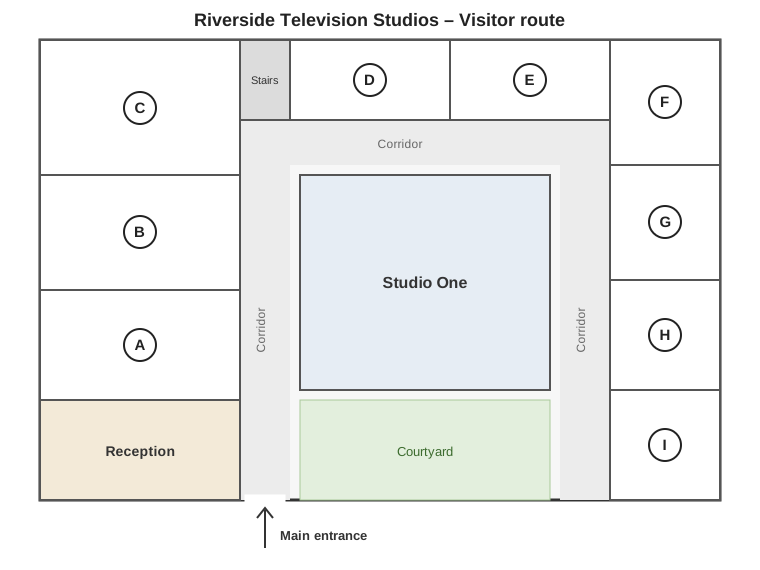
15Make-up room
The answer is A.
In the recording: “The first room you pass on your left is the make-up room, where presenters get ready before they go on air.”
16Green room
The answer is B.
In the recording: “Next to that, also on your left, is the green room, which is where guests wait before they're called into the studio.”
17Control gallery
The answer is D.
In the recording: “Just past the stairs, the first room on your left is the control gallery, where the director sits in front of a whole wall of screens.”
18Costume store
The answer is E.
In the recording: “When the news team moved out, that room became our costume store, and we just never took the sign down.”
19Weather studio
The answer is G.
In the recording: “Now, last year the weather studio was the second room on your left, but we've swapped it with one of the editing suites, so it's now the first room on your left after the rehearsal room.”
20Café
The answer is I.
In the recording: “And finally, at the very end of the corridor, on the left, is the café, where you can have something to eat before you leave.”
Questions 21–25
Choose the correct letter, A, B or C.
21What did Jack find difficult about working in the Post Office archive?
The answer is B.
In the recording: “But most of the documents are handwritten, and some of the clerks had terrible handwriting.”
22What problem does Dr Fleming see in Jack's introduction?
The answer is C.
In the recording: “You describe the reform very clearly, but you don't tell the reader what your position is.”
23What does Dr Fleming say about the section on how letters were paid for before 1840?
The answer is A.
In the recording: “But you spend nearly three pages on it, and it's only background.”
24What is Dr Fleming's opinion of Jack's claim that the Penny Post was an immediate success?
The answer is C.
In the recording: “The Post Office's income fell dramatically, and it was more than thirty years before it got back to where it had been before the reform.”
25What does Dr Fleming tell Jack to do with the story about the poet Coleridge?
The answer is B.
In the recording: “But you should make it clear that it's an anecdote which may not be true, rather than presenting it as a fact.”
Questions 26–30
Complete the summary below. Choose FIVE answers from the box and move them into the gaps.
Jack's plan for revising his essay
Jack will shorten the section on 26. Instead, he will explain why 27 were against the reform, and describe how 28 campaigned for it. The figures for the number of letters will be shown in a 29. In his conclusion, he will discuss the effect of the reform on 30.
- Aa map
- Bmerchants
- Cthe Penny Black
- Dliteracy
- Enewspapers
- Fthe old charges
- Ga table
- HPost Office officials
- Itrade
The answer is F.
In the recording: “You'll have some space to play with once you've cut down the section on the old charges.”
The answer is H.
In the recording: “You mention that senior Post Office officials were against the reform, but you don't explain why.”
The answer is B.
In the recording: “Businesses suffered most from the high cost of postage, and a committee of merchants campaigned very effectively for the reform.”
The answer is G.
In the recording: “They'd be much easier to follow in a table.”
The answer is D.
In the recording: “What's more original is the effect on literacy.”
Questions 31–40
Complete the notes. Write NO MORE THAN TWO WORDS for each answer.
Ice cores as records of past climate
• How the record forms: snow is buried and compressed into ice, and air is trapped in tiny 31
• In parts of Greenland, yearly layers can be counted like the rings of a 32
• Temperature: worked out from the proportions of heavy and light 33
• The EPICA core shows that today's 34 levels are far higher than at any time in 800,000 years
• Volcanic eruptions leave layers of ash and 35, which help scientists check dates
• Cold periods: more 36 in the ice, as the climate was drier and windier
• Human history: lead released by smelting ore from 37 in Spain
• Lead levels fell sharply during 38 in the 2nd and 3rd centuries
• Threat: meltwater can damage the 39 in mountain glaciers
• Ice Memory cores are stored in Antarctica, where no 40 is needed
The answer is bubbles.
In the recording: “As this happens, small amounts of air are sealed inside tiny bubbles, so the ice contains samples of the atmosphere as it was when the snow fell.”
The answer is tree.
In the recording: “In parts of Greenland, where a lot of snow falls each year, the layers are thick enough to be counted, rather like the rings of a tree, which allows individual years to be dated with remarkable precision.”
The answer is oxygen atoms.
In the recording: “The proportions of heavy and light oxygen atoms in the snow depend on how cold it was when the snow formed, so by measuring them, scientists can work out past temperatures.”
The answer is carbon dioxide.
In the recording: “Throughout that time, carbon dioxide levels rose and fell with the temperature, but they never came close to the levels we see in the atmosphere today.”
The answer is acid.
In the recording: “Large volcanic eruptions send ash and acid high into the atmosphere, and these eventually fall onto the ice sheets, leaving distinct layers.”
The answer is dust.
In the recording: “During cold periods, the cores contain far more dust, because the climate was drier and windier, and more dust was blown across the planet from deserts and other dry land.”
The answer is silver mines.
In the recording: “The lead had been released when ore from silver mines, mostly in Spain, was smelted, and it was carried north by the wind.”
The answer is (great) plagues.
In the recording: “The levels rose as the Roman Empire expanded, peaked during its most prosperous period, and fell sharply when two great plagues swept through the empire in the second and third centuries.”
The answer is chemical record.
In the recording: “Mountain glaciers in the Alps, the Andes and the Himalayas are melting rapidly, and even where the ice remains, meltwater seeping down through it can damage the chemical record, mixing layers that took centuries to form.”
The answer is refrigeration.
In the recording: “The site was chosen because the temperature there stays at around minus fifty degrees all year round, so the samples can be kept frozen without any need for refrigeration, which might one day fail.”
Answer key for IELTS Listening Practice Test 8
All 40 answers. Try the questions first, then check here.
- 1 Thwaite
- 2 14
- 3 church
- 4 medium
- 5 pushchair
- 6 seat
- 7 46
- 8 tank
- 9 sister
- 10 folder
- 11 A, D
- 12 A, D
- 13 B, E
- 14 B, E
- 15 A
- 16 B
- 17 D
- 18 E
- 19 G
- 20 I
- 21 B
- 22 C
- 23 A
- 24 C
- 25 B
- 26 F
- 27 H
- 28 B
- 29 G
- 30 D
- 31 bubbles
- 32 tree
- 33 oxygen atoms
- 34 carbon dioxide
- 35 acid
- 36 dust
- 37 silver mines
- 38 (great) plagues
- 39 chemical record
- 40 refrigeration
Ready for the real test?
40 questions in about 30 minutes, on a screen like the computer test. You hear each part once and get your band at the end.
About the real test: ielts.org