IELTS Listening / Practice Test 3
IELTS Listening Practice Test 3: Free, with Answers
This free IELTS Listening Practice Test 3 has 4 parts and 40 questions. Play each part, answer the questions, and see at once if you are right.
0 of 40 checked · 0 right
IELTS Listening Practice Test 3 · Part 1
A man phoning a gym to become a member
Here you can stop and play again. In the real test you hear it once.
Part 1 transcript
Megan:Good afternoon, Riverside Fitness, Megan speaking. How can I help you?
Ryan:Hi there. I'm calling because I'd like to join the gym. I've just moved to the area, and a friend at work told me you're the best place around here.
Megan:Oh, that's nice to hear. Well, I can set up your membership over the phone right now, if you like, and then you just come in to collect your card.
Ryan:Great, let's do that.
Megan:OK. Can I start with your name?
Ryan:Sure. It's Ryan Mitchell.
Megan:Ryan Mitchell. And what's your address, Ryan?
Ryan:It's twenty-seven Gaskell Street. That's in Brookfield.
Megan:Sorry, could you spell the name of the street for me?
Ryan:Of course. It's G-A-S-K-E-L-L.
Megan:Two Ls at the end?
Ryan:That's right. People always leave one off.
Megan:Thanks. And what do you do for a living? I only ask because some employers have a discount arrangement with us.
Ryan:Oh, OK. Well, back home I used to be a firefighter, but here I'm working as a paramedic, with the ambulance service.
Megan:A paramedic. Then you're in luck, because ambulance staff get ten per cent off.
Ryan:Even better.
Megan:Now, when would you like your membership to start?
Ryan:I was going to say this Saturday, the fourteenth. But actually, I'm away visiting my parents that week, so there wouldn't be much point. Could we make it the Saturday after, the twenty-first?
Megan:No problem. Saturday the twenty-first of June it is. And just so I can let the trainers know, have you got a particular goal in mind?
Ryan:I have, yes. My brother's always running marathons, and somehow he talked me into doing something even crazier. I've signed up for a triathlon in September. So I really need to get my swimming up to standard.
Megan:A triathlon, that's ambitious! The trainers will love that. Right, the last thing is the type of membership. Our standard membership is forty-eight pounds a month, and that lets you come in at any time. Then there's off-peak, which is thirty-two pounds. That's for weekdays between ten and four, and any time at weekends.
Ryan:Well, I work shifts, so I'm often free during the day. I think off-peak would suit me best.
Megan:Off-peak, then, at thirty-two pounds. And that's before your ten per cent discount, which comes off at the end of each month.
Ryan:That's fine.
Megan:Now, as you're new, let me tell you a bit about how things work here. Before you can use any of the equipment, you'll need to do an induction.
Ryan:OK. What does that involve?
Megan:It's a forty-five-minute session with one of our personal trainers. They show you how to use the machines safely and set up a programme for you. It's free, and you can book it at reception when you come in.
Ryan:Sounds good. Do I need to bring anything with me?
Megan:Well, we provide towels, so you don't need to worry about those. But the lockers don't have keys, so you'll need to bring your own padlock. And a water bottle, of course, although you can buy one here if you forget.
Ryan:A padlock, right. What about the classes? Do I just turn up?
Megan:No, they get very full, especially the evening ones, so you have to book. People used to phone us to do that, but now all the bookings are made through our app. You'll get a link to download it in your welcome email.
Ryan:And the swimming pool's included, isn't it? I'll be needing that for the triathlon.
Megan:Ah. I'm afraid the pool's closed at the moment. We're having the roof replaced, and it won't reopen until the end of August. But to make up for it, we're letting all members use the steam room for free. Normally that costs extra.
Ryan:Oh, that's a shame about the pool. I guess I'll have to swim at the public baths for a while.
Megan:A lot of our members are doing that. The leisure centre on the high street is only five minutes away.
Ryan:OK. And finally, is there anywhere to park? I'll probably drive over after work.
Megan:Yes, there's a car park at the back of the building. It's free for members for up to three hours, but you need to display a parking permit. So when you come in to collect your membership card, just ask at the desk and they'll give you one.
Ryan:Perfect. Thanks so much for your help, Megan.
Megan:You're welcome, Ryan. See you on the twenty-first.
Part 2 transcript
Guide:Good morning, everyone, and welcome to Millbrook Museum. My name's Martin, and I'm one of the volunteer guides. I'm delighted to be showing you round in our very first week since we reopened. As most of you probably know, the museum was closed for almost two years while the building was renovated. Before we start the tour, I'd like to give you a quick idea of where everything is on the ground floor, so if you look at the plan in your leaflet, you'll be able to follow me.
Guide:We're standing in the entrance hall now, with the reception desk right in front of us. If you have coats or large bags, you'll want to leave them in the cloakroom. That's the first room on your left as you come in through the main doors, and it's free to use. On the other side of the entrance hall, to the right of the doors, is the room that used to be the shop. The shop has actually moved upstairs, and that room is now the ticket office for our evening events, so you won't need it today.
Guide:If you walk straight past reception, you come out into the courtyard. This used to be open to the sky, which meant it was hardly ever used, because it rained so often. As part of the renovation, a glass roof was added, and now it's one of the most popular spaces in the building. On the left-hand side of the courtyard is the children's activity room. It's the one with the big windows, so parents can sit in the courtyard and keep an eye on their children while they draw or build things. On the right-hand side of the courtyard there are two rooms. The one nearer to the entrance is where we keep the textile collection, including some beautiful nineteenth-century lace that was made here in Millbrook. The other one, further back, is our education room. That's used by school groups, so it's usually closed to the public.
Guide:Now, at the far end of the courtyard, directly opposite the way you came in, is the largest room in the museum. This is where we hold our temporary exhibitions. To the left of it are the toilets, and beyond those, in the back left-hand corner of the building, are the staff offices. And finally, in the back right-hand corner, there's the café. You can get to it from the courtyard, of course, but it also has its own door onto the garden, so you can take your coffee outside on a fine day.
Guide:Now, before we go round, a few words about the renovation itself. People often assume that the work was done to repair the damage from the floods three years ago. In fact, the water only reached the cellar, and that was put right quite quickly. The real reason for the project was that the old building was very difficult for many visitors to get around. There were steps everywhere, and anyone in a wheelchair or with a pushchair simply couldn't reach the upper floor. So the main aim was to make every part of the museum accessible to everyone, and we now have a lift and ramps throughout. We did gain a little extra space when the courtyard was covered, but that was really just a bonus.
Guide:Many of you will remember the model of Millbrook as it was in nineteen hundred, which used to stand in the entrance hall. A lot of people have asked what happened to it. During the building work, it was put into storage, and when we took it out again, we found that some of the tiny houses had been damaged by damp. One of our volunteers, a retired engineer, has spent the last six months rebuilding them by hand, and the model should be back on display next month. Some people suggested replacing it with a digital version on a screen, but we felt that visitors, especially children, would much rather see the real thing.
Guide:As for the exhibition that's on in the large room at the moment, it's a collection of photographs of the town in the nineteen-fifties. What makes it special is where the pictures came from. Before we reopened, we put out an appeal, and we were amazed by the response. More than three hundred local families lent us photos from their own albums, and most of them have never been seen in public before. The exhibition runs until the end of March, and after that, it'll be replaced by one on the history of the town's football club.
Guide:Finally, a practical tip. Since we reopened, we've been much busier than we expected, especially at weekends, and on weekday mornings, when the school groups come in. So if you'd like to come back and explore on your own, the quietest time is weekday afternoons, after about three o'clock. And if you do come back, remember that your ticket today is valid for a whole year, so there's no need to pay again.
Part 3 transcript
Hughes:Come in, both of you, have a seat. So, you wanted to talk about your project on the impact of tourism. Remind me which place you chose in the end?
Amy:Seabrook. It's a fishing village on the south coast, about an hour from here.
Hughes:I know it. Why Seabrook, out of interest? I thought you were considering one of the big seaside resorts.
Leo:We were, at first. But there's already loads of research on places like that. Seabrook's different, because until about five years ago, hardly anyone went there. Then a couple of travel videos about it went viral online, and now it gets thousands of visitors every summer. So it's a chance to look at what happens when tourism arrives really suddenly.
Amy:It also helped that my aunt lives there, so we had somewhere to stay. But that wasn't really the reason.
Hughes:That makes sense. And how did you collect your data?
Leo:We did a questionnaire for residents, and we interviewed some of the business owners. The questionnaire was the tricky part.
Hughes:In what way?
Leo:Well, we'd planned to do it all online, because that's so much quicker to analyse. But a lot of the people who've lived in Seabrook the longest are retired, and quite a few of them told us straight away that they weren't going to fill in forms on the internet.
Amy:So we ended up printing copies and going from door to door. It took twice as long, but in the end we got a hundred and twenty responses, which was actually more than we'd hoped for.
Hughes:Good for you. And what were the main findings?
Amy:Well, one thing that surprised us was employment. We assumed people would say tourism had created lots of jobs, and it has, in a way. But nearly all of them are seasonal. They only last from May to September, so a lot of young people still have to leave the village to find work.
Hughes:That's a really important point. I wouldn't just mention it in passing, I'd make it one of the central arguments of your report, because it challenges the usual claim that tourism always benefits the local economy.
Leo:OK, we can do that.
Hughes:What about housing? That's often the most controversial issue in places like this.
Leo:Yes, it's a big issue. A lot of the cottages have been bought as holiday homes, and some of them are rented out to tourists all year round.
Amy:Some residents told us that holiday homes should simply be banned. Personally, I don't think that's the answer. I think it'd be fairer to make the owners pay a much higher tax, and use the money to build affordable houses for local families.
Leo:I'm not so sure. I think limiting the number of holiday rentals would work better. But we've agreed to present both views.
Hughes:Fine, as long as you make it clear which view the evidence supports. Anything else that stood out?
Amy:The general attitude of the residents. We expected them to be quite negative, because of all the newspaper stories about crowds and traffic. But actually, most people said that on balance, tourism had been good for the village, mainly because it had saved the village shop and the pub, which were both about to close.
Hughes:Now, your plan says the second half of the report will look at specific impacts. Shall we go through them?
Leo:Sure. The first one's traffic. Everyone mentioned it, and you'd expect it to be a nightmare in a village with such narrow streets. But actually, the council has already sorted most of it out. They opened a park-and-ride on the edge of the village two years ago, so visitors leave their cars there and take a bus in. It's much less of a problem than it used to be.
Amy:Then there's noise. Some residents complained about people coming out of the bars late at night.
Hughes:Is that a widespread problem?
Amy:There aren't any official figures, but we don't think so. When we looked at where the complaints came from, they were almost all from the few streets around the harbour, where the bars are. In the rest of the village, people said it was as quiet as ever.
Leo:The fishing industry was interesting. We assumed tourism would have nothing to do with it, or might even harm it, because the harbour's so crowded now. But the fishermen we spoke to told us the opposite. A lot of them now sell their catch directly to the restaurants that have opened for the tourists, and they get a much better price than they would at the market.
Hughes:And the coastal path? I imagine that's suffering, with so many walkers.
Amy:It is, and the worrying thing is that visitor numbers are still growing every year. Parts of the path near the cliffs are already badly eroded, and the trust that looks after it says that without serious investment, some sections will have to close.
Leo:And the last one is the summer festival. That started as a small event for local people, but now it attracts visitors from all over the country.
Hughes:How do the residents feel about that?
Leo:That's the thing. It's really divided opinion. Some people love it, and say it's put Seabrook on the map. Others told us it's been completely taken over by tourists, and they don't even go any more.
Amy:It was actually the topic people got most heated about in the interviews.
Hughes:Well, it sounds like a well-organised report. My only other suggestion would be a short section at the end comparing Seabrook with a village that hasn't become popular, so you have something to measure the changes against.
Part 4 transcript
Lecturer:Good morning. Today I'm going to talk about a trend that has spread rapidly through many of the world's cities over the last twenty years or so, and that's urban beekeeping. In cities such as London, Paris and New York, it's now quite common to find hives on the roofs of offices, hotels and even famous buildings. In London, for example, the number of hives is estimated to have roughly doubled in a decade. So what lies behind this trend, and, more importantly, is it actually good for bees?
Lecturer:The main driver has been public concern about the decline of bees. From the early two thousands onwards, there were widespread reports of honeybee colonies dying, and many people wanted to do something practical to help. Keeping a hive on a roof or in a back garden seemed an obvious solution. Some of that concern was based on a misunderstanding, as I'll explain later, but it certainly encouraged thousands of people to take up the hobby. Companies have also become involved, partly because it improves their public image. A hive on the roof is a very visible way of showing that a business cares about the environment, although some critics have started calling this practice "bee-washing".
Lecturer:Now, you might expect a city to be a poor place for bees, but in many ways cities suit honeybees surprisingly well. For one thing, they contain an enormous variety of plants. Parks, private gardens, roadside verges and even balconies are full of flowers, and because gardeners choose plants from all over the world, something is in flower for most of the year. In fact, hives in cities often produce more honey than those in the countryside, where large areas may be planted with a single crop, and there's very little for bees to eat once that crop has finished flowering. Cities are also slightly warmer than the surrounding land, which means bees can start foraging earlier in the spring. And finally, city bees are exposed to lower levels of pesticides than bees living on intensively farmed land. Some studies have even suggested that urban colonies are healthier overall, although the evidence on that point is still quite limited.
Lecturer:However, there's growing concern that the boom in urban beekeeping has gone too far. The problem is that honeybees are just one of many bee species. In Britain alone, there are around two hundred and seventy species of bee, and most of them are wild bees, such as bumblebees and solitary bees, which don't live in hives at all. Honeybees, by contrast, are managed by beekeepers rather like farm animals, so their numbers aren't really under threat. The wild bees are generally in far greater danger, and they depend on the same flowers. In parts of central London, researchers have calculated that there are now so many hives that the honeybees need more pollen and nectar than the local flowers can provide. In other words, adding more hives may actually be harming the very species people are trying to protect. There's also the problem of disease. When hives are kept close together, parasites and infections can spread from one colony to another far more easily. The parasite that worries beekeepers most is a mite called varroa, which weakens the bees and carries viruses between them.
Lecturer:Interestingly, though, urban hives have found an unexpected scientific use. Because bees collect nectar from an area several kilometres across, the honey they produce contains tiny traces of whatever is in the local environment. Researchers in Vancouver, in Canada, analysed honey from hives all over the city, and found that honey from the downtown area and near the port contained higher levels of lead than honey from quieter residential districts. The levels were far below anything that would be harmful to people, so the honey itself was perfectly safe to eat. So honey can act as a kind of environmental record, showing how pollution varies from one neighbourhood to another, and it's far cheaper than installing monitoring equipment.
Lecturer:So what should people who want to help bees actually do? Most experts now argue that, rather than setting up new hives, the most effective thing is to increase the amount of food available for all bees. That means planting flowers that bees can use, ideally native species, and leaving some areas of grass uncut so that wild flowers have a chance to grow. Some cities have also started to require a permit before a new hive can be placed in an area that already has a lot of them. The message, in short, is this: plant more flowers, don't just add more bees.
Questions 1–5
Complete the form. Write ONE WORD AND/OR A NUMBER for each answer.
RIVERSIDE FITNESS – New member
• Name: Ryan Mitchell
• Address: 27 1 Street, Brookfield
• Job: 2 (10% discount)
• Start date: Saturday 3 June
• Aim: to prepare for a 4 in September
• Membership: off-peak – £5 a month before discount
The answer is Gaskell.
In the recording: “It's twenty-seven Gaskell Street.”
The answer is paramedic.
In the recording: “Well, back home I used to be a firefighter, but here I'm working as a paramedic, with the ambulance service.”
The answer is 21.
In the recording: “Could we make it the Saturday after, the twenty-first?”
The answer is triathlon.
In the recording: “I've signed up for a triathlon in September.”
The answer is 32.
In the recording: “Then there's off-peak, which is thirty-two pounds.”
Questions 6–10
Complete the notes. Write NO MORE THAN TWO WORDS for each answer.
Information for new members
• Induction: a 45-minute session with a 6
• Bring your own 7 for the lockers
• Classes must be booked through the 8
• Pool closed until end of August – members can use the 9 free of charge
• Car park: free for 3 hours with a 10 (ask at the desk)
The answer is personal trainer.
In the recording: “It's a forty-five-minute session with one of our personal trainers.”
The answer is padlock.
In the recording: “But the lockers don't have keys, so you'll need to bring your own padlock.”
The answer is app.
In the recording: “People used to phone us to do that, but now all the bookings are made through our app.”
The answer is steam room.
In the recording: “But to make up for it, we're letting all members use the steam room for free.”
The answer is parking permit.
In the recording: “It's free for members for up to three hours, but you need to display a parking permit.”
Questions 11–16
Label the plan. Choose the correct letter, A–H, for each label.
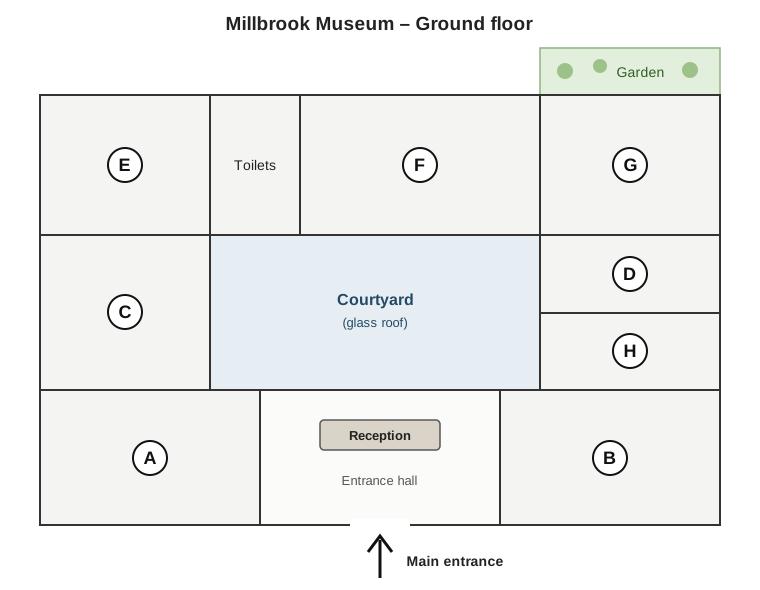
11Cloakroom
The answer is A.
In the recording: “If you have coats or large bags, you'll want to leave them in the cloakroom.”
12Ticket office
The answer is B.
In the recording: “The shop has actually moved upstairs, and that room is now the ticket office for our evening events, so you won't need it today.”
13Children's activity room
The answer is C.
In the recording: “On the left-hand side of the courtyard is the children's activity room.”
14Textile collection
The answer is H.
In the recording: “The one nearer to the entrance is where we keep the textile collection, including some beautiful nineteenth-century lace that was made here in Millbrook.”
15Temporary exhibitions
The answer is F.
In the recording: “This is where we hold our temporary exhibitions.”
16Café
The answer is G.
In the recording: “And finally, in the back right-hand corner, there's the café.”
Questions 17–20
Choose the correct answer.
17What was the main purpose of the renovation?
The answer is A.
In the recording: “So the main aim was to make every part of the museum accessible to everyone, and we now have a lift and ramps throughout.”
18What does the guide say about the model of the town?
The answer is B.
In the recording: “One of our volunteers, a retired engineer, has spent the last six months rebuilding them by hand, and the model should be back on display next month.”
19What is special about the current photography exhibition?
The answer is C.
In the recording: “More than three hundred local families lent us photos from their own albums, and most of them have never been seen in public before.”
20When does the guide suggest visiting to avoid the crowds?
The answer is C.
In the recording: “So if you'd like to come back and explore on your own, the quietest time is weekday afternoons, after about three o'clock.”
Questions 21–25
Choose the correct answer.
21Why did the students choose Seabrook for their project?
The answer is C.
In the recording: “Then a couple of travel videos about it went viral online, and now it gets thousands of visitors every summer.”
22What problem did they have with their questionnaire?
The answer is A.
In the recording: “But a lot of the people who've lived in Seabrook the longest are retired, and quite a few of them told us straight away that they weren't going to fill in forms on the internet.”
23What does the tutor say about the findings on employment?
The answer is B.
In the recording: “I wouldn't just mention it in passing, I'd make it one of the central arguments of your report, because it challenges the usual claim that tourism always benefits the local economy.”
24What is Amy's view on holiday homes?
The answer is B.
In the recording: “I think it'd be fairer to make the owners pay a much higher tax, and use the money to build affordable houses for local families.”
25What surprised the students about the residents' attitudes?
The answer is A.
In the recording: “But actually, most people said that on balance, tourism had been good for the village, mainly because it had saved the village shop and the pub, which were both about to close.”
Questions 26–30
Choose the correct answer for each gap.
Comments
- AIt has been exaggerated in the media.
- BIt affects only one part of the village.
- CA solution has already been found.
- DIt is likely to get worse.
- EIt has had an unexpected benefit.
- FThere is no reliable information about it.
- GPeople have very different views about it.
26traffic
The answer is C.
In the recording: “They opened a park-and-ride on the edge of the village two years ago, so visitors leave their cars there and take a bus in.”
27noise
The answer is B.
In the recording: “When we looked at where the complaints came from, they were almost all from the few streets around the harbour, where the bars are.”
28the fishing industry
The answer is E.
In the recording: “A lot of them now sell their catch directly to the restaurants that have opened for the tourists, and they get a much better price than they would at the market.”
29the coastal path
The answer is D.
In the recording: “It is, and the worrying thing is that visitor numbers are still growing every year.”
30the summer festival
The answer is G.
In the recording: “It's really divided opinion.”
Questions 31–40
Complete the notes. Write NO MORE THAN TWO WORDS for each answer.
Urban beekeeping
Background
• hives are now common on city roofs, e.g. London, Paris
• main reason for the trend: worries about the 31 of bees
• businesses: a hive can help their 32
Why cities suit honeybees
• wide range of plants, so there is something 33 most of the year
• in the countryside, land is often used for a 34, so food runs out
• higher temperatures allow bees to begin 35 sooner
• less contact with 36 than on farms
Problems
• honeybees take food from 37, which are more endangered
• disease spreads quickly when hives are 38
A scientific use
• Vancouver: honey from busy areas contained more 39
• a cheap way to compare pollution between neighbourhoods
How to help
• plant flowers – preferably 40 – and leave some grass uncut
The answer is decline.
In the recording: “The main driver has been public concern about the decline of bees.”
The answer is (public) image.
In the recording: “Companies have also become involved, partly because it improves their public image.”
The answer is in flower.
In the recording: “Parks, private gardens, roadside verges and even balconies are full of flowers, and because gardeners choose plants from all over the world, something is in flower for most of the year.”
The answer is single crop.
In the recording: “In fact, hives in cities often produce more honey than those in the countryside, where large areas may be planted with a single crop, and there's very little for bees to eat once that crop has finished flowering.”
The answer is foraging.
In the recording: “Cities are also slightly warmer than the surrounding land, which means bees can start foraging earlier in the spring.”
The answer is pesticides.
In the recording: “And finally, city bees are exposed to lower levels of pesticides than bees living on intensively farmed land.”
The answer is wild bees.
In the recording: “In Britain alone, there are around two hundred and seventy species of bee, and most of them are wild bees, such as bumblebees and solitary bees, which don't live in hives at all.”
The answer is close together.
In the recording: “When hives are kept close together, parasites and infections can spread from one colony to another far more easily.”
The answer is lead.
In the recording: “Researchers in Vancouver, in Canada, analysed honey from hives all over the city, and found that honey from the downtown area and near the port contained higher levels of lead than honey from quieter residential districts.”
The answer is native species.
In the recording: “That means planting flowers that bees can use, ideally native species, and leaving some areas of grass uncut so that wild flowers have a chance to grow.”
Answer key for IELTS Listening Practice Test 3
All 40 answers. Try the questions first, then check here.
- 1 Gaskell
- 2 paramedic
- 3 21
- 4 triathlon
- 5 32
- 6 personal trainer
- 7 padlock
- 8 app
- 9 steam room
- 10 parking permit
- 11 A
- 12 B
- 13 C
- 14 H
- 15 F
- 16 G
- 17 A
- 18 B
- 19 C
- 20 C
- 21 C
- 22 A
- 23 B
- 24 B
- 25 A
- 26 C
- 27 B
- 28 E
- 29 D
- 30 G
- 31 decline
- 32 (public) image
- 33 in flower
- 34 single crop
- 35 foraging
- 36 pesticides
- 37 wild bees
- 38 close together
- 39 lead
- 40 native species
Ready for the real test?
40 questions in about 30 minutes, on a screen like the computer test. You hear each part once and get your band at the end.
About the real test: ielts.org