IELTS Listening / Practice Test 1
IELTS Listening Practice Test 1: Free, with Answers
This free IELTS Listening Practice Test 1 has 4 parts and 40 questions. Play each part, answer the questions, and see at once if you are right.
0 of 40 checked · 0 right
IELTS Listening Practice Test 1 · Part 1
A telephone conversation about booking a cycle tour
Here you can stop and play again. In the real test you hear it once.
Part 1 transcript
Receptionist:Good morning, Greenway Cycle Tours, Lucy speaking. How can I help?
Daniel:Oh, hi there. I'm calling about a group booking. I organise the social events for the people at my work, and we're thinking about doing one of your bike tours next month.
Receptionist:Lovely. Well, I can certainly take some details and check what's available. Could I start with your name?
Daniel:Sure. It's Daniel Pryce.
Receptionist:Is that P, R, I, C, E?
Daniel:No, it's spelt P, R, Y, C, E. People always get that wrong.
Receptionist:Sorry about that. P, R, Y, C, E. And what's the name of the company you work for?
Daniel:It's Harbour Freight. So, harbour, like a harbour for boats, and then freight, that's F, R, E, I, G, H, T.
Receptionist:Harbour Freight. Got it. And how many people would be coming along?
Daniel:Well, when I first put a notice up, about twenty people signed up, but a few have dropped out since then, so it's now sixteen.
Receptionist:Sixteen. That's a nice size, actually. Our guides prefer to keep groups under twenty anyway.
Daniel:Oh, good.
Receptionist:And did you have a date in mind?
Daniel:We were hoping for a Saturday in May. Is the twentieth free?
Receptionist:Let me just have a look. Ah, I'm afraid the twentieth is fully booked. We've got a large school group that day. But the following Saturday, the twenty-seventh, is completely free at the moment.
Daniel:The twenty-seventh. Yes, that should be fine. Most people said any Saturday in May would work for them.
Receptionist:OK, so I'll put you down for Saturday the twenty-seventh of May. Now, we run two different routes on Saturdays. There's the Coastal Route, which is our most popular one, but it's quite demanding. It's about forty kilometres, and there are a couple of steep hills.
Daniel:Hmm, that might be a bit much. Some of our group haven't been on a bike for years.
Receptionist:In that case, I'd suggest the Lakeside Route. It's much flatter, and it goes all the way round Elmer Lake and through the forest.
Daniel:That sounds much better. Let's go for the Lakeside one.
Daniel:Can I just check how long the Lakeside Route is? People are bound to ask me.
Receptionist:Of course. It's twenty-five kilometres in total. With all the stops, the whole tour takes about five hours.
Daniel:Twenty-five. That's manageable. And where do we meet?
Receptionist:Well, our website still says we meet outside the old post office, but we've actually moved. We now meet outside the library in Market Square. The guide will be waiting there with the bikes at half past nine.
Daniel:Outside the library. Right. And what about the cost? The website says forty-five pounds per person.
Receptionist:Yes, that's our standard price, and it includes the bike, a helmet and a guide. But for groups of more than twelve we give a discount, so for your group it would be thirty-eight pounds each.
Daniel:Oh, that's good news. And is lunch included?
Receptionist:It is. We stop for a picnic lunch at Hollow Farm, which is about halfway round. The farm prepares the food for us, so if anyone in your group has any allergies, you'll need to let us know at least a week before.
Daniel:Right, I'll ask everyone. Actually, one of my colleagues can't eat nuts, so I'll definitely mention that.
Receptionist:Thank you. Now, to confirm the booking, we'll need a deposit of one hundred pounds.
Daniel:No problem. When do you need it by?
Receptionist:We'd normally ask for it within seven days, so that would be next Monday. But our office is closed on Monday because of the bank holiday, so could you get it to us by Thursday?
Daniel:By Thursday. Fine, I'll sort that out today.
Receptionist:Wonderful. I'll email you a booking confirmation in the next few minutes.
Daniel:Great. Thanks very much for your help, Lucy.
Receptionist:You're very welcome. Bye now.
Part 2 transcript
Graham:Good morning, everyone, and welcome to Fernhill Wetland Centre. My name's Graham Hollis, and I'm the centre manager. Thanks so much for giving up your time to volunteer with us. Honestly, we couldn't run the place without you. I'll start by telling you a little about the centre, and then I'll take you through the map in your welcome pack, so you know where everything is.
Graham:A lot of visitors assume that this site was always a natural wetland, or that it was farmland that was flooded. And it's true that the fields to the north are still farmed. But the lake you can see in front of you was actually created by people. Until nineteen ninety, this whole area was a gravel quarry. When the digging stopped, the pits slowly filled with water from the river, and nature gradually took over. The trust bought the land in nineteen ninety-five, and we opened to the public three years later.
Graham:Now, you've all signed up for different shifts. Those of you on weekday shifts will spend a lot of your time with school groups, because we get two or three classes visiting most days. The café, by the way, is run by our paid staff, so you won't be asked to work there. The Saturday morning team has a slightly different role. On Saturdays the reserve is quieter early on, so that team's main job is to help our ecologist count the birds on the lake. It's one of the most important things we do, because the numbers are sent to a national database every month.
Graham:You'll also notice that our visitor centre has just been rebuilt, and we're very proud of it. People often ask about the timber. It isn't recycled, actually, but it does come from a local forest that's managed sustainably. We'd hoped to put solar panels on the roof as well, but unfortunately that's been delayed until next year because of the cost. What we have done is fit a system that collects rainwater from the roof, and that water is used to flush all the toilets in the building, which saves a huge amount of mains water.
Graham:Just a couple of rules before we look at the map. You're very welcome to use the staff car park. You'll be given a permit at the end of this session. Visitors are allowed to feed the ducks with the special seed we sell in the shop, so please don't stop them doing that. But there's one rule that's very important for your own safety. The paths through the reed beds are quite remote, and the ground can be uneven, so please don't go onto those paths on your own. Always go with at least one other person.
Graham:Right, if you'd like to look at the map in your pack. You'll see the main entrance at the bottom of the map, with the car park on the right as you come in. Just inside the entrance gate, on your left, there's a small brick building. That used to be the ticket office, but it's now our first-aid room. If anyone is injured, that's where you take them. There's always a trained first-aider on duty.
Graham:Walk straight ahead and you come to the visitor centre. If you go round the left-hand side of the building, towards the woods, you'll find the children's play area. It's fenced in, so parents can relax in the café garden and keep an eye on their children.
Graham:Carry on past the play area and you'll reach the edge of the woodland. There's a huge old oak tree there, right where the woodland trail begins, and that's where you should meet at the start of every shift. Please don't wait inside the visitor centre. It gets very busy at weekends.
Graham:If you follow the woodland trail north, it takes you all the way up to the footbridge over the stream. Just before you reach the bridge, on the right-hand side of the path, there's a wooden shed. That's the tool store, and the key is kept in the volunteers' office.
Graham:Now, back to the visitor centre. If you go out of the back door, you'll be on the south shore of the lake. Turn right, and after about a hundred metres there are some tables along the water's edge. That's the picnic area. Visitors love it, but please remind them to take their rubbish home.
Graham:And finally, the highlight for most of our visitors is the bird hide. To get there, you take the boardwalk, which starts at the eastern end of the lake and crosses the reed beds. Don't take the first path off the boardwalk. That one just goes to a viewing platform. Keep going right to the very end of the boardwalk, and the hide is there, looking back across the lake. It's the best place to see herons, and if you're very lucky, an otter.
Graham:OK, that's everything on the map. Are there any questions so far?
Part 3 transcript
Tom:So, Maya, did you get a chance to look at the draft I sent you last night?
Maya:I did, and I think it's really coming together. I was just thinking back to how we picked the topic, actually. Dr Lawson gave us that long list of suggestions, and food waste wasn't even on it.
Tom:No, it was all energy and transport, wasn't it? I was worried she'd say no.
Maya:Me too. But after that first week of eating in the dining hall, I couldn't stop thinking about the bins by the exit. They were overflowing every single lunchtime.
Tom:Yeah, that's what got me as well. Just seeing how much perfectly good food went in there. I did wonder at first whether it had all been done before. There's actually loads of research on food waste in schools and hospitals.
Maya:Right, but nobody had looked at our campus, so it still felt worth doing.
Tom:And then there was the survey.
Maya:Don't remind me. I still can't believe how many people filled it in. Two hundred responses in three days.
Tom:That was the easy part. It only took about five minutes to do, so people didn't mind. The real problem was question seven.
Maya:The one about portion size?
Tom:Yeah. Half the people thought "portion" meant the amount they took themselves, and the other half thought it meant what the staff gave them. So we couldn't really use those answers.
Maya:We definitely need to word it better next time.
Tom:What I found most surprising, though, wasn't really about the students at all.
Maya:The breakfast thing? I really expected breakfast to be worse than dinner, because everyone's always in a rush in the morning.
Tom:Well, it was a bit worse, but only slightly. No, I meant the kitchen. When we weighed everything, most of the waste was food that never even left the kitchen. Whole trays of pasta and rice that were cooked but never served.
Maya:Yes, that was a real shock. I'd assumed it would mostly be leftovers on people's plates.
Tom:And the vegetarian dishes were always the first to run out, so there was hardly any waste there at all.
Maya:That's a good point for the recommendations. Now, what about all the photos we took of people's plates? I counted them, and there are over three hundred.
Tom:There's no way we can show three hundred photos in a fifteen-minute presentation.
Maya:I know, but they're so powerful. I thought maybe we could put them all in an appendix?
Tom:Dr Lawson said appendices aren't marked for presentations, so there's not much point. Why don't we just pick out half a dozen that really show the problem?
Maya:OK, fair enough. Six good ones.
Tom:Oh, and I meant to ask. How did the meeting with the dining hall manager go? I thought she might be a bit defensive, to be honest.
Maya:So did I, but she was really open. She said they'd talked about using smaller plates, though they haven't actually tried it yet. And at the end she asked if she could have a copy of our final report. She wants to show it to the catering committee.
Tom:That's brilliant.
Tom:So, shall we go through the presentation section by section?
Maya:Sure. Starting with the introduction. I know we planned to begin with the background, all the global figures, but I think that's a bit dull.
Tom:Agreed. What if we got people involved straight away? Something like, "Hands up if you finished everything on your plate at lunch today."
Maya:I love that. That'll wake them up.
Tom:Then the survey method. At the moment it's four slides.
Maya:That's far too many. Nobody wants to hear how we designed the questionnaire. One slide is plenty.
Tom:Yeah, let's cut it right down.
Maya:Then the kitchen observations. I think that's our strongest section.
Tom:It is. We've already got lots of numbers there, so I don't think we need any more. But remember the clip we filmed of the chef scraping the trays into the bin? The manager said we could use it.
Maya:Oh, yes. Just thirty seconds of that would be really effective. Let's put it in.
Tom:OK. What about the comparison with other universities?
Maya:Hmm. I emailed four universities and only one replied, so we don't really have enough to compare.
Tom:Should we move it to the end, then, as a suggestion for further research?
Maya:I'd rather just take it out completely. It'll only raise questions we can't answer.
Tom:Fair enough. It goes.
Maya:And finally, the recommendations.
Tom:I think the ideas are good, but they need figures behind them. If we can say how much money the university would save by cooking less pasta, for example, people will take them much more seriously.
Maya:Good idea. I'll work out the costs using the numbers the manager gave us.
Tom:Great. Shall we meet again on Thursday to rehearse?
Maya:Thursday's perfect.
Part 4 transcript
Lecturer:Good morning, everyone. In today's lecture, I'm going to talk about one of the most remarkable ecosystems on the planet: mangrove forests. I'll start with where they grow and how they survive, then look at why they matter so much, and finish with what's being done to protect them.
Lecturer:Mangroves are trees and shrubs found along tropical and subtropical coastlines, and they occupy a very particular strip of land. Not the deep water offshore, and not the dry ground behind the beach, but the tidal zone, the area between the high-water and low-water marks. Twice a day their roots are covered by sea water, and twice a day they're exposed to the air again. Very few plants can tolerate those conditions, so it's worth looking at how mangroves manage it.
Lecturer:The first challenge is oxygen. The mud they grow in is thick and waterlogged, and it contains almost no oxygen at all. Some species deal with this using roots that do something quite unusual: instead of growing down, they grow up, out of the mud. These roots are covered in tiny pores, and when the tide goes out, they take in air. They've been compared to chimneys, and even to drinking straws, but personally I think the best comparison is a snorkel, which lets a swimmer breathe while the rest of the body stays under the surface.
Lecturer:The second challenge, of course, is salt. You might expect the roots to deal with this, and in some species they do filter out a great deal of it before it enters the plant. But many mangroves also have a second line of defence. They push the excess salt out through special glands in their leaves. If you lick a mangrove leaf, which I don't necessarily recommend, it tastes salty, and on a dry day you can even see tiny white crystals on the surface.
Lecturer:Reproduction is unusual, too. Most plants drop their seeds, which then germinate in the soil. Many mangroves, however, are what biologists call viviparous. The seed begins to grow into a young plant while it's still attached to the parent tree, sometimes for several months. When it finally drops, it can take root in the mud almost immediately, or, if the tide carries it away, it can float for up to a year before settling somewhere new.
Lecturer:So, why do mangroves matter? Well, first of all, they're a natural form of coastal defence. You'll often read that they prevent flooding, which is only partly true; a large storm surge will flood a mangrove coast too. What they really do well is hold the shoreline together. Their dense roots trap sediment and keep the mud in place, which greatly reduces erosion. After the Indian Ocean tsunami in two thousand and four, several studies found that villages behind healthy mangroves suffered less damage, although scientists still argue about how much difference the forests actually made.
Lecturer:Second, mangroves are vital for wildlife. The tangle of roots creates a sheltered environment that larger predators can't easily enter, so the forest functions as a nursery for young fish and crabs. In fact, a large share of the fish caught commercially in tropical regions spend the early part of their lives among mangrove roots before moving out to the reefs.
Lecturer:And third, there's the climate. Mangroves are extremely efficient at storing carbon, but most of it isn't held in the trees themselves. It's locked in the waterlogged soil beneath them, where, because there's so little oxygen, it can remain for thousands of years.
Lecturer:Despite all this, mangroves have been disappearing fast. Some have been lost to coastal development, such as hotels and ports, pollution has played a part, and so has the cutting of timber for fuel. But in many countries, the single biggest cause has been aquaculture: in particular, the clearing of mangroves to make way for shrimp farms. These farms are frequently abandoned after just a few years, once the ponds become too polluted, leaving land where almost nothing will grow.
Lecturer:The good news is that there's now a great deal of interest in restoring mangroves. But early attempts were often disappointing. In some projects, millions of seedlings were planted and almost all of them died. At first, people blamed the choice of species, or a lack of watering and care. Neither turned out to be the real problem. The seedlings had simply been planted in the wrong locations, usually too low on the shore, where they spent too long under water. Today, ecologists first study how water naturally flows across a site before anything is planted.
Lecturer:The other lesson is about people. Many projects have been led by governments or international charities, and some have relied heavily on volunteers. But those run entirely from outside tend to collapse once the funding comes to an end. The most successful ones involve local communities from the very beginning, because the people who live alongside the forest are the ones who will protect it in the long term.
Lecturer:Next time, we'll look at a case study from Southeast Asia where this approach has been used.
Questions 1–10
Complete the notes. Write ONE WORD AND/OR A NUMBER for each answer.
GREENWAY CYCLE TOURS – Group booking
• Name: Daniel 1
• Company: Harbour 2
• Final group size: 3
• Date: Saturday 4 May
• Route chosen: the less demanding 5 Route
• Distance: 6 km
• Meeting place: in front of the 7 (Market Square), 9.30 am
• Group rate: £8 per person (bike, helmet and guide included)
• Food: picnic lunch prepared by a farm – any 9 must be reported at least seven days beforehand
• £100 deposit – deadline: 10
The answer is Pryce.
In the recording: “It's Daniel Pryce.”
The answer is Freight.
In the recording: “It's Harbour Freight.”
The answer is 16.
In the recording: “Well, when I first put a notice up, about twenty people signed up, but a few have dropped out since then, so it's now sixteen.”
The answer is 27.
In the recording: “But the following Saturday, the twenty-seventh, is completely free at the moment.”
The answer is Lakeside.
In the recording: “In that case, I'd suggest the Lakeside Route.”
The answer is 25.
In the recording: “It's twenty-five kilometres in total.”
The answer is library.
In the recording: “We now meet outside the library in Market Square.”
The answer is 38.
In the recording: “But for groups of more than twelve we give a discount, so for your group it would be thirty-eight pounds each.”
The answer is allergies.
In the recording: “The farm prepares the food for us, so if anyone in your group has any allergies, you'll need to let us know at least a week before.”
The answer is Thursday.
In the recording: “But our office is closed on Monday because of the bank holiday, so could you get it to us by Thursday?”
Questions 11–14
Choose the correct answer.
11The site of the wetland centre was originally
The answer is B.
In the recording: “Until nineteen ninety, this whole area was a gravel quarry.”
12What is the main job of the Saturday morning volunteers?
The answer is B.
In the recording: “On Saturdays the reserve is quieter early on, so that team's main job is to help our ecologist count the birds on the lake.”
13Which feature does the new visitor centre already have?
The answer is C.
In the recording: “What we have done is fit a system that collects rainwater from the roof, and that water is used to flush all the toilets in the building, which saves a huge amount of mains water.”
14Volunteers should not
The answer is C.
In the recording: “The paths through the reed beds are quite remote, and the ground can be uneven, so please don't go onto those paths on your own.”
Questions 15–20
Label the map. Choose the correct letter, A–I, for each label.
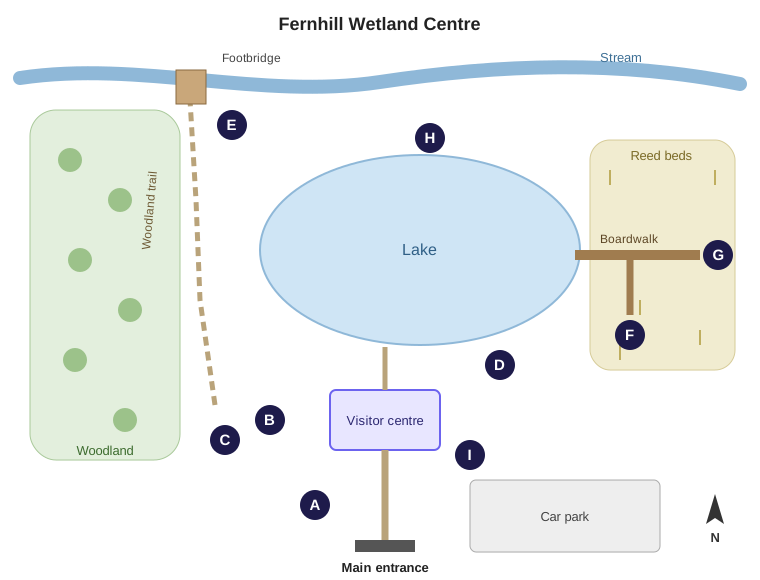
15Bird hide
The answer is G.
In the recording: “That used to be the ticket office, but it's now our first-aid room.”
16Children's play area
The answer is B.
In the recording: “If you go round the left-hand side of the building, towards the woods, you'll find the children's play area.”
17First-aid room
The answer is A.
In the recording: “There's a huge old oak tree there, right where the woodland trail begins, and that's where you should meet at the start of every shift.”
18Tool store
The answer is E.
In the recording: “That's the tool store, and the key is kept in the volunteers' office.”
19Picnic area
The answer is D.
In the recording: “That's the picnic area.”
20Volunteer meeting point
The answer is C.
In the recording: “Keep going right to the very end of the boardwalk, and the hide is there, looking back across the lake.”
Questions 21–25
Choose the correct answer.
21Why did Maya and Tom choose their topic?
The answer is B.
In the recording: “But after that first week of eating in the dining hall, I couldn't stop thinking about the bins by the exit.”
22What was the problem with their survey?
The answer is B.
In the recording: “The real problem was question seven.”
23What did Tom find most surprising?
The answer is C.
In the recording: “Whole trays of pasta and rice that were cooked but never served.”
24What do they decide to do with the photographs?
The answer is A.
In the recording: “Why don't we just pick out half a dozen that really show the problem?”
25What did Maya learn about the dining hall manager?
The answer is B.
In the recording: “And at the end she asked if she could have a copy of our final report.”
Questions 26–30
Choose the correct decision for each section and move it into the gap.
Decisions
- Ashorten it
- Badd financial information
- Cinclude a video clip
- Dstart with a question for the audience
- Emove it to the end
- Fask the tutor for advice
- Gremove it
26Introduction
The answer is D.
In the recording: “Something like, "Hands up if you finished everything on your plate at lunch today."”
27Survey method
The answer is A.
In the recording: “One slide is plenty.”
28Kitchen observations
The answer is C.
In the recording: “Just thirty seconds of that would be really effective.”
29Comparison with other universities
The answer is G.
In the recording: “I'd rather just take it out completely.”
30Recommendations
The answer is B.
In the recording: “If we can say how much money the university would save by cooking less pasta, for example, people will take them much more seriously.”
Questions 31–40
Complete the notes. Write ONE WORD ONLY for each answer.
MANGROVE FORESTS
Habitat
• Warm coastlines, in the 31 zone, which is flooded and then exposed twice a day
Adaptations
• Lack of oxygen in the mud: certain roots rise above the surface and work in a similar way to a 32
• Excess salt: many species expel it through glands located in their 33
• New plants: they begin to develop while still joined to the 34 tree
Value
• Protecting the shore: by holding mud in place, the roots limit 35
• Marine life: the roots provide a sheltered 36 for young fish and crabs
• Climate: the waterlogged ground can hold 37 for thousands of years
Losses
• Biggest cause in many countries: conversion of coastal forest into 38 farms
Restoration
• Early failures: seedlings were put in unsuitable 39
• Long-term success depends on involving local 40 from the outset
The answer is tidal.
In the recording: “Not the deep water offshore, and not the dry ground behind the beach, but the tidal zone, the area between the high-water and low-water marks.”
The answer is snorkel.
In the recording: “They've been compared to chimneys, and even to drinking straws, but personally I think the best comparison is a snorkel, which lets a swimmer breathe while the rest of the body stays under the surface.”
The answer is leaves.
In the recording: “They push the excess salt out through special glands in their leaves.”
The answer is parent.
In the recording: “The seed begins to grow into a young plant while it's still attached to the parent tree, sometimes for several months.”
The answer is erosion.
In the recording: “Their dense roots trap sediment and keep the mud in place, which greatly reduces erosion.”
The answer is nursery.
In the recording: “The tangle of roots creates a sheltered environment that larger predators can't easily enter, so the forest functions as a nursery for young fish and crabs.”
The answer is carbon.
In the recording: “Mangroves are extremely efficient at storing carbon, but most of it isn't held in the trees themselves.”
The answer is shrimp.
In the recording: “But in many countries, the single biggest cause has been aquaculture: in particular, the clearing of mangroves to make way for shrimp farms.”
The answer is locations.
In the recording: “The seedlings had simply been planted in the wrong locations, usually too low on the shore, where they spent too long under water.”
The answer is communities.
In the recording: “The most successful ones involve local communities from the very beginning, because the people who live alongside the forest are the ones who will protect it in the long term.”
Answer key for IELTS Listening Practice Test 1
All 40 answers. Try the questions first, then check here.
- 1 Pryce
- 2 Freight
- 3 16
- 4 27
- 5 Lakeside
- 6 25
- 7 library
- 8 38
- 9 allergies
- 10 Thursday
- 11 B
- 12 B
- 13 C
- 14 C
- 15 G
- 16 B
- 17 A
- 18 E
- 19 D
- 20 C
- 21 B
- 22 B
- 23 C
- 24 A
- 25 B
- 26 D
- 27 A
- 28 C
- 29 G
- 30 B
- 31 tidal
- 32 snorkel
- 33 leaves
- 34 parent
- 35 erosion
- 36 nursery
- 37 carbon
- 38 shrimp
- 39 locations
- 40 communities
Ready for the real test?
40 questions in about 30 minutes, on a screen like the computer test. You hear each part once and get your band at the end.
About the real test: ielts.org