IELTS Listening / Practice Test 5
IELTS Listening Practice Test 5: Free, with Answers
This free IELTS Listening Practice Test 5 has 4 parts and 40 questions. Play each part, answer the questions, and see at once if you are right.
0 of 40 checked · 0 right
IELTS Listening Practice Test 5 · Part 1
A man phoning a hotel to ask about hiring a room for a party
Here you can stop and play again. In the real test you hear it once.
Part 1 transcript
Joanna:Good afternoon, Ashcombe Hotel, events team. Joanna speaking.
Paul:Oh, hello. I'm ringing about hiring a room for a party. I saw on your website that you have function rooms, and I was wondering what you've got available in June.
Joanna:Of course. We have two rooms that are popular for private parties, so let me tell you about both. What kind of event is it?
Paul:It's a retirement party. One of our managers is leaving after thirty years with the company, so we want to give her a proper send-off. It'll be on a Friday evening.
Joanna:How lovely. And how many guests are you expecting?
Paul:That's the tricky part. At the moment it's about fifty, but it keeps growing, because a lot of former staff want to come as well.
Joanna:I see. Well, the smaller room is the Orchard Room. That holds forty-five people seated, so it might be a little tight for you. The Riverside Suite is much bigger. You could get a hundred people in there for a standing reception, but if everyone's sitting at tables, the limit is eighty.
Paul:I think most people will want to sit down. Some of our former colleagues are well into their seventies.
Joanna:Then eighty is the figure to work with.
Paul:Right. And what do the rooms cost?
Joanna:The Orchard Room is normally three hundred and fifty pounds for an evening. But you mentioned a Friday, and we have a special rate on Fridays, so for you it would be two hundred and ninety. The Riverside Suite is five hundred and twenty, and that's the same on any night of the week.
Paul:OK. Can you tell me a bit about each room?
Joanna:Sure. The Orchard Room is at the back of the hotel, on the ground floor. It has big windows onto the garden, and the floor is wooden, so it's perfect if your guests want to dance.
Paul:That sounds nice. And the Riverside Suite?
Joanna:That's on the first floor, looking out over the river, and the thing people love most about it is that it has its own private bar. Your guests won't have to share it with hotel residents.
Paul:Are there any drawbacks I should know about?
Joanna:Well, I'd rather be honest with you. People sometimes assume the Orchard Room will be noisy because it's next to the car park, but the car park is round the side, and you can't hear it at all. The problem is that the room is right next to the kitchen, so on a busy night you can hear plates and pans through the wall.
Paul:Ah. And the Riverside Suite?
Joanna:Because it's on the river, sound travels across the water to the houses on the other side, so we have an agreement with our neighbours. Your guests are welcome to stay until midnight, but the music has to stop at eleven.
Paul:That's fine. Most of our lot will be tired by then anyway.
Joanna:So, which room would you like to go for?
Paul:Oh, it has to be the Riverside Suite, with the numbers we've got.
Joanna:Good choice. Now, is the booking for you personally, or for your company?
Paul:For the company. They're paying, so the invoice should go to them. It's Brennock Engineering.
Joanna:Could you spell the company name for me?
Paul:Of course. It's B-R-E-N-N-O-C-K.
Joanna:B-R-E, double N, O-C-K. Brennock Engineering. And your name?
Paul:Paul Denton. I work in the finance department.
Joanna:Thank you, Mr Denton. And which Friday are you thinking of?
Paul:The twentieth of June.
Joanna:Let me just check. Yes, the Riverside Suite is free that evening, so I'll hold it for you. Now, food. For an event like this, people usually choose either a sit-down meal with three courses, or a buffet.
Paul:We've talked about that in the office. A sit-down meal feels a bit formal, and people will want to move around and catch up with each other. So a buffet, please. Could it be a hot one, as it's in the evening?
Joanna:Certainly. I'll email you our menus so you can choose.
Paul:Great. And is there a deposit to pay?
Joanna:Yes, there is. We ask for a deposit of one hundred pounds to confirm the booking, and that needs to be paid within seven days. The rest is due on the night.
Paul:That's fine. I'll arrange it with our accounts team tomorrow.
Joanna:Wonderful. I'll send you a confirmation email this afternoon.
Paul:Perfect. Thanks so much for your help.
Part 2 transcript
Presenter:Good morning, and welcome back to City Matters. Now, if you live anywhere near the old railway yards on the east side of the city, you can hardly have missed all the work that's been going on there. Well, after nearly three years, Millfield Park finally opens to the public this Saturday, and I've spent the last few days finding out all about it, so here's what you need to know.
Presenter:The park was originally supposed to open last autumn, and a lot of you have been asking why it's taken so long. There have been plenty of rumours: that the builders couldn't find enough workers, for example, or that the council and the designers had fallen out over the plans. In fact, the design was agreed very quickly, and there were always plenty of people on site. What held things up was the ground itself. The land had been used by the railway for well over a century, and when engineers tested it, they found it was full of oil and other chemicals. All of that had to be dug out and taken away before a single tree could be planted, and that added about eight months to the schedule.
Presenter:Then there's the question of money. The final bill came to just over four million pounds, which is quite a lot more than the three and a half million that was first announced. But before anyone starts writing angry letters, it wasn't all paid for by the city council. Roughly half came from the council, a national heritage fund gave a large grant because of the old railway buildings, and a group of local firms got together and paid for the playgrounds.
Presenter:What I really like about this project is how much local people were involved. The designers visited every primary school in the area and asked the children what they wanted. Top of their list, not surprisingly, was a climbing wall. The designers looked at that very seriously, but in the end they decided it couldn't be made safe without staff there all day to supervise it. The children also said they wanted somewhere to put on plays and concerts, though, and that's exactly how the outdoor stage came about. The wildflower meadow, which I'll come back to in a moment, was the idea of the local wildlife trust.
Presenter:And a quick word for dog owners, because I've had lots of questions about this. Dogs are very welcome. They do need to be on a lead on the main paths, and they're not allowed in the children's play areas. You can walk them through the orchard, on a lead, and best of all, there's a fenced field just beyond the car park where they can run around as much as they like.
Presenter:Right, let me take you on a quick tour, so you know where everything is. If you've downloaded the map from the council's website, start at the main entrance on Station Road, at the bottom of the map. As soon as you come through the gates, you'll see an information kiosk immediately on your right, where you can pick up a free guide to the park. The toilets are opposite, on your left.
Presenter:From there, the main path heads north, up the middle of the park. The first thing you'll pass is the outdoor stage, set back on the left. Families with young children will want to find the water play area, which has fountains and little streams to splash about in. Some of you may have seen the early drawings, which put it right beside the big fountain in the centre of the park, but the designers moved it so that it would get the afternoon sun. It's now on the other side of the main path from the stage, directly opposite it.
Presenter:Carry on past the fountain towards the old railway bridge. Just before you reach the bridge, a narrow path on the left will take you to the skate park. It's hidden behind a row of trees, so the noise doesn't disturb people who've come for a bit of peace and quiet.
Presenter:Go under the bridge, and you're in the northern part of the park. Over on the right, running alongside the canal, is the community orchard, with about two hundred apple and pear trees, all planted by volunteers.
Presenter:Now, the wildflower meadow. When the plans were first published, the meadow was going to fill the whole north-west corner, by the North gate. But that area is now a tree nursery, where young trees are grown for the city's streets. So the meadow ended up on the other side of the main path, in the space between the path and the orchard.
Presenter:And finally, if you'd like to explore the park on two wheels, there's a bike hire shop down by the canal. Go to the footbridge, follow the towpath south for about fifty metres, and you'll find it on your right, just inside the park.
Part 3 transcript
Morris:Come in, Leah. I've read the draft chapters you sent me last week.
Leah:Thanks for reading them so quickly.
Morris:Let's start with the literature review, which I was very impressed by. What really makes it work is the structure: instead of going through the studies one by one, in the order they were published, you've grouped them under clear themes, so the reader can see where the gaps are.
Leah:Oh, good. I did wonder whether I should have found some more recent studies. Most of the work on wordless picture books is more than ten years old.
Morris:That's not a problem. There simply isn't much recent research, and you say so. But it's the organisation that really stands out.
Leah:That's good to hear.
Morris:Now, your method. You filmed parents sharing wordless books with their children at home. Remind me why you didn't do it at the city library, as you'd originally planned?
Leah:The library was actually really helpful. They offered me a quiet room, and setting up the camera there every time would have been much easier. But in my trial session there, the mother kept looking at the camera, and she was almost performing the book rather than sharing it. At home, people forgot about the camera after a few minutes, and the conversations were far more relaxed.
Morris:That makes sense. And one of your findings really caught my eye: the difference between mothers and fathers.
Leah:Yes, I didn't expect that. I assumed the fathers would rush through the books, but they spent just as long on each page as the mothers. What they did differently was invent things: they'd give the characters names and add whole stories that weren't in the pictures. The mothers mostly described what was on the page and asked the child questions about it.
Morris:Now, you also found that the children used far more new words with the wordless books than with the ordinary picture books.
Leah:Yes, a lot more. At first I thought it might be because the children in that group were older, but when I checked, the ages were almost identical.
Morris:I don't think age explains it. And it's not that the books were new to them, either, because the ordinary books were new to them too. My guess is that it's because nobody was reading a text aloud. With an ordinary picture book, the adult reads and the child listens. With a wordless book, the child has to do much more of the talking, so they have to find the words themselves.
Leah:So it's really about who's doing the talking.
Morris:Exactly. You should make that argument in your discussion. Now, you say you recorded fourteen families, but your results only include twelve.
Leah:Yes. In one family, the little boy was four and a half, which is just over my age limit, but I decided that was close enough to keep him in. The two I left out were different. In both of those, the parents had read the books with their children so many times before I arrived that they were basically reciting them from memory. That would be fine with an ordinary book, but with a wordless book the whole point is that they make up the words as they go along.
Morris:Fair enough. And the recordings?
Leah:A couple were quite noisy, but I could still transcribe them.
Morris:Good. Then just one more thing on this chapter: the title. 'Talking without text: wordless picture books and parent-child conversation.'
Leah:I know, it's a bit long.
Morris:Length isn't the issue. Titles in this field are often longer than that, and I like 'talking without text'. But at the moment, a reader wouldn't know whether you're looking at babies or at eight-year-olds, and that makes a huge difference.
Leah:So I should add something like 'pre-school children'?
Morris:Something like that, yes.
Morris:A few practical things now. Chapter three is very long, and at the moment it's quite hard to keep track of which family is which.
Leah:I did wonder about that. Should I add some more graphs?
Morris:No, you've got plenty of graphs. What it needs is a summary table at the start of the chapter, listing each family, the child's age and the number of sessions.
Leah:OK. A summary table at the beginning.
Morris:Next, your choice of books. You've explained why you chose the twenty books you used, but you haven't said anything about the ones you rejected.
Leah:Well, I didn't use any books with flaps, because in the trial session the child just wanted to keep lifting them, and stopped talking. Books with sound buttons would have been similar, but none of the wordless books had those anyway.
Morris:Then say so in the chapter. It's a sensible decision, but the reader needs to know about it. And there's a study I'd like you to read. It's from Finland, and it looks at how nursery staff use picture books. I thought at first it was about storytelling, but in fact it focuses on what they call group reading: one adult sharing a book with four or five children at the same time.
Leah:That's interesting, because all my sessions were one parent and one child.
Morris:Exactly, so it gives you a comparison. I'll email you the reference.
Leah:Thanks. And what about the conclusion? I haven't started it yet.
Morris:Keep it short, no more than a couple of pages. A lot of students just repeat their results there, or slip in findings they forgot to mention earlier. Don't do either. The most useful thing a conclusion can do is point to areas for future research.
Leah:OK. Could I send you a draft by the end of the month?
Morris:That would be perfect.
Part 4 transcript
Lecturer:Good morning. Over the last few weeks we've looked at sleep in humans: the stages of sleep, what happens in the brain, and what goes wrong when we don't get enough. Today I want to widen the picture and look at sleep in other animals, because that turns out to be one of the best ways of approaching a very old question: what is sleep actually for?
Lecturer:First, though, we have a problem of definition. In humans, we can identify sleep by recording electrical activity in the brain. But that only works for animals with brains similar to ours, and many animals have very simple nervous systems, or no brain at all. Breathing doesn't help much either, because it varies so much from one species to another. So biologists rely mainly on behaviour. An animal is considered to be asleep if it stays still, usually in a particular position or place; if it takes a stronger signal than usual to get a reaction from it; and if it can be woken up quickly, which is what separates sleep from hibernation. One further test is especially important: if an animal is kept awake, does it make up for the lost sleep later?
Lecturer:That last test produced one of the most surprising results of recent years. In two thousand and seventeen, a team in California studied the upside-down jellyfish, an animal with no brain at all. At night, the jellyfish pulsed more slowly, and they were slower to react when they were disturbed. Then the researchers kept some of them awake, by pushing small jets of water at them every twenty minutes through the night. The next day, those jellyfish were noticeably less active than usual, just as a tired person would be. So it seems that sleep goes back much further in evolution than anyone had imagined, to a time before brains even existed.
Lecturer:At the other extreme, sleep can be squeezed into very difficult circumstances. Frigate birds spend weeks at a time over the ocean without landing. By attaching small recording devices to their heads, researchers showed that these birds really do sleep while they're flying, although only for about forty minutes a day, compared with more than twelve hours when they're back on land.
Lecturer:Frigate birds often do this with just one half of the brain at a time, and so do a number of marine mammals. Dolphins are the best-known example. While one half of the brain sleeps, the other stays awake, and the eye controlled by the awake half stays open. It was long assumed that this eye was watching for predators. But studies of dolphins in captivity, where there's nothing to be afraid of, suggest that the open eye is mainly directed at other members of the group, so that the animals stay in contact while they rest. Mothers and calves, for instance, keep each other in view.
Lecturer:Fur seals are even more flexible. On land, they sleep much as other mammals do. But when they're at sea, they switch to sleeping with half the brain, and the stage of sleep we associate with dreaming, known as REM sleep, almost disappears. It can stay that way for days or even weeks, and it only returns when the seals come back onto land.
Lecturer:How much sleep animals need also varies enormously. Wild elephants in Botswana, fitted with activity monitors, slept for only about two hours a night, mostly standing up, and lay down to sleep only every third or fourth night. On one occasion, a female went without sleep for forty-six hours and walked about thirty kilometres, apparently because the herd felt threatened, perhaps by lions or by poachers. At the other end of the scale, the little brown bat sleeps for around twenty hours a day. That isn't really about hiding from predators. It seems to be mainly a way of saving energy during the hours when there are no insects about for it to catch. In fact, it's only properly awake for about four hours, mostly around dusk.
Lecturer:So why do animals sleep at all? Studies of fruit flies suggest one answer. Flies that are kept awake can still walk and fly normally, but they do badly in tests of memory, which suggests that sleep helps to strengthen what was learned during the day. Another answer comes from research on mice. During sleep, the spaces between their brain cells became wider, by around sixty per cent. That allowed fluid to flow through the brain more easily and remove waste more quickly. So sleep may be, among other things, the brain's cleaning shift. These two explanations aren't in competition, of course; sleep probably does several jobs at once. Next week, we'll look at what happens when that cleaning goes wrong.
Questions 1–6
Complete the table. Write ONE WORD AND/OR A NUMBER for each answer.
ASHCOMBE HOTEL – Function rooms
| Orchard Room | Riverside Suite | |
|---|---|---|
| Maximum number of guests (seated) | 45 | 1 |
| Cost for this party | £2 | £520 |
| Main attraction | 3 floor, ideal for dancing | a 4 just for the party guests |
| Possible problem | next to the 5 | music must stop at 6 p.m. |
The answer is 80.
In the recording: “You could get a hundred people in there for a standing reception, but if everyone's sitting at tables, the limit is eighty.”
The answer is 290.
In the recording: “But you mentioned a Friday, and we have a special rate on Fridays, so for you it would be two hundred and ninety.”
The answer is wooden.
In the recording: “It has big windows onto the garden, and the floor is wooden, so it's perfect if your guests want to dance.”
The answer is bar.
In the recording: “That's on the first floor, looking out over the river, and the thing people love most about it is that it has its own private bar.”
The answer is kitchen.
In the recording: “The problem is that the room is right next to the kitchen, so on a busy night you can hear plates and pans through the wall.”
The answer is 11.
In the recording: “Your guests are welcome to stay until midnight, but the music has to stop at eleven.”
Questions 7–10
Complete the table. Write ONE WORD AND/OR A NUMBER for each answer.
Booking details
| Room | Riverside Suite |
| Company | 7 Engineering |
| Date of party | Friday 8 June |
| Food | a hot 9 |
| Deposit | £10, to be paid within seven days |
The answer is Brennock.
In the recording: “It's Brennock Engineering.”
The answer is 20.
In the recording: “The twentieth of June.”
The answer is buffet.
In the recording: “For an event like this, people usually choose either a sit-down meal with three courses, or a buffet.”
The answer is 100.
In the recording: “We ask for a deposit of one hundred pounds to confirm the booking, and that needs to be paid within seven days.”
Questions 11–14
Choose the correct answer.
11Why did the park open later than planned?
The answer is A.
In the recording: “The land had been used by the railway for well over a century, and when engineers tested it, they found it was full of oil and other chemicals.”
12How was the park paid for?
The answer is B.
In the recording: “Roughly half came from the council, a national heritage fund gave a large grant because of the old railway buildings, and a group of local firms got together and paid for the playgrounds.”
13Which feature of the park was suggested by local schoolchildren?
The answer is B.
In the recording: “The children also said they wanted somewhere to put on plays and concerts, though, and that's exactly how the outdoor stage came about.”
14What are dog owners told?
The answer is C.
In the recording: “You can walk them through the orchard, on a lead, and best of all, there's a fenced field just beyond the car park where they can run around as much as they like.”
Questions 15–20
Label the map. Choose the correct letter, A–I, for each label.
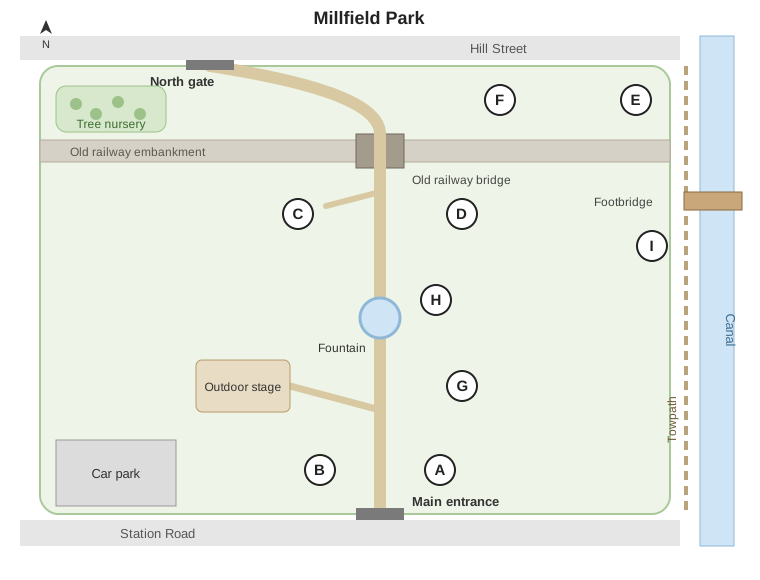
15Information kiosk
The answer is A.
In the recording: “As soon as you come through the gates, you'll see an information kiosk immediately on your right, where you can pick up a free guide to the park.”
16Water play area
The answer is G.
In the recording: “It's now on the other side of the main path from the stage, directly opposite it.”
17Skate park
The answer is C.
In the recording: “Just before you reach the bridge, a narrow path on the left will take you to the skate park.”
18Community orchard
The answer is E.
In the recording: “Over on the right, running alongside the canal, is the community orchard, with about two hundred apple and pear trees, all planted by volunteers.”
19Wildflower meadow
The answer is F.
In the recording: “So the meadow ended up on the other side of the main path, in the space between the path and the orchard.”
20Bike hire
The answer is I.
In the recording: “And finally, if you'd like to explore the park on two wheels, there's a bike hire shop down by the canal.”
Questions 21–26
Choose the correct answer.
21What does Dr Morris like most about Leah's literature review?
The answer is B.
In the recording: “What really makes it work is the structure: instead of going through the studies one by one, in the order they were published, you've grouped them under clear themes, so the reader can see where the gaps are.”
22What happened during Leah's trial session at the library?
The answer is A.
In the recording: “But in my trial session there, the mother kept looking at the camera, and she was almost performing the book rather than sharing it.”
23What did Leah notice about the fathers in her study?
The answer is B.
In the recording: “What they did differently was invent things: they'd give the characters names and add whole stories that weren't in the pictures.”
24Why does Dr Morris think the children used more new words with the wordless books?
The answer is C.
In the recording: “With a wordless book, the child has to do much more of the talking, so they have to find the words themselves.”
25What did Leah decide about the boy who was older than her age limit?
The answer is A.
In the recording: “In one family, the little boy was four and a half, which is just over my age limit, but I decided that was close enough to keep him in.”
26What does Dr Morris say about the title of Leah's dissertation?
The answer is A.
In the recording: “But at the moment, a reader wouldn't know whether you're looking at babies or at eight-year-olds, and that makes a huge difference.”
Questions 27–30
Complete the sentences. Write NO MORE THAN TWO WORDS for each answer.
Leah should add a 27 at the beginning of chapter three.
She must explain why she did not use books with 28.
Dr Morris recommends a Finnish study on 29 in nurseries.
Her conclusion should suggest topics for 30.
The answer is summary table.
In the recording: “What it needs is a summary table at the start of the chapter, listing each family, the child's age and the number of sessions.”
The answer is flaps.
In the recording: “Well, I didn't use any books with flaps, because in the trial session the child just wanted to keep lifting them, and stopped talking.”
The answer is group reading.
In the recording: “I thought at first it was about storytelling, but in fact it focuses on what they call group reading: one adult sharing a book with four or five children at the same time.”
The answer is future research.
In the recording: “The most useful thing a conclusion can do is point to areas for future research.”
Questions 31–33
Choose the correct answer.
31According to the lecturer, biologists mainly decide whether an animal is asleep by
The answer is B.
In the recording: “So biologists rely mainly on behaviour.”
32What happened to the jellyfish that were kept awake at night?
The answer is B.
In the recording: “The next day, those jellyfish were noticeably less active than usual, just as a tired person would be.”
33The lecturer mentions frigate birds as an example of animals that
The answer is A.
In the recording: “By attaching small recording devices to their heads, researchers showed that these birds really do sleep while they're flying, although only for about forty minutes a day, compared with more than twelve hours when they're back on land.”
Questions 34–40
Complete the notes. Write ONE WORD ONLY for each answer.
Sleep in different animals
Sleeping with half the brain
• Dolphins: the open eye mainly keeps them in contact with their 34
• Fur seals: REM sleep is almost absent at sea and comes back only on 35
Amount of sleep
• Wild elephants: about two hours a night, mostly standing
• One stayed awake for 46 hours, probably because the herd felt 36
• Little brown bats: their long sleep is probably a way to save 37
Purpose of sleep
• Fruit flies: lack of sleep harms their 38 but not their movement
• Mice: during sleep, the gaps between brain cells get 39
• This allows 40 to be cleared from the brain faster
The answer is group.
In the recording: “But studies of dolphins in captivity, where there's nothing to be afraid of, suggest that the open eye is mainly directed at other members of the group, so that the animals stay in contact while they rest.”
The answer is land.
In the recording: “It can stay that way for days or even weeks, and it only returns when the seals come back onto land.”
The answer is threatened.
In the recording: “On one occasion, a female went without sleep for forty-six hours and walked about thirty kilometres, apparently because the herd felt threatened, perhaps by lions or by poachers.”
The answer is energy.
In the recording: “It seems to be mainly a way of saving energy during the hours when there are no insects about for it to catch.”
The answer is memory.
In the recording: “Flies that are kept awake can still walk and fly normally, but they do badly in tests of memory, which suggests that sleep helps to strengthen what was learned during the day.”
The answer is wider.
In the recording: “During sleep, the spaces between their brain cells became wider, by around sixty per cent.”
The answer is waste.
In the recording: “That allowed fluid to flow through the brain more easily and remove waste more quickly.”
Answer key for IELTS Listening Practice Test 5
All 40 answers. Try the questions first, then check here.
- 1 80
- 2 290
- 3 wooden
- 4 bar
- 5 kitchen
- 6 11
- 7 Brennock
- 8 20
- 9 buffet
- 10 100
- 11 A
- 12 B
- 13 B
- 14 C
- 15 A
- 16 G
- 17 C
- 18 E
- 19 F
- 20 I
- 21 B
- 22 A
- 23 B
- 24 C
- 25 A
- 26 A
- 27 summary table
- 28 flaps
- 29 group reading
- 30 future research
- 31 B
- 32 B
- 33 A
- 34 group
- 35 land
- 36 threatened
- 37 energy
- 38 memory
- 39 wider
- 40 waste
Ready for the real test?
40 questions in about 30 minutes, on a screen like the computer test. You hear each part once and get your band at the end.
About the real test: ielts.org