IELTS Listening / Practice Test 6
IELTS Listening Practice Test 6: Free, with Answers
This free IELTS Listening Practice Test 6 has 4 parts and 40 questions. Play each part, answer the questions, and see at once if you are right.
0 of 40 checked · 0 right
IELTS Listening Practice Test 6 · Part 1
A man phoning a letting agency about a flat to rent
Here you can stop and play again. In the real test you hear it once.
Part 1 transcript
Linda:Good morning, Harbourside Lettings, Linda speaking.
Ryan:Hi, good morning. I'm calling about one of the flats on your website. I'm moving to Bristol next month, and I'm trying to find somewhere to live before I arrive.
Linda:Of course. Can I take your name first?
Ryan:Sure. It's Ryan Brooks.
Linda:Thank you, Mr Brooks. And what kind of place are you looking for?
Ryan:Well, something with two bedrooms, because my partner's coming with me. And the most important thing for me is being close to the station. I'll be working in Bath, so I'll be taking the train every day, and I don't want a long walk at either end.
Linda:That makes sense. And do you have a budget in mind?
Ryan:Ideally no more than a thousand pounds a month, including bills if possible, but I know Bristol isn't cheap.
Linda:It isn't, I'm afraid, but there are still some good flats in that range. Which one was it that you saw?
Ryan:The one on Ashley Road. Number twenty-seven, I think. It said second floor.
Linda:Ah yes, that's a lovely flat. It's on a quiet street, there's a small park at the end of the road, and it's only about ten minutes' walk from the station.
Ryan:Great. Could you give me the full postcode? I'd like to look at the area on a map.
Linda:Of course. It's B-S-6, then a space, then 5-N-J.
Ryan:B-S-6, 5-N-J. Got it.
Linda:That's right.
Ryan:And the rent? The website said nine hundred and fifty pounds a month.
Linda:It did, but the landlord reduced it last week, because the flat's been empty for a while. It's now nine hundred and twenty-five.
Ryan:Oh, that's good news. Does that include any bills?
Linda:Just water. Electricity, gas and the internet you'd need to arrange yourself.
Ryan:OK. And is it furnished? The photos showed a sofa and a dining table.
Linda:Ah, those photos are a bit out of date. Some of the furniture belonged to the previous tenants, so it's now only partly furnished. The beds and the wardrobes are staying, and there's a kitchen table, but you'd need your own sofa.
Ryan:Right. That's fine, we've got one in storage. What about the kitchen? Is there a washing machine?
Linda:Yes, there's a washing machine, and the landlord put in a new dishwasher last year, so the kitchen's in very good condition.
Ryan:That sounds great.
Ryan:So when would it be available?
Linda:From the first of March.
Ryan:Perfect, that's exactly when I start work. Is there a minimum contract?
Linda:Most of our flats can be rented for six months at a time, but this landlord prefers longer lets, so the minimum is twelve months.
Ryan:That's fine. We're planning to stay at least a year anyway. What about the heating? The last flat I rented, in London, had electric heaters, and the bills were terrible.
Linda:Then you'll be pleased to hear that this one has gas central heating. And the windows were all replaced two years ago, so it stays quite warm.
Ryan:That's a relief. My partner really feels the cold. Oh, and is there anywhere to keep a bike? I might cycle to the station on dry days.
Linda:There's no garage, but there's a lockable storage room on the ground floor that all the residents share, and several of them keep bikes in there.
Ryan:Perfect. Would it be possible to see the flat this weekend?
Linda:Let me check. I could do Saturday at ten o'clock. Oh, no, sorry, the landlord's got a decorator working there that morning, and he's asked us not to come before half past ten. So shall we say ten thirty?
Ryan:Ten thirty on Saturday is fine.
Linda:And one more thing. When you come, could you bring a reference from your current landlord? The owner always asks for one before he accepts an application.
Ryan:No problem. I'll ask him today. He's been very easy to deal with, so I'm sure he'll write something positive.
Linda:Lovely. I'll send you an email to confirm the viewing, with directions and details of where you can park nearby.
Ryan:Thanks very much. See you on Saturday.
Part 2 transcript
Manager:Good evening, everyone, and thank you for coming. My name's Graham Shaw, and I'm the practice manager at the new Northgate Health Centre, which opens on Monday the third of next month. Many of you have been registered at the old clinic on Mill Street for years, so I'd like to explain how the new building works, and where you'll find things. The building was designed with a lot of input from patients, and it uses about half as much energy as the old one, thanks to its solar panels and much better insulation. You should all have a copy of the ground-floor plan, so let's start at the main entrance, at the bottom of the plan.
Manager:As you come through the main doors, you'll see the reception desk straight ahead of you, with the waiting area behind it. But before you get that far, on your left, right beside the entrance, is the pharmacy. It's run by an independent company, so it will also serve people who aren't patients here, and it'll be open on Saturdays as well.
Manager:Now, the building has two wings, one on each side of the waiting area, and each one has its own corridor. For blood tests, go into the corridor on the right, just inside the entrance. The first room on your right is for staff only, so please don't go in there. The blood test room is the next one along.
Manager:Physiotherapy has the largest room in the building. It's right at the far end of the left-hand wing, in the corner, and it has glass doors opening onto the garden, so in good weather some of the exercises can be done outside. The other corner room at the back of the building, at the end of the right-hand wing, is our staff room, so please don't confuse the two.
Manager:The children's clinic is something we've thought about very carefully. In the original plans it was right beside the waiting area, but parents told us they wanted somewhere calmer, away from the main entrance. So it's now in the right-hand wing, between the blood test room and the staff room.
Manager:And finally, we've included a small quiet room, for anyone who needs some privacy, perhaps to make a phone call after receiving difficult news. You might expect it to be next to the pharmacy, near the entrance, but we felt that area would be too busy. So it's in the left-hand wing, next door to physiotherapy.
Manager:Now for some practical points. When you arrive for an appointment, you won't need to queue at reception any more. There are touch screens just inside the entrance, and you can check in on one of those in a few seconds. The reception staff will still be there to help with anything else, of course, and if you'd rather speak to a person, just go straight to the desk. You'll also be able to book appointments online or by phone, just as you do now.
Manager:Our opening hours will be eight till six on weekdays. We'd originally planned to stay open late on Wednesdays, but in the survey we carried out last year, more of you said you'd prefer a late evening towards the end of the week. So on Thursdays we'll be open until eight in the evening.
Manager:A lot of you have asked about parking. There are sixty spaces behind the building. For patients, parking is free for the first two hours, which should be more than enough for most appointments, and after that it's one pound an hour. Staff have their own separate area, so they won't be taking your spaces.
Manager:If you're coming for your first appointment at the new centre, please bring a list of your medicines, including anything you buy without a prescription, such as vitamins. Your records have already been transferred from Mill Street, so you won't need to bring any letters or identification.
Manager:And finally, many of you have asked what will happen to the old clinic on Mill Street. There have been rumours that it will be knocked down and replaced with flats, and the council did consider selling it at one point. But I'm pleased to say they've now decided to keep the building, and it's going to become a youth centre, which this part of town has needed for a long time. Thank you very much for listening, and I'm happy to take any questions.
Part 3 transcript
Liam:So, Sophie, shall we go through our notes from the field trip before we start writing it up?
Sophie:Good idea. I've got all the data sheets here. Let's start with the rocky shore.
Liam:Right. We laid out a tape from the low-water mark up to the bottom of the cliff, and every two metres we put down the quadrat.
Sophie:The square metal frame. And then we counted everything inside it. It took much longer than I expected, especially near the top of the shore, where the rocks were covered in seaweed and we had to lift it up to see what was underneath.
Liam:Yes. So what was the most common animal, in the end? I remember we both expected it to be limpets.
Sophie:So did I, because they're so easy to spot. But when we added it all up, the barnacles were far more numerous. There were thousands of them on some of the rocks. Limpets came second, and the mussels were only on the lowest rocks.
Liam:I'd forgotten about the seaweed. My hands were freezing by the end. OK, then the sandy beach. We didn't actually see any lugworms, did we?
Sophie:No, they stay buried in the sand. But we counted the casts in each square, those little coils of sand they leave on the surface. There were far more of them near the low-tide line.
Liam:And after lunch we went to the estuary.
Sophie:Where we measured the salinity, how salty the water was, at five points going upstream. We used that little handheld meter, which was much quicker than the method we practised in the lab.
Liam:And the readings were lower than the figures in the textbook, weren't they?
Sophie:Yes, but that's not really surprising. There'd been heavy rain the day before, so there was a lot more fresh water coming down the river than usual. We should mention that in the report.
Liam:Definitely. And the last site was the harbour.
Sophie:Where we pulled that fine net through the water from the end of the pier to collect plankton. And then we looked at the samples under the microscope back at the field centre.
Liam:That was my favourite part, actually. Some of those tiny creatures were amazing. I'd never realised how much life there is in a single drop of sea water.
Sophie:Me neither. We should include a couple of the drawings we made of them, too.
Liam:Good idea. Mine aren't very artistic, but at least they're accurate.
Liam:Now, in the method section, we'll need to explain the order we did things in. Why did we start at the rocky shore, again? I thought it was because it was nearest to where the minibus parked.
Sophie:It was quite near, but that wasn't the reason. And the warden did tell us to visit the rocky shore at some point, but the main thing was the tide. Low tide was at half past eight that morning, and the rock pools are only uncovered for a couple of hours.
Liam:Of course. And we were supposed to finish with a boat trip round the bay, but that was cancelled.
Sophie:I was really disappointed about that. At first I thought there must be something wrong with the boat, but the skipper said the engine was fine. And there were still enough of us, even though a few people had dropped out. It was the waves. The wind had died down by then, but there was still a big swell out in the bay, and he said it wasn't safe to go out.
Liam:What a shame. Our lecturer said she'd try to arrange another trip next term, though. And what did the warden say about the rock pools, by the way? I was too busy counting to listen properly.
Sophie:She said they used to be stripped every summer by people collecting crabs and shellfish to take home, until collecting was banned about ten years ago. Since then, the number of species has gone up a lot. She also mentioned that a storm last winter moved a lot of rocks around, but it did surprisingly little damage.
Liam:Interesting. We could compare our counts with some of the older surveys, then. The field centre keeps records going back to the nineteen-nineties, doesn't it?
Sophie:It does. I'll email them and ask whether we can have a copy. Anyway, what do you think the trip taught us most?
Liam:Well, I enjoyed working as a team, but we'd done plenty of that before. And I suppose we saw how the coast is changing, although one day isn't really long enough to see that.
Sophie:For me, it was how much our results depended on doing everything in exactly the same way each time. When the other group put their quadrats down a bit carelessly, their numbers came out completely different from ours.
Liam:That's true. Measuring carefully made all the difference. Let's make that the main point of our conclusion.
Sophie:Agreed. I'll start on the results section tonight and send it to you tomorrow.
Part 4 transcript
Lecturer:Good afternoon. Today we're going to look at one of the clearest examples of how human activity changes the climate on a local scale: the urban heat island. The term refers to the fact that towns and cities are usually warmer than the countryside around them. The effect was first described more than two hundred years ago by Luke Howard, an amateur scientist who is best remembered today for giving the clouds their names. In his book The Climate of London, published between 1818 and 1820, he showed that the city was regularly warmer than the surrounding countryside. Interestingly, the difference was greatest not in the afternoon, as you might expect, but at night, and on some days the city was actually slightly cooler during the daytime. That pattern has been confirmed many times since. Today, of course, we don't have to rely on thermometers in a few gardens. Satellites can measure the temperature of every street and rooftop in a city, and the images they produce show the heat island very clearly: the city centre and industrial areas glow like hot spots, while parks, rivers and the surrounding farmland appear much cooler. On average, the difference in air temperature is only a few degrees, but on calm, clear nights it can be considerably larger.
Lecturer:So what causes it? The most important factor is the materials that cities are built from. Dark surfaces, such as roads and roofs, absorb a large proportion of the sunlight that falls on them and store it as heat, which they then release slowly through the evening and the night. That's why cities stay warm long after sunset. A second factor is the lack of vegetation. In the countryside, plants draw water from the soil and release it through their leaves, and that process of evaporation has a powerful cooling effect, rather like sweat on your skin. Replace fields and trees with concrete, and you lose much of that cooling. This is one reason why neighbourhoods with plenty of mature trees can be noticeably cooler than nearby streets without them, even within the same city.
Lecturer:Thirdly, the shape of the city matters. Tall buildings on either side of a narrow street trap heat, and they also block the wind that might otherwise carry the warm air away. And finally, cities produce heat of their own, from traffic, from factories, and from air conditioning, which, ironically, warms the streets outside while it cools the rooms inside.
Lecturer:Why does all this matter? In a cold climate, a little extra warmth might seem welcome, but during a heatwave it can be deadly. In the European heatwave of 2003, tens of thousands of people died, and the great majority of the victims were elderly, many of them living alone in top-floor flats in city centres. Doctors now believe that hot nights are particularly dangerous, because if the temperature doesn't fall after dark, the body has no chance of recovering from the heat of the day. Heat also makes air pollution worse, because many of the chemical reactions that produce smog happen faster at higher temperatures.
Lecturer:Fortunately, there's a great deal that cities can do. Some of the simplest solutions involve colour. Los Angeles has been coating some of its streets with a special paint. It isn't white, which would dazzle drivers, but a light grey, and it reflects much more sunlight than ordinary asphalt, so on hot days the coated surfaces are many degrees cooler. The coating has to be renewed every few years, but it is relatively cheap compared with rebuilding roads. Other cities have concentrated on plants. In Medellín, in Colombia, the authorities created a network of green corridors, planting tens of thousands of trees and other plants along busy roads and streams, and they report that this has reduced the heat island effect by around two degrees. The project also created jobs, as local people were trained as gardeners to look after the new planting. And in Paris, where many children go to school in densely built neighbourhoods, a programme is turning asphalt school playgrounds into shaded green spaces, which can also be opened to local residents during heatwaves. The aim is that eventually every state school in the city will have one.
Lecturer:None of these solutions is perfect, of course. Trees need water, which may be scarce during the very heatwaves they're supposed to protect us from. And light-coloured roofs, which are extremely effective in hot regions, may actually increase heating costs in places with long, cold winters, because they reflect away warmth that would otherwise be welcome. As with so many environmental questions, the right answer depends very much on where you live.
Questions 1–10
Complete the notes. Write NO MORE THAN TWO WORDS AND/OR A NUMBER for each answer.
HARBOURSIDE LETTINGS – Flat enquiry
• Name: Ryan Brooks
• Wants a flat that is close to the 1
• Address: 27 Ashley Road, Bristol
• Postcode: 2
• Rent: £3 per month
• Bills included: 4 only
• Furniture: the flat is 5 furnished
• Available from: 6
• Minimum let: 7 months
• Heating: 8 central heating
• Viewing: Saturday at 9 a.m.
• Bring: a 10 from his current landlord
The answer is station.
In the recording: “And the most important thing for me is being close to the station.”
The answer is BS6 5NJ.
In the recording: “It's B-S-6, then a space, then 5-N-J.”
The answer is 925.
In the recording: “It's now nine hundred and twenty-five.”
The answer is water.
In the recording: “Just water.”
The answer is partly.
In the recording: “Some of the furniture belonged to the previous tenants, so it's now only partly furnished.”
The answer is 1 March.
In the recording: “From the first of March.”
The answer is 12.
In the recording: “Most of our flats can be rented for six months at a time, but this landlord prefers longer lets, so the minimum is twelve months.”
The answer is gas.
In the recording: “Then you'll be pleased to hear that this one has gas central heating.”
The answer is 10.30.
In the recording: “So shall we say ten thirty?”
The answer is reference.
In the recording: “When you come, could you bring a reference from your current landlord?”
Questions 11–15
Label the plan. Choose the correct letter, A–H, for each label.
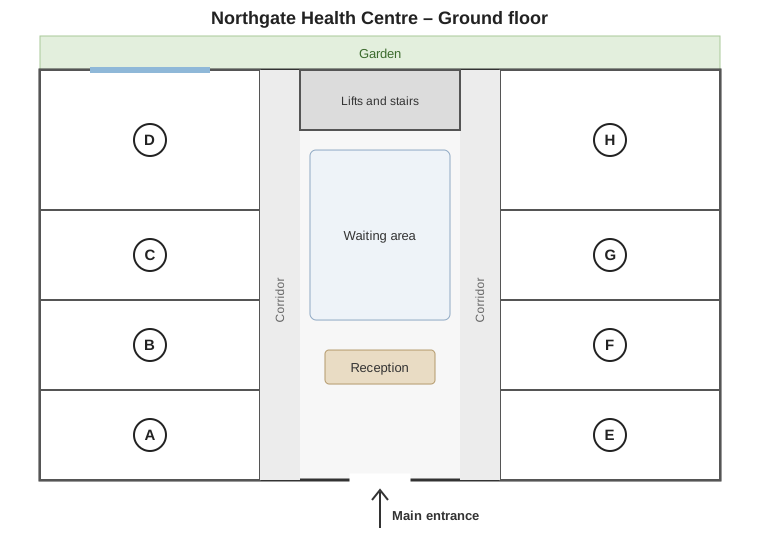
11Pharmacy
The answer is A.
In the recording: “But before you get that far, on your left, right beside the entrance, is the pharmacy.”
12Blood test room
The answer is F.
In the recording: “The blood test room is the next one along.”
13Physiotherapy
The answer is D.
In the recording: “Physiotherapy has the largest room in the building.”
14Children's clinic
The answer is G.
In the recording: “So it's now in the right-hand wing, between the blood test room and the staff room.”
15Quiet room
The answer is C.
In the recording: “So it's in the left-hand wing, next door to physiotherapy.”
Questions 16–20
Answer the questions. Write NO MORE THAN THREE WORDS AND/OR A NUMBER for each answer.
What can patients use to check in when they arrive? 16
On which day of the week will the centre be open until 8 p.m.? 17
For how long can patients park without paying? 18
What should patients bring to their first appointment at the centre? 19
What will the old clinic building be turned into? 20
The answer is (the) touch screens.
In the recording: “There are touch screens just inside the entrance, and you can check in on one of those in a few seconds.”
The answer is Thursday.
In the recording: “So on Thursdays we'll be open until eight in the evening.”
The answer is (the first) two hours.
In the recording: “For patients, parking is free for the first two hours, which should be more than enough for most appointments, and after that it's one pound an hour.”
The answer is (a) list of (their) medicines.
In the recording: “If you're coming for your first appointment at the new centre, please bring a list of your medicines, including anything you buy without a prescription, such as vitamins.”
The answer is (a) youth centre.
In the recording: “But I'm pleased to say they've now decided to keep the building, and it's going to become a youth centre, which this part of town has needed for a long time.”
Questions 21–26
Complete the table. Write ONE WORD ONLY for each answer.
Field trip: work at each site
| Site | What the students did | Notes |
|---|---|---|
| Rocky shore | counted species inside a square frame called a 21 | most common animal: 22 |
| Sandy beach | counted the 23 left by lugworms | highest numbers near the low-tide line |
| Estuary | measured the 24 of the water at five points | results affected by heavy 25 the day before |
| Harbour | collected plankton with a fine 26 | samples examined under a microscope |
The answer is quadrat.
In the recording: “We laid out a tape from the low-water mark up to the bottom of the cliff, and every two metres we put down the quadrat.”
The answer is barnacles.
In the recording: “But when we added it all up, the barnacles were far more numerous.”
The answer is casts.
In the recording: “But we counted the casts in each square, those little coils of sand they leave on the surface.”
The answer is salinity.
In the recording: “Where we measured the salinity, how salty the water was, at five points going upstream.”
The answer is rain.
In the recording: “There'd been heavy rain the day before, so there was a lot more fresh water coming down the river than usual.”
The answer is net.
In the recording: “Where we pulled that fine net through the water from the end of the pier to collect plankton.”
Questions 27–30
Choose the correct answer.
27According to Sophie, why did the rocky shore have to be visited early in the day?
The answer is A.
In the recording: “Low tide was at half past eight that morning, and the rock pools are only uncovered for a couple of hours.”
28Why was the boat trip cancelled?
The answer is B.
In the recording: “The wind had died down by then, but there was still a big swell out in the bay, and he said it wasn't safe to go out.”
29What did the warden tell them about the rock pools?
The answer is C.
In the recording: “Since then, the number of species has gone up a lot.”
30What do the students agree the trip taught them most about?
The answer is B.
In the recording: “Measuring carefully made all the difference.”
Questions 31–40
Complete the notes. Write ONE WORD ONLY for each answer.
Urban heat islands
Background
• Luke Howard found that London was warmer than the countryside, especially at 31
Causes
• dark surfaces, e.g. roads and 32, store heat from the sun
• fewer plants, so less cooling from 33
• tall buildings on narrow streets trap heat and block the 34
Effects on health
• 2003 heatwave: most of the victims were 35
• hot nights prevent the body from 36
Solutions
• Los Angeles: some streets coated with a light 37 paint
• Medellín: trees and plants added along roads and 38
• Paris: asphalt school 39 turned into shaded green spaces
• Drawback: light-coloured roofs may raise 40 costs in cold climates
The answer is night.
In the recording: “Interestingly, the difference was greatest not in the afternoon, as you might expect, but at night, and on some days the city was actually slightly cooler during the daytime.”
The answer is roofs.
In the recording: “Dark surfaces, such as roads and roofs, absorb a large proportion of the sunlight that falls on them and store it as heat, which they then release slowly through the evening and the night.”
The answer is evaporation.
In the recording: “In the countryside, plants draw water from the soil and release it through their leaves, and that process of evaporation has a powerful cooling effect, rather like sweat on your skin.”
The answer is wind.
In the recording: “Tall buildings on either side of a narrow street trap heat, and they also block the wind that might otherwise carry the warm air away.”
The answer is elderly.
In the recording: “In the European heatwave of 2003, tens of thousands of people died, and the great majority of the victims were elderly, many of them living alone in top-floor flats in city centres.”
The answer is recovering.
In the recording: “Doctors now believe that hot nights are particularly dangerous, because if the temperature doesn't fall after dark, the body has no chance of recovering from the heat of the day.”
The answer is grey.
In the recording: “It isn't white, which would dazzle drivers, but a light grey, and it reflects much more sunlight than ordinary asphalt, so on hot days the coated surfaces are many degrees cooler.”
The answer is streams.
In the recording: “In Medellín, in Colombia, the authorities created a network of green corridors, planting tens of thousands of trees and other plants along busy roads and streams, and they report that this has reduced the heat island effect by around two degrees.”
The answer is playgrounds.
In the recording: “And in Paris, where many children go to school in densely built neighbourhoods, a programme is turning asphalt school playgrounds into shaded green spaces, which can also be opened to local residents during heatwaves.”
The answer is heating.
In the recording: “And light-coloured roofs, which are extremely effective in hot regions, may actually increase heating costs in places with long, cold winters, because they reflect away warmth that would otherwise be welcome.”
Answer key for IELTS Listening Practice Test 6
All 40 answers. Try the questions first, then check here.
- 1 station
- 2 BS6 5NJ
- 3 925
- 4 water
- 5 partly
- 6 1 March
- 7 12
- 8 gas
- 9 10.30
- 10 reference
- 11 A
- 12 F
- 13 D
- 14 G
- 15 C
- 16 (the) touch screens
- 17 Thursday
- 18 (the first) two hours
- 19 (a) list of (their) medicines
- 20 (a) youth centre
- 21 quadrat
- 22 barnacles
- 23 casts
- 24 salinity
- 25 rain
- 26 net
- 27 A
- 28 B
- 29 C
- 30 B
- 31 night
- 32 roofs
- 33 evaporation
- 34 wind
- 35 elderly
- 36 recovering
- 37 grey
- 38 streams
- 39 playgrounds
- 40 heating
Ready for the real test?
40 questions in about 30 minutes, on a screen like the computer test. You hear each part once and get your band at the end.
About the real test: ielts.org