IELTS Listening / Practice Test 10
IELTS Listening Practice Test 10: Free, with Answers
This free IELTS Listening Practice Test 10 has 4 parts and 40 questions. Play each part, answer the questions, and see at once if you are right.
0 of 40 checked · 0 right
IELTS Listening Practice Test 10 · Part 1
A woman phoning an insurance company to ask for a quote for her home
Here you can stop and play again. In the real test you hear it once.
Part 1 transcript
James:Good afternoon, Brightwell Insurance, James speaking. How can I help?
Sarah:Hello. I'd like a quote for home insurance, please. My current policy runs out at the end of next month.
James:Certainly. Before we start, I'll give you a reference number for this quote, so that you can come back to it later if you'd like some time to think it over. It's T-K-three-nine-five-eight.
Sarah:Sorry, was that T for Tom?
James:Yes, T for Tom, K for kite, then three-nine-five-eight.
Sarah:T-K-three-nine-five-eight. Got it.
James:Thank you. So, let's start with the property itself. Is it a house or a flat?
Sarah:It's a bungalow. We moved out of a flat in the town centre about five years ago, when my husband retired, because we wanted somewhere without any stairs.
James:A bungalow. And do you know roughly when it was built?
Sarah:Yes, the survey said nineteen thirty-four. It still has some of the original features, like the fireplaces, which is one of the reasons we bought it.
James:Lovely. And how many bedrooms are there?
Sarah:Three, although we use the smallest one as an office.
James:That's fine, it still counts as a bedroom for our purposes. And is the roof tiled?
Sarah:Yes, tiles. In fact, it was completely replaced last year, after we lost a lot of them in a storm.
James:Good. Is the house ever left empty for long periods?
Sarah:We visit our daughter in Canada for three weeks every summer.
James:That's fine. It only matters if a property's empty for more than sixty days at a time. Now, security. Do you have a burglar alarm?
Sarah:Yes. We had a new one fitted in twenty twenty-one, after a couple of houses in our street were broken into. The old one was about thirty years old, and it went off every time there was a thunderstorm.
James:Well, that's helpful, because a modern alarm brings the price down. And I assume you'd like both the building and its contents covered?
Sarah:Yes, both, please.
James:Before I work out a price, can I ask what made you look for a new insurer? Have you had any problems with your current one?
Sarah:No, none at all. I've never even made a claim. It's simply that they've put the price up by nearly forty per cent this year, and I'm sure I can find something cheaper.
James:I'm afraid that's happening a lot at the moment. Now, contents. Are there any individual items worth more than two thousand pounds? We need to list those separately.
Sarah:Let me think. The television's quite new, but it wasn't anywhere near that much. My husband's bicycle was expensive, but not that expensive. Oh, my engagement ring, of course. It was valued last year at about three thousand.
James:Then we'll list the ring separately. Is there a garden shed?
Sarah:Yes, with all our gardening tools and the lawnmower in it.
James:The shed itself is covered as part of the buildings insurance, and the things inside it are covered up to five hundred pounds in total, as long as the shed's kept locked.
Sarah:Five hundred should be plenty. The lawnmower's the most valuable thing in there, and that's quite old now.
James:Right, I've got a price for you. It comes to three hundred and twelve pounds a year if you pay in one go, or twenty-seven pounds a month.
Sarah:So paying it all at once is cheaper overall.
James:That's right. We used to offer payment every three months as well, but we've stopped doing that, I'm afraid.
Sarah:Well, with Christmas coming up, I'd rather spread the cost, so I'll pay monthly, please.
James:No problem. One last piece of advice. Before the policy starts, it's a good idea to go round the house and take photographs of anything valuable, especially the ring. If you ever need to make a claim, it makes everything much quicker.
Sarah:That's a good idea. Should I send the photos to you?
James:No, just keep them somewhere safe, perhaps saved online. We'd only ask to see them if you made a claim.
Sarah:Fine. Thank you very much for your help.
Part 2 transcript
Manager:Good morning, everyone, and welcome to the new North Terminal at Eastfield Airport. My name's Graham Ellis, and I'm the terminal manager. You're the first group of journalists to see inside the building, which opens to passengers in just a few weeks, so I'll start by explaining how it's laid out, and then I'll tell you about some of its features. The terminal took just under three years to build, and it's designed to handle up to eight million passengers a year, which is almost twice the capacity of the old terminal. The architects wanted the main hall to feel open and calm, so the roof is supported by tall columns that branch out at the top, rather like trees, and there's natural light almost everywhere.
Manager:If you look at the plan, we're standing just inside the main doors, at the bottom of the plan. Something passengers asked for in our surveys was a place to get help as soon as they arrive, so the assistance desk is immediately on the left as you come in. Staff there can arrange a wheelchair, or simply help people who are unsure where to go. The space on the right of the entrance is a currency exchange. Passengers arriving by train will come up by escalator from the new railway station beneath the building, which has trains to the city centre every fifteen minutes, and they'll arrive in exactly the same place.
Manager:Straight ahead is the check-in hall. Most passengers now check in online, so if they only need to leave a suitcase, they should go to the bag drop, which is behind the check-in desks on the right-hand side. Behind the desks on the left, we've put the prayer room, which is open to people of all faiths. We deliberately placed it there, well away from the noise of the main hall.
Manager:Once passengers are through security, they come out into the departure lounge. The first unit on the left is a bookshop, and opposite it, on the right, is the duty-free shop. Then, in the far right-hand corner, there's something I'm particularly proud of: a viewing gallery with huge windows overlooking the runway, where people can watch the planes taking off and landing. And in the far left-hand corner, we have sleep pods. These are small private cabins that passengers can rent by the hour if their flight's been delayed, or if they have a long wait between connections.
Manager:Now let me tell you about a few of the terminal's features. The building has been designed to use as little energy as possible. The whole roof is covered with solar panels, which will provide around a third of the terminal's electricity, and the large windows mean that the lights can stay off for much of the day.
Manager:Security should be much quicker than at the old terminal. We've installed new scanners, so passengers can leave their laptops in their bags. They'll still have to take out any liquids, I'm afraid, at least for the time being, but we expect that to change next year. We've also created a separate, quieter lane through security for passengers who find crowds stressful, including people with conditions such as autism, and for families with very young children. Outside, the new multistorey car park has around four thousand spaces, and about a tenth of them have charging points for electric cars. We've also doubled the number of bus stops at the front of the building, so that local buses no longer have to queue behind taxis.
Manager:Something passengers often worry about is how far they'll have to walk. So, throughout the departure lounge, there are screens showing not only when each flight is boarding, but also how many minutes it takes to walk to each gate. That way, people can relax in a café without worrying that they'll miss their flight.
Manager:Finally, the opening date. We'd originally planned to open on the thirtieth of March, but the final safety checks have taken a little longer than expected, so the first flight will now leave on the second of April, at six in the morning. It's going to Amsterdam, and I'm told it's already fully booked. Right, if you'd like to follow me, we'll go through to the departure lounge.
Part 3 transcript
Sam:Hi, Lucy. Have you started writing up the dig yet? I haven't even unpacked my muddy boots.
Receptionist:I've started on the methods section. I'm describing exactly what happened whenever somebody found something. Could you check I've got the stages in the right order?
Sam:Sure. Well, the first rule was that you weren't allowed to pick anything up straight away.
Receptionist:Right. You had to call one of the supervisors over, and they photographed it exactly where it was, with a scale bar next to it, so you could tell how big it was from the picture.
Sam:I'm sure I saw someone using an ordinary ruler at one point.
Receptionist:That was only on the first morning, before the proper equipment arrived. After that, it was always a scale bar.
Sam:OK. And then the supervisors used that laser instrument to measure its exact position, and it was marked on the site plan.
Receptionist:That's right. I remember the site plan being covered in hundreds of tiny dots by the end of the second week. After that, the find went into a plastic bag with a label showing the trench number and the date.
Sam:Not paper bags?
Receptionist:No, the soil was so damp that paper just fell apart. Then, at the end of each day, all the bags were carried to the finds tent, where the volunteers cleaned everything.
Sam:Do you mention the sieving? In trench two, all the soil from around each find was put through a fine sieve, to catch tiny things like beads and fish bones.
Receptionist:I do, but separately, because it only happened in that one trench. It doesn't really fit into the general sequence.
Sam:Except the metal objects, which went straight to the conservator without being washed, because water can damage them.
Receptionist:Good point, I'll add that. And the last stage, once the dig was over, was packing everything into boxes and sending it to the county museum, which will look after the finds permanently.
Sam:I hope they put the comb on display there. It deserves to be seen.
Sam:That sounds right to me. You've got it all.
Sam:So, what surprised you most about the dig? It was your first one, wasn't it?
Receptionist:It was. I suppose I'd watched too many documentaries where people seem to dig up treasure every five minutes. I knew we wouldn't find much gold, and in fact we found quite a lot of objects, over three hundred in the end. What I hadn't realised was how slow it all is. We spent two whole days removing one thin layer of soil.
Sam:I know. It's very careful work. What did you find hardest?
Receptionist:Honestly, the weather. It was so hot in the second week. What about you?
Sam:The heat didn't bother me, and I'm used to early starts from my job at the bakery. But kneeling in the trench for eight hours a day was really tough. My knees still hurt now.
Receptionist:You should have borrowed one of those foam pads. I loved the camping, though. Cooking together every evening in the farmer's field was one of the best parts.
Sam:Me too. And the volunteers were great. Most of them were retired people from the village, and some of them knew far more about the local history than we did.
Receptionist:Mrs Hughes, especially. She'd been on digs for forty years. Anyway, what do you think was the most important find?
Sam:Well, everybody got excited about the coin, but it turned out to be about a thousand years later than the rest of the site. The director thinks a farmer probably dropped it. The cooking pot was nice, but it was in about forty pieces.
Receptionist:Whereas the bone comb was almost perfect.
Sam:Exactly. And it's a type that's only been found at much older sites, so the director thinks it might change the date of the whole settlement. That's far more significant.
Receptionist:No wonder the local newspaper sent a photographer to take pictures of it.
Receptionist:So, what are you going to focus on in your report?
Sam:I was going to describe the methods, like you, but our tutor said that two of us writing the same thing would be a waste. So I'm going to look at the animal bones we found, and what they tell us about what people there actually ate.
Receptionist:That's a great idea. And what about next summer? Will you go back to the same site?
Sam:We can't. The landowner's covering it over next spring. I did think about applying to the museum for some work experience, but I'd rather be digging. There's a dig in Portugal that takes students. Shall we both apply?
Receptionist:Definitely. Let's do it.
Sam:Great. Applications don't close until January, so we've got plenty of time to ask our tutors for references.
Receptionist:I'll ask Dr Morgan this week. She was really pleased with how the dig went.
Part 4 transcript
Lecturer:Good morning, everyone. Today's lecture is about a material that engineers have been trying to copy for decades, so far without complete success: spider silk. We'll look at what makes it so remarkable, why we can't simply farm spiders the way we farm silkworms, and how scientists are trying to produce it artificially.
Lecturer:Let's start with what it is. Like the silk produced by silkworms, spider silk is made of protein. A single spider can produce several different kinds of silk, each from its own gland, and each suited to a different job, such as building the frame of a web, catching prey or wrapping eggs. Inside the spider, the silk is stored as a liquid. It only turns into a solid thread as it's pulled out through tiny openings called spinnerets. Silk is also expensive for a spider to make, so many web-building spiders eat their old web every day and reuse the protein to build a new one. The strongest is the silk that a spider uses as a safety line, which it trails behind it wherever it goes, so that it can catch itself if it falls. This is known as dragline silk. Weight for weight, dragline silk is stronger than steel, and it can also stretch a long way before it breaks, which makes it extraordinarily tough.
Lecturer:The most impressive silk of all belongs to Darwin's bark spider, which lives in Madagascar and was only described by scientists in 2010. This spider builds enormous webs across rivers, and the lines that hold the web in place can be up to twenty-five metres long. Because the webs hang over water, they catch large numbers of insects, such as mayflies, as they emerge from the river. Its silk is about ten times tougher than Kevlar, the material used in bulletproof vests.
Lecturer:So why don't we simply farm spiders? The answer is their behaviour. People have been trying for a long time. In the early eighteenth century, a French scientist presented a pair of gloves and stockings made from spider silk to the Academy of Sciences in Paris, and it was suggested that spiders might be bred for silk on a large scale. Another scientist was asked to investigate, and he concluded that the idea was impractical. Silkworms are happy to live together in large numbers, but spiders are territorial, and if you keep them close together, they fight and eat each other. Only one large project has ever succeeded in making cloth from natural spider silk. In Madagascar, teams of workers collected more than a million golden orb-weaver spiders from the wild. The silk was drawn out of each spider using a hand-powered machine, and the spiders were then released, unharmed. After several years of work, the result was a golden cape, which was shown at the Victoria and Albert Museum in London in 2012. It's beautiful, but no one could produce silk on an industrial scale that way.
Lecturer:Instead, scientists have tried to persuade other organisms to make the protein for them. In one well-known experiment in the early two-thousands, a Canadian company gave goats a spider gene, so that the silk protein appeared in their milk. More recently, researchers have used bacteria and yeast, which are much easier to grow in large quantities. But making the protein turns out to be the easy part. The real difficulty is spinning it into a fibre. A spider controls the speed, the pressure and the chemistry inside its body with great precision, and so far no machine has matched the quality of its thread. Even small differences in the process can produce a fibre that's weak or brittle, and producing the long, very large protein molecules of natural silk is still a major challenge.
Lecturer:If these problems can be solved, the uses could be enormous. Because spider silk doesn't usually provoke a reaction in the human body, it's being tested in surgery, for example as a guide to help damaged nerves grow back together. It could also be used to make lightweight protective clothing for the police, the army and people who work in dangerous industries. Some researchers are even investigating whether artificial spider silk could replace some plastics, since it's strong, light and breaks down naturally.
Lecturer:To sum up, spider silk combines strength and stretch in a way that no human-made material can yet match, and the search for a way to produce it on a large scale is one of the most interesting challenges in materials science today.
Questions 1–5
Complete the form. Write ONE WORD AND/OR A NUMBER for each answer.
BRIGHTWELL INSURANCE – Home insurance quote
• Quote reference: 1
• Type of property: 2
• Year built: 3
• Number of bedrooms: 4
• Burglar alarm fitted in: 5
The answer is TK3958.
In the recording: “It's T-K-three-nine-five-eight.”
The answer is bungalow.
In the recording: “It's a bungalow.”
The answer is 1934.
In the recording: “Yes, the survey said nineteen thirty-four.”
The answer is 3.
In the recording: “Three, although we use the smallest one as an office.”
The answer is 2021.
In the recording: “We had a new one fitted in twenty twenty-one, after a couple of houses in our street were broken into.”
Questions 6–10
Choose the correct letter, A, B or C.
6Why is Sarah looking for a new insurer?
The answer is B.
In the recording: “It's simply that they've put the price up by nearly forty per cent this year, and I'm sure I can find something cheaper.”
7Which item needs to be listed separately?
The answer is C.
In the recording: “Oh, my engagement ring, of course.”
8What does James say about the garden shed?
The answer is A.
In the recording: “The shed itself is covered as part of the buildings insurance, and the things inside it are covered up to five hundred pounds in total, as long as the shed's kept locked.”
9How will Sarah pay?
The answer is B.
In the recording: “Well, with Christmas coming up, I'd rather spread the cost, so I'll pay monthly, please.”
10What does James advise Sarah to do before the policy starts?
The answer is A.
In the recording: “Before the policy starts, it's a good idea to go round the house and take photographs of anything valuable, especially the ring.”
Questions 11–16
Label the plan. Choose the correct letter, A–H, for each label.
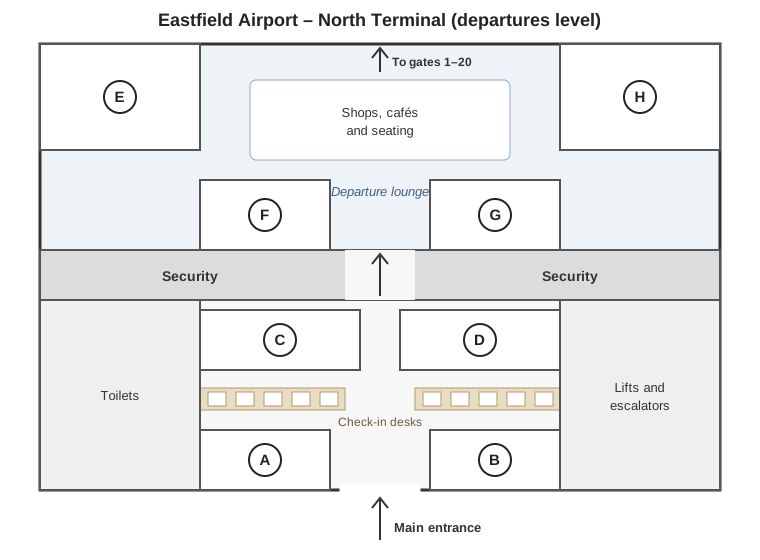
11Assistance desk
The answer is A.
In the recording: “Something passengers asked for in our surveys was a place to get help as soon as they arrive, so the assistance desk is immediately on the left as you come in.”
12Bag drop
The answer is D.
In the recording: “Most passengers now check in online, so if they only need to leave a suitcase, they should go to the bag drop, which is behind the check-in desks on the right-hand side.”
13Prayer room
The answer is C.
In the recording: “Behind the desks on the left, we've put the prayer room, which is open to people of all faiths.”
14Bookshop
The answer is F.
In the recording: “The first unit on the left is a bookshop, and opposite it, on the right, is the duty-free shop.”
15Viewing gallery
The answer is H.
In the recording: “Then, in the far right-hand corner, there's something I'm particularly proud of: a viewing gallery with huge windows overlooking the runway, where people can watch the planes taking off and landing.”
16Sleep pods
The answer is E.
In the recording: “And in the far left-hand corner, we have sleep pods.”
Questions 17–20
Complete the notes. Write NO MORE THAN TWO WORDS AND/OR A NUMBER for each answer.
Features of the North Terminal
• About a third of the electricity comes from 17 on the roof
• New scanners: passengers can leave 18 in their bags
• Screens show how many minutes it takes to walk to each 19
• The first flight will leave on 20
The answer is solar panels.
In the recording: “The whole roof is covered with solar panels, which will provide around a third of the terminal's electricity, and the large windows mean that the lights can stay off for much of the day.”
The answer is (their) laptops.
In the recording: “We've installed new scanners, so passengers can leave their laptops in their bags.”
The answer is gate.
In the recording: “So, throughout the departure lounge, there are screens showing not only when each flight is boarding, but also how many minutes it takes to walk to each gate.”
The answer is 2 April.
In the recording: “We'd originally planned to open on the thirtieth of March, but the final safety checks have taken a little longer than expected, so the first flight will now leave on the second of April, at six in the morning.”
Questions 21–25
Complete the flow-chart. Write NO MORE THAN TWO WORDS for each answer.
How each find was recorded
The find is left exactly where it was found
A supervisor photographs it with a 21 next to it
Its exact position is marked on the 22
It is put into a 23 with a label
Every evening, finds are taken to the 24 to be cleaned
When the dig is over, all finds are sent to the 25
The answer is scale bar.
In the recording: “You had to call one of the supervisors over, and they photographed it exactly where it was, with a scale bar next to it, so you could tell how big it was from the picture.”
The answer is site plan.
In the recording: “And then the supervisors used that laser instrument to measure its exact position, and it was marked on the site plan.”
The answer is plastic bag.
In the recording: “After that, the find went into a plastic bag with a label showing the trench number and the date.”
The answer is finds tent.
In the recording: “Then, at the end of each day, all the bags were carried to the finds tent, where the volunteers cleaned everything.”
The answer is county museum.
In the recording: “And the last stage, once the dig was over, was packing everything into boxes and sending it to the county museum, which will look after the finds permanently.”
Questions 26–30
Choose the correct letter, A, B or C.
26What had Lucy not expected about the dig?
The answer is A.
In the recording: “What I hadn't realised was how slow it all is.”
27What did Sam find most difficult?
The answer is C.
In the recording: “But kneeling in the trench for eight hours a day was really tough.”
28Which find do the students think was the most important?
The answer is B.
In the recording: “Whereas the bone comb was almost perfect.”
29What will Sam's report focus on?
The answer is A.
In the recording: “So I'm going to look at the animal bones we found, and what they tell us about what people there actually ate.”
30What do the students plan to do next summer?
The answer is C.
In the recording: “There's a dig in Portugal that takes students.”
Questions 31–40
Complete the notes. Write NO MORE THAN TWO WORDS for each answer.
Spider silk
• Like silkworm silk, spider silk is made of 31
• The strongest type, used as a safety line, is called 32 silk
• Weight for weight, it is stronger than 33
• Darwin's bark spider builds its webs across 34
• Spiders cannot be farmed, because they fight and 35 each other
• Golden cape: over a million spiders were collected and then 36
• Goats were given a spider gene, so the protein appeared in their 37
• The main difficulty is 38 the protein into a fibre
• Medical use: helping damaged 39 to grow back together
• Other use: lightweight 40
The answer is protein.
In the recording: “Like the silk produced by silkworms, spider silk is made of protein.”
The answer is dragline.
In the recording: “This is known as dragline silk.”
The answer is steel.
In the recording: “Weight for weight, dragline silk is stronger than steel, and it can also stretch a long way before it breaks, which makes it extraordinarily tough.”
The answer is rivers.
In the recording: “This spider builds enormous webs across rivers, and the lines that hold the web in place can be up to twenty-five metres long.”
The answer is eat.
In the recording: “Silkworms are happy to live together in large numbers, but spiders are territorial, and if you keep them close together, they fight and eat each other.”
The answer is released.
In the recording: “The silk was drawn out of each spider using a hand-powered machine, and the spiders were then released, unharmed.”
The answer is milk.
In the recording: “In one well-known experiment in the early two-thousands, a Canadian company gave goats a spider gene, so that the silk protein appeared in their milk.”
The answer is spinning.
In the recording: “The real difficulty is spinning it into a fibre.”
The answer is nerves.
In the recording: “Because spider silk doesn't usually provoke a reaction in the human body, it's being tested in surgery, for example as a guide to help damaged nerves grow back together.”
The answer is protective clothing.
In the recording: “It could also be used to make lightweight protective clothing for the police, the army and people who work in dangerous industries.”
Answer key for IELTS Listening Practice Test 10
All 40 answers. Try the questions first, then check here.
- 1 TK3958
- 2 bungalow
- 3 1934
- 4 3
- 5 2021
- 6 B
- 7 C
- 8 A
- 9 B
- 10 A
- 11 A
- 12 D
- 13 C
- 14 F
- 15 H
- 16 E
- 17 solar panels
- 18 (their) laptops
- 19 gate
- 20 2 April
- 21 scale bar
- 22 site plan
- 23 plastic bag
- 24 finds tent
- 25 county museum
- 26 A
- 27 C
- 28 B
- 29 A
- 30 C
- 31 protein
- 32 dragline
- 33 steel
- 34 rivers
- 35 eat
- 36 released
- 37 milk
- 38 spinning
- 39 nerves
- 40 protective clothing
Ready for the real test?
40 questions in about 30 minutes, on a screen like the computer test. You hear each part once and get your band at the end.
About the real test: ielts.org