IELTS Environment Vocabulary: 50 Words with Examples
These 50 words of IELTS environment vocabulary come up again and again in Writing Task 2, Speaking Part 3 and the Listening and Reading tests. Each word has a simple meaning, its sound, a band level, examples for Writing and Speaking, and the mistake to avoid.
50 words · free quiz and flashcards · updated October 2026
pollution
pol·LU·tion · nounDirt, smoke or chemicals that make air, water or land harmful.Band 6 · everyday
Word family: pollute (verb) · polluted (adjective) · pollutant (noun)
Collocations
- air pollution
- cause pollution
- reduce pollution
Similar: contamination
WritingAir pollution is a serious threat to public health in large cities.
SpeakingThe pollution in my city is at its worst in winter.
Common mistake: Saying “pollutions”. It is usually uncountable: “a lot of pollution”.
climate change
CLI·mate CHANGE · nounChanges in the world’s weather over a long time, mainly caused by people.Band 6 · everyday
Collocations
- tackle climate change
- the effects of climate change
- fight climate change
Similar: global warming
WritingGovernments must work together to tackle climate change.
SpeakingI think climate change is the biggest problem my generation faces.
Common mistake: Saying “the climate change” in general. Use no “the”: “Climate change is serious.”
global warming
GLO·bal WARM·ing · nounThe slow rise in the Earth’s temperature.Band 6 · everyday
Collocations
- the causes of global warming
- slow global warming
- contribute to global warming
Similar: climate change
WritingBurning coal and oil is the main cause of global warming.
SpeakingSummers are much hotter now, maybe because of global warming.
Common mistake: Saying “the global warming”. Use no “the”: “Global warming is a threat.”
recycle
re·CY·cle · verbTo collect used things like glass and paper so they can be made into something new.Band 6 · everyday
Word family: recycling (noun) · recycled (adjective) · recyclable (adjective)
Collocations
- recycle waste
- recycle plastic bottles
- recycling bins
Similar: reprocess
WritingLocal councils should make it easier for residents to recycle their waste.
SpeakingWe recycle almost everything at home: paper, glass and cans.
Common mistake: Mixing it up with “reuse”. To recycle is to make something new from it; to reuse is to use it again as it is.
renewable energy
re·NEW·a·ble EN·er·gy · nounPower from sources that do not run out, like the sun and the wind.Band 6 · everyday
Word family: renew (verb) · renewable (adjective) · renewables (noun)
Collocations
- invest in renewable energy
- switch to renewable energy
- renewable energy sources
Similar: clean energy, green energy
WritingInvesting in renewable energy creates jobs as well as cleaner air.
SpeakingI’d love my town to switch to renewable energy, like wind power.
Common mistake: Saying “renewable energies are”. It is usually uncountable: “renewable energy is”.
fossil fuels
FOS·sil FU·els · noun, pluralCoal, oil and gas: fuels formed in the ground over millions of years.Band 6 · everyday
Collocations
- burn fossil fuels
- depend on fossil fuels
- move away from fossil fuels
Similar: coal, oil and gas
WritingMany countries still depend heavily on fossil fuels for electricity.
SpeakingMost of our electricity still comes from fossil fuels, sadly.
Common mistake: Spelling it “fossile”. The word is “fossil”.
emissions
e·MIS·sions · noun, usually pluralGases that cars, factories and planes send into the air.Band 6 · everyday
Word family: emit (verb) · emission (noun)
Collocations
- carbon emissions
- cut emissions
- vehicle emissions
Similar: discharge
WritingGovernments must cut carbon emissions to slow down climate change.
SpeakingI think car emissions are the main cause of smog in my city.
Common mistake: Saying “the emission of cars”. Say “vehicle emissions” or “emissions from cars”.
deforestation
de·for·es·TA·tion · nounCutting down a large area of forest.Band 6 · everyday
Word family: deforest (verb) · deforested (adjective)
Collocations
- rapid deforestation
- tackle deforestation
- deforestation in the Amazon
Similar: logging, forest loss
WritingRapid deforestation is destroying the homes of many animal species.
SpeakingWhere I live, deforestation is a problem because farms need more land.
Common mistake: Spelling it “deforestration”. There is no r before “-ation”.
endangered species
en·DAN·gered SPE·cies · nounAn animal or plant that may soon die out completely.Band 6 · everyday
Word family: endanger (verb) · danger (noun)
Collocations
- protect endangered species
- an endangered species of bird
- become an endangered species
Similar: threatened species
WritingHunting has turned many large animals into endangered species.
SpeakingTigers are an endangered species, so I was lucky to see one.
Common mistake: Saying “an endangered specie”. “Species” is both singular and plural: one species, two species.
natural resources
NAT·u·ral re·SOUR·ces · noun, pluralUseful things from nature, such as water, wood, oil and minerals.Band 6 · everyday
Collocations
- use natural resources
- protect natural resources
- be rich in natural resources
Similar: raw materials
WritingRich countries use far more than their share of the world’s natural resources.
SpeakingMy country is rich in natural resources, especially oil.
Common mistake: Saying “natural resource” for the whole group. Use the plural: “natural resources”.
waste
WASTE · noun / verbThings that people throw away because they no longer want them.Band 6 · everyday
Word family: wasteful (adjective) · wastage (noun)
Collocations
- household waste
- reduce waste
- food waste
Similar: rubbish, garbage
WritingCities produce huge amounts of household waste every day.
SpeakingI try not to waste food; I hate throwing it away.
Common mistake: Saying “wastes” for rubbish in general. It is usually uncountable: “a lot of waste”.
litter
LIT·ter · noun / verbPaper, cans and other rubbish left on the ground in public places.Band 6 · everyday
Collocations
- drop litter
- pick up litter
- litter bins
Similar: rubbish
WritingFines for dropping litter would keep streets and beaches cleaner.
SpeakingIt annoys me when people leave litter in the park.
Common mistake: Saying “litters”. It is uncountable: “a lot of litter”.
greenhouse gases
GREEN·house GAS·es · noun, pluralGases, like carbon dioxide, that trap heat around the Earth.Band 6 · everyday
Word family: the greenhouse effect (noun)
Collocations
- release greenhouse gases
- reduce greenhouse gases
- greenhouse gas emissions
Similar: heat-trapping gases
WritingFarming releases large amounts of greenhouse gases such as methane.
SpeakingI didn’t know cows produce so many greenhouse gases!
Common mistake: Spelling the plural “gasses”. Write “gases”.
environmentally friendly
en·vi·ron·MEN·tal·ly FRIEND·ly · adjectiveNot harmful to the environment.Band 6 · everyday
Word family: environment (noun) · environmental (adjective)
Collocations
- environmentally friendly products
- an environmentally friendly way to travel
- more environmentally friendly
Similar: eco-friendly, green
WritingGovernments could reward companies that make environmentally friendly products.
SpeakingCycling is the most environmentally friendly way to get around my town.
Common mistake: Writing “environmental friendly”. You need the adverb: “environmentally friendly”.
single-use plastic
sin·gle-USE PLAS·tic · nounPlastic things, like straws and bags, that are used once and then thrown away.Band 6 · everyday
Collocations
- ban single-use plastic
- cut down on single-use plastic
- single-use plastic bags
Similar: disposable plastic
WritingSeveral countries have banned single-use plastic bags in shops.
SpeakingI carry my own bottle to avoid single-use plastic.
Common mistake: Writing “single use plastic” without the hyphen. Write “single-use”.
drought
DROUGHT · nounA long time with little or no rain.Band 6 · everyday
Collocations
- a severe drought
- suffer from drought
- long periods of drought
Similar: dry spell
WritingLong periods of drought are destroying crops in many parts of Africa.
SpeakingWe had a terrible drought last summer and the river nearly dried up.
Common mistake: Saying it to rhyme with “bought”. It rhymes with “out”.
flood
FLOOD · noun / verbA large amount of water covering land that is usually dry.Band 6 · everyday
Word family: flooding (noun) · flooded (adjective)
Collocations
- severe floods
- be hit by floods
- flood defences
Similar: flooding
WritingRising seas mean coastal cities will face more frequent floods.
SpeakingMy grandparents’ village flooded twice last year.
Common mistake: Saying it to rhyme with “food”. It rhymes with “mud”.
solar power
SO·lar POW·er · nounElectricity made from the energy of the sun.Band 6 · everyday
Word family: solar panel (noun) · solar energy (noun)
Collocations
- generate solar power
- invest in solar power
- solar power plants
Similar: solar energy
WritingHot, sunny countries are ideal for generating solar power.
SpeakingMy uncle’s house runs completely on solar power.
Common mistake: Saying “sun power”. The adjective is “solar”.
sustainable
sus·TAIN·a·ble · adjectiveAble to continue for a long time without harming the environment.Band 7 · less common
Word family: sustainability (noun) · sustainably (adverb)
Collocations
- sustainable development
- a sustainable lifestyle
- environmentally sustainable
Similar: eco-friendly, green
WritingCities should invest in sustainable transport, such as trams and cycle lanes.
SpeakingI try to buy clothes from more sustainable brands.
Common mistake: Saying “sustainability development”. Put the adjective before the noun: “sustainable development”.
biodiversity
bi·o·di·VER·si·ty · noun, uncountableThe number and variety of plants and animals in one place.Band 7 · less common
Word family: biodiverse (adjective)
Collocations
- protect biodiversity
- the loss of biodiversity
- rich in biodiversity
Similar: variety of life
WritingThe loss of biodiversity threatens our food supply, since many crops need insects.
SpeakingThe forest near my hometown is rich in biodiversity.
Common mistake: Saying “biodiversities”. It is uncountable.
carbon footprint
CAR·bon FOOT·print · nounThe amount of carbon dioxide that a person’s or a company’s activities produce.Band 7 · less common
Collocations
- reduce your carbon footprint
- a large carbon footprint
- cut our carbon footprint
Similar: environmental impact
WritingFlying less is one of the simplest ways to reduce our carbon footprint.
SpeakingI take the bus to work to cut my carbon footprint.
Common mistake: Writing “foot print” as two words. Write “footprint”.
conservation
con·ser·VA·tion · nounProtecting animals, plants and natural places.Band 7 · less common
Word family: conserve (verb) · conservationist (noun)
Collocations
- wildlife conservation
- conservation projects
- conservation areas
Similar: protection, preservation
WritingGovernments should fund conservation projects that protect rare species.
SpeakingMy cousin works in conservation, looking after sea turtles.
Common mistake: Mixing it up with “conversation”. Conservation is about protecting nature.
ecosystem
E·co·sys·tem · nounAll the plants and animals in one area, and the way they depend on each other.Band 7 · less common
Word family: ecology (noun)
Collocations
- a fragile ecosystem
- damage the ecosystem
- marine ecosystems
Similar: natural environment
WritingPlastic waste is damaging marine ecosystems around the world.
SpeakingCoral reefs are such beautiful ecosystems, but they’re dying.
Common mistake: Putting the stress on “sys”. Stress the first part: EE-co-system.
habitat loss
HAB·i·tat LOSS · nounWhen the natural home of animals or plants is destroyed.Band 7 · less common
Word family: habitat (noun)
Collocations
- suffer habitat loss
- the main cause of habitat loss
- habitat loss and pollution
Similar: loss of natural homes
WritingHabitat loss is the biggest threat to wildlife in many regions.
SpeakingElephants here are struggling because of habitat loss.
Common mistake: Spelling it “habitate”. Write “habitat”.
contaminate
con·TAM·i·nate · verbTo make water, food or soil dirty or harmful by adding something bad.Band 7 · less common
Word family: contamination (noun) · contaminated (adjective)
Collocations
- contaminate water supplies
- contaminated soil
- contaminate the food chain
Similar: pollute, poison
WritingChemicals from factories can contaminate rivers and harm local people.
SpeakingAfter the floods, our drinking water was contaminated for a week.
Common mistake: Using it for air in general. We usually say air is “polluted”, and water, food or soil is “contaminated”.
depletion
de·PLE·tion · nounUsing up a supply of something until little is left.Band 7 · less common
Word family: deplete (verb) · depleted (adjective)
Collocations
- the depletion of natural resources
- ozone depletion
- rapid depletion
Similar: using up, exhaustion
WritingThe depletion of fish stocks is a serious problem for coastal communities.
SpeakingI worry about the depletion of water in our local lake.
Common mistake: Saying “the depletion of pollution”. You deplete a supply of something useful, like water or fish.
extreme weather
ex·TREME WEATH·er · nounVery unusual and dangerous weather, like storms, heatwaves and floods.Band 7 · less common
Collocations
- extreme weather events
- more frequent extreme weather
- extreme weather conditions
Similar: severe weather
WritingScientists link the rise in extreme weather events to climate change.
SpeakingWe’ve had more extreme weather recently, like huge storms.
Common mistake: Saying “an extreme weather”. Weather is uncountable: “extreme weather” or “an extreme weather event”.
landfill
LAND·fill · nounA large hole in the ground where rubbish is buried.Band 7 · less common
Word family: landfill site (noun)
Collocations
- send waste to landfill
- landfill sites
- end up in landfill
Similar: rubbish dump, tip
WritingMost plastic packaging still ends up in landfill instead of being recycled.
SpeakingThere’s a huge landfill site outside my city, and it smells awful.
Common mistake: Saying “a landfill place”. Say “a landfill site” or just “landfill”.
toxic
TOX·ic · adjectivePoisonous and able to cause harm.Band 7 · less common
Word family: toxin (noun) · toxicity (noun)
Collocations
- toxic waste
- toxic chemicals
- toxic fumes
Similar: poisonous, harmful
WritingFactories must be stopped from dumping toxic waste into rivers.
SpeakingThe smoke from the fire was really toxic, so we stayed inside.
Common mistake: Saying “toxical”. The adjective is “toxic”.
rising sea levels
RIS·ing SEA LEV·els · noun, pluralThe slow rise of the oceans as the Earth gets warmer.Band 7 · less common
Collocations
- threatened by rising sea levels
- the impact of rising sea levels
- rising sea levels and floods
Similar: sea-level rise
WritingLow-lying countries are especially threatened by rising sea levels.
SpeakingSome islands could disappear because of rising sea levels.
Common mistake: Saying “rising sea level” for the general problem. Use the plural: “rising sea levels”.
carbon neutral
CAR·bon NEU·tral · adjectiveAdding no extra carbon dioxide to the air overall.Band 7 · less common
Word family: carbon neutrality (noun)
Collocations
- become carbon neutral
- a carbon neutral company
- carbon neutral by 2050
Similar: net zero
WritingMany companies have promised to become carbon neutral by 2050.
SpeakingMy university says it’ll be carbon neutral in ten years.
Common mistake: Thinking it means “no carbon at all”. It means the carbon you add is balanced by carbon you remove.
reusable
re·US·a·ble · adjectiveAble to be used again and again.Band 7 · less common
Word family: reuse (verb)
Collocations
- reusable bags
- reusable water bottles
- reusable cups
Similar: refillable
WritingShops could charge for plastic bags to encourage people to bring reusable ones.
SpeakingI always take a reusable coffee cup to work.
Common mistake: Spelling it “reuseable”. Drop the e: “reusable”.
overconsumption
o·ver·con·SUMP·tion · nounUsing or buying more than we need, especially of the Earth’s resources.Band 7 · less common
Word family: consume (verb) · consumption (noun)
Collocations
- the problem of overconsumption
- overconsumption of resources
- reduce overconsumption
Similar: excessive consumption
WritingOverconsumption in rich countries puts heavy pressure on the planet.
SpeakingI think fast fashion is a clear example of overconsumption.
Common mistake: Using “overconsume” as a noun. The noun is “overconsumption”.
pesticide
PES·ti·cide · nounA chemical used to kill insects that damage crops.Band 7 · less common
Collocations
- use pesticides
- harmful pesticides
- pesticide-free food
Similar: insecticide
WritingHeavy use of pesticides is one reason bee numbers are falling.
SpeakingMy parents only buy fruit grown without pesticides.
Common mistake: Using it for all farm chemicals. Fertilisers feed plants; pesticides kill insects.
water scarcity
WA·ter SCAR·ci·ty · nounNot having enough clean water for people’s needs.Band 7 · less common
Word family: scarce (adjective)
Collocations
- face water scarcity
- tackle water scarcity
- regions with water scarcity
Similar: water shortage
WritingMany dry regions already face serious water scarcity.
SpeakingWater scarcity is a big issue in the south of my country.
Common mistake: Saying “water scarceness”. The usual noun is “scarcity”.
smog
SMOG · nounDirty, smoky air that hangs over a city.Band 7 · less common
Word family: smoggy (adjective)
Collocations
- thick smog
- a layer of smog
- city smog
Similar: haze, air pollution
WritingOn some days, thick smog makes it unsafe for children to play outside.
SpeakingSome mornings the smog is so thick I can’t see the mountains.
Common mistake: Saying “smogs”. It is uncountable: “a lot of smog”.
environmental awareness
en·vi·ron·MEN·tal a·WARE·ness · nounKnowing and caring about the problems of the natural world.Band 7 · less common
Word family: aware (adjective)
Collocations
- raise environmental awareness
- growing environmental awareness
- a lack of environmental awareness
Similar: eco-consciousness
WritingSchools play a key role in raising environmental awareness among young people.
SpeakingThere’s much more environmental awareness now than when I was a child.
Common mistake: Saying “environment awareness”. Use the adjective: “environmental awareness”.
preserve
pre·SERVE · verbTo keep something safe from harm or change.Band 7 · less common
Word family: preservation (noun)
Collocations
- preserve natural habitats
- preserve the environment
- preserve for future generations
Similar: protect, conserve
WritingWe have a duty to preserve the rainforests for future generations.
SpeakingMy town is trying to preserve the old forest near the river.
Common mistake: Mixing it up with “reserve”. To preserve is to protect; to reserve is to book or keep for later.
exacerbate
ex·AC·er·bate · verbTo make a bad situation worse.Band 8 · uncommon
Word family: exacerbation (noun)
Collocations
- exacerbate the problem
- exacerbate air pollution
- be exacerbated by
Similar: worsen, aggravate
WritingHeavy traffic in city centres exacerbates air pollution.
SpeakingBuilding more roads may only exacerbate the traffic problem.
Common mistake: Using it for good things. It is only for problems: not “exacerbate the economy”.
irreversible
ir·re·VER·si·ble · adjectiveImpossible to change back to how it was before.Band 8 · uncommon
Word family: reverse (verb) · reversible (adjective)
Collocations
- irreversible damage
- irreversible harm
- an irreversible decline
Similar: permanent
WritingScientists warn that some damage to coral reefs may soon be irreversible.
SpeakingLosing a language is irreversible, so we should record old stories.
Common mistake: Writing “unreversible”. The opposite of “reversible” is “irreversible”.
mitigate
MIT·i·gate · verbTo make something bad less serious.Band 8 · uncommon
Word family: mitigation (noun)
Collocations
- mitigate the effects
- mitigate the risk
- mitigate climate change
Similar: reduce, lessen
WritingPlanting trees in cities can mitigate the effects of extreme heat.
SpeakingI think better buses would mitigate the traffic jams a lot.
Common mistake: Mixing it up with “militate”, which is a different word.
environmental degradation
en·vi·ron·MEN·tal deg·ra·DA·tion · nounThe slow damage of land, water and air.Band 8 · uncommon
Word family: degrade (verb) · degraded (adjective)
Collocations
- cause environmental degradation
- prevent environmental degradation
- widespread environmental degradation
Similar: environmental damage
WritingUncontrolled mining has led to widespread environmental degradation.
SpeakingYou can see the environmental degradation along the coast near my city.
Common mistake: Using “degrading” as the noun. The noun is “degradation”.
detrimental
det·ri·MEN·tal · adjectiveCausing harm or damage.Band 8 · uncommon
Word family: detriment (noun)
Collocations
- a detrimental effect
- be detrimental to health
- detrimental to the environment
Similar: harmful, damaging
WritingAir pollution has a detrimental effect on children’s health.
SpeakingCheap flights are detrimental to the environment, but they’re so tempting.
Common mistake: Saying “detrimental for”. The usual preposition is “to”: “detrimental to health”.
unprecedented
un·PREC·e·dent·ed · adjectiveNever having happened before.Band 8 · uncommon
Word family: precedent (noun)
Collocations
- unprecedented levels
- an unprecedented rise
- on an unprecedented scale
Similar: record-breaking
WritingCarbon dioxide in the air has reached unprecedented levels.
SpeakingThe heat last summer was unprecedented; nobody had seen anything like it.
Common mistake: Using it for things that are only rare. It means it has never happened before.
curb
CURB · verb / nounTo control or limit something bad.Band 8 · uncommon
Collocations
- curb emissions
- curb pollution
- put a curb on
Similar: limit, restrict, rein in
WritingStrict laws are needed to curb emissions from heavy industry.
SpeakingOur city is trying to curb traffic by charging drivers to enter the centre.
Common mistake: Mixing it up with “kerb”, the edge of the pavement in British English.
offset
off·SET · verbTo balance a bad effect with something good of the same size.Band 8 · uncommon
Word family: carbon offsetting (noun)
Collocations
- offset carbon emissions
- offset the damage
- offset the cost
Similar: balance out, compensate for
WritingSome airlines plant trees to offset the emissions from their flights.
SpeakingI’m not sure planting trees really offsets flying so much.
Common mistake: Saying “offsetted”. The past form is the same: “offset”.
ecological
e·co·LOG·i·cal · adjectiveConnected with how plants, animals and their environment depend on each other.Band 8 · uncommon
Word family: ecology (noun) · ecologist (noun)
Collocations
- an ecological disaster
- ecological balance
- ecological damage
Similar: environmental
WritingThe oil spill was an ecological disaster for the whole coastline.
SpeakingCutting down that forest would be an ecological mistake.
Common mistake: Saying “ecologic”. The usual form is “ecological”.
catastrophic
cat·a·STROPH·ic · adjectiveCausing sudden and very great damage.Band 8 · uncommon
Word family: catastrophe (noun)
Collocations
- catastrophic consequences
- catastrophic floods
- potentially catastrophic
Similar: disastrous, devastating
WritingWithout action, the consequences of climate change could be catastrophic.
SpeakingThe fires last year were catastrophic for the farmers.
Common mistake: Stressing it like “catastrophe”. The noun stresses “-tas-”; the adjective stresses “-stroph-”.
pristine
PRIS·tine · adjectiveClean, fresh and not spoiled by people.Band 8 · uncommon
Collocations
- pristine beaches
- pristine forests
- in pristine condition
Similar: untouched, unspoilt
WritingMass tourism can damage even the most pristine natural areas.
SpeakingWe found a pristine beach with nobody else on it.
Common mistake: Saying it to rhyme with “mine”. It rhymes with “seen”.
desertification
de·sert·i·fi·CA·tion · nounWhen good land slowly turns into desert.Band 8 · uncommon
Word family: desert (noun)
Collocations
- cause desertification
- prevent desertification
- the spread of desertification
Similar: land degradation
WritingOvergrazing and drought are speeding up desertification in parts of Africa.
SpeakingPlanting trees can help stop desertification, I think.
Common mistake: Spelling it “desertation”. Write “desertification”.
Environment vocabulary in IELTS Writing and Speaking
Here is how IELTS environment vocabulary can come up in the test, with our own practice questions. So, try to answer them with words from the list above.
Writing Task 2
Some people think environmental problems are too big for one person to solve. Others believe each of us must act. Discuss both views and give your own opinion.
Speaking
- Part 1: Do you recycle at home?
- Part 1: Is there much pollution where you live?
- Part 2: Describe a natural place that you like to visit.
- Part 3: Who should pay to protect the environment: governments or companies?
- Part 3: Will people change the way they travel to protect the planet?
Our free tests on this topic
- Listening Practice Test 1, Part 4a lecture on mangrove forests
- Listening Practice Test 6, Part 4a lecture on urban heat islands
- Listening Practice Test 11, Part 4a lecture on restoring coral reefs
- Reading Practice Test 5, Passage 2how the world protects the seeds of its plants
A model paragraph with IELTS environment vocabulary
Rapid deforestation and rising carbon emissions are problems that no single person can solve. However, individuals still matter. If millions of people reduce their carbon footprint by flying less and choosing sustainable products, the combined effect is large. Without strong laws, though, these efforts may be too small, and some damage, such as the loss of biodiversity, could become irreversible.
Practise this IELTS environment vocabulary
Take the 10-question quiz on this IELTS environment vocabulary, or go through every word with the flashcards.
Question 1 of 10
Which word means “the slow rise in the Earth’s temperature”?
Now use the words
Write a Task 2 essay with five of these words. Then our free Writing Checker gives you a band for vocabulary and for the other three criteria.
Open the Writing Checker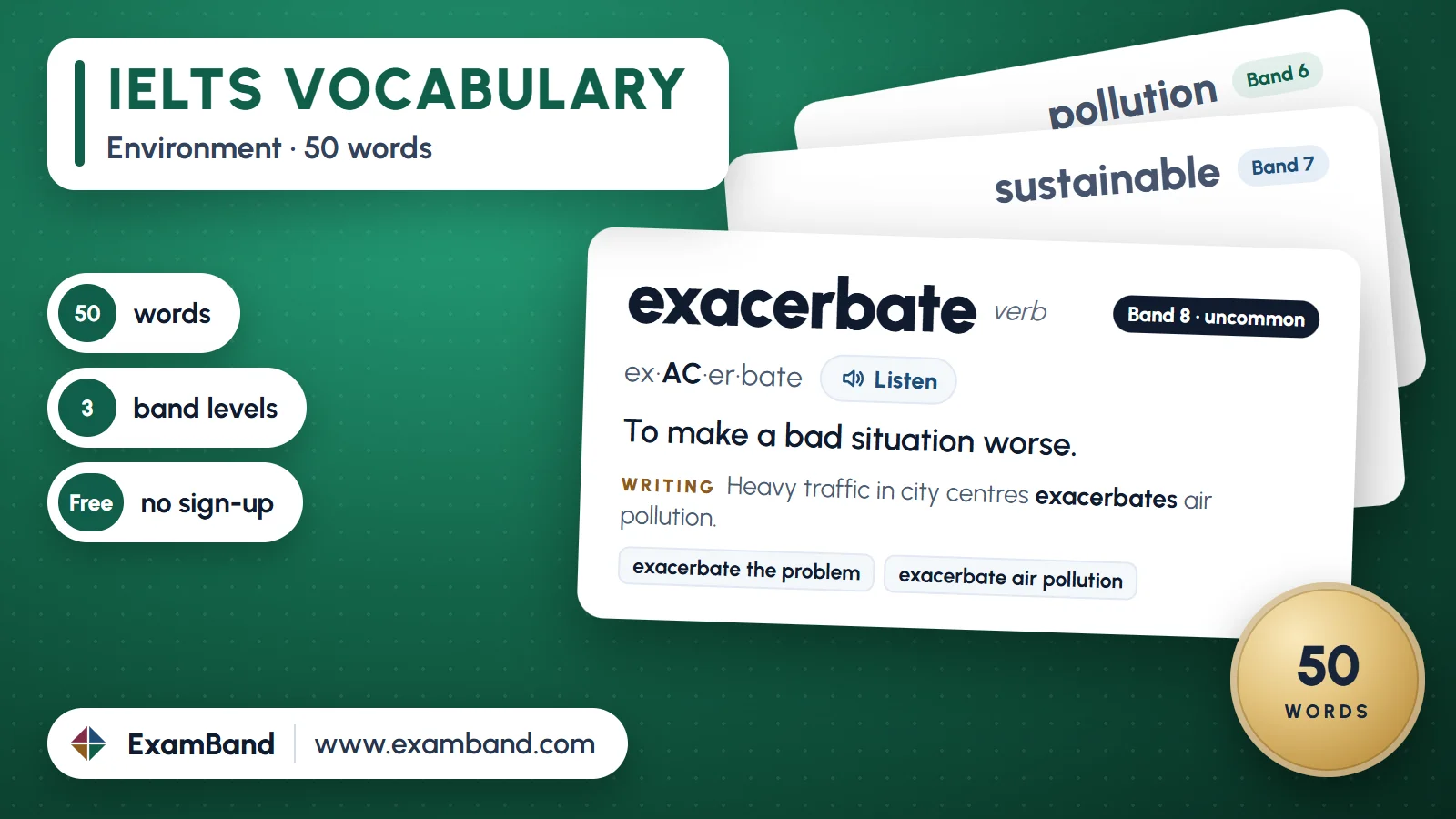
Questions about IELTS environment vocabulary
How do I learn IELTS environment vocabulary?
Learn about ten words a day. First, read the meaning, listen to the word and say it out loud with the right stress. Then test yourself with the quiz and the flashcards on this page. Finally, use five of the words in an essay and check it with our free Writing Checker.
Which words should I learn first?
Start with the band 6 words, because you need them to explain any idea clearly. After that, add the band 7 words. However, use the band 8 words only when you are sure of their meaning, because a rare word used wrongly can lower your score.
Are these official IELTS words?
No. IELTS has no official word list. Instead, our levels follow the words of the public IELTS band descriptors: band 7 asks for some “less common” words, and band 8 for “uncommon” words used with skill.