IELTS Language Vocabulary: 50 Words with Examples
These 50 words of IELTS language vocabulary help you talk and write about learning languages, communication and dying languages, topics that come up in Writing Task 2, Speaking Part 3 and Academic Reading. Each word has a simple meaning, its sound, a band level, examples for Writing and Speaking, and the mistake to avoid.
50 words · free quiz and flashcards · updated October 2026
foreign language
FOR·eign LAN·guage · nounA language that is not spoken in your own country.Band 6 · everyday
Word family: foreigner (noun)
Collocations
- learn a foreign language
- speak a foreign language
- foreign language skills
Similar: second language
WritingLearning a foreign language opens up jobs in other countries.
SpeakingI started learning a foreign language at the age of ten.
Common mistake: Saying “a strange language” for one you do not know. Say “a foreign language”.
mother tongue
MOTH·er TONGUE · nounThe first language you learned as a child.Band 6 · everyday
Collocations
- my mother tongue
- speak your mother tongue
- lose your mother tongue
Similar: first language, native language
WritingChildren of immigrants sometimes lose their mother tongue.
SpeakingMy mother tongue is Arabic, but I think in English at work.
Common mistake: Saying “mother language”. The phrase is “mother tongue” or “first language”.
native speaker
NA·tive SPEAK·er · nounA person who learned a language as a child, as their first language.Band 6 · everyday
Collocations
- a native speaker of English
- speak like a native speaker
- non-native speakers
WritingMost people who speak English today are not native speakers.
SpeakingI practise speaking with a native speaker online every week.
Common mistake: Saying “a native” alone in an essay. Say “a native speaker”.
bilingual
bi·LIN·gual · adjectiveAble to speak two languages very well.Band 6 · everyday
Word family: bilingualism (noun)
Collocations
- bilingual children
- a bilingual school
- grow up bilingual
Similar: multilingual
WritingGrowing up bilingual can help children understand other cultures.
SpeakingMy kids are bilingual; they speak French and English.
Common mistake: Spelling it “bilangual”. Write “bilingual”, with -lingual.
fluent
FLU·ent · adjectiveAble to speak a language easily and well.Band 6 · everyday
Word family: fluency (noun) · fluently (adverb)
Collocations
- fluent in
- fluent English
- speak fluently
Similar: articulate
WritingBecoming fluent in a second language takes years of practice.
SpeakingI’m fluent in Spanish, but my German is basic.
Common mistake: Saying “fluent on English”. Say “fluent in English”.
accent
AC·cent · nounThe way people from one place say words.Band 6 · everyday
Word family: accented (adjective)
Collocations
- a strong accent
- a British accent
- lose your accent
WritingHaving an accent does not stop someone from being understood.
SpeakingPeople say I have a slight American accent.
Common mistake: Mixing up “accent” and “dialect”. An accent is how words sound; a dialect also has its own words and grammar.
grammar
GRAM·mar · nounThe rules for how words change and go together in sentences.Band 6 · everyday
Word family: grammatical (adjective)
Collocations
- English grammar
- grammar mistakes
- learn grammar
WritingAccurate grammar is one of the four things IELTS Writing is marked on.
SpeakingGrammar was never my strong point at school.
Common mistake: Spelling it “grammer”. Write “grammar”, with -ar.
pronunciation
pro·nun·ci·A·tion · nounThe way a word is said.Band 6 · everyday
Word family: pronounce (verb)
Collocations
- clear pronunciation
- improve your pronunciation
- pronunciation mistakes
WritingClear pronunciation matters more than having a perfect accent.
SpeakingI watch films in English to work on my pronunciation.
Common mistake: Spelling it “pronounciation”. The noun has no o after n: “pronunciation”.
communicate
com·MU·ni·cate · verbTo share information or ideas with someone.Band 6 · everyday
Word family: communication (noun) · communicative (adjective)
Collocations
- communicate with
- communicate clearly
- communicate effectively
Similar: talk, interact
WritingTeenagers now communicate mostly through messages, not calls.
SpeakingI can communicate in English, but I still make mistakes.
Common mistake: Leaving out “with”. Say “communicate with people”.
translate
trans·LATE · verbTo change words from one language into another.Band 6 · everyday
Word family: translation (noun) · translator (noun)
Collocations
- translate into
- translate from
- translate a document
Similar: interpret
WritingApps can now translate speech almost instantly.
SpeakingI sometimes translate letters for my parents.
Common mistake: Saying “translate to Spanish”. “Translate into Spanish” is the usual British form.
pick up
pick UP · phrasal verbTo learn something without studying it formally.Band 6 · everyday
Collocations
- pick up a language
- pick up a few words
- pick up an accent
Similar: acquire
WritingYoung children pick up a new accent more easily than adults.
SpeakingI picked up some Italian while I was working in Rome.
Common mistake: Using “pick up” for serious study. It means learning naturally, without classes.
body language
BOD·y LAN·guage · nounMessages you give with your face, hands and the way you sit or stand.Band 6 · everyday
Collocations
- read body language
- positive body language
- use body language
Similar: gestures, non-verbal communication
WritingGood body language can make a speaker seem more confident.
SpeakingWhen I don’t know a word, I use body language.
Common mistake: Saying “body languages”. It is uncountable: “her body language”.
second language
SEC·ond LAN·guage · nounA language you learn after your first one.Band 6 · everyday
Collocations
- learn a second language
- English as a second language
Similar: foreign language
WritingMany people use English as a second language at work.
SpeakingEnglish is my second language, and Japanese is my third.
Common mistake: Saying “secondary language”. Use “second language”.
language barrier
LAN·guage BAR·ri·er · nounA problem in communicating because people speak different languages.Band 6 · everyday
Collocations
- overcome the language barrier
- break down language barriers
WritingTranslation apps help tourists overcome the language barrier.
SpeakingThe language barrier was hard when I first moved to Turkey.
Common mistake: Saying “language border”. The phrase is “language barrier”.
official language
of·FI·cial LAN·guage · nounThe language used by a country’s government, schools and courts.Band 6 · everyday
Collocations
- the official language of
- have two official languages
Similar: national language
WritingCanada has two official languages: English and French.
SpeakingArabic is the official language of my country.
Common mistake: Spelling it “officiel”. Write “official language”.
express yourself
ex·PRESS your·SELF · phraseTo show your feelings or ideas in words or actions.Band 6 · everyday
Word family: expression (noun) · expressive (adjective)
Collocations
- express yourself clearly
- find it hard to express yourself
Similar: put into words
WritingLearning to express yourself clearly is useful in every job.
SpeakingI express myself better in writing than in speaking.
Common mistake: Leaving out “yourself”. Say “I can express myself”, not “I can express”.
memorise
MEM·o·rise · verbTo learn something so that you remember it exactly.Band 6 · everyday
Word family: memory (noun)
Collocations
- memorise words
- memorise a speech
- try to memorise
Similar: learn by heart
WritingStudents who only memorise answers rarely understand the topic.
SpeakingI memorise ten new words every day.
Common mistake: Spelling it “memorize” in a British essay. UK: “memorise”; US: “memorize”.
misunderstanding
mis·un·der·STAND·ing · nounWhen someone understands something in the wrong way.Band 6 · everyday
Word family: misunderstand (verb)
Collocations
- cause a misunderstanding
- a simple misunderstanding
- clear up a misunderstanding
Similar: confusion
WritingCultural misunderstandings can harm business relationships.
SpeakingThere was a funny misunderstanding when I ordered food in Japan.
Common mistake: Writing “miss understanding” as two words. It is one word: “misunderstanding”.
dialect
DI·a·lect · nounA form of a language spoken in one area, with its own words and grammar.Band 7 · less common
Word family: dialectal (adjective)
Collocations
- a local dialect
- speak in dialect
- regional dialects
Similar: variety
WritingLocal dialects are disappearing as people move to cities.
SpeakingMy grandparents speak a dialect that I can barely understand.
Common mistake: Using “dialect” for a separate language. A dialect is a form of one language.
slang
SLANG · nounVery informal words, often used by young people.Band 7 · less common
Word family: slangy (adjective)
Collocations
- use slang
- teenage slang
- street slang
Similar: informal language
WritingSlang should be avoided in an academic essay.
SpeakingI learned a lot of slang from watching TV series.
Common mistake: Saying “slangs”. It is uncountable: “a lot of slang”.
lingua franca
LIN·gua FRAN·ca · nounA language used between people who have different first languages.Band 7 · less common
Collocations
- a global lingua franca
- English as a lingua franca
Similar: common language
WritingEnglish has become the lingua franca of science and business.
SpeakingAt my company, English is the lingua franca.
Common mistake: Writing “lingua franka”. Write “lingua franca”.
multilingual
mul·ti·LIN·gual · adjectiveAble to use several languages.Band 7 · less common
Word family: multilingualism (noun)
Collocations
- a multilingual country
- multilingual staff
- multilingual societies
Similar: polyglot
WritingIn multilingual countries like India, signs often appear in several languages.
SpeakingMy office is very multilingual; we speak five languages.
Common mistake: Writing “multi-lingual” with a hyphen. It is one word: “multilingual”.
proficiency
pro·FI·cien·cy · nounA high level of skill.Band 7 · less common
Word family: proficient (adjective)
Collocations
- language proficiency
- English proficiency
- a proficiency test
Similar: skill, competence
WritingIELTS is a test of English language proficiency.
SpeakingMy proficiency in English has grown since I moved abroad.
Common mistake: Saying “a good proficient”. The noun is “proficiency”; the adjective is “proficient”.
immersion
im·MER·sion · nounLearning a language by living in it, hearing and using it all day.Band 7 · less common
Word family: immerse (verb)
Collocations
- language immersion
- total immersion
- an immersion course
WritingImmersion is one of the fastest ways to learn a language.
SpeakingA month of immersion in Spain did more for me than a year of classes.
Common mistake: Mixing it up with “immigration”. Immersion means being surrounded by the language.
endangered language
en·DAN·gered LAN·guage · nounA language that may soon have no speakers left.Band 7 · less common
Word family: endanger (verb)
Collocations
- protect endangered languages
- record endangered languages
Similar: dying language
WritingWhen an endangered language dies, a whole way of seeing the world is lost.
SpeakingMy grandmother speaks an endangered language; only a few thousand people know it.
Common mistake: Saying “dangerous language”. The term is “endangered language”.
die out
die OUT · phrasal verbTo stop existing completely.Band 7 · less common
Collocations
- die out completely
- languages die out
- traditions die out
Similar: disappear, vanish
WritingExperts warn that many languages could die out this century.
SpeakingI worry that our local dialect will die out.
Common mistake: Saying “die off” for languages. Usually say “die out”.
linguistic
lin·GUIS·tic · adjectiveConnected with language.Band 7 · less common
Word family: linguist (noun) · linguistics (noun)
Collocations
- linguistic diversity
- linguistic skills
- linguistic research
WritingLinguistic diversity is part of humanity’s shared heritage.
SpeakingMy cousin is studying linguistic development in babies.
Common mistake: Mixing it up with “linguistics”. Linguistics is the subject; linguistic is the adjective.
articulate
ar·TIC·u·late · adjective / verbAble to express ideas clearly in words.Band 7 · less common
Word family: articulately (adverb) · articulation (noun)
Collocations
- highly articulate
- an articulate speaker
- articulate your ideas
Similar: eloquent, well-spoken
WritingDebating clubs help young people become more articulate.
SpeakingMy sister is really articulate; she always wins arguments.
Common mistake: Saying the adjective and the verb the same way. The adjective ends “-lət”; the verb ends “-late”.
idiom
ID·i·om · nounA phrase whose meaning is different from its words, like “a piece of cake”.Band 7 · less common
Word family: idiomatic (adjective)
Collocations
- use an idiom
- English idioms
- a common idiom
Similar: expression
WritingUsing an idiom wrongly sounds worse than not using one at all.
SpeakingMy favourite English idiom is “break the ice”.
Common mistake: Mixing it up with “idiot”. An idiom is a phrase; an idiot is a foolish person.
jargon
JAR·gon · nounSpecial words used by one group that others may not understand.Band 7 · less common
Collocations
- technical jargon
- medical jargon
- avoid jargon
Similar: technical language
WritingDoctors should explain things without medical jargon.
SpeakingMy dad uses so much computer jargon that I get lost.
Common mistake: Saying “jargons”. It is uncountable: “too much jargon”.
colloquial
col·LO·qui·al · adjectiveInformal; used in everyday conversation, not in writing.Band 7 · less common
Word family: colloquially (adverb) · colloquialism (noun)
Collocations
- colloquial language
- colloquial expressions
- colloquial English
Similar: informal, conversational
WritingColloquial expressions are fine in Speaking but not in an academic essay.
SpeakingI learned colloquial English from friends, not from books.
Common mistake: Spelling it “coloquial”. Write “colloquial”, with double l.
acquire
ac·QUIRE · verbTo get or learn something, often over time.Band 7 · less common
Word family: acquisition (noun)
Collocations
- acquire a language
- acquire skills
- acquire knowledge
Similar: pick up, gain
WritingChildren acquire their first language without any lessons.
SpeakingI acquired most of my English vocabulary from games.
Common mistake: Spelling it “aquire”. Write “acquire”, with c before q.
non-verbal communication
non-VER·bal com·mu·ni·CA·tion · nounSharing meaning without words, through gestures, faces and tone.Band 7 · less common
Word family: verbal (adjective)
Collocations
- the importance of non-verbal communication
- forms of non-verbal communication
Similar: body language
WritingMuch of what we mean is carried by non-verbal communication.
SpeakingEye contact is an important part of non-verbal communication in my culture.
Common mistake: Writing “non verbal” with no hyphen. Write “non-verbal”.
rusty
RUST·y · adjectiveNot as good as before because you have not practised.Band 7 · less common
Word family: rust (noun)
Collocations
- a bit rusty
- my French is rusty
- get rusty
Similar: out of practice
WritingWithout regular practice, language skills soon get rusty.
SpeakingMy German is really rusty; I haven’t used it for years.
Common mistake: Using “rusty” only for metal. It also describes skills you have not used for a while.
get your message across
get your MES·sage a·CROSS · phraseTo make people understand what you mean.Band 7 · less common
Collocations
- get your message across clearly
- struggle to get your message across
Similar: make yourself understood
WritingGood speakers get their message across with simple words.
SpeakingEven with mistakes, I can usually get my message across.
Common mistake: Saying “pass your message across”. The phrase is “get your message across”.
interpreter
in·TER·pre·ter · nounA person who changes spoken words from one language into another.Band 7 · less common
Word family: interpret (verb) · interpretation (noun)
Collocations
- work as an interpreter
- through an interpreter
- a sign language interpreter
Similar: translator
WritingHospitals need interpreters so that every patient can be understood.
SpeakingAt the conference, I listened through an interpreter.
Common mistake: Mixing it up with “translator”. An interpreter works with speech; a translator works with written text.
brush up on
brush UP on · phrasal verbTo practise something to make it better again.Band 7 · less common
Collocations
- brush up on your English
- brush up on grammar
- brush up on your skills
Similar: revise, polish
WritingMany adults take evening classes to brush up on a language.
SpeakingI need to brush up on my French before my trip.
Common mistake: Leaving out “on”. Say “brush up on your English”.
convey
con·VEY · verbTo make an idea or feeling known to someone.Band 7 · less common
Collocations
- convey a message
- convey meaning
- convey emotion
Similar: communicate, express
WritingEmojis help people convey emotion in short messages.
SpeakingIt’s hard to convey humour in a foreign language.
Common mistake: Saying “convey to someone an idea”. Say “convey an idea to someone”.
eloquent
EL·o·quent · adjectiveAble to speak or write well and in a way that moves people.Band 8 · uncommon
Word family: eloquence (noun) · eloquently (adverb)
Collocations
- an eloquent speaker
- an eloquent speech
- eloquently expressed
Similar: articulate, fluent
WritingAn eloquent speech can change public opinion.
SpeakingOur teacher was so eloquent; I loved her lessons.
Common mistake: Saying “e-LO-quent”. The stress is at the start: “EL-o-quent”.
lexical
LEX·i·cal · adjectiveConnected with words and vocabulary.Band 8 · uncommon
Word family: lexicon (noun)
Collocations
- lexical resource
- lexical range
- lexical knowledge
Similar: vocabulary-related
WritingLexical Resource is one of the four criteria in IELTS Writing and Speaking.
SpeakingI’m working on my lexical range for the Speaking test.
Common mistake: Mixing it up with “lexicon”. A lexicon is a set of words; lexical is the adjective.
nuance
NU·ance · nounA very small difference in meaning or feeling.Band 8 · uncommon
Word family: nuanced (adjective)
Collocations
- subtle nuances
- capture the nuances
- cultural nuance
Similar: subtlety, shade of meaning
WritingMachine translation still misses the nuances of humour.
SpeakingI love the little nuances in Japanese politeness.
Common mistake: Saying “nu-ANCE”. The stress is at the start: “NEW-ahns”.
critical period
CRIT·i·cal PE·ri·od · nounThe early years when it is easiest to learn a skill, such as a language.Band 8 · uncommon
Collocations
- the critical period for language
- after the critical period
Similar: sensitive period
WritingSome researchers believe there is a critical period for perfect pronunciation.
SpeakingI started English after the critical period, so I’ll probably always have an accent.
Common mistake: Using it for any important time. In language learning, it means the best early age to learn.
revitalise
re·VI·tal·ise · verbTo bring new life to something.Band 8 · uncommon
Word family: revitalisation (noun)
Collocations
- revitalise a language
- revitalise the economy
- efforts to revitalise
Similar: revive, restore
WritingSchools that teach in Welsh have helped revitalise the language.
SpeakingThe new festival has revitalised our town.
Common mistake: Spelling it “revitalize” in a British essay. UK: “revitalise”; US: “revitalize”.
monolingual
mon·o·LIN·gual · adjectiveSpeaking only one language.Band 8 · uncommon
Word family: monolingualism (noun)
Collocations
- monolingual speakers
- a monolingual country
- largely monolingual
WritingMonolingual English speakers may be at a disadvantage in global business.
SpeakingMost people in my town are monolingual.
Common mistake: Saying “monolanguage”. The adjective is “monolingual”.
verbatim
ver·BA·tim · adverb / adjectiveUsing exactly the same words.Band 8 · uncommon
Collocations
- quote verbatim
- a verbatim copy
- repeat verbatim
Similar: word for word
WritingStudents who copy text verbatim from the internet learn very little.
SpeakingI wrote down the instructions verbatim so I wouldn’t forget.
Common mistake: Using it for “roughly the same”. It means word for word.
vernacular
ver·NAC·u·lar · noun / adjectiveThe everyday language spoken by ordinary people in an area.Band 8 · uncommon
Collocations
- the local vernacular
- in the vernacular
- vernacular language
Similar: dialect, everyday speech
WritingWriters who use the local vernacular make their stories feel real.
SpeakingIn the vernacular of my city, “mate” means friend.
Common mistake: Spelling it “vernaculer”. Write “vernacular”, with -ar.
ambiguity
am·bi·GU·i·ty · nounWhen something can be understood in more than one way.Band 8 · uncommon
Word family: ambiguous (adjective)
Collocations
- avoid ambiguity
- lexical ambiguity
- without ambiguity
Similar: vagueness
WritingLegal documents are written carefully to avoid ambiguity.
SpeakingThere was some ambiguity in the email, so I asked again.
Common mistake: Using “ambiguous” as a noun. The noun is “ambiguity”.
idiomatic
id·i·o·MAT·ic · adjectiveNatural, using expressions as native speakers do.Band 8 · uncommon
Word family: idiom (noun)
Collocations
- idiomatic language
- idiomatic expressions
- idiomatic English
Similar: natural, native-like
WritingBand 7 in Speaking needs some idiomatic vocabulary used with awareness of style.
SpeakingI want my English to sound more idiomatic.
Common mistake: Thinking it means “full of idioms”. It means natural and native-like, not packed with sayings.
rhetoric
RHET·o·ric · nounLanguage used to persuade people, sometimes without real meaning.Band 8 · uncommon
Word family: rhetorical (adjective)
Collocations
- political rhetoric
- empty rhetoric
- the rhetoric of
Similar: persuasion, oratory
WritingVoters are tired of empty rhetoric and want real action.
SpeakingPoliticians here use a lot of rhetoric, but little changes.
Common mistake: Spelling it “rethoric”. Write “rhetoric”, with rh-.
succinct
suc·CINCT · adjectiveClear and using few words.Band 8 · uncommon
Word family: succinctly (adverb)
Collocations
- a succinct summary
- clear and succinct
- put it succinctly
Similar: concise, brief
WritingA good conclusion is succinct and does not add new ideas.
SpeakingTry to be succinct in Part 1; just give a reason and an example.
Common mistake: Saying “suc-SINCT” with a soft c. The cc is said “ks”: “suk-SINKT”.
Language vocabulary in IELTS Writing and Speaking
Here is how IELTS language vocabulary can come up in the test, with our own practice questions. So, try to answer them with words from the list above.
Writing Task 2
Some people think that, with translation apps, there is no longer any need to learn a foreign language. To what extent do you agree or disagree?
Speaking
- Part 1: How many languages can you speak?
- Part 1: Was it difficult for you to learn English?
- Part 2: Describe a time when you had to communicate with someone who did not speak your language.
- Part 3: Why do some languages die out?
- Part 3: Is it better to learn a language at school or by living abroad?
Our free tests on this topic
- Writing Practice Test 2, Task 2when children should start learning a foreign language
- Reading Practice Test 3, Passage 2saving the world’s languages
- Reading Practice Test 11, Passage 3whether our language changes how we see the world
A model paragraph with IELTS language vocabulary
Translation apps help tourists, but they cannot replace a real second language. Apps miss the nuance of a joke and the meaning of body language, and they make conversations slow. So, although apps can break the language barrier, becoming fluent is still worth the effort.
Practise this IELTS language vocabulary
Take the 10-question quiz on this IELTS language vocabulary, or go through every word with the flashcards.
Question 1 of 10
Which word means “a person who learned a language as a child, as their first language”?
Now use the words
Write a Task 2 essay with five of these words. Then our free Writing Checker gives you a band for vocabulary and for the other three criteria.
Open the Writing Checker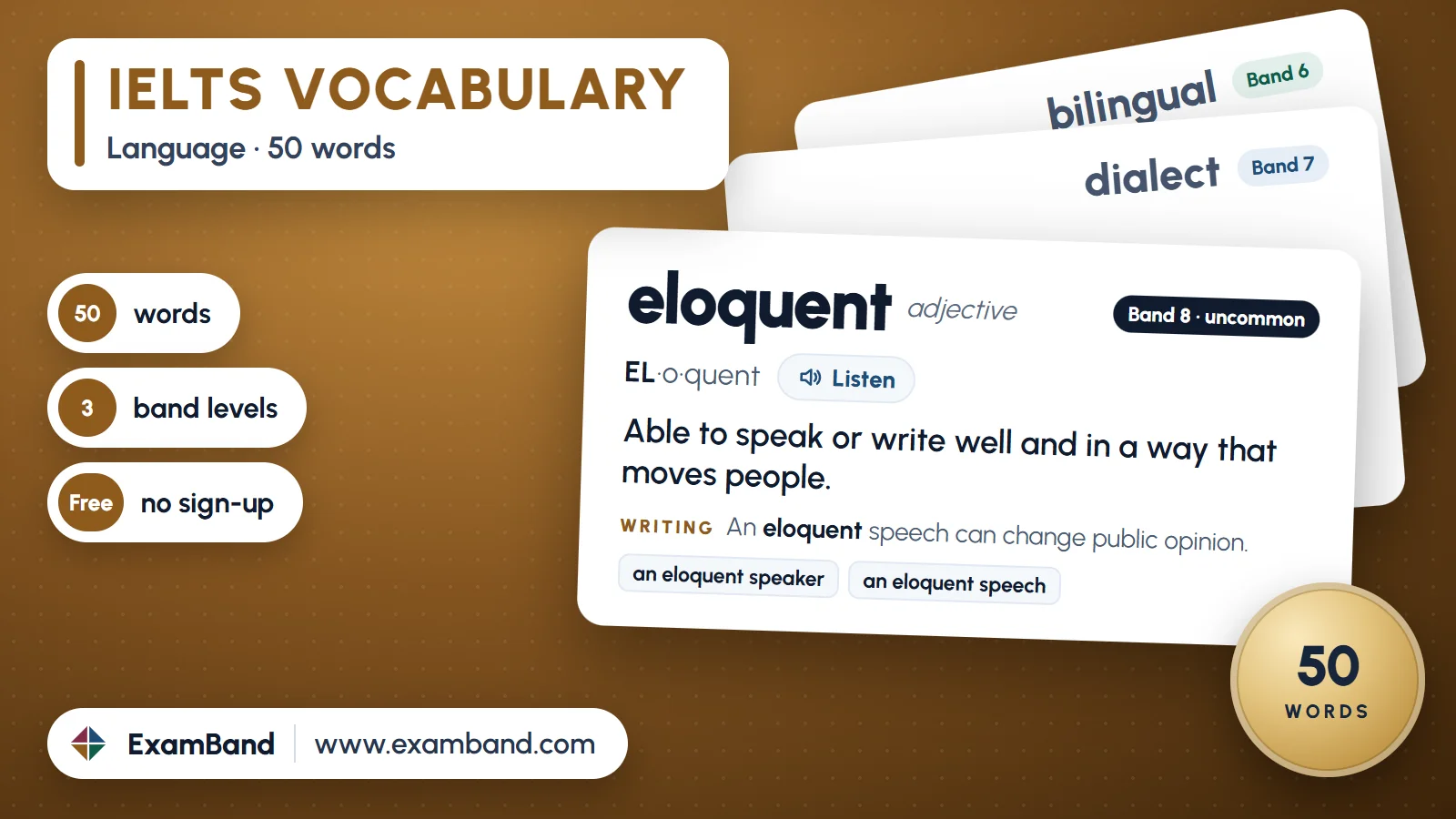
Questions about IELTS language vocabulary
How do I learn IELTS language vocabulary?
Learn about ten words a day. First, read the meaning, listen to the word and say it out loud with the right stress. Then test yourself with the quiz and the flashcards on this page. Finally, use five of the words in an essay and check it with our free Writing Checker.
Which words should I learn first?
Start with the band 6 words, because you need them to explain any idea clearly. After that, add the band 7 words. However, use the band 8 words only when you are sure of their meaning, because a rare word used wrongly can lower your score.
Are these official IELTS words?
No. IELTS has no official word list. Instead, our levels follow the words of the public IELTS band descriptors: band 7 asks for some “less common” words, and band 8 for “uncommon” words used with skill.