IELTS Food Vocabulary: 50 Words with Examples
These 50 words of IELTS food vocabulary come up again and again in Speaking Part 1, in Writing Task 2 essays on health and farming, and in the Listening and Reading tests. Each word has a simple meaning, its sound, a band level, examples for Writing and Speaking, and the mistake to avoid.
50 words · free quiz and flashcards · updated October 2026
diet
DI·et · nounThe kind of food that a person usually eats.Band 6 · everyday
Word family: dietary (adjective) · dieter (noun)
Collocations
- a healthy diet
- a poor diet
- go on a diet
Similar: eating habits
WritingA poor diet is one of the main causes of heart disease.
SpeakingMy diet is much healthier since I started cooking at home.
Common mistake: Saying “I am on diet”. Use “a”: “I am on a diet.”
balanced diet
BAL·anced DI·et · nounMeals with the right amounts of different kinds of food.Band 6 · everyday
Word family: balance (noun, verb)
Collocations
- eat a balanced diet
- maintain a balanced diet
- part of a balanced diet
Similar: healthy diet
WritingSchools should teach children why a balanced diet matters.
SpeakingI try to eat a balanced diet, but I love chocolate too much.
Common mistake: Saying “a balance diet”. Use the adjective with -ed: “a balanced diet”.
junk food
JUNK FOOD · nounFood that is quick and tasty but not good for your health.Band 6 · everyday
Collocations
- eat junk food
- ban junk food adverts
- cut out junk food
Similar: fast food, unhealthy food
WritingAdvertising junk food to children should be banned.
SpeakingI eat junk food when I’m too tired to cook.
Common mistake: Saying “junk foods” in general. It is usually uncountable: “too much junk food”.
processed food
PRO·cessed FOOD · nounFood changed in a factory, often with added salt, sugar or chemicals.Band 6 · everyday
Word family: process (verb) · processing (noun)
Collocations
- highly processed food
- eat less processed food
- ready meals and processed food
Similar: ready meals
WritingHighly processed food is often cheaper than fresh vegetables.
SpeakingI try to avoid processed food, like sausages and instant noodles.
Common mistake: Writing “process food”. You need -ed: “processed food”.
home-cooked
home-COOKED · adjectiveMade at home rather than bought ready to eat.Band 6 · everyday
Word family: home cooking (noun)
Collocations
- a home-cooked meal
- home-cooked food
Similar: homemade
WritingFamilies who share home-cooked meals tend to eat more healthily.
SpeakingNothing beats my mum’s home-cooked food.
Common mistake: Writing “home-cook meals”. The adjective is “home-cooked”.
takeaway
TAKE·a·way · nounA meal bought from a restaurant and eaten somewhere else.Band 6 · everyday
Word family: take away (verb)
Collocations
- order a takeaway
- a Chinese takeaway
- takeaway food
Similar: takeout
WritingBusy parents increasingly rely on takeaway meals.
SpeakingOn Fridays we usually order a takeaway, often pizza.
Common mistake: Writing the noun as two words. The noun is one word: “a takeaway”; Americans say “takeout”.
ingredient
in·GRE·di·ent · nounOne of the foods that you mix to make a dish.Band 6 · everyday
Collocations
- fresh ingredients
- the main ingredient
- simple ingredients
Similar: component
WritingCooking with fresh ingredients is usually healthier and cheaper.
SpeakingThe main ingredient in our national dish is rice.
Common mistake: Spelling it “ingrediant”. Write “ingredient”, with -ent.
recipe
REC·i·pe · nounA set of steps that tells you how to cook something.Band 6 · everyday
Collocations
- follow a recipe
- a family recipe
- a recipe for
WritingOnline videos have made it easy to follow a recipe step by step.
SpeakingI got this recipe from my grandmother.
Common mistake: Mixing it up with “receipt”. A recipe tells you how to cook; a receipt shows what you paid.
vegetarian
veg·e·TAR·i·an · noun / adjectiveA person who does not eat meat or fish.Band 6 · everyday
Word family: vegetarianism (noun)
Collocations
- become a vegetarian
- a vegetarian diet
- vegetarian options
WritingMore restaurants now offer vegetarian options on their menus.
SpeakingI became a vegetarian when I was sixteen.
Common mistake: Mixing it up with “vegan”. A vegetarian eats no meat or fish; a vegan eats nothing from animals.
organic
or·GAN·ic · adjectiveGrown without man-made chemicals.Band 6 · everyday
Word family: organically (adverb)
Collocations
- organic food
- organic farming
- organic vegetables
Similar: chemical-free
WritingOrganic food is better for the soil, but it is often too expensive for poor families.
SpeakingI buy organic eggs when I can afford them.
Common mistake: Using “organic” for any healthy food. It only means grown without man-made chemicals.
cuisine
cui·SINE · nounA style of cooking from a country or area.Band 6 · everyday
Collocations
- local cuisine
- Italian cuisine
- traditional cuisine
Similar: cooking, food
WritingTrying the local cuisine is one of the best parts of travelling.
SpeakingThai cuisine is my favourite because it’s so spicy.
Common mistake: Saying “cuisine” for the room. That is the “kitchen”; cuisine is a style of cooking.
portion
POR·tion · nounThe amount of food given to one person.Band 6 · everyday
Word family: portion size (noun)
Collocations
- a large portion
- portion sizes
- a generous portion
Similar: serving, helping
WritingRestaurant portions have grown much larger over the last thirty years.
SpeakingThe portions at that café are huge, so I never finish.
Common mistake: Saying “a big portion of people”. Use “a large proportion of people”; a portion is an amount of food.
snack
SNACK · noun / verbA small amount of food eaten between meals.Band 6 · everyday
Word family: snack (verb)
Collocations
- a healthy snack
- have a snack
- snack on fruit
Similar: bite to eat
WritingChildren who snack on crisps and sweets often eat badly at mealtimes.
SpeakingI usually have a snack at about four o’clock.
Common mistake: Saying “take a snack”. Say “have a snack”.
calories
CAL·o·ries · noun, usually pluralUnits that show how much energy food gives you.Band 6 · everyday
Word family: calorie (noun) · calorific (adjective)
Collocations
- high in calories
- count calories
- burn calories
Similar: energy
WritingMany fizzy drinks contain a huge number of calories.
SpeakingI don’t count calories, but I do watch how much sugar I eat.
Common mistake: Saying “this food has many calorie”. Use the plural: “a lot of calories”.
nutritious
nu·TRI·tious · adjectiveFull of the things your body needs to stay healthy.Band 6 · everyday
Word family: nutrition (noun) · nutritional (adjective) · nutritionist (noun)
Collocations
- nutritious food
- a nutritious meal
- cheap and nutritious
Similar: healthy, wholesome
WritingSchools should provide free, nutritious lunches for every pupil.
SpeakingSoup is cheap, quick and really nutritious.
Common mistake: Spelling it “nutricious”. Write “nutritious”, with -tious.
sugary
SU·gar·y · adjectiveContaining a lot of sugar.Band 6 · everyday
Word family: sugar (noun)
Collocations
- sugary drinks
- sugary snacks
- sugary cereals
Similar: sweet
WritingA tax on sugary drinks could reduce tooth decay in children.
SpeakingI’ve stopped drinking sugary drinks; now it’s mostly water.
Common mistake: Spelling it “sugery” or “sugarry”. Write “sugary”.
eat out
eat OUT · phrasal verbTo have a meal in a restaurant, not at home.Band 6 · everyday
Word family: eating out (noun)
Collocations
- eat out once a week
- eat out more often
- can’t afford to eat out
Similar: dine out
WritingPeople who eat out often find it harder to control what they eat.
SpeakingWe eat out about twice a month, usually at a Lebanese place.
Common mistake: Saying “eat outside” for restaurants. “Eat outside” means in the open air; “eat out” means at a restaurant.
local produce
LO·cal PRO·duce · nounFruit, vegetables and other food grown near where it is sold.Band 6 · everyday
Word family: produce (verb) · producer (noun)
Collocations
- buy local produce
- fresh local produce
- support local produce
Similar: local food
WritingBuying local produce supports farmers and cuts transport pollution.
SpeakingThe market near my house sells lots of local produce.
Common mistake: Saying “local produces”. “Produce” here is uncountable: “fresh local produce”.
nutrient
NU·tri·ent · nounA substance in food, like a vitamin, that helps the body grow and stay healthy.Band 7 · less common
Word family: nutrition (noun) · nutritious (adjective)
Collocations
- essential nutrients
- rich in nutrients
- absorb nutrients
Similar: vitamins and minerals
WritingFast food is high in fat but low in essential nutrients.
SpeakingApparently, spinach is full of nutrients, so I eat it a lot.
Common mistake: Mixing it up with “nutrition”. Nutrients are the things in food; nutrition is the whole process of getting them.
eating habits
EAT·ing HAB·its · noun, pluralThe way someone usually eats: what, when and how much.Band 7 · less common
Collocations
- healthy eating habits
- change your eating habits
- poor eating habits
Similar: diet
WritingChildren’s eating habits are shaped mostly by their parents.
SpeakingMy eating habits changed completely when I moved abroad.
Common mistake: Saying “eating habit” for someone’s general way of eating. Use the plural: “healthy eating habits”.
food security
FOOD se·CU·ri·ty · nounWhen everyone can always get enough safe, healthy food.Band 7 · less common
Word family: secure (adjective) · food insecurity (noun)
Collocations
- ensure food security
- threaten food security
- global food security
WritingClimate change is a growing threat to food security in poorer countries.
SpeakingRising prices have made food security a real worry in my country.
Common mistake: Mixing it up with “food safety”. Food security means having enough food; food safety means food that will not make you ill.
staple food
STA·ple FOOD · nounA basic food that people eat most days, like rice or bread.Band 7 · less common
Word family: staple (noun, adjective)
Collocations
- a staple food
- the staple diet
- staple crops
Similar: basic food
WritingRice is the staple food for more than half of the world’s population.
SpeakingBread is the staple food in my country; we eat it with everything.
Common mistake: Saying “a stable food”. The word is “staple”, with a p.
additive
AD·di·tive · nounA chemical added to food to give it colour or taste, or to make it last.Band 7 · less common
Word family: add (verb) · addition (noun)
Collocations
- food additives
- artificial additives
- free from additives
Similar: E-numbers
WritingSome artificial additives have been linked to poor behaviour in children.
SpeakingI check labels for additives, but there are so many strange names.
Common mistake: Saying “additions” for chemicals in food. The word is “additives”.
preservative
pre·SER·va·tive · nounA substance that stops food from going bad quickly.Band 7 · less common
Word family: preserve (verb) · preservation (noun)
Collocations
- contain preservatives
- natural preservatives
- free from preservatives
WritingReady meals often contain preservatives so that they last for weeks.
SpeakingMy grandma used salt as a preservative for fish.
Common mistake: Mixing it up with “preserve”. “Preserve” is the verb; the thing added to food is a “preservative”.
intensive farming
in·TEN·sive FARM·ing · nounFarming that uses a lot of machines and chemicals to produce as much food as possible.Band 7 · less common
Word family: intensively (adverb) · intensity (noun)
Collocations
- the effects of intensive farming
- intensive farming methods
- move away from intensive farming
Similar: factory farming
WritingIntensive farming produces cheap food, but it can harm soil and wildlife.
SpeakingNear my hometown, intensive farming has replaced the old family farms.
Common mistake: Saying “intensive agriculture farming”. Use either “intensive farming” or “intensive agriculture”.
genetically modified
ge·NET·i·cal·ly MOD·i·fied · adjectiveChanged in a laboratory so that a plant or animal grows in a new way.Band 7 · less common
Word family: genetic modification (noun) · gene (noun)
Collocations
- genetically modified crops
- genetically modified food
- GM crops
Similar: GM
WritingGenetically modified crops could help farmers grow food in dry regions.
SpeakingI’m not sure genetically modified food is safe, to be honest.
Common mistake: Writing “genetic modified”. You need the adverb: “genetically modified”, often shortened to “GM”.
food miles
FOOD MILES · noun, pluralHow far food travels from the farm to the person who eats it.Band 7 · less common
Collocations
- cut food miles
- reduce food miles
- the food miles of
WritingBuying seasonal fruit is one simple way to cut food miles.
SpeakingStrawberries in winter have a lot of food miles, so I don’t buy them.
Common mistake: Using it for how far a person travels to shop. It is how far the food travels.
plant-based
plant-BASED · adjectiveMade from plants, not from animals.Band 7 · less common
Collocations
- a plant-based diet
- plant-based food
- plant-based milk
Similar: vegan
WritingA plant-based diet produces far fewer emissions than one rich in beef.
SpeakingI’ve switched to plant-based milk because it tastes nicer in coffee.
Common mistake: Writing “plant based” without a hyphen before a noun. Write “a plant-based diet”.
self-sufficient
self-suf·FI·cient · adjectiveAble to produce everything you need without help from others.Band 7 · less common
Word family: self-sufficiency (noun)
Collocations
- self-sufficient in food
- become self-sufficient
- largely self-sufficient
Similar: independent
WritingFew countries are fully self-sufficient in food today.
SpeakingMy uncle grows all his own vegetables, so he’s almost self-sufficient.
Common mistake: Using the noun as an adjective. The adjective is “self-sufficient”; the noun is “self-sufficiency”.
dietary
DI·e·ta·ry · adjectiveConnected with the food you eat.Band 7 · less common
Word family: diet (noun)
Collocations
- dietary habits
- dietary needs
- dietary advice
WritingSchools should consider pupils’ dietary needs, such as allergies.
SpeakingMy sister has special dietary needs because she can’t eat gluten.
Common mistake: Writing “diet needs” in an essay. The formal adjective is “dietary”: “dietary needs”.
cut down on
cut DOWN on · phrasal verbTo eat, drink or use less of something.Band 7 · less common
Word family: cutback (noun)
Collocations
- cut down on sugar
- cut down on salt
- cut down on meat
Similar: reduce
WritingDoctors advise adults to cut down on salt and red meat.
SpeakingI’m trying to cut down on coffee, but it’s hard.
Common mistake: Leaving out “on”. Say “cut down on sugar”.
moderation
mod·e·RA·tion · nounNot having too much of something.Band 7 · less common
Word family: moderate (adjective) · moderately (adverb)
Collocations
- in moderation
- eat in moderation
- drink in moderation
WritingSweets are not harmful if children eat them in moderation.
SpeakingI think anything’s fine in moderation, even fast food.
Common mistake: Saying “with moderation”. The phrase is “in moderation”.
wholesome
WHOLE·some · adjectiveGood for your health; also good in a moral way.Band 7 · less common
Collocations
- wholesome food
- a wholesome meal
- wholesome ingredients
Similar: nutritious, healthy
WritingMany parents want their children to eat simple, wholesome food.
SpeakingMy grandmother’s cooking is plain but wholesome.
Common mistake: Spelling it “holesome”. Write “wholesome”, with w, like “whole”.
food poisoning
FOOD POI·son·ing · nounAn illness caused by eating food that has gone bad or has germs in it.Band 7 · less common
Word family: poison (noun, verb) · poisonous (adjective)
Collocations
- get food poisoning
- a case of food poisoning
- cause food poisoning
WritingPoor hygiene in kitchens is a common cause of food poisoning.
SpeakingI got food poisoning on holiday once, and it ruined the trip.
Common mistake: Saying “food poison”. The illness is “food poisoning”.
perishable
PER·ish·a·ble · adjectiveGoing bad quickly, like milk or fish.Band 7 · less common
Word family: perish (verb) · non-perishable (adjective)
Collocations
- perishable food
- perishable goods
- highly perishable
WritingPerishable food must be kept cold from the farm to the shop.
SpeakingFish is so perishable that we buy it on the day we cook it.
Common mistake: Spelling it “perishible”. Write “perishable”, with -able.
culinary
CUL·i·na·ry · adjectiveConnected with cooking.Band 7 · less common
Word family: cuisine (noun)
Collocations
- culinary skills
- culinary traditions
- a culinary school
WritingTelevision cookery shows have made culinary skills fashionable again.
SpeakingMy culinary skills are limited to eggs and pasta.
Common mistake: Using it as a noun: “the culinary of Italy”. Say “Italian culinary traditions” or “Italian cuisine”.
famine
FAM·ine · nounA serious lack of food in a large area, which causes many deaths.Band 7 · less common
Collocations
- suffer a famine
- a severe famine
- famine relief
Similar: starvation
WritingWar and drought can turn food shortages into famine.
SpeakingMy grandfather remembers the famine when he was a boy.
Common mistake: Mixing it up with “hunger”. Famine is a disaster in a whole area; hunger is the feeling or the general problem.
fussy eater
FUS·sy EAT·er · nounSomeone who refuses many kinds of food.Band 7 · less common
Word family: fuss (noun) · fussiness (noun)
Collocations
- a fussy eater
- fussy about food
- deal with fussy eaters
Similar: picky eater
WritingParents of fussy eaters often give in and cook only what children like.
SpeakingI was a terribly fussy eater as a kid.
Common mistake: Mixing it up with “fuzzy”. “Fuzzy” means soft or unclear; a “fussy” eater refuses many foods.
deficiency
de·FI·cien·cy · nounA lack of something the body needs, such as a vitamin.Band 8 · uncommon
Word family: deficient (adjective) · deficit (noun)
Collocations
- a vitamin deficiency
- iron deficiency
- a deficiency in
Similar: lack, shortage
WritingA deficiency in vitamin D is common in countries with little sunshine.
SpeakingMy doctor said I had an iron deficiency, which explained why I was so tired.
Common mistake: Spelling it “deficiancy”. Write “deficiency”, with -ency.
palatable
PAL·a·ta·ble · adjectivePleasant to eat; also, acceptable to people.Band 8 · uncommon
Word family: unpalatable (adjective) · palate (noun)
Collocations
- palatable food
- make something palatable
- a palatable solution
Similar: tasty, acceptable
WritingHealthy school meals must be palatable, or children will simply not eat them.
SpeakingHospital food is barely palatable, honestly.
Common mistake: Mixing it up with “palette” (a painter’s colours). “Palatable” means pleasant to eat or acceptable.
sustenance
SUS·te·nance · nounFood and drink that keep a person alive.Band 8 · uncommon
Word family: sustain (verb)
Collocations
- a source of sustenance
- provide sustenance
- for sustenance
Similar: nourishment
WritingFor millions of families, rice is the main source of sustenance.
SpeakingWhen I’m studying, coffee is my only sustenance!
Common mistake: Using it as a verb. The verb is “sustain”; sustenance is the food itself.
glut
GLUT · nounMuch more of something than is needed.Band 8 · uncommon
Collocations
- a glut of
- a global glut
- an oil glut
Similar: surplus, oversupply
WritingA glut of milk has pushed prices so low that many farmers are losing money.
SpeakingEvery summer there’s a glut of tomatoes, so they cost almost nothing.
Common mistake: Mixing it up with “gut”. A glut is too much of something: “a glut of tomatoes”.
indulge
in·DULGE · verbTo let yourself enjoy something, especially something you should not have too much of.Band 8 · uncommon
Word family: indulgence (noun) · indulgent (adjective)
Collocations
- indulge in
- indulge yourself
- indulge a craving
Similar: treat yourself
WritingIt is fine to indulge in sweets now and then, but not every day.
SpeakingOn my birthday, I indulge in a huge chocolate cake.
Common mistake: Leaving out “in”. Say “indulge in sweets” or “indulge yourself”.
abstain
ab·STAIN · verbTo choose not to eat, drink or do something.Band 8 · uncommon
Word family: abstinence (noun) · abstention (noun)
Collocations
- abstain from alcohol
- abstain from meat
- choose to abstain
Similar: avoid, refrain
WritingMany people abstain from meat for religious or ethical reasons.
SpeakingDuring Ramadan, we abstain from food and drink until sunset.
Common mistake: Leaving out “from”. Say “abstain from alcohol”.
agribusiness
AG·ri·busi·ness · nounFarming run as a big business, often by large companies.Band 8 · uncommon
Word family: agriculture (noun) · agricultural (adjective)
Collocations
- large agribusiness
- agribusiness companies
- the growth of agribusiness
Similar: industrial agriculture
WritingThe rise of agribusiness has pushed many small farmers out of the market.
SpeakingIn my region, huge agribusiness firms now own most of the land.
Common mistake: Writing it as two words: “agri business”. It is one word: “agribusiness”.
monoculture
MON·o·cul·ture · nounGrowing only one crop on a large area of land.Band 8 · uncommon
Collocations
- palm oil monoculture
- move away from monoculture
- vast monocultures
Similar: single-crop farming
WritingMonoculture makes farming efficient but leaves crops open to disease.
SpeakingAll you see for miles is wheat; it’s pure monoculture.
Common mistake: Writing it as two words: “mono culture”. It is one word: “monoculture”.
empty calories
EMP·ty CAL·o·ries · noun, pluralEnergy from food that has almost no vitamins or other nutrients.Band 8 · uncommon
Collocations
- full of empty calories
- a source of empty calories
WritingFizzy drinks provide empty calories and nothing else.
SpeakingCrisps are just empty calories, but I still love them.
Common mistake: Thinking it means food with no calories. It means calories with almost no nutrients.
gourmet
GOUR·met · adjective / nounOf very high quality, made with special care; also, a person who knows a lot about good food.Band 8 · uncommon
Collocations
- gourmet food
- a gourmet restaurant
- gourmet coffee
Similar: fine dining
WritingGourmet food has become a symbol of status for wealthy consumers.
SpeakingThere’s a little gourmet burger place near my office.
Common mistake: Saying the final t. It is said “GOOR-may”, with a silent t.
delicacy
DEL·i·ca·cy · nounRare or special food that people think is very good.Band 8 · uncommon
Word family: delicate (adjective)
Collocations
- a local delicacy
- a great delicacy
- regarded as a delicacy
Similar: speciality
WritingIn some cultures, insects are regarded as a delicacy.
SpeakingGrilled locusts are a delicacy in some parts of my country, believe it or not.
Common mistake: Using it for any tasty dish. A delicacy is rare or special food, often from one place.
gluttony
GLUT·ton·y · nounEating far more than you need.Band 8 · uncommon
Word family: glutton (noun) · gluttonous (adjective)
Collocations
- the sin of gluttony
- pure gluttony
Similar: overeating, greed
WritingSome critics see all-you-can-eat buffets as a celebration of gluttony.
SpeakingEating three desserts was pure gluttony, I admit.
Common mistake: Using it for the person. The person is “a glutton”; the habit is “gluttony”.
Food vocabulary in IELTS Writing and Speaking
Here is how IELTS food vocabulary can come up in the test, with our own practice questions. So, try to answer them with words from the list above.
Writing Task 2
In many countries, people are eating more fast food and fewer home-cooked meals. Why is this happening? What can be done to encourage healthier eating?
Speaking
- Part 1: What is your favourite food?
- Part 1: Do you prefer eating at home or eating out?
- Part 2: Describe a meal that you enjoyed with other people.
- Part 3: Why do young people eat more fast food than older people?
- Part 3: Should schools teach children how to cook?
Our free tests on this topic
- Writing Practice Test 4, Task 2a tax on sugary drinks
- Reading Practice Test 7, Passage 1how the potato travelled from the Andes to the world
- Reading Practice Test 10, Passage 2farming without fields
- Listening Practice Test 1, Part 3a student project on food waste
A model paragraph with IELTS food vocabulary
Many young people now rely on junk food and processed food because they are cheap and quick. As a result, their diets are high in empty calories but low in essential nutrients. Governments could tax sugary drinks and teach cooking in schools, so that home-cooked meals become normal again.
Practise this IELTS food vocabulary
Take the 10-question quiz on this IELTS food vocabulary, or go through every word with the flashcards.
Question 1 of 10
Which word means “food that is quick and tasty but not good for your health”?
Now use the words
Write a Task 2 essay with five of these words. Then our free Writing Checker gives you a band for vocabulary and for the other three criteria.
Open the Writing Checker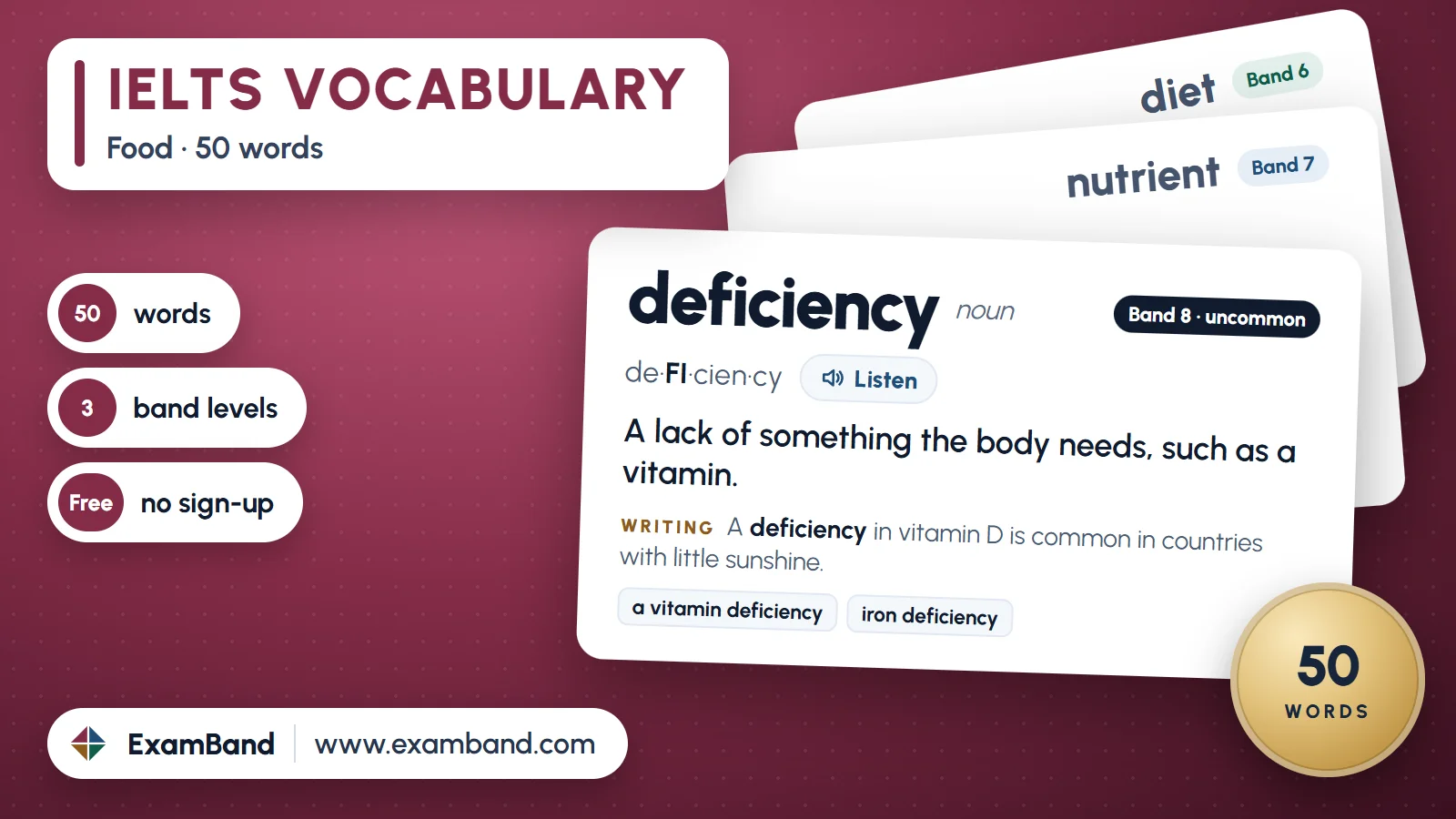
Questions about IELTS food vocabulary
How do I learn IELTS food vocabulary?
Learn about ten words a day. First, read the meaning, listen to the word and say it out loud with the right stress. Then test yourself with the quiz and the flashcards on this page. Finally, use five of the words in an essay and check it with our free Writing Checker.
Which words should I learn first?
Start with the band 6 words, because you need them to explain any idea clearly. After that, add the band 7 words. However, use the band 8 words only when you are sure of their meaning, because a rare word used wrongly can lower your score.
Are these official IELTS words?
No. IELTS has no official word list. Instead, our levels follow the words of the public IELTS band descriptors: band 7 asks for some “less common” words, and band 8 for “uncommon” words used with skill.