IELTS Culture Vocabulary: 50 Words with Examples
These 50 words of IELTS culture vocabulary come up again and again in Speaking Part 2 cards about festivals and traditions, in Writing Task 2 essays on the arts and history, and in the Reading test. Each word has a simple meaning, its sound, a band level, examples for Writing and Speaking, and the mistake to avoid.
50 words · free quiz and flashcards · updated October 2026
tradition
tra·DI·tion · nounA custom or belief that has been passed down for a long time.Band 6 · everyday
Word family: traditional (adjective) · traditionally (adverb)
Collocations
- a long tradition
- keep a tradition alive
- break with tradition
Similar: custom
WritingYoung people should be encouraged to keep local traditions alive.
SpeakingIt’s a tradition in my family to eat together every Friday.
Common mistake: Using “traditional” as a noun. The noun is “tradition”; “traditional” is the adjective.
customs
CUS·toms · noun, pluralWays of behaving that are usual in a society.Band 6 · everyday
Word family: customary (adjective)
Collocations
- local customs
- follow customs
- ancient customs
Similar: traditions, practices
WritingTourists should learn about local customs before they travel.
SpeakingIn my country, it’s one of our customs to take off your shoes at home.
Common mistake: Mixing it up with “costumes”. Customs are habits; costumes are special clothes.
festival
FES·ti·val · nounA special time of celebration, often with music, food and events.Band 6 · everyday
Word family: festive (adjective) · festivity (noun)
Collocations
- a music festival
- a religious festival
- hold a festival
Similar: celebration, carnival
WritingCultural festivals bring communities together and attract tourists.
SpeakingMy favourite festival is the lantern festival in spring.
Common mistake: Spelling it “festivel”. Write “festival”, with -al.
celebrate
CEL·e·brate · verbTo do something enjoyable for a special day or event.Band 6 · everyday
Word family: celebration (noun) · celebratory (adjective)
Collocations
- celebrate a festival
- celebrate the new year
- celebrate together
Similar: mark, commemorate
WritingFamilies celebrate national holidays in very different ways.
SpeakingWe celebrate my grandmother’s birthday with a big lunch.
Common mistake: Saying “celebrate for my birthday”. Say “celebrate my birthday”.
museum
mu·SE·um · nounA building where you can see important objects from history, art or science.Band 6 · everyday
Collocations
- visit a museum
- a history museum
- museum exhibits
Similar: gallery
WritingFree entry to museums encourages families with little money to visit.
SpeakingThere’s a great science museum in my city.
Common mistake: Saying “MU-se-um”. The stress is “mu-SE-um”.
art gallery
ART GAL·ler·y · nounA building where paintings and other art are shown.Band 6 · everyday
Collocations
- visit an art gallery
- a national art gallery
- a modern art gallery
Similar: gallery
WritingPublic art galleries make great works available to everyone.
SpeakingI sometimes go to an art gallery on rainy weekends.
Common mistake: Spelling it “art galery”. Write “gallery”, with double l.
exhibition
ex·hi·BI·tion · nounA public show of art or objects.Band 6 · everyday
Word family: exhibit (verb, noun)
Collocations
- hold an exhibition
- an art exhibition
- visit an exhibition
Similar: show, display
WritingTravelling exhibitions let people see treasures from other countries.
SpeakingI saw an amazing photography exhibition last month.
Common mistake: Saying the h. It is silent: “ek-si-BI-shun”.
concert
CON·cert · nounA performance of music for an audience.Band 6 · everyday
Collocations
- go to a concert
- a live concert
- a classical concert
Similar: gig, performance
WritingFree outdoor concerts bring people from different backgrounds together.
SpeakingThe best concert I’ve ever been to was in a football stadium.
Common mistake: Mixing it up with “concern”. A concert is a music show; a concern is a worry.
the arts
the ARTS · noun, pluralPainting, music, theatre, dance and other creative activities.Band 6 · everyday
Word family: artist (noun) · artistic (adjective)
Collocations
- funding for the arts
- support the arts
- the arts and culture
Similar: culture
WritingGovernment funding for the arts is often the first to be cut.
SpeakingI think the arts make life much richer.
Common mistake: Saying “the art” for all creative activities. Use the plural: “the arts”.
theatre
THE·a·tre · nounA building where plays are performed; also, the work of acting in plays.Band 6 · everyday
Word family: theatrical (adjective)
Collocations
- go to the theatre
- a theatre company
- open-air theatre
Similar: playhouse
WritingTaking children to the theatre develops their imagination.
SpeakingI don’t go to the theatre often, because tickets are expensive.
Common mistake: Writing “theater” in a British essay. UK: “theatre”; US: “theater”.
historical
his·TOR·i·cal · adjectiveConnected with the past.Band 6 · everyday
Word family: history (noun) · historian (noun)
Collocations
- historical buildings
- historical sites
- historical events
Similar: past
WritingHistorical buildings should be protected from modern development.
SpeakingI love historical films.
Common mistake: Mixing up “historic” and “historical”. “Historic” means very important in history; “historical” means about the past.
heritage
HER·i·tage · nounThe traditions, buildings and art that a country has had for many years.Band 6 · everyday
Collocations
- cultural heritage
- national heritage
- protect our heritage
Similar: legacy, inheritance
WritingEvery country has a duty to protect its cultural heritage.
SpeakingOur national dance is an important part of our heritage.
Common mistake: Saying “heritages” for the general idea. It is usually uncountable: “our heritage”.
ancient
AN·cient · adjectiveVery old; from thousands of years ago.Band 6 · everyday
Collocations
- ancient history
- ancient ruins
- ancient civilisations
Similar: old, historic
WritingAncient ruins attract millions of tourists each year.
SpeakingThere are ancient temples near my hometown.
Common mistake: Saying “ancient” for anything old, like a car. Use “old”; ancient means thousands of years old.
religion
re·LI·gion · nounBelief in a god or gods, and the practices connected with it.Band 6 · everyday
Word family: religious (adjective)
Collocations
- practise a religion
- freedom of religion
- world religions
Similar: faith, belief
WritingSchools should teach children about different religions.
SpeakingReligion plays a big part in my family’s life.
Common mistake: Saying “a religious” for a religion. “Religious” is an adjective: “a religious festival”.
painting
PAINT·ing · nounA picture made with paint; also, the activity of making one.Band 6 · everyday
Word family: paint (verb) · painter (noun)
Collocations
- an oil painting
- a famous painting
- take up painting
Similar: artwork, picture
WritingFamous paintings can sell for hundreds of millions of dollars.
SpeakingMy grandmother took up painting when she retired.
Common mistake: Mixing it up with “drawing”. A drawing uses pencils or pens; a painting uses paint.
folk music
FOLK MU·sic · nounTraditional music of a country or area.Band 6 · everyday
Collocations
- traditional folk music
- a folk music festival
- listen to folk music
Similar: traditional music
WritingFolk music helps young people connect with their roots.
SpeakingMy dad plays folk music on the guitar.
Common mistake: Saying the l in “folk”. It is silent: “foke”.
handicrafts
HAN·di·crafts · noun, pluralThings made skilfully by hand, like pots, baskets or carpets.Band 6 · everyday
Word family: craft (noun) · craftsman (noun)
Collocations
- local handicrafts
- traditional handicrafts
- sell handicrafts
Similar: crafts
WritingBuying local handicrafts helps keep traditional skills alive.
SpeakingThe market sells beautiful handicrafts, like rugs and pottery.
Common mistake: Writing “hand crafts” as two words. Write “handicrafts”.
monument
MON·u·ment · nounA building or statue built to remember a person or event.Band 6 · everyday
Word family: monumental (adjective)
Collocations
- a historic monument
- a national monument
- build a monument
Similar: memorial, statue
WritingAncient monuments need money to protect them from damage.
SpeakingThe most famous monument in my city is an old clock tower.
Common mistake: Saying “a monument for” a person. Say “a monument to someone”.
cultural identity
CUL·tur·al i·DEN·ti·ty · nounThe feeling of belonging to a group with its own culture.Band 7 · less common
Word family: identify (verb)
Collocations
- a strong cultural identity
- lose your cultural identity
- preserve cultural identity
Similar: national identity
WritingLearning a family language helps children keep their cultural identity.
SpeakingLiving abroad made me think more about my cultural identity.
Common mistake: Saying “culture identity”. Use the adjective: “cultural identity”.
multicultural
mul·ti·CUL·tur·al · adjectiveHaving people from many different cultures.Band 7 · less common
Word family: multiculturalism (noun)
Collocations
- a multicultural society
- a multicultural city
Similar: diverse
WritingMulticultural cities often have richer food, music and art.
SpeakingLondon is so multicultural; I heard ten languages on one bus.
Common mistake: Writing “multi-cultural” with a hyphen. Today it is one word: “multicultural”.
diversity
di·VER·si·ty · nounHaving many different kinds of people or things.Band 7 · less common
Word family: diverse (adjective) · diversify (verb)
Collocations
- cultural diversity
- celebrate diversity
- ethnic diversity
Similar: variety
WritingCultural diversity can make a country more creative.
SpeakingI love the diversity of food in my neighbourhood.
Common mistake: Mixing it up with “difference”. Diversity is about variety in a group.
restore
re·STORE · verbTo repair an old building or object so it looks as it did.Band 7 · less common
Word family: restoration (noun)
Collocations
- restore a building
- carefully restored
- restore to its former glory
Similar: repair, renovate
WritingOld theatres can be restored and used again by the community.
SpeakingThey restored the old market, and now it’s full of cafés.
Common mistake: Mixing it up with “renovate”. Restore means make it like the original; renovate means make it modern and new.
artefact
AR·te·fact · nounAn object made by people long ago, often kept in a museum.Band 7 · less common
Collocations
- ancient artefacts
- historical artefacts
- return artefacts
Similar: object, relic
WritingMuseums should return artefacts that were taken without permission.
SpeakingI saw some amazing Egyptian artefacts at the museum.
Common mistake: Spelling it “artifact” in a British essay. UK: “artefact”; US: “artifact”.
masterpiece
MAS·ter·piece · nounA work of art that is excellent, often the artist’s best.Band 7 · less common
Collocations
- a great masterpiece
- a literary masterpiece
- create a masterpiece
Similar: classic, work of genius
WritingEvery child should see at least one great masterpiece in person.
SpeakingI think that film is a masterpiece.
Common mistake: Spelling it “masterpeice”. Write “masterpiece”: i before e.
indigenous
in·DIG·e·nous · adjectiveBelonging to a place from the earliest times.Band 7 · less common
Collocations
- indigenous people
- indigenous languages
- indigenous culture
Similar: native
WritingMany indigenous languages are in danger of disappearing.
SpeakingI’d love to learn more about the indigenous people of my region.
Common mistake: Spelling it “indigineous”. Write “indigenous”.
etiquette
ET·i·quette · nounThe rules of polite behaviour in a society or group.Band 7 · less common
Collocations
- table etiquette
- business etiquette
- a breach of etiquette
Similar: manners, protocol
WritingVisitors should learn basic etiquette before travelling to a new country.
SpeakingTable etiquette is very strict in my family.
Common mistake: Using it to mean a label or ticket, as in some languages. In English, etiquette is polite behaviour.
pass down
pass DOWN · phrasal verbTo give knowledge or objects to younger people in your family or society.Band 7 · less common
Collocations
- pass down traditions
- passed down through generations
- pass down a skill
Similar: hand down
WritingStories and songs are passed down from one generation to the next.
SpeakingThis recipe was passed down from my great-grandmother.
Common mistake: Leaving out “from” or “to”. Say “passed down from parents to children”.
time-honoured
TIME-hon·oured · adjectiveRespected because it has been done for a very long time.Band 7 · less common
Collocations
- a time-honoured tradition
- time-honoured methods
Similar: traditional, long-established
WritingWeaving is a time-honoured craft in many rural areas.
SpeakingDrinking tea in the afternoon is a time-honoured habit in my family.
Common mistake: Writing “time honored” in a British essay. UK: “time-honoured”, with -our and a hyphen.
ritual
RIT·u·al · nounA set of actions always done in the same way, often in religion.Band 7 · less common
Word family: ritualistic (adjective)
Collocations
- a religious ritual
- a daily ritual
- perform a ritual
Similar: ceremony, custom
WritingWedding rituals differ widely from one culture to another.
SpeakingMy morning coffee is a ritual; I can’t skip it.
Common mistake: Spelling it “rituel”. Write “ritual”, with -al.
aesthetic
aes·THET·ic · adjective / nounConnected with beauty and art.Band 7 · less common
Word family: aesthetically (adverb) · aesthetics (noun)
Collocations
- aesthetic value
- aesthetic appeal
- aesthetically pleasing
Similar: artistic
WritingOld buildings have an aesthetic value that modern ones often lack.
SpeakingI chose my flat for its aesthetic appeal more than its size.
Common mistake: Spelling it “asthetic”. The British spelling is “aesthetic”.
integrate
IN·te·grate · verbTo become part of a group or society.Band 7 · less common
Word family: integration (noun) · integrated (adjective)
Collocations
- integrate into society
- integrate immigrants
- fully integrated
Similar: fit in, assimilate
WritingLanguage classes help immigrants integrate into their new country.
SpeakingIt took me a year to integrate into life in Canada.
Common mistake: Saying “integrate with society” for joining. Say “integrate into society”.
ethnic
ETH·nic · adjectiveConnected with a group of people who share a culture, language or origin.Band 7 · less common
Word family: ethnicity (noun)
Collocations
- ethnic groups
- ethnic minorities
- ethnic diversity
WritingMore than two hundred ethnic groups live in Nigeria.
SpeakingMy city has a large ethnic Chinese community.
Common mistake: Using “ethnic” to mean foreign or exotic. It just means connected with a group’s origin.
contemporary
con·TEM·po·rar·y · adjectiveBelonging to the present time; modern.Band 7 · less common
Collocations
- contemporary art
- contemporary music
- contemporary society
Similar: modern, current
WritingContemporary art is often harder to understand than classical painting.
SpeakingI prefer contemporary music to classical.
Common mistake: Spelling it “contemporery”. Write “contemporary”.
spiritual
SPIR·i·tu·al · adjectiveConnected with the human soul or religion, not physical things.Band 7 · less common
Word family: spirit (noun) · spirituality (noun)
Collocations
- spiritual values
- a spiritual experience
- a spiritual leader
Similar: religious
WritingFor many people, festivals have a spiritual meaning as well as a social one.
SpeakingVisiting that temple was a spiritual experience for me.
Common mistake: Mixing it up with “spirited” (full of energy). Spiritual is about the soul.
folklore
FOLK·lore · nounThe old stories, beliefs and customs of a group of people.Band 7 · less common
Word family: folk (adjective)
Collocations
- local folklore
- rich folklore
- in folklore
Similar: legends, myths
WritingLocal folklore often explains how a town got its name.
SpeakingIn our folklore, there are lots of stories about magic foxes.
Common mistake: Saying “folklores”. It is uncountable: “local folklore”.
craftsmanship
CRAFTS·man·ship · nounThe skill of making things well by hand.Band 7 · less common
Word family: craftsman (noun) · craft (noun)
Collocations
- fine craftsmanship
- traditional craftsmanship
- the craftsmanship of
Similar: skill, workmanship
WritingMass production has made traditional craftsmanship rare.
SpeakingYou can see the craftsmanship in my grandfather’s wooden chairs.
Common mistake: Writing “craftmanship”. There is an s: “craftsmanship”.
national pride
NA·tion·al PRIDE · nounA feeling of love and respect for your own country.Band 7 · less common
Word family: proud (adjective)
Collocations
- a sense of national pride
- a source of national pride
Similar: patriotism
WritingHosting big events can boost national pride.
SpeakingOur team’s win was a huge source of national pride.
Common mistake: Saying “nation pride”. Use the adjective: “national pride”.
repatriation
re·pat·ri·A·tion · nounReturning objects or people to the country they came from.Band 8 · uncommon
Word family: repatriate (verb)
Collocations
- the repatriation of artefacts
- call for repatriation
Similar: return, restitution
WritingCalls for the repatriation of museum treasures are growing.
SpeakingI support the repatriation of objects that were stolen.
Common mistake: Spelling it “repatriaton”. Write “repatriation”.
commemorate
com·MEM·o·rate · verbTo do something to remember an important person or event.Band 8 · uncommon
Word family: commemoration (noun) · commemorative (adjective)
Collocations
- commemorate the anniversary
- commemorate the dead
Similar: honour, mark
WritingPublic holidays often commemorate key moments in a nation’s history.
SpeakingWe commemorate our independence day with parades.
Common mistake: Mixing it up with “celebrate”. You can commemorate sad events; you celebrate happy ones.
intangible heritage
in·TAN·gi·ble HER·i·tage · nounTraditions you cannot touch, such as songs, skills and stories.Band 8 · uncommon
Word family: tangible (adjective)
Collocations
- intangible cultural heritage
- protect intangible heritage
WritingUNESCO protects intangible heritage, such as dances and crafts.
SpeakingOur storytelling tradition is part of our intangible heritage.
Common mistake: Thinking it means unimportant. It means you cannot touch it, like a song or a skill.
eclectic
ec·LEC·tic · adjectiveMade of many different styles or sources.Band 8 · uncommon
Collocations
- an eclectic mix
- eclectic tastes
- an eclectic collection
Similar: varied, diverse
WritingThe festival offers an eclectic mix of music from around the world.
SpeakingMy taste in music is quite eclectic.
Common mistake: Mixing it up with “electric”. Eclectic means varied.
avant-garde
av·ant-GARDE · adjectiveVery new and experimental, especially in art.Band 8 · uncommon
Collocations
- avant-garde art
- avant-garde music
- an avant-garde artist
Similar: experimental, cutting-edge
WritingAvant-garde art often shocks people before it is accepted.
SpeakingThat gallery shows really avant-garde stuff that I don’t always get.
Common mistake: Saying it as English words. It comes from French: “a-von-GARD”.
highbrow
HIGH·brow · adjectiveSerious and intellectual, often for educated people.Band 8 · uncommon
Word family: lowbrow (adjective)
Collocations
- highbrow culture
- highbrow literature
- a highbrow audience
Similar: intellectual
WritingOpera is often seen as highbrow, but cheap tickets could change that.
SpeakingI’m not into highbrow films; I like a good comedy.
Common mistake: Using it as praise only. It can also be critical: too serious for most people.
custodian
cus·TO·di·an · nounA person or group that looks after something valuable.Band 8 · uncommon
Word family: custody (noun)
Collocations
- custodian of
- act as custodians of
- custodians of culture
Similar: guardian, keeper
WritingMuseums act as custodians of a nation’s treasures.
SpeakingMy grandmother is the custodian of all our family stories.
Common mistake: Using it for a cleaner, as in American English. In British essays, a custodian is a protector of something valuable.
ethnocentric
eth·no·CEN·tric · adjectiveJudging other cultures by the values of your own.Band 8 · uncommon
Word family: ethnocentrism (noun)
Collocations
- an ethnocentric view
- deeply ethnocentric
Similar: narrow-minded
WritingHistory lessons can be ethnocentric if they show only one country’s view.
SpeakingI used to be a bit ethnocentric before I travelled.
Common mistake: Mixing it up with “egocentric”. Ethnocentric is about your culture; egocentric is about yourself.
melting pot
MELT·ing POT · nounA place where people from many cultures mix together.Band 8 · uncommon
Collocations
- a cultural melting pot
- a melting pot of
Similar: mix, fusion
WritingNew York has long been described as a melting pot of cultures.
SpeakingMy university was a real melting pot; I made friends from twenty countries.
Common mistake: Saying “melting pan”. The phrase is “melting pot”.
assimilation
as·sim·i·LA·tion · nounWhen people from one culture become part of another and lose some of their own ways.Band 8 · uncommon
Word family: assimilate (verb)
Collocations
- cultural assimilation
- pressure for assimilation
- assimilation into
Similar: absorption
WritingAssimilation can mean losing your own language and customs.
SpeakingMy grandparents chose assimilation; they never spoke their language at home.
Common mistake: Mixing it up with “integration”. Integration keeps your culture; assimilation often replaces it.
revival
re·VI·val · nounWhen something becomes popular again.Band 8 · uncommon
Word family: revive (verb)
Collocations
- a revival of
- a cultural revival
- enjoy a revival
Similar: comeback, resurgence
WritingVinyl records are enjoying a revival among young people.
SpeakingThere’s been a revival of traditional crafts in my town.
Common mistake: Saying “a revive”. The verb is “revive”; the noun is “revival”.
philistine
PHIL·is·tine · noun / adjectiveA person who does not value art or culture.Band 8 · uncommon
Word family: philistinism (noun)
Collocations
- a philistine attitude
- accused of being a philistine
WritingCutting all funding for the arts would be a philistine decision.
SpeakingMy friends call me a philistine because I fall asleep at the opera.
Common mistake: Spelling it “philistene”. Write “philistine”, with -ine.
Culture vocabulary in IELTS Writing and Speaking
Here is how IELTS culture vocabulary can come up in the test, with our own practice questions. So, try to answer them with words from the list above.
Writing Task 2
Some people believe governments should spend money on the arts, such as museums and theatres. Others think this money should go to more important services. Discuss both views and give your own opinion.
Speaking
- Part 1: What is your favourite festival?
- Part 1: Do you often visit museums?
- Part 2: Describe a traditional celebration in your country.
- Part 3: Why do some young people lose interest in their own traditions?
- Part 3: Should museums be free for everyone?
Our free tests on this topic
- Reading Practice Test 4, Passage 3whether museums should return objects taken from other countries
- Reading Practice Test 5, Passage 1how the Sydney Opera House became a national symbol
- Speaking Practice Test 6, Part 2a live performance that you enjoyed
- Listening Practice Test 2, Part 2a radio talk about a summer festival
A model paragraph with IELTS culture vocabulary
Museums and festivals keep a country’s heritage alive and help each generation pass down its traditions. In a multicultural society, they also teach people about each other’s customs. For these reasons, public money for the arts is not a luxury but an investment in national identity.
Practise this IELTS culture vocabulary
Take the 10-question quiz on this IELTS culture vocabulary, or go through every word with the flashcards.
Question 1 of 10
Which word means “a special time of celebration, often with music, food and events”?
Now use the words
Write a Task 2 essay with five of these words. Then our free Writing Checker gives you a band for vocabulary and for the other three criteria.
Open the Writing Checker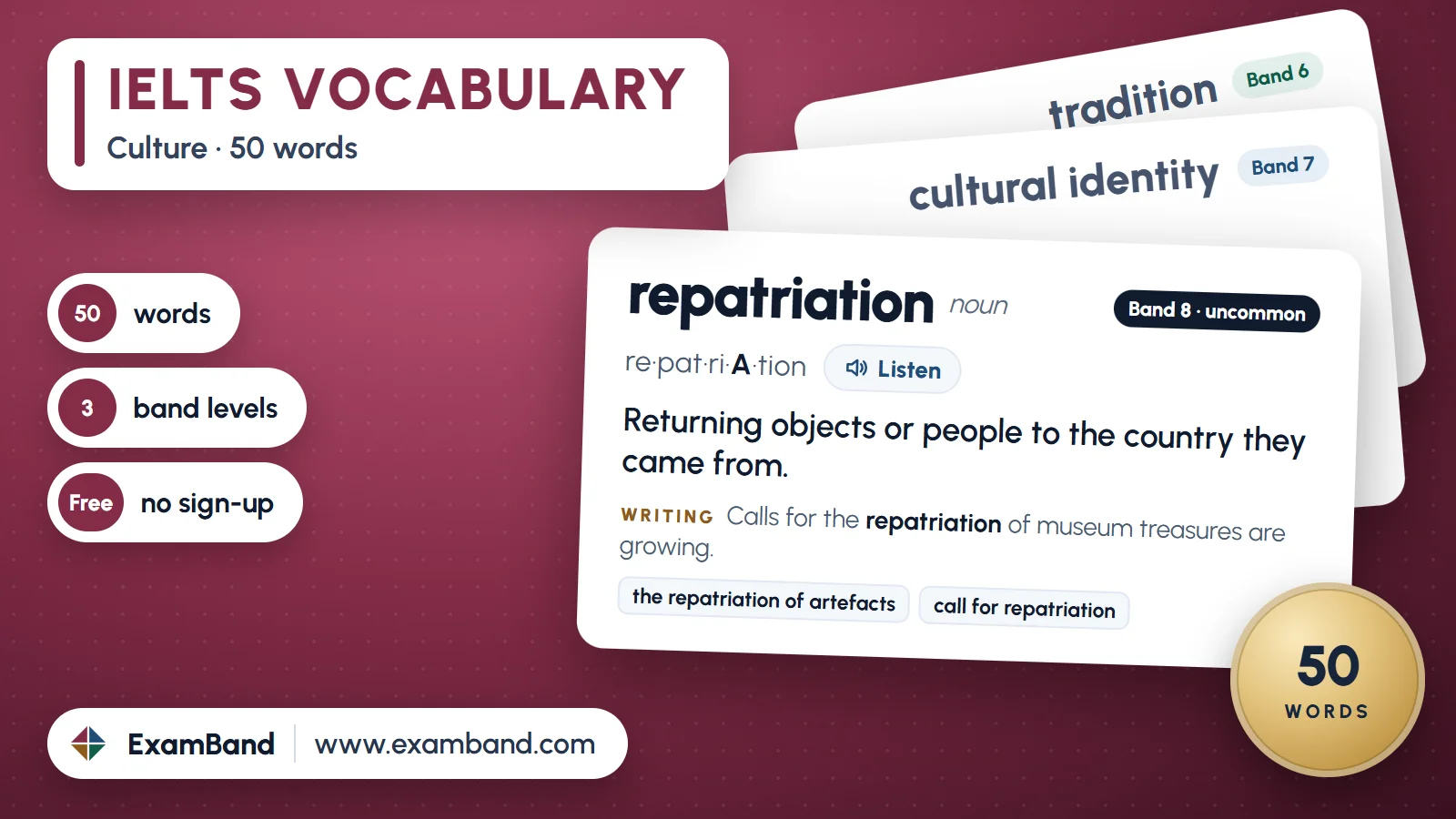
Questions about IELTS culture vocabulary
How do I learn IELTS culture vocabulary?
Learn about ten words a day. First, read the meaning, listen to the word and say it out loud with the right stress. Then test yourself with the quiz and the flashcards on this page. Finally, use five of the words in an essay and check it with our free Writing Checker.
Which words should I learn first?
Start with the band 6 words, because you need them to explain any idea clearly. After that, add the band 7 words. However, use the band 8 words only when you are sure of their meaning, because a rare word used wrongly can lower your score.
Are these official IELTS words?
No. IELTS has no official word list. Instead, our levels follow the words of the public IELTS band descriptors: band 7 asks for some “less common” words, and band 8 for “uncommon” words used with skill.