IELTS Cities Vocabulary: 50 Words with Examples
This list of IELTS cities vocabulary covers housing, traffic, city planning and life in towns and the countryside, which are all common IELTS topics. Each word has a simple meaning, its sound, a band level, examples for Writing and Speaking, and the mistake to avoid.
50 words · free quiz and flashcards · updated October 2026
affordable housing
af·FORD·a·ble HOUS·ing · nounHomes that people on normal incomes can pay for.Band 6 · everyday
Word family: afford (verb)
Collocations
- build affordable housing
- a lack of affordable housing
- access to affordable housing
Similar: low-cost housing
WritingGovernments should build more affordable housing for young families.
SpeakingThere’s very little affordable housing in the centre of my city.
Common mistake: Saying “affordable houses” for the general problem. The usual phrase is “affordable housing”.
rent
RENT · noun / verbMoney you pay every month to live in a home that you do not own.Band 6 · everyday
Word family: rental (adjective / noun)
Collocations
- pay rent
- high rents
- rent a flat
Similar: lease
WritingRising rents push many young people out of city centres.
SpeakingI rent a small flat with two friends.
Common mistake: Saying “rent a flat to my landlord”. You rent a flat from a landlord.
landlord
LAND·lord · nounA person who owns a house or flat and rents it to other people.Band 6 · everyday
Word family: landlady (noun)
Collocations
- a private landlord
- pay the landlord
- landlords and tenants
Similar: property owner
WritingLaws should stop landlords from raising rents unfairly.
SpeakingMy landlord is great; he fixes things quickly.
Common mistake: Using it for the person who rents. The landlord owns the home; the tenant rents it.
tenant
TEN·ant · nounA person who rents a home from its owner.Band 6 · everyday
Word family: tenancy (noun)
Collocations
- protect tenants
- a tenancy agreement
- evict a tenant
Similar: renter
WritingTenants in many cities spend half their income on rent.
SpeakingI’ve been a tenant in the same flat for five years.
Common mistake: Spelling it “tenent”. Write “tenant”.
neighbourhood
NEIGH·bour·hood · nounThe area around your home, and the people who live there.Band 6 · everyday
Word family: neighbour (noun)
Collocations
- a quiet neighbourhood
- a safe neighbourhood
- the local neighbourhood
Similar: area, district
WritingSafe neighbourhoods with parks encourage children to play outside.
SpeakingMy neighbourhood is quiet, but there’s a great market nearby.
Common mistake: Mixing spellings. British English writes “neighbourhood”; American English writes “neighborhood”.
suburb
SUB·urb · nounAn area where people live on the edge of a city.Band 6 · everyday
Word family: suburban (adjective)
Collocations
- live in the suburbs
- a quiet suburb
- suburban areas
Similar: outskirts
WritingMany families move to the suburbs for bigger homes and gardens.
SpeakingI grew up in a suburb, so the city centre feels noisy to me.
Common mistake: Saying “in suburb”. Use an article: “in the suburbs” or “in a suburb”.
city centre
CIT·y CEN·tre · nounThe main part of a city, with shops and offices.Band 6 · everyday
Collocations
- in the city centre
- city-centre flats
- ban cars from the city centre
Similar: town centre, downtown
WritingBanning cars from the city centre would make the air cleaner.
SpeakingI love going to the city centre at the weekend.
Common mistake: Mixing spellings. British English writes “centre”; American English writes “center” and often says “downtown”.
resident
RES·i·dent · nounA person who lives in a particular place.Band 6 · everyday
Word family: reside (verb) · residential (adjective)
Collocations
- local residents
- residents of the city
- residential areas
Similar: inhabitant
WritingLocal residents should have a say in new building projects.
SpeakingMost residents in my street are retired.
Common mistake: Using it for visitors. A resident lives in a place; a visitor only comes for a short time.
crowded
CROWD·ed · adjectiveFull of people.Band 6 · everyday
Word family: crowd (noun) · overcrowded (adjective)
Collocations
- crowded streets
- crowded trains
- get crowded
Similar: packed, busy
WritingCrowded public transport makes daily commuting stressful.
SpeakingThe market gets really crowded on Saturdays.
Common mistake: Saying “crowdy”. The adjective is “crowded”.
skyscraper
SKY·scrap·er · nounA very tall building in a city.Band 6 · everyday
Collocations
- build skyscrapers
- a modern skyscraper
- city skyscrapers
Similar: tower block
WritingSkyscrapers allow cities to house more people on less land.
SpeakingMy city has a new skyscraper with a restaurant at the top.
Common mistake: Writing “sky scraper” as two words. Write “skyscraper”.
noise pollution
NOISE pol·LU·tion · nounLoud, unpleasant noise from traffic, planes or building work.Band 6 · everyday
Word family: noisy (adjective)
Collocations
- reduce noise pollution
- suffer from noise pollution
- noise pollution from traffic
Similar: noise
WritingNoise pollution from traffic can damage sleep and health.
SpeakingI live near the airport, so noise pollution is a real problem.
Common mistake: Saying “noise pollutions”. It is uncountable.
housing shortage
HOUS·ing SHORT·age · nounWhen there are not enough homes for the people who need them.Band 6 · everyday
Word family: short (adjective)
Collocations
- a severe housing shortage
- tackle the housing shortage
- a housing shortage in cities
Similar: lack of homes
WritingA housing shortage pushes prices beyond the reach of young people.
SpeakingThere’s a big housing shortage in my city; flats go in one day.
Common mistake: Saying “housing lack”. The term is “housing shortage”.
block of flats
BLOCK of FLATS · nounA tall building with many homes in it.Band 6 · everyday
Word family: flat (noun)
Collocations
- live in a block of flats
- a new block of flats
- high-rise blocks of flats
Similar: apartment building
WritingMany old houses have been replaced by blocks of flats.
SpeakingI live on the tenth floor of a block of flats.
Common mistake: Saying “a flats block”. Say “a block of flats” (UK) or “an apartment building” (US).
green space
GREEN SPACE · nounAn area of grass, trees or parks in a town.Band 6 · everyday
Collocations
- public green spaces
- protect green space
- a lack of green space
Similar: parks, open space
WritingCities need more green space to improve residents’ mental health.
SpeakingThere isn’t much green space near my home, just roads.
Common mistake: Saying “greens” for parks. “Greens” are vegetables; use “green space”.
homeless
HOME·less · adjectiveHaving no place to live.Band 6 · everyday
Word family: homelessness (noun)
Collocations
- homeless people
- become homeless
- help the homeless
Similar: without a home
WritingRising rents are making more people homeless in big cities.
SpeakingI volunteer at a shelter for homeless people.
Common mistake: Saying “homelesses”. Say “homeless people” or “the homeless”.
property prices
PROP·er·ty PRI·ces · noun, pluralHow much it costs to buy houses and flats.Band 6 · everyday
Word family: property (noun)
Collocations
- rising property prices
- high property prices
- property prices fall
Similar: house prices
WritingRising property prices mean many young adults cannot buy a home.
SpeakingProperty prices in my city have doubled in ten years.
Common mistake: Saying “house costs”. The usual phrases are “property prices” and “house prices”.
rural
RU·ral · adjectiveIn the countryside, not in a town.Band 6 · everyday
Collocations
- rural areas
- rural life
- rural communities
Similar: countryside, country
WritingYoung people often leave rural areas to find work in cities.
SpeakingI grew up in a rural village with only one shop.
Common mistake: Saying it so fast that it sounds like “rule”. It has two parts: ROO-ral.
urban
UR·ban · adjectiveIn a town or city.Band 6 · everyday
Word family: urbanise (verb)
Collocations
- urban areas
- urban life
- the urban population
Similar: city
WritingMore than half of the world’s population now lives in urban areas.
SpeakingI prefer urban life; there’s always something to do.
Common mistake: Saying “urbanic”. The adjective is “urban”.
urbanisation
ur·ban·i·SA·tion · nounThe growth of towns and cities as people move there from the countryside.Band 7 · less common
Word family: urbanise (verb)
Collocations
- rapid urbanisation
- the effects of urbanisation
- urbanisation in Asia
Similar: urban growth
WritingRapid urbanisation has put pressure on housing and transport.
SpeakingUrbanisation has changed my hometown completely in ten years.
Common mistake: Mixing spellings. British English writes “urbanisation”; American English writes “urbanization”.
congestion
con·GES·tion · nounToo much traffic, so that roads are very slow.Band 7 · less common
Word family: congested (adjective)
Collocations
- traffic congestion
- reduce congestion
- a congestion charge
Similar: traffic jams
WritingA congestion charge could reduce traffic in the city centre.
SpeakingThe congestion in my city is terrible at rush hour.
Common mistake: Saying “a congestion”. It is usually uncountable: “traffic congestion”.
urban sprawl
UR·ban SPRAWL · nounThe spread of a city into the countryside around it.Band 7 · less common
Word family: sprawling (adjective)
Collocations
- prevent urban sprawl
- uncontrolled urban sprawl
- the problems of urban sprawl
Similar: suburban growth
WritingUrban sprawl destroys farmland and increases car use.
SpeakingUrban sprawl means my city now reaches the next town.
Common mistake: Thinking “sprawl” means growing upwards. It means spreading outwards.
infrastructure
IN·fra·struc·ture · nounThe basic systems a city needs, like roads, water and power.Band 7 · less common
Collocations
- invest in infrastructure
- transport infrastructure
- poor infrastructure
Similar: public works
WritingGrowing cities must invest in infrastructure such as roads and water supply.
SpeakingThe infrastructure in my town is old; the roads are full of holes.
Common mistake: Saying “infrastructures” in general. It is usually uncountable.
densely populated
DENSE·ly POP·u·lat·ed · adjectiveWith a lot of people living in a small area.Band 7 · less common
Word family: density (noun)
Collocations
- a densely populated city
- densely populated areas
- one of the most densely populated
Similar: crowded, overcrowded
WritingIn densely populated cities, high-rise housing may be the only option.
SpeakingHong Kong is the most densely populated place I’ve ever visited.
Common mistake: Saying “dense populated”. You need the adverb: “densely populated”.
amenities
a·MEN·i·ties · noun, pluralUseful places in an area, like shops, parks and hospitals.Band 7 · less common
Collocations
- local amenities
- basic amenities
- close to amenities
Similar: facilities, services
WritingNew housing estates must include amenities such as schools and clinics.
SpeakingMy area has great amenities: a gym, a library and a park.
Common mistake: Saying “amenity” for the general idea. It is usually plural: “local amenities”.
inner city
IN·ner CIT·y · nounThe older central part of a city, often poorer and with social problems.Band 7 · less common
Collocations
- inner-city areas
- inner-city schools
- the inner city
Similar: city centre
WritingMany inner-city schools lack funding and experienced teachers.
SpeakingThe inner city near me has improved a lot recently.
Common mistake: Leaving out the hyphen before a noun. Write “inner-city schools”, but “the inner city”.
high-rise
HIGH-rise · adjective / nounA very tall building with many floors.Band 7 · less common
Collocations
- high-rise buildings
- high-rise flats
- live in a high-rise
Similar: tower block, skyscraper
WritingHigh-rise buildings save space, but they can feel isolating.
SpeakingWe live in a high-rise with a great view of the river.
Common mistake: Writing “high rise” without a hyphen. Write “high-rise”.
commuter belt
com·MUT·er BELT · nounThe towns around a big city where many people who work in the city live.Band 7 · less common
Word family: commute (verb)
Collocations
- live in the commuter belt
- commuter belt towns
- move to the commuter belt
Similar: outer suburbs
WritingHigh prices push many families out to the commuter belt.
SpeakingMy parents live in the commuter belt, an hour from the city.
Common mistake: Saying “commuting belt”. The term is “commuter belt”.
cost of living
COST of LIV·ing · nounHow much money you need to pay for basic things like food and housing.Band 7 · less common
Collocations
- the rising cost of living
- a high cost of living
- the cost-of-living crisis
Similar: living costs
WritingThe high cost of living in capital cities pushes young workers away.
SpeakingThe cost of living here has gone up a lot this year.
Common mistake: Saying “the living cost” in formal writing. The usual phrase is “the cost of living”.
renovate
REN·o·vate · verbTo repair and improve an old building.Band 7 · less common
Word family: renovation (noun)
Collocations
- renovate old buildings
- a renovated flat
- fully renovated
Similar: restore, do up
WritingCities should renovate old buildings instead of knocking them down.
SpeakingWe renovated our kitchen last summer.
Common mistake: Using it for building something new. Renovate means repairing something old.
derelict
DER·e·lict · adjectiveEmpty and in very bad condition.Band 7 · less common
Word family: dereliction (noun)
Collocations
- derelict buildings
- a derelict factory
- derelict land
Similar: abandoned, run-down
WritingDerelict factories could be turned into homes and community centres.
SpeakingThere’s a derelict hotel by the beach that nobody uses.
Common mistake: Using it for people. It is used for buildings and land.
pedestrianised
pe·DES·tri·an·ised · adjectiveClosed to cars, so that only people on foot can use it.Band 7 · less common
Word family: pedestrian (noun) · pedestrianise (verb)
Collocations
- a pedestrianised street
- pedestrianised zones
- fully pedestrianised
Similar: car-free
WritingPedestrianised streets are safer and better for local shops.
SpeakingThe old town is pedestrianised, so it’s lovely to walk around.
Common mistake: Mixing spellings. British English writes “pedestrianised”; American English writes “pedestrianized”.
urban planning
UR·ban PLAN·ning · nounDesigning how a city’s buildings, roads and spaces are arranged.Band 7 · less common
Word family: urban planner (noun)
Collocations
- good urban planning
- poor urban planning
- careful urban planning
Similar: town planning
WritingCareful urban planning can reduce traffic and pollution.
SpeakingI’d like to study urban planning and design better cities.
Common mistake: Saying “city planification”. The term is “urban planning”.
slum
SLUM · nounA very poor and crowded area of a city with bad housing.Band 7 · less common
Collocations
- live in slums
- slum areas
- slum clearance
Similar: shanty town
WritingMillions of people in fast-growing cities live in slums without clean water.
SpeakingWe visited a project helping children in the slums.
Common mistake: Using it for any poor area. A slum has very bad, crowded housing and few services.
mortgage
MORT·gage · nounMoney borrowed from a bank to buy a home.Band 7 · less common
Collocations
- take out a mortgage
- pay off a mortgage
- mortgage repayments
Similar: home loan
WritingHigh house prices force young buyers to take out huge mortgages.
SpeakingWe’ll finish paying our mortgage in fifteen years.
Common mistake: Saying the t. The t is silent: MOR-gij.
vibrant
VI·brant · adjectiveFull of energy, activity and life.Band 7 · less common
Word family: vibrancy (noun)
Collocations
- a vibrant city
- vibrant nightlife
- a vibrant community
Similar: lively, energetic
WritingA vibrant city centre attracts both tourists and businesses.
SpeakingMy city is really vibrant at night, with lots of music.
Common mistake: Using it only for loud noise. Vibrant means full of life and energy.
regeneration
re·gen·er·A·tion · nounImproving a poor or old area with new buildings and jobs.Band 7 · less common
Word family: regenerate (verb)
Collocations
- urban regeneration
- regeneration projects
- the regeneration of the docks
Similar: redevelopment, renewal
WritingUrban regeneration can bring jobs to struggling neighbourhoods.
SpeakingThe regeneration of the old port has made it really popular.
Common mistake: Using “regenerating” as the noun. The noun is “regeneration”.
gentrification
gen·tri·fi·CA·tion · nounWhen richer people move into a poor area, making it too expensive for the people who already live there.Band 8 · uncommon
Word family: gentrify (verb)
Collocations
- the effects of gentrification
- rapid gentrification
- resist gentrification
Similar: upmarket change
WritingGentrification can push long-term residents out of their own neighbourhoods.
SpeakingMy old area went through gentrification; now it’s full of expensive cafés.
Common mistake: Thinking it is only positive. It improves areas but can force poorer people out.
rural-urban migration
RU·ral-UR·ban mi·GRA·tion · nounPeople moving from the countryside to the cities.Band 8 · uncommon
Word family: migrate (verb)
Collocations
- large-scale rural-urban migration
- the causes of rural-urban migration
- rural-urban migration in Asia
Similar: the move to the cities
WritingRural-urban migration has left many villages with only elderly residents.
SpeakingThere’s a lot of rural-urban migration in my country; young people want city jobs.
Common mistake: Mixing up “migration” (moving) and “immigration” (coming to live in a new country).
metropolis
me·TROP·o·lis · nounA very large and important city.Band 8 · uncommon
Word family: metropolitan (adjective)
Collocations
- a busy metropolis
- a global metropolis
- the metropolitan area
Similar: megacity, big city
WritingGrowing up in a metropolis offers more opportunities but less space.
SpeakingTokyo is the biggest metropolis I’ve ever seen.
Common mistake: Putting the stress at the start. Stress “-trop-”: me-TROP-o-lis.
cosmopolitan
cos·mo·POL·i·tan · adjectiveFull of people and cultures from many countries.Band 8 · uncommon
Collocations
- a cosmopolitan city
- a cosmopolitan atmosphere
- cosmopolitan cities like London
Similar: multicultural, international
WritingCosmopolitan cities give people the chance to experience other cultures.
SpeakingDubai is so cosmopolitan; you hear ten languages a day.
Common mistake: Using it only to mean a large city. It means a city with many cultures.
soulless
SOUL·less · adjectiveLacking character, warmth or interest.Band 8 · uncommon
Collocations
- soulless buildings
- a soulless suburb
- feel soulless
Similar: characterless, bland
WritingSome modern housing estates are criticised as soulless and isolating.
SpeakingThe new shopping centre feels a bit soulless to me.
Common mistake: Spelling it “soulles” or “soul-less”. Write “soulless”.
sanitation
san·i·TA·tion · nounSystems that keep places clean and safe, such as drains and toilets.Band 8 · uncommon
Word family: sanitary (adjective)
Collocations
- poor sanitation
- improve sanitation
- access to sanitation
Similar: drainage, hygiene
WritingPoor sanitation in slums causes the rapid spread of disease.
SpeakingSanitation in my city improved a lot after the new sewers were built.
Common mistake: Mixing it up with “sanity”, which is about the mind.
zoning laws
ZON·ing LAWS · noun, pluralRules that say what can be built in each part of a city.Band 8 · uncommon
Word family: zone (noun / verb)
Collocations
- strict zoning laws
- relax zoning laws
- zoning laws allow
Similar: planning rules
WritingChanging zoning laws could allow more homes to be built near city centres.
SpeakingZoning laws stop people building factories near my home.
Common mistake: Saying “zone laws”. The term is “zoning laws”.
liveable
LIVE·a·ble · adjectiveGood and pleasant to live in.Band 8 · uncommon
Word family: liveability (noun)
Collocations
- a liveable city
- the most liveable cities
- make cities more liveable
Similar: pleasant to live in
WritingCities become more liveable when they have parks and clean air.
SpeakingVienna is often called one of the most liveable cities in the world.
Common mistake: Mixing spellings. British English often writes “liveable”; American English writes “livable”.
concrete jungle
CON·crete JUN·gle · nounA city with too many big buildings and very little nature.Band 8 · uncommon
Collocations
- a concrete jungle
- turn into a concrete jungle
- escape the concrete jungle
Similar: urban jungle
WritingWithout planning, cities risk becoming concrete jungles with no green space.
SpeakingI love nature, so living in a concrete jungle is hard for me.
Common mistake: Using it to praise a city. It is usually negative.
squalid
SQUAL·id · adjectiveVery dirty and unpleasant, often because of poverty.Band 8 · uncommon
Word family: squalor (noun)
Collocations
- squalid conditions
- squalid housing
- live in squalor
Similar: filthy, run-down
WritingMany migrant workers live in squalid conditions on the edge of cities.
SpeakingThe first flat I rented was quite squalid; it had mould everywhere.
Common mistake: Spelling it “squallid”, with double l. Write “squalid”.
conurbation
con·ur·BA·tion · nounA large area where several towns have grown and joined together.Band 8 · uncommon
Collocations
- a large conurbation
- the conurbation around a city
- urban conurbations
Similar: metropolitan area
WritingSeveral towns have merged into a single conurbation of five million people.
SpeakingMy town is part of a big conurbation; you can’t see where one town ends.
Common mistake: Using it for one big city. It means several towns joined together.
housing bubble
HOUS·ing BUB·ble · nounWhen house prices rise very fast and may then suddenly fall.Band 8 · uncommon
Collocations
- a housing bubble bursts
- fears of a housing bubble
- inflate a housing bubble
Similar: property bubble
WritingWhen the housing bubble burst, many families lost their homes.
SpeakingPeople here think there’s a housing bubble; prices are crazy.
Common mistake: Saying “the bubble exploded”. A bubble “bursts”.
Cities vocabulary in IELTS Writing and Speaking
Here is how IELTS cities vocabulary can come up in the test, with our own practice questions. So, try to answer them with words from the list above.
Writing Task 2
In many countries, people are moving from the countryside to big cities. Do the advantages of this trend outweigh the disadvantages?
Speaking
- Part 1: Do you live in a house or a flat?
- Part 1: What do you like about the area where you live?
- Part 2: Describe a city you have visited that you would like to live in.
- Part 3: Should cars be banned from city centres?
- Part 3: How can governments make housing more affordable?
Our free tests on this topic
- Writing Practice Test 3, Task 2rents rising faster than young people’s incomes
- Writing Practice Test 7, Task 2banning private cars from city centres
- Listening Practice Test 6, Part 1a call about renting a flat
- Reading Practice Test 2, Passage 1how a hot summer gave London a new sewer system
A model paragraph with IELTS cities vocabulary
Urbanisation brings jobs and amenities, but it also causes serious problems. Congestion and noise pollution make daily life stressful, and property prices in many cities have risen far faster than wages. To keep cities liveable, governments need careful urban planning, more affordable housing and protected green space.
Practise this IELTS cities vocabulary
Take the 10-question quiz on this IELTS cities vocabulary, or go through every word with the flashcards.
Question 1 of 10
Which word means “a person who owns a house or flat and rents it to other people”?
Now use the words
Write a Task 2 essay with five of these words. Then our free Writing Checker gives you a band for vocabulary and for the other three criteria.
Open the Writing Checker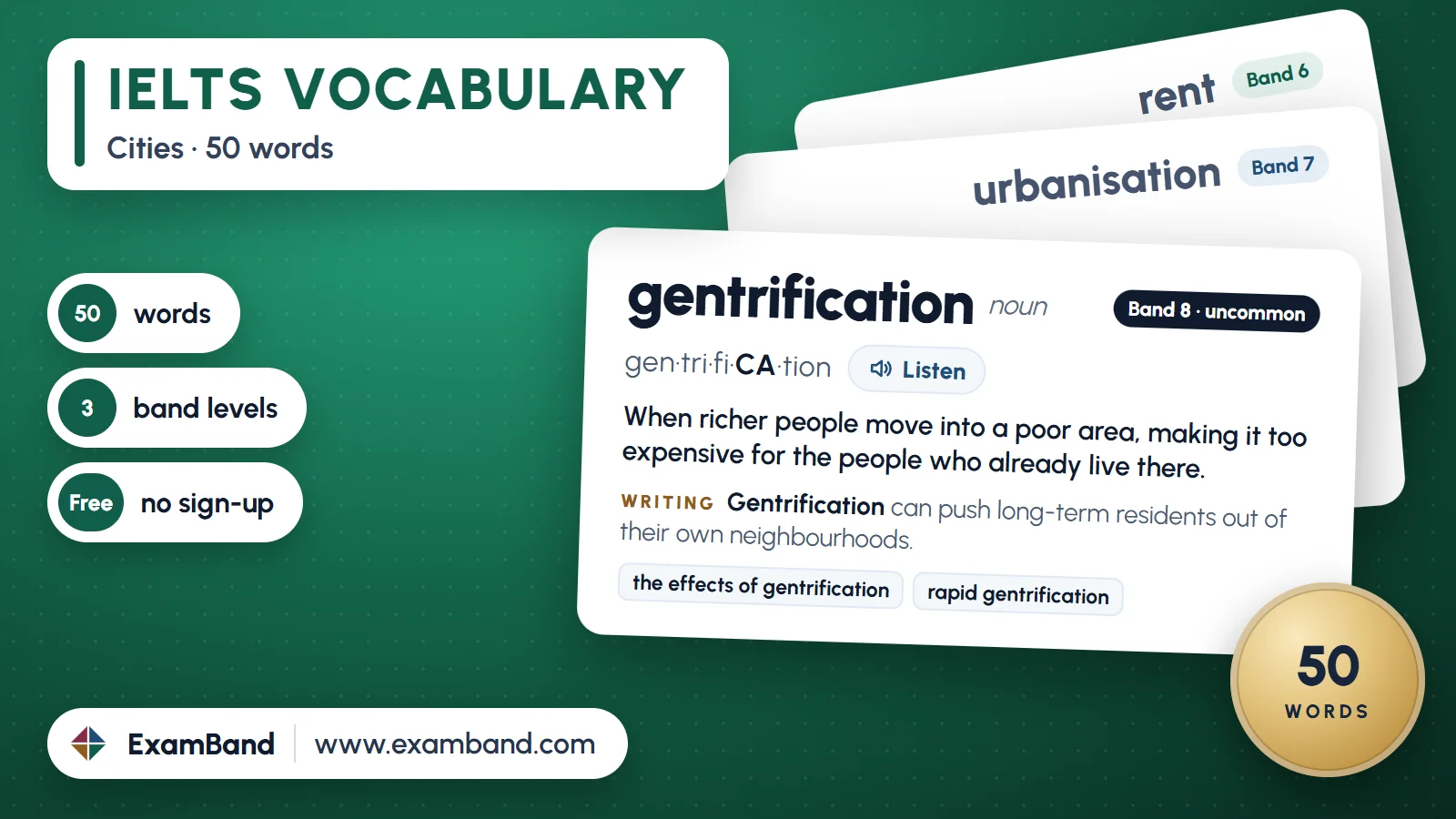
Questions about IELTS cities vocabulary
How do I learn IELTS cities vocabulary?
Learn about ten words a day. First, read the meaning, listen to the word and say it out loud with the right stress. Then test yourself with the quiz and the flashcards on this page. Finally, use five of the words in an essay and check it with our free Writing Checker.
Which words should I learn first?
Start with the band 6 words, because you need them to explain any idea clearly. After that, add the band 7 words. However, use the band 8 words only when you are sure of their meaning, because a rare word used wrongly can lower your score.
Are these official IELTS words?
No. IELTS has no official word list. Instead, our levels follow the words of the public IELTS band descriptors: band 7 asks for some “less common” words, and band 8 for “uncommon” words used with skill.