IELTS Crime Vocabulary: 50 Words with Examples
This list of IELTS crime vocabulary helps you write and talk about crime, punishment, prisons and the law, which is a very common Writing Task 2 topic. Each word has a simple meaning, its sound, a band level, examples for Writing and Speaking, and the mistake to avoid.
50 words · free quiz and flashcards · updated October 2026
crime rate
CRIME RATE · nounThe number of crimes in a place in a period of time.Band 6 · everyday
Collocations
- a high crime rate
- reduce the crime rate
- crime rates fall
Similar: level of crime
WritingBetter street lighting can help to reduce the crime rate.
SpeakingThe crime rate in my town is really low.
Common mistake: Saying “crimes rate”. The term is “crime rate”.
criminal
CRIM·i·nal · noun / adjectiveA person who has broken the law; connected with crime.Band 6 · everyday
Word family: crime (noun) · criminality (noun)
Collocations
- a convicted criminal
- criminal behaviour
- a criminal record
Similar: offender, lawbreaker
WritingSome argue that criminals should be helped to change, not just punished.
SpeakingIn films, the criminal always gets caught in the end.
Common mistake: Saying “a crime person”. The noun is “a criminal”.
prison
PRIS·on · nounA building where criminals are kept as a punishment.Band 6 · everyday
Word family: prisoner (noun) · imprison (verb)
Collocations
- go to prison
- send someone to prison
- prison conditions
Similar: jail
WritingPrison does not always stop people from committing crimes again.
SpeakingThere’s an old prison in my city that’s now a museum.
Common mistake: Saying “go to the prison” for the punishment. Without “the” it means being punished: “He went to prison.”
punishment
PUN·ish·ment · nounSomething done to a person because they have broken the law or a rule.Band 6 · everyday
Word family: punish (verb)
Collocations
- a harsh punishment
- a fair punishment
- receive punishment
Similar: penalty
WritingPunishment should match the seriousness of the crime.
SpeakingAt my school, the punishment for being late was extra homework.
Common mistake: Saying “give a punish”. The noun is “punishment”.
illegal
il·LE·gal · adjectiveNot allowed by law.Band 6 · everyday
Word family: illegally (adverb) · legal (adjective)
Collocations
- illegal drugs
- it is illegal to
- illegal parking
Similar: unlawful, against the law
WritingIn many countries, it is illegal to use a phone while driving.
SpeakingParking here is illegal, so don’t leave your car.
Common mistake: Saying “unlegal”. The opposite of “legal” is “illegal”.
victim
VIC·tim · nounA person who is hurt or harmed by a crime.Band 6 · everyday
Word family: victimise (verb)
Collocations
- crime victims
- a victim of theft
- support victims
Similar: injured party
WritingVictims of crime should receive more support from the government.
SpeakingMy uncle was the victim of a phone scam last year.
Common mistake: Saying “a victim from”. Use “of”: “a victim of crime”.
theft
THEFT · nounThe crime of stealing.Band 6 · everyday
Word family: thief (noun) · steal (verb)
Collocations
- car theft
- identity theft
- petty theft
Similar: stealing
WritingOnline theft of personal data is growing fast.
SpeakingBike theft is a real problem at my university.
Common mistake: Mixing up “theft” (the crime) and “thief” (the person).
burglary
BUR·glar·y · nounBreaking into a building to steal things.Band 6 · everyday
Word family: burglar (noun) · burgle (verb)
Collocations
- a burglary at
- report a burglary
- the risk of burglary
Similar: break-in
WritingSimple alarms can greatly reduce the risk of burglary.
SpeakingOur neighbours had a burglary while they were on holiday.
Common mistake: Mixing up “burglary” and “robbery”. Burglary is breaking into a building; robbery uses force or threats against people.
fine
FINE · noun / verbMoney you must pay as a punishment.Band 6 · everyday
Collocations
- pay a fine
- a heavy fine
- be fined for
Similar: penalty
WritingHeavy fines could stop companies from polluting rivers.
SpeakingI got a parking fine last week; it was so annoying.
Common mistake: Mixing up the meanings. “I’m fine” means well; “a fine” is money you pay as a punishment.
court
COURT · nounThe place where a judge decides if someone is guilty of a crime.Band 6 · everyday
Collocations
- go to court
- appear in court
- a court case
Similar: law court
WritingYoung offenders should be dealt with by special courts.
SpeakingI had to go to court once as a witness.
Common mistake: Saying “go to the court” to mean a trial. Say “go to court”, without “the”.
judge
JUDGE · noun / verbThe person who controls a trial in court and decides the punishment.Band 6 · everyday
Word family: judgement (noun)
Collocations
- a judge decides
- appear before a judge
- judges should
Similar: magistrate
WritingJudges should consider why a person committed a crime.
SpeakingMy cousin wants to become a judge one day.
Common mistake: Spelling it “jugde”. Write “judge”.
commit a crime
com·MIT a CRIME · verb phraseTo do something that is against the law.Band 6 · everyday
Word family: crime (noun)
Collocations
- commit a serious crime
- commit crimes
- people who commit crimes
Similar: break the law
WritingPoverty can push young people to commit crimes.
SpeakingIn my opinion, people rarely commit a crime without a reason.
Common mistake: Saying “do a crime” or “make a crime”. The verb is “commit”.
violent crime
VI·o·lent CRIME · nounCrime that hurts people, such as an attack.Band 6 · everyday
Word family: violence (noun)
Collocations
- a rise in violent crime
- victims of violent crime
- violent crime rates
Similar: serious crime
WritingViolent crime has fallen in many cities over the last twenty years.
SpeakingLuckily, violent crime is rare where I live.
Common mistake: Saying “violence crime”. Use the adjective: “violent crime”.
arrest
ar·REST · verb / nounWhen the police take someone away because they may have committed a crime.Band 6 · everyday
Collocations
- arrest a suspect
- be arrested for
- under arrest
Similar: detain
WritingThe police arrested hundreds of people for drink-driving last year.
SpeakingA man was arrested outside my building yesterday.
Common mistake: Saying “arrested from the police”. Use “by”: “arrested by the police”.
witness
WIT·ness · noun / verbA person who sees a crime or an accident happen.Band 6 · everyday
Word family: eyewitness (noun)
Collocations
- a key witness
- witness a crime
- a witness statement
Similar: eyewitness, observer
WritingCameras can provide evidence when there are no witnesses.
SpeakingI witnessed a car accident on my way to work.
Common mistake: Saying “witness of” as a verb. As a verb, you witness something: “I witnessed a crime.”
security camera
se·CU·ri·ty CAM·er·a · nounA camera that records what happens in a place, to prevent crime.Band 6 · everyday
Collocations
- install security cameras
- caught on a security camera
- security camera footage
Similar: CCTV
WritingSecurity cameras in shops have reduced shoplifting.
SpeakingThere’s a security camera outside every shop in my street.
Common mistake: Saying “safety camera” for crime. The usual terms are “security camera” and “CCTV”.
shoplifting
SHOP·lift·ing · nounStealing things from a shop.Band 6 · everyday
Word family: shoplifter (noun)
Collocations
- arrested for shoplifting
- prevent shoplifting
- a rise in shoplifting
Similar: theft from shops
WritingShoplifting costs shops huge amounts of money every year.
SpeakingA teenager was caught shoplifting in the supermarket.
Common mistake: Saying “shop-stealing”. The word is “shoplifting”.
police force
po·LICE FORCE · nounAll the police officers in a country or an area.Band 6 · everyday
Collocations
- join the police force
- a well-trained police force
- the national police force
Similar: the police
WritingA well-funded police force is essential for public safety.
SpeakingMy brother just joined the police force.
Common mistake: Saying “a police” for one officer. Say “a police officer”.
deterrent
de·TER·rent · nounSomething, like a punishment, that makes people decide not to do something.Band 7 · less common
Word family: deter (verb)
Collocations
- an effective deterrent
- act as a deterrent
- a strong deterrent
Similar: disincentive
WritingSome argue that long prison sentences act as a deterrent to crime.
SpeakingI think cameras are a good deterrent for thieves.
Common mistake: Spelling it “deterent”. Write “deterrent”, with double r.
rehabilitation
re·ha·bil·i·TA·tion · nounHelping a criminal to live a normal, honest life again.Band 7 · less common
Word family: rehabilitate (verb)
Collocations
- the rehabilitation of offenders
- rehabilitation programmes
- focus on rehabilitation
Similar: reform
WritingEducation in prison is an important part of rehabilitation.
SpeakingI believe in rehabilitation; people can change.
Common mistake: Using it only for hospitals. With crime it means helping offenders to change.
reoffend
re·of·FEND · verbTo commit another crime after being punished.Band 7 · less common
Word family: reoffending (noun)
Collocations
- likely to reoffend
- reduce reoffending
- reoffending rates
Similar: relapse into crime
WritingPrisoners who learn a trade are less likely to reoffend.
SpeakingMany young people reoffend because they can’t find work.
Common mistake: Mixing it up with “offend”, which also means to upset someone. “Reoffend” is only about crime.
offender
of·FEND·er · nounA person who has committed a crime.Band 7 · less common
Word family: offence (noun) · offend (verb)
Collocations
- young offenders
- first-time offenders
- repeat offenders
Similar: criminal, lawbreaker
WritingFirst-time offenders should be given a second chance.
SpeakingYoung offenders in my country do community work.
Common mistake: Mixing spellings. British English writes “offence”; American English writes “offense”.
prison sentence
PRIS·on SEN·tence · nounThe time a judge says a criminal must spend in prison.Band 7 · less common
Word family: sentence (verb)
Collocations
- a long prison sentence
- serve a prison sentence
- receive a prison sentence
Similar: jail term
WritingLonger prison sentences do not always reduce crime.
SpeakingHe got a two-year prison sentence for fraud.
Common mistake: Saying “do a prison sentence”. You “serve” a sentence.
juvenile delinquency
JU·ve·nile de·LIN·quen·cy · nounCrime committed by young people.Band 7 · less common
Word family: juvenile delinquent (noun)
Collocations
- tackle juvenile delinquency
- a rise in juvenile delinquency
- the causes of juvenile delinquency
Similar: youth crime
WritingYouth clubs can help to prevent juvenile delinquency.
SpeakingJuvenile delinquency is quite common in poorer areas here.
Common mistake: Spelling it “deliquency”. Write “delinquency”, with an n.
community service
com·MU·ni·ty SER·vice · nounUnpaid work for the local area, given as a punishment instead of prison.Band 7 · less common
Collocations
- do community service
- sentenced to community service
- hours of community service
Similar: unpaid work
WritingCommunity service can be more useful than prison for minor crimes.
SpeakingHe had to do community service, cleaning parks every weekend.
Common mistake: Saying “social service” for the punishment. The term is “community service”.
capital punishment
CAP·i·tal PUN·ish·ment · nounKilling someone as a punishment for a crime.Band 7 · less common
Collocations
- abolish capital punishment
- support capital punishment
- the use of capital punishment
Similar: the death penalty
WritingMany countries have abolished capital punishment.
SpeakingI’m against capital punishment because mistakes can happen.
Common mistake: Thinking it is about money. Here “capital” means involving death.
legislation
leg·is·LA·tion · nounLaws, or the making of laws.Band 7 · less common
Word family: legislate (verb) · legislative (adjective)
Collocations
- introduce legislation
- new legislation
- strict legislation
Similar: laws
WritingNew legislation is needed to tackle online crime.
SpeakingThere’s new legislation on drink-driving in my country.
Common mistake: Saying “a legislation”. It is uncountable: “new legislation” or “a piece of legislation”.
enforce
en·FORCE · verbTo make sure that people obey a law or a rule.Band 7 · less common
Word family: enforcement (noun)
Collocations
- enforce the law
- strictly enforce
- enforce rules
Similar: apply, impose
WritingLaws are useless if the police do not enforce them.
SpeakingThey don’t really enforce the speed limit on my road.
Common mistake: Saying “enforce people to”. You enforce a law; you “force” people to do something.
petty crime
PET·ty CRIME · nounSmall crimes, like stealing things of little value.Band 7 · less common
Collocations
- commit petty crime
- petty crime rates
- a rise in petty crime
Similar: minor crime
WritingPetty crime is often linked to poverty and unemployment.
SpeakingPickpocketing is the main petty crime in tourist areas.
Common mistake: Saying “small crime”. The usual term is “petty crime”.
cybercrime
CY·ber·crime · nounCrime committed using computers and the internet.Band 7 · less common
Word family: cybercriminal (noun)
Collocations
- tackle cybercrime
- the rise of cybercrime
- victims of cybercrime
Similar: online crime
WritingCybercrime is growing faster than police forces can respond.
SpeakingMy friend lost money to cybercrime; someone stole her card details.
Common mistake: Writing “cyber crime” as two words. Write “cybercrime”.
corruption
cor·RUP·tion · nounDishonest behaviour by people in power, especially taking money.Band 7 · less common
Word family: corrupt (adjective / verb)
Collocations
- political corruption
- fight corruption
- widespread corruption
Similar: bribery, dishonesty
WritingCorruption weakens trust in the police and the courts.
SpeakingPeople in my country are angry about corruption in politics.
Common mistake: Spelling it “curruption”. Write “corruption”.
fraud
FRAUD · nounTricking people in order to get money illegally.Band 7 · less common
Word family: fraudulent (adjective) · fraudster (noun)
Collocations
- credit card fraud
- commit fraud
- online fraud
Similar: scam, deception
WritingOnline fraud has become one of the most common crimes.
SpeakingMy dad nearly fell for an email fraud.
Common mistake: Saying “a fraud” for the crime. The crime is “fraud”; “a fraud” is a person who pretends to be something they are not.
prosecute
PROS·e·cute · verbTo accuse someone of a crime in court.Band 7 · less common
Word family: prosecution (noun) · prosecutor (noun)
Collocations
- prosecute offenders
- be prosecuted for
- prosecute companies
Similar: charge, take to court
WritingCompanies that pollute rivers should be prosecuted.
SpeakingThe driver was prosecuted for speeding.
Common mistake: Mixing it up with “persecute”, which means treating people cruelly.
convict
con·VICT · verb / nounTo decide officially in court that someone is guilty of a crime.Band 7 · less common
Word family: conviction (noun)
Collocations
- be convicted of
- convict criminals
- a convicted criminal
Similar: find guilty
WritingOnly a few people who commit online crimes are ever convicted.
SpeakingHe was convicted of theft and sent to prison.
Common mistake: Stressing the verb like the noun. The verb is con-VICT; the noun (a prisoner) is CON-vict.
law enforcement
LAW en·FORCE·ment · nounThe police and other people who make sure that laws are obeyed.Band 7 · less common
Collocations
- law enforcement agencies
- law enforcement officers
- effective law enforcement
Similar: the police
WritingBetter pay for law enforcement officers could reduce corruption.
SpeakingMy uncle works in law enforcement at the airport.
Common mistake: Saying “law enforcing”. The noun is “law enforcement”.
vandalism
VAN·dal·ism · nounDamaging public or private property on purpose.Band 7 · less common
Word family: vandal (noun) · vandalise (verb)
Collocations
- acts of vandalism
- reduce vandalism
- vandalism in parks
Similar: criminal damage
WritingYouth centres can reduce vandalism by giving teenagers somewhere to go.
SpeakingThe bus stops in my area suffer a lot of vandalism.
Common mistake: Saying “vandalisation”. The noun is “vandalism”.
organised crime
OR·gan·ised CRIME · nounCrime planned by large, powerful groups of criminals.Band 7 · less common
Collocations
- fight organised crime
- organised crime groups
- links to organised crime
Similar: gang crime
WritingOrganised crime often profits from the illegal drug trade.
SpeakingFilms about organised crime are really popular.
Common mistake: Mixing spellings. British English writes “organised”; American English writes “organized”.
law-abiding
LAW-a·bid·ing · adjectiveAlways obeying the law.Band 7 · less common
Word family: abide by (phrasal verb)
Collocations
- law-abiding citizens
- law-abiding people
- a law-abiding life
Similar: honest, obedient
WritingMost law-abiding citizens support stronger action against crime.
SpeakingMy neighbours are very law-abiding; they never even park badly.
Common mistake: Writing “law abiding” without the hyphen. Write “law-abiding”.
recidivism
re·CID·i·vism · nounWhen criminals keep committing crimes after they have been punished.Band 8 · uncommon
Word family: recidivist (noun)
Collocations
- reduce recidivism
- high recidivism rates
- the causes of recidivism
Similar: reoffending
WritingEducation programmes in prisons can lower recidivism.
SpeakingRecidivism is high because prisoners have no job when they leave.
Common mistake: Putting the stress at the start. Stress “-cid-”: re-SID-i-vism.
incarceration
in·car·cer·A·tion · nounKeeping someone in prison.Band 8 · uncommon
Word family: incarcerate (verb)
Collocations
- mass incarceration
- rates of incarceration
- alternatives to incarceration
Similar: imprisonment
WritingIncarceration is expensive and often fails to change behaviour.
SpeakingI read that incarceration rates are very high in some countries.
Common mistake: Spelling it “incarseration”. Write “incarceration”.
punitive
PU·ni·tive · adjectiveMeant as a punishment, and often very strict.Band 8 · uncommon
Word family: punish (verb)
Collocations
- punitive measures
- punitive sentences
- a punitive approach
Similar: harsh, severe
WritingA purely punitive approach to crime does little to prevent it.
SpeakingThe fines for littering here are really punitive.
Common mistake: Saying “punishive”. The adjective is “punitive”.
lenient
LE·ni·ent · adjectiveNot as strict as expected when punishing someone.Band 8 · uncommon
Word family: leniency (noun)
Collocations
- a lenient sentence
- be too lenient
- lenient judges
Similar: soft, mild
WritingCritics argue that sentences for dangerous driving are too lenient.
SpeakingMy parents were quite lenient; I could stay out late.
Common mistake: Saying it with a short e. It starts like “lean”: LEE-nee-ent.
retribution
ret·ri·BU·tion · nounPunishment for a crime that is seen as deserved.Band 8 · uncommon
Collocations
- seek retribution
- a desire for retribution
- justice or retribution
Similar: revenge, payback
WritingPrison should aim at reform, not simply retribution.
SpeakingSome victims want retribution, but others just want an apology.
Common mistake: Using it to mean giving something back. It means deserved punishment.
judicial system
ju·DI·cial SYS·tem · nounThe courts and judges of a country.Band 8 · uncommon
Word family: judiciary (noun)
Collocations
- an independent judicial system
- reform the judicial system
- trust in the judicial system
Similar: justice system
WritingAn independent judicial system is essential in a democracy.
SpeakingPeople in my country don’t really trust the judicial system.
Common mistake: Mixing up “judicial” (about courts) and “judicious” (wise).
clampdown
CLAMP·down · nounStrong, sudden action to stop an activity.Band 8 · uncommon
Word family: clamp down on (phrasal verb)
Collocations
- a clampdown on crime
- announce a clampdown
- a police clampdown
Similar: crackdown
WritingThe government announced a clampdown on knife crime.
SpeakingThere’s been a clampdown on illegal parking in my city.
Common mistake: Saying “a clampdown at”. Use “on”: “a clampdown on crime”.
impunity
im·PU·ni·ty · nounFreedom from punishment.Band 8 · uncommon
Collocations
- act with impunity
- a culture of impunity
- break the law with impunity
Similar: freedom from punishment
WritingWeak courts allow powerful people to break the law with impunity.
SpeakingDrivers here run red lights with impunity; nobody stops them.
Common mistake: Mixing it up with “immunity”. Impunity means not being punished.
heinous
HEI·nous · adjectiveExtremely evil and shocking.Band 8 · uncommon
Collocations
- a heinous crime
- heinous acts
- the most heinous crimes
Similar: atrocious, monstrous
WritingSome argue that life imprisonment is right for the most heinous crimes.
SpeakingThat case was so heinous that it was in the news for weeks.
Common mistake: Saying it like “HEE-nee-us”. It sounds like “HAY-nus”.
reintegrate
re·IN·te·grate · verbTo help someone become part of society again.Band 8 · uncommon
Word family: reintegration (noun)
Collocations
- reintegrate offenders
- reintegrate into society
- help prisoners reintegrate
Similar: rejoin society
WritingJob training helps former prisoners reintegrate into society.
SpeakingIt’s hard for ex-prisoners to reintegrate without a home.
Common mistake: Saying “reintegrate to society”. Use “into”: “reintegrate into society”.
miscarriage of justice
mis·CAR·riage of JUS·tice · nounWhen an innocent person is wrongly punished.Band 8 · uncommon
Collocations
- a terrible miscarriage of justice
- victims of miscarriages of justice
- prevent miscarriages of justice
Similar: wrongful conviction
WritingThe death penalty makes any miscarriage of justice impossible to correct.
SpeakingI watched a documentary about a miscarriage of justice; he spent twenty years in prison.
Common mistake: Using it for a light punishment. It means an innocent person was punished.
Crime vocabulary in IELTS Writing and Speaking
Here is how IELTS crime vocabulary can come up in the test, with our own practice questions. So, try to answer them with words from the list above.
Writing Task 2
Some people believe the best way to reduce youth crime is to punish young offenders more strictly. Others think education and support work better. Discuss both views and give your own opinion.
Speaking
- Part 1: Is your hometown a safe place to live?
- Part 1: Do you like watching crime films or reading crime stories?
- Part 2: Describe a rule or law in your country that you think is important.
- Part 3: Should prisons focus on punishment or on helping prisoners change?
- Part 3: Why do some young people turn to crime?
Our free tests on this topic
- Writing Practice Test 6, Task 2whether longer prison sentences reduce crime
A model paragraph with IELTS crime vocabulary
Longer prison sentences may seem an obvious deterrent, but the evidence is mixed. Many offenders reoffend soon after release because they have no job or home. Rehabilitation, through education and training, gives them a real chance to change. For petty crime, community service may protect society better than prison.
Practise this IELTS crime vocabulary
Take the 10-question quiz on this IELTS crime vocabulary, or go through every word with the flashcards.
Question 1 of 10
Which word means “a building where criminals are kept as a punishment”?
Now use the words
Write a Task 2 essay with five of these words. Then our free Writing Checker gives you a band for vocabulary and for the other three criteria.
Open the Writing Checker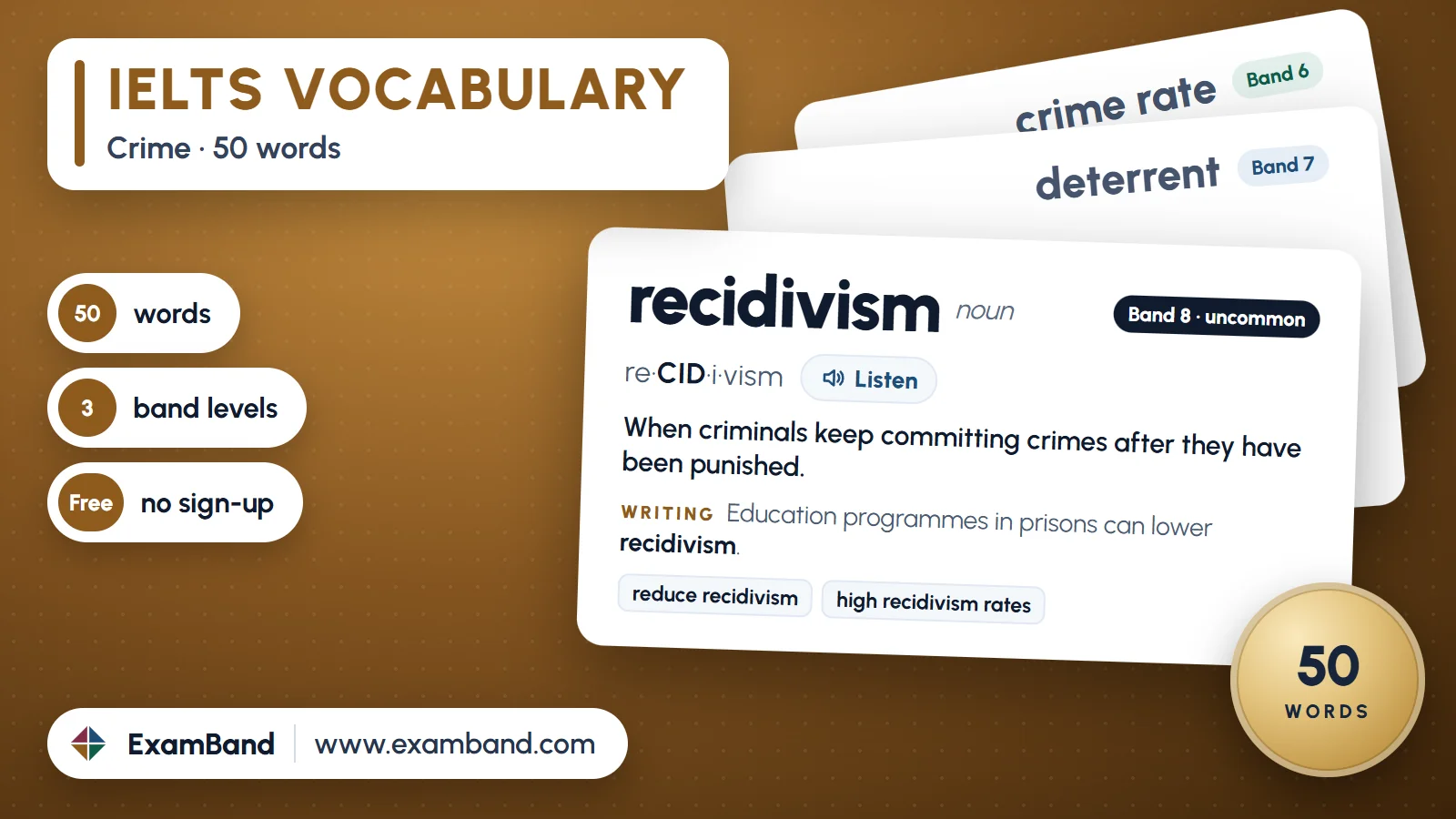
Questions about IELTS crime vocabulary
How do I learn IELTS crime vocabulary?
Learn about ten words a day. First, read the meaning, listen to the word and say it out loud with the right stress. Then test yourself with the quiz and the flashcards on this page. Finally, use five of the words in an essay and check it with our free Writing Checker.
Which words should I learn first?
Start with the band 6 words, because you need them to explain any idea clearly. After that, add the band 7 words. However, use the band 8 words only when you are sure of their meaning, because a rare word used wrongly can lower your score.
Are these official IELTS words?
No. IELTS has no official word list. Instead, our levels follow the words of the public IELTS band descriptors: band 7 asks for some “less common” words, and band 8 for “uncommon” words used with skill.