IELTS Money Vocabulary: 50 Words with Examples
These 50 words of IELTS money vocabulary come up again and again in Speaking Part 1 and Part 2, in Writing Task 2 essays on shopping and the economy, and in the Listening and Reading tests. Each word has a simple meaning, its sound, a band level, examples for Writing and Speaking, and the mistake to avoid.
50 words · free quiz and flashcards · updated October 2026
save up
save UP · phrasal verbTo keep money over time so that you can buy something later.Band 6 · everyday
Word family: savings (noun) · saver (noun)
Collocations
- save up for
- save up money
- save up to buy
Similar: put money aside
WritingYoung people need years to save up for a deposit on a home.
SpeakingI saved up for six months to buy my laptop.
Common mistake: Leaving out “for”. Say “save up for a car”.
afford
af·FORD · verbTo have enough money to pay for something.Band 6 · everyday
Word family: affordable (adjective) · affordability (noun)
Collocations
- can’t afford
- afford to buy
- afford a holiday
Similar: pay for
WritingMany families cannot afford healthy food.
SpeakingI can’t afford to eat out every day.
Common mistake: Using “afford” without “can”, “could” or “be able to”. Say “I can’t afford it”.
cash
CASH · nounMoney in coins and notes.Band 6 · everyday
Word family: cashless (adjective) · cashier (noun)
Collocations
- pay in cash
- a cash machine
- carry cash
Similar: notes and coins
WritingFewer shops now accept cash, which is a problem for older people.
SpeakingI hardly ever carry cash these days.
Common mistake: Saying “pay by cash”. Say “pay in cash” or “pay cash”, but “pay by card”.
credit card
CRED·it CARD · nounA plastic card that lets you buy things now and pay later.Band 6 · everyday
Word family: credit (noun)
Collocations
- pay by credit card
- credit card debt
- a credit card bill
WritingEasy access to credit cards encourages young people to overspend.
SpeakingI only use my credit card for big things, like flights.
Common mistake: Mixing it up with “debit card”. A credit card borrows money; a debit card uses your own money.
debt
DEBT · nounMoney that you owe to someone.Band 6 · everyday
Word family: debtor (noun) · indebted (adjective)
Collocations
- get into debt
- pay off a debt
- be in debt
Similar: money owed
WritingMany students finish university with large debts.
SpeakingI hate being in debt, so I pay my card off every month.
Common mistake: Saying “be on debt”. Say “be in debt”.
loan
LOAN · nounMoney that you borrow and must pay back, often with extra money.Band 6 · everyday
Word family: loan (verb)
Collocations
- take out a loan
- pay back a loan
- a bank loan
Similar: credit
WritingSmall loans can help poor families start their own businesses.
SpeakingI took out a loan to buy my first car.
Common mistake: Mixing up “lend” and “borrow”. The bank lends you money; you borrow it, and that money is a loan.
bank account
BANK ac·COUNT · nounAn arrangement with a bank to keep your money there.Band 6 · everyday
Collocations
- open a bank account
- a joint bank account
- a savings account
Similar: account
WritingMillions of people around the world still have no bank account.
SpeakingI opened my first bank account when I was sixteen.
Common mistake: Saying “a bank count”. The word is “account”.
bargain
BAR·gain · noun / verbSomething bought for much less than its usual price.Band 6 · everyday
Word family: bargaining (noun)
Collocations
- a real bargain
- bargain hunting
- bargain with someone
Similar: good deal
WritingOnline shopping makes it easy to compare prices and find a bargain.
SpeakingI got these trainers for half price; a real bargain.
Common mistake: Spelling it “bargin”. Write “bargain”, with -gain.
discount
DIS·count · nounAn amount taken off the usual price.Band 6 · everyday
Word family: discounted (adjective)
Collocations
- a 20% discount
- get a discount
- a student discount
Similar: reduction, sale
WritingSupermarkets use discounts to persuade shoppers to buy more.
SpeakingI always ask if there’s a student discount.
Common mistake: Saying “a discount of the price”. Say “a discount on something”.
pocket money
POCK·et MON·ey · nounMoney parents give to children, usually every week.Band 6 · everyday
Collocations
- get pocket money
- weekly pocket money
- save your pocket money
Similar: allowance
WritingGiving children pocket money can teach them how to manage money.
SpeakingI got a little pocket money every Friday as a kid.
Common mistake: Saying “pocket moneys”. It is uncountable: “some pocket money”.
income
IN·come · nounMoney that a person or family gets, for example from work.Band 6 · everyday
Collocations
- a high income
- a low income
- a source of income
Similar: earnings
WritingPeople on low incomes spend a bigger share of their money on food.
SpeakingMy main income comes from part-time teaching.
Common mistake: Saying “a big income”. Incomes are “high” or “low”.
earn
EARN · verbTo get money for the work you do.Band 6 · everyday
Word family: earnings (noun)
Collocations
- earn a living
- earn money
- earn a good salary
Similar: make money
WritingFootballers earn far more than doctors or nurses.
SpeakingI earn a bit of money by tutoring at weekends.
Common mistake: Mixing up “earn” and “win”. You earn money by working; you win money in a game or a prize.
wealthy
WEALTH·y · adjectiveHaving a lot of money or property.Band 6 · everyday
Word family: wealth (noun)
Collocations
- wealthy families
- a wealthy nation
- extremely wealthy
Similar: rich, well-off
WritingWealthy nations should do more to help poorer countries.
SpeakingMy best friend comes from quite a wealthy family.
Common mistake: Spelling it “welthy”. Write “wealthy”, with -ea-.
poverty
POV·er·ty · nounBeing very poor.Band 6 · everyday
Word family: poor (adjective)
Collocations
- live in poverty
- reduce poverty
- the poverty line
Similar: hardship
WritingEducation is one of the best ways to lift families out of poverty.
SpeakingThere’s still a lot of poverty in some parts of my country.
Common mistake: Saying “a poverty”. It is uncountable: “a lot of poverty”.
online shopping
ON·line SHOP·ping · nounBuying things on the internet.Band 6 · everyday
Word family: online shopper (noun)
Collocations
- the growth of online shopping
- do your online shopping
- online shopping sites
Similar: e-commerce
WritingOnline shopping has forced many high-street shops to close.
SpeakingI do almost all my online shopping on my phone.
Common mistake: Saying “shopping online things”. Say “I buy things online” or “online shopping”.
currency
CUR·ren·cy · nounThe type of money used in a country.Band 6 · everyday
Collocations
- local currency
- a strong currency
- exchange currency
WritingA weak currency makes imported goods more expensive.
SpeakingI always change some currency before I travel.
Common mistake: Saying “money” for the system. The type of money, like the euro, is a “currency”.
second-hand
sec·ond-HAND · adjective / adverbOwned by someone else before you.Band 6 · everyday
Collocations
- second-hand clothes
- buy second-hand
- a second-hand car
Similar: used, pre-owned
WritingBuying second-hand clothes saves money and reduces waste.
SpeakingMost of my furniture is second-hand.
Common mistake: Writing “second hand” without a hyphen before a noun. Write “a second-hand car”.
refund
RE·fund · noun / verbMoney given back to you, for example when you return something to a shop.Band 6 · everyday
Word family: refundable (adjective)
Collocations
- get a refund
- ask for a refund
- a full refund
Similar: repayment
WritingConsumers have a legal right to a refund if a product is faulty.
SpeakingThe shoes broke after a week, so I asked for a refund.
Common mistake: Saying “make a refund back”. Say “get a refund” or “give someone a refund”.
financial
fi·NAN·cial · adjectiveConnected with money.Band 7 · less common
Word family: finance (noun) · financially (adverb)
Collocations
- financial problems
- financial support
- financial security
Similar: monetary, economic
WritingMany students face serious financial pressure.
SpeakingGetting a job gave me some financial independence.
Common mistake: Spelling it “financal”. Write “financial”, with -cial.
inflation
in·FLA·tion · nounThe rise in prices over time.Band 7 · less common
Word family: inflate (verb) · inflationary (adjective)
Collocations
- high inflation
- the rate of inflation
- keep up with inflation
Similar: rising prices
WritingWhen wages do not keep up with inflation, families become poorer.
SpeakingInflation is so high that my rent went up again.
Common mistake: Saying “the prices are inflation”. Say “prices are rising” or “inflation is high”.
interest rate
IN·ter·est RATE · nounThe percentage a bank charges you for a loan, or pays you for saving.Band 7 · less common
Collocations
- high interest rates
- raise interest rates
- a low interest rate
WritingHigher interest rates make it more expensive to borrow money.
SpeakingThe interest rate on my savings is tiny.
Common mistake: Saying “interesting rate”. The term is “interest rate”.
savings
SAV·ings · noun, pluralMoney that you have kept, often in a bank.Band 7 · less common
Word family: save (verb) · saver (noun)
Collocations
- life savings
- spend your savings
- a savings account
Similar: nest egg
WritingRising prices are eating into people’s savings.
SpeakingI spent most of my savings on travelling.
Common mistake: Saying “a saving” for money in the bank. Use the plural: “my savings”.
invest
in·VEST · verbTo put money into something to make a profit or to improve it.Band 7 · less common
Word family: investment (noun) · investor (noun)
Collocations
- invest in
- invest money
- invest heavily
Similar: put money into
WritingGovernments should invest in public transport, not new motorways.
SpeakingI’d like to invest in property one day.
Common mistake: Leaving out “in”. Say “invest in education”.
wealth gap
WEALTH GAP · nounThe difference between the money that rich and poor people have.Band 7 · less common
Collocations
- widen the wealth gap
- close the wealth gap
- a growing wealth gap
Similar: inequality
WritingSome experts warn that technology could widen the wealth gap.
SpeakingThe wealth gap in big cities is really obvious.
Common mistake: Saying “the gap of wealth”. The term is “the wealth gap”, or “the gap between rich and poor”.
inequality
in·e·QUAL·i·ty · nounAn unfair difference between groups, for example in money or chances.Band 7 · less common
Word family: unequal (adjective) · equality (noun)
Collocations
- income inequality
- reduce inequality
- social inequality
Similar: disparity
WritingFree education is one way to reduce inequality.
SpeakingInequality is one of the biggest problems in my country.
Common mistake: Saying “unequality”. The noun is “inequality”; the adjective is “unequal”.
impulse buying
IM·pulse BUY·ing · nounBuying things suddenly without planning to.Band 7 · less common
Word family: impulsive (adjective) · impulse buy (noun)
Collocations
- encourage impulse buying
- avoid impulse buying
WritingShops place sweets near the tills to encourage impulse buying.
SpeakingOnline sales make impulse buying too easy for me.
Common mistake: Saying “impulsive buying”. The usual phrase is “impulse buying”.
splash out
splash OUT · phrasal verbTo spend a lot of money on something you enjoy.Band 7 · less common
Collocations
- splash out on
- splash out on a holiday
Similar: spend freely
WritingSome young people splash out on designer clothes they cannot afford.
SpeakingI splashed out on a nice dinner for my mum’s birthday.
Common mistake: Leaving out “on”. Say “splash out on something”.
cashless society
CASH·less so·CI·e·ty · nounA society where people pay by card or phone, not with coins and notes.Band 7 · less common
Word family: cash (noun)
Collocations
- move towards a cashless society
- the risks of a cashless society
WritingA cashless society could leave older people and the poor behind.
SpeakingMy country is becoming a cashless society; even street sellers take cards.
Common mistake: Writing “cash-less”. It is one word: “cashless”.
financial literacy
fi·NAN·cial LIT·er·a·cy · nounKnowing how to manage money well.Band 7 · less common
Word family: financially literate (adjective)
Collocations
- improve financial literacy
- teach financial literacy
- a lack of financial literacy
Similar: money skills
WritingSchools should teach financial literacy alongside maths.
SpeakingMy financial literacy was zero when I left school.
Common mistake: Saying “finance literacy”. Use the adjective: “financial literacy”.
prosperity
pros·PER·i·ty · nounSuccess and wealth.Band 7 · less common
Word family: prosperous (adjective) · prosper (verb)
Collocations
- economic prosperity
- a time of prosperity
- bring prosperity
Similar: wealth, success
WritingTrade has brought prosperity to many coastal cities.
SpeakingThe new factory brought prosperity to my town.
Common mistake: Spelling it “prosparity”. Write “prosperity”.
economic growth
ec·o·NOM·ic GROWTH · nounWhen a country produces more and becomes richer.Band 7 · less common
Word family: economy (noun) · economist (noun)
Collocations
- boost economic growth
- slow economic growth
- sustainable economic growth
Similar: development
WritingEconomic growth should not come at the cost of the environment.
SpeakingThere’s been a lot of economic growth in my city lately.
Common mistake: Mixing up “economic” and “economical”. “Economic” is about the economy; “economical” means saving money.
recession
re·CES·sion · nounA time when a country’s economy gets smaller and many people lose jobs.Band 7 · less common
Word family: recede (verb)
Collocations
- go into recession
- a global recession
- in a recession
Similar: downturn, slump
WritingYoung workers are often the first to lose their jobs in a recession.
SpeakingMy dad lost his job during the recession.
Common mistake: Spelling it “recesion”. Write “recession”, with double s.
consumer
con·SUM·er · nounA person who buys goods or services.Band 7 · less common
Word family: consume (verb) · consumption (noun)
Collocations
- consumer rights
- consumer spending
- protect consumers
Similar: buyer, shopper
WritingConsumers have the power to change how companies behave.
SpeakingAs a consumer, I try to buy from local shops.
Common mistake: Mixing it up with “customer”. A customer buys from one shop; a consumer is anyone who buys.
disposable income
dis·POS·a·ble IN·come · nounMoney left to spend after paying tax and bills.Band 7 · less common
Collocations
- high disposable income
- have little disposable income
Similar: spare cash
WritingRising rents leave young people with little disposable income.
SpeakingAfter rent, I don’t have much disposable income.
Common mistake: Mixing it up with “disposable” meaning thrown away after use. Here it means money free to spend.
luxury
LUX·u·ry · noun / adjectiveSomething expensive and pleasant that you do not really need.Band 7 · less common
Word family: luxurious (adjective)
Collocations
- luxury goods
- a luxury hotel
- can’t afford luxuries
Similar: extravagance
WritingLuxury goods are often used to show social status.
SpeakingA taxi is a luxury for me; I usually take the bus.
Common mistake: Spelling it “luxery”. Write “luxury”.
status symbol
STA·tus SYM·bol · nounSomething people own to show they are rich or important.Band 7 · less common
Collocations
- a status symbol
- seen as a status symbol
WritingFor many people, an expensive phone is a status symbol.
SpeakingDesigner bags are a big status symbol where I live.
Common mistake: Saying “a symbol status”. The phrase is “a status symbol”.
make ends meet
make ENDS MEET · phraseTo have just enough money to pay for what you need.Band 7 · less common
Collocations
- struggle to make ends meet
- barely make ends meet
Similar: get by
WritingMany workers on low wages struggle to make ends meet.
SpeakingWhen I was a student, I could barely make ends meet.
Common mistake: Saying “make end meets”. The phrase is “make ends meet”.
live beyond your means
live be·YOND your MEANS · phraseTo spend more money than you have.Band 7 · less common
Collocations
- live beyond your means
- live within your means
Similar: overspend
WritingEasy credit encourages people to live beyond their means.
SpeakingI try not to live beyond my means, but it isn’t easy.
Common mistake: Saying “live over your means”. The phrase is “beyond your means”, or “within your means”.
frugal
FRU·gal · adjectiveCareful to spend very little money.Band 8 · uncommon
Word family: frugality (noun)
Collocations
- a frugal lifestyle
- live frugally
- a frugal meal
Similar: thrifty, economical
WritingOlder generations tend to be more frugal than young people.
SpeakingMy grandparents are very frugal; they never waste anything.
Common mistake: Thinking it means poor. It means careful with money, even if you are rich.
affluent
AF·flu·ent · adjectiveRich, with a comfortable life.Band 8 · uncommon
Word family: affluence (noun)
Collocations
- affluent families
- an affluent area
- affluent societies
Similar: wealthy, well-off
WritingChildren in affluent areas often have better schools.
SpeakingI grew up in quite an affluent neighbourhood.
Common mistake: Saying “af-FLU-ent”. The stress is at the start: “AF-flu-ent”.
extravagant
ex·TRAV·a·gant · adjectiveSpending far too much money.Band 8 · uncommon
Word family: extravagance (noun)
Collocations
- extravagant spending
- an extravagant lifestyle
- an extravagant gift
Similar: lavish, wasteful
WritingSome weddings have become very extravagant.
SpeakingBuying a new car every year seems extravagant to me.
Common mistake: Spelling it “extravagent”. Write “extravagant”, with -ant.
exorbitant
ex·OR·bi·tant · adjectiveMuch too expensive.Band 8 · uncommon
Collocations
- exorbitant prices
- exorbitant fees
- an exorbitant cost
Similar: overpriced, excessive
WritingExorbitant rents force many young people to live with their parents.
SpeakingConcert tickets are exorbitant these days.
Common mistake: Spelling it “exhorbitant”. There is no h: “exorbitant”.
prudent
PRU·dent · adjectiveCareful and sensible, especially with money.Band 8 · uncommon
Word family: prudence (noun) · prudently (adverb)
Collocations
- a prudent decision
- prudent with money
- financially prudent
Similar: sensible, careful
WritingIt is prudent to save at least some of your income every month.
SpeakingMy dad is very prudent with money.
Common mistake: Mixing it up with “prude” (someone easily shocked). Prudent means careful and wise.
squander
SQUAN·der · verbTo waste money or chances in a foolish way.Band 8 · uncommon
Collocations
- squander money
- squander an opportunity
- squander resources
Similar: waste, fritter away
WritingSome lottery winners squander their prize within a few years.
SpeakingI squandered most of my first salary on clothes.
Common mistake: Leaving out the object. Say “squander money” or “squander a chance”.
windfall
WIND·fall · nounMoney you get that you did not expect.Band 8 · uncommon
Collocations
- an unexpected windfall
- a windfall tax
- a financial windfall
Similar: bonus
WritingSome governments put a windfall tax on unusually large profits.
SpeakingI got a small windfall when my aunt sent me money.
Common mistake: Writing “wind fall” as two words. It is one word: “windfall”.
philanthropy
phi·LAN·thro·py · nounGiving money to help other people.Band 8 · uncommon
Word family: philanthropist (noun) · philanthropic (adjective)
Collocations
- private philanthropy
- a life of philanthropy
Similar: charity, generosity
WritingPrivate philanthropy cannot replace a fair tax system.
SpeakingI admire rich people who give their money away through philanthropy.
Common mistake: Mixing it up with “philosophy”. Philanthropy is giving money to good causes.
economic downturn
ec·o·NOM·ic DOWN·turn · nounA period when the economy gets weaker.Band 8 · uncommon
Collocations
- during an economic downturn
- a sharp economic downturn
Similar: recession, slump
WritingIn an economic downturn, people cut spending on luxuries first.
SpeakingLots of shops closed during the economic downturn.
Common mistake: Writing “down turn” as two words. It is one word: “downturn”.
socio-economic
so·ci·o-ec·o·NOM·ic · adjectiveConnected with both money and social class.Band 8 · uncommon
Collocations
- socio-economic background
- socio-economic status
- socio-economic factors
Similar: class-related
WritingPupils from poor socio-economic backgrounds are less likely to go to university.
SpeakingMy classmates came from very different socio-economic backgrounds.
Common mistake: Using it about money only. It is about money and social position together.
cost-effective
cost-ef·FEC·tive · adjectiveGiving good results for the money spent.Band 8 · uncommon
Word family: cost-effectiveness (noun)
Collocations
- a cost-effective solution
- highly cost-effective
- a cost-effective way to
Similar: economical, efficient
WritingPrevention is far more cost-effective than treatment.
SpeakingCycling is the most cost-effective way to get around.
Common mistake: Writing “cost effective” without a hyphen before a noun. Write “a cost-effective way”.
destitute
DES·ti·tute · adjectiveExtremely poor, without money, food or a home.Band 8 · uncommon
Word family: destitution (noun)
Collocations
- left destitute
- destitute families
- completely destitute
Similar: penniless, impoverished
WritingWithout a welfare system, people who lose their jobs can quickly become destitute.
SpeakingThe war left many families in my grandparents’ village destitute.
Common mistake: Using it for someone who is a bit short of money. It means having almost nothing.
Money vocabulary in IELTS Writing and Speaking
Here is how IELTS money vocabulary can come up in the test, with our own practice questions. So, try to answer them with words from the list above.
Writing Task 2
Some people think children should be taught how to manage money at school. To what extent do you agree or disagree?
Speaking
- Part 1: Do you prefer paying by card or with cash?
- Part 1: Did you get pocket money as a child?
- Part 2: Describe something expensive that you saved up to buy.
- Part 3: Why do some people find it hard to save money?
- Part 3: Will cash disappear in the future?
Our free tests on this topic
- Reading Practice Test 10, Passage 3when paying people to do the right thing backfires
- Reading Practice Test 6, Passage 3whether more choice makes shoppers less happy
- Speaking Practice Test 5, Part 2something you bought that you were pleased with
- Listening Practice Test 7, Part 3two students planning a business for a café
A model paragraph with IELTS money vocabulary
Many young adults leave school without basic financial literacy. They take out loans they do not understand and use credit cards to splash out on things they cannot afford. Teaching children to plan and save up would help them avoid debt and make ends meet later in life.
Practise this IELTS money vocabulary
Take the 10-question quiz on this IELTS money vocabulary, or go through every word with the flashcards.
Question 1 of 10
Which word means “money in coins and notes”?
Now use the words
Write a Task 2 essay with five of these words. Then our free Writing Checker gives you a band for vocabulary and for the other three criteria.
Open the Writing Checker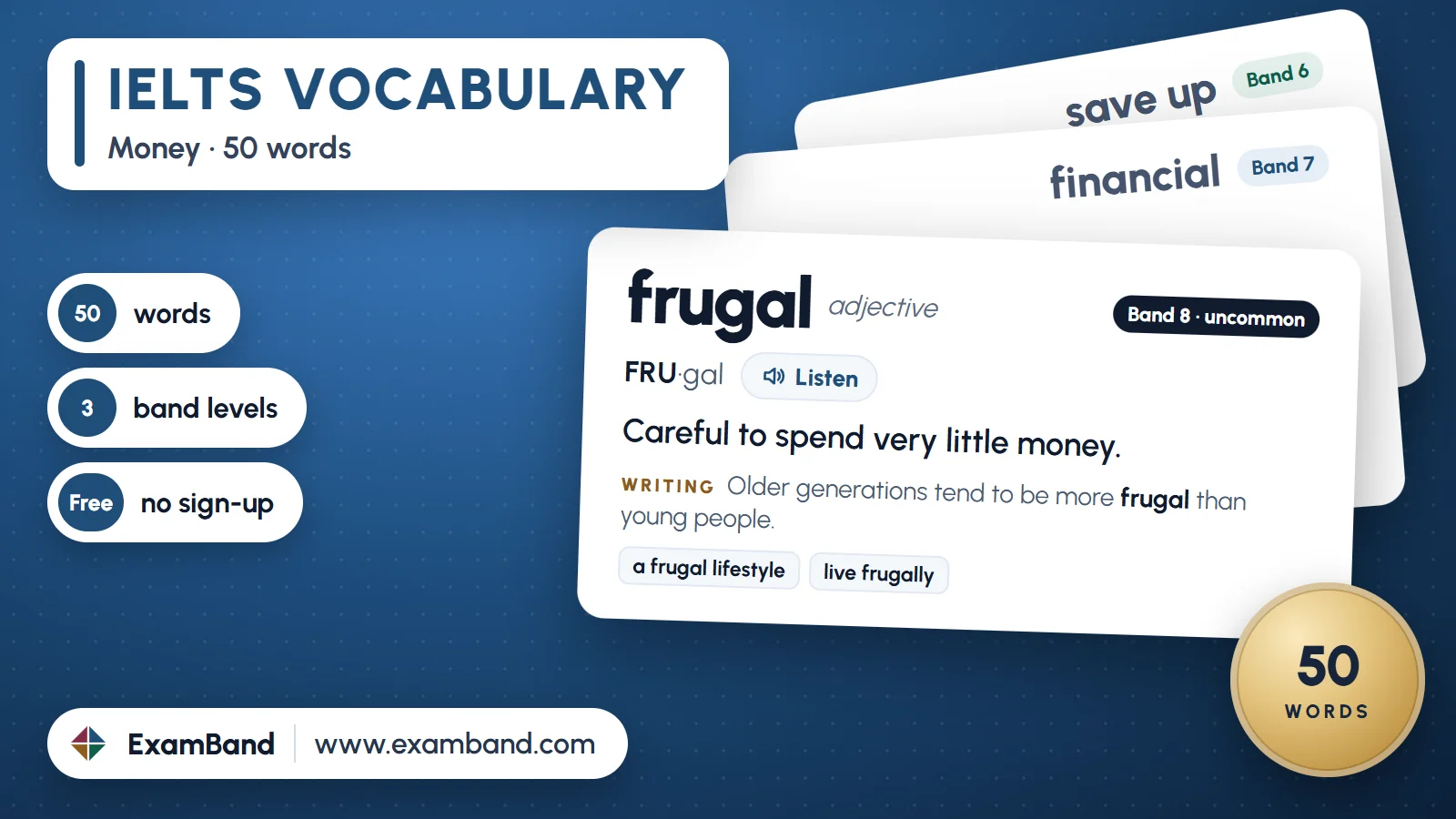
Questions about IELTS money vocabulary
How do I learn IELTS money vocabulary?
Learn about ten words a day. First, read the meaning, listen to the word and say it out loud with the right stress. Then test yourself with the quiz and the flashcards on this page. Finally, use five of the words in an essay and check it with our free Writing Checker.
Which words should I learn first?
Start with the band 6 words, because you need them to explain any idea clearly. After that, add the band 7 words. However, use the band 8 words only when you are sure of their meaning, because a rare word used wrongly can lower your score.
Are these official IELTS words?
No. IELTS has no official word list. Instead, our levels follow the words of the public IELTS band descriptors: band 7 asks for some “less common” words, and band 8 for “uncommon” words used with skill.