IELTS Transport Vocabulary: 50 Words with Examples
These 50 words of IELTS transport vocabulary come up again and again in Writing Task 2 essays on traffic and cities, in Speaking Part 1 questions about getting around, and in the Listening test. Each word has a simple meaning, its sound, a band level, examples for Writing and Speaking, and the mistake to avoid.
50 words · free quiz and flashcards · updated October 2026
public transport
PUB·lic TRANS·port · nounBuses, trains and other vehicles that everyone can pay to use.Band 6 · everyday
Collocations
- use public transport
- invest in public transport
- free public transport
Similar: mass transit
WritingCheap, reliable public transport is the best way to reduce traffic.
SpeakingI use public transport every day; I don’t even have a car.
Common mistake: Saying “public transports”. It is uncountable: “public transport is”.
traffic jam
TRAF·fic JAM · nounA long line of vehicles that cannot move or move very slowly.Band 6 · everyday
Collocations
- be stuck in a traffic jam
- cause traffic jams
- a huge traffic jam
Similar: tailback, hold-up
WritingLong traffic jams waste time and increase air pollution.
SpeakingI was stuck in a traffic jam for two hours yesterday.
Common mistake: Saying “a traffic” for a jam. Say “a traffic jam”, or “heavy traffic”.
commute
com·MUTE · verb / nounTo travel regularly between home and work; the journey itself.Band 6 · everyday
Word family: commuter (noun)
Collocations
- a long commute
- commute to work
- a daily commute
Similar: journey to work
WritingLong commutes leave workers tired and stressed.
SpeakingMy commute takes about forty minutes by train.
Common mistake: Saying “I commute my car”. You commute “by car” or “by train”.
rush hour
RUSH HOUR · nounThe busy time when most people travel to or from work.Band 6 · everyday
Collocations
- during the rush hour
- rush-hour traffic
- avoid the rush hour
Similar: peak time
WritingFlexible working hours could reduce crowding during the rush hour.
SpeakingI try to avoid the rush hour because the trains are packed.
Common mistake: Saying “rush times”. The phrase is “the rush hour”, even when it lasts longer than an hour.
passenger
PAS·sen·ger · nounA person who travels in a vehicle but does not drive it.Band 6 · everyday
Collocations
- passenger numbers
- bus passengers
- passenger safety
Similar: traveller, rider
WritingPassenger numbers on city trains have risen sharply.
SpeakingAs a passenger, I always fall asleep in the car.
Common mistake: Spelling it “passanger”. Write “passenger”, with -en-.
vehicle
VE·hi·cle · nounA machine that carries people or goods, like a car, bus or lorry.Band 6 · everyday
Word family: vehicular (adjective)
Collocations
- motor vehicles
- electric vehicles
- heavy vehicles
Similar: car, automobile
WritingHeavy vehicles should be kept out of narrow city streets.
SpeakingI don’t own a vehicle; I just cycle everywhere.
Common mistake: Saying the h. In British English it is usually silent: “VEE-uh-kl”.
cycle lane
CY·cle LANE · nounA part of the road only for bicycles.Band 6 · everyday
Word family: cyclist (noun) · cycling (noun)
Collocations
- build cycle lanes
- a separate cycle lane
- protected cycle lanes
Similar: bike lane
WritingSafe cycle lanes would encourage more people to cycle to work.
SpeakingThere’s a new cycle lane near my house, so I ride more now.
Common mistake: Saying “bicycle road”. The British term is “cycle lane”; Americans say “bike lane”.
fare
FARE · nounThe money you pay to travel on a bus, train or plane.Band 6 · everyday
Collocations
- bus fares
- train fares
- raise fares
Similar: ticket price
WritingCheaper fares would persuade more people to leave their cars at home.
SpeakingTrain fares in my country are really expensive.
Common mistake: Mixing it up with “fee” or “fair”. You pay a “fare” to travel; a “fee” for a service.
speed limit
SPEED LIM·it · nounThe fastest speed that is allowed on a road.Band 6 · everyday
Collocations
- break the speed limit
- lower the speed limit
- a 30 mph speed limit
WritingLower speed limits near schools save children’s lives.
SpeakingLots of people drive over the speed limit on my street.
Common mistake: Saying “speed limitation”. The term is “speed limit”.
road safety
ROAD SAFE·ty · nounKeeping people safe from accidents on roads.Band 6 · everyday
Word family: safe (adjective)
Collocations
- improve road safety
- road safety campaigns
- teach road safety
Similar: traffic safety
WritingChildren should be taught road safety from an early age.
SpeakingAt school we had lessons about road safety.
Common mistake: Saying “road security”. The term is “road safety”.
railway
RAIL·way · nounA track for trains, or the system of trains in a country.Band 6 · everyday
Word family: rail (noun)
Collocations
- a railway station
- a railway line
- build a railway
Similar: rail, railroad
WritingHigh-speed railways can replace many short flights.
SpeakingThere’s a beautiful old railway station in my town.
Common mistake: Writing “rail way” as two words. It is one word: “railway”; Americans say “railroad”.
electric car
e·LEC·tric CAR · nounA car that runs on electricity, not petrol.Band 6 · everyday
Word family: electricity (noun)
Collocations
- drive an electric car
- charge an electric car
- switch to electric cars
Similar: EV
WritingElectric cars produce no exhaust fumes, but their batteries need rare metals.
SpeakingMy dad just bought an electric car, and it’s so quiet.
Common mistake: Saying “electrical car”. Use “electric car”; “electrical” is for things like electrical goods.
pedestrian
pe·DES·tri·an · nounA person walking in the street.Band 6 · everyday
Word family: pedestrianise (verb)
Collocations
- a pedestrian crossing
- pedestrian safety
- a pedestrian zone
Similar: walker
WritingWider pavements would make city centres safer for pedestrians.
SpeakingDrivers here don’t always stop for pedestrians.
Common mistake: Spelling it “pedestrain”. Write “pedestrian”, with -ian.
parking space
PARK·ing SPACE · nounA place where you can leave a car.Band 6 · everyday
Word family: park (verb)
Collocations
- find a parking space
- a lack of parking spaces
- a reserved parking space
Similar: parking spot
WritingRemoving parking spaces in the centre discourages people from driving.
SpeakingIt takes ages to find a parking space near my office.
Common mistake: Saying “a parking” for one space. Say “a parking space”; “parking” is uncountable.
the underground
the UN·der·ground · nounA railway that runs under a city; in London, “the Tube”.Band 6 · everyday
Collocations
- take the underground
- an underground station
- the London Underground
Similar: metro, the Tube
WritingBuilding the underground was expensive, but it transformed the city.
SpeakingI take the underground because it’s faster than the bus.
Common mistake: Saying “the subway” in Britain. In British English, a subway is a path under a road; the train is “the underground”.
motorway
MO·tor·way · nounA wide road for fast traffic between cities.Band 6 · everyday
Word family: motorist (noun)
Collocations
- build a motorway
- motorway traffic
- on the motorway
Similar: highway, freeway
WritingBuilding more motorways often just leads to more traffic.
SpeakingThe motorway to the capital is always busy on Fridays.
Common mistake: Using “highway” in a British essay. In the UK, the word is “motorway”.
road accident
ROAD AC·ci·dent · nounA crash involving vehicles on a road.Band 6 · everyday
Word family: accidental (adjective)
Collocations
- be injured in a road accident
- prevent road accidents
- a serious road accident
Similar: crash, collision
WritingMost road accidents are caused by human error.
SpeakingMy cousin was hurt in a road accident, but he’s fine now.
Common mistake: Saying “an accident happened me”. Say “I had an accident” or “I was in an accident”.
get around
get a·ROUND · phrasal verbTo travel from place to place.Band 6 · everyday
Collocations
- get around the city
- easy to get around
- get around by bike
Similar: travel, move about
WritingOlder people need affordable ways to get around their town.
SpeakingThe easiest way to get around my city is by scooter.
Common mistake: Saying “go around” for travelling in a town. The usual phrase is “get around”.
carpool
CAR·pool · verb / nounTo share a car with others going the same way.Band 7 · less common
Word family: carpooling (noun)
Collocations
- carpool to work
- a carpool lane
- organise a carpool
Similar: car-share, lift-share
WritingSpecial lanes for drivers who carpool can cut traffic.
SpeakingI carpool with two colleagues, so we share the petrol money.
Common mistake: Writing “car pool” as two words for the verb. It is usually one word: “carpool”.
high-speed rail
high-SPEED RAIL · nounTrains that travel much faster than normal trains, on special tracks.Band 7 · less common
Collocations
- a high-speed rail link
- invest in high-speed rail
- a high-speed rail network
Similar: bullet train
WritingHigh-speed rail is a cleaner alternative to short domestic flights.
SpeakingI took a high-speed rail trip across Spain and loved it.
Common mistake: Writing “high speed rail” with no hyphen. Write “high-speed rail”.
gridlock
GRID·lock · nounA traffic jam so bad that nothing can move.Band 7 · less common
Word family: gridlocked (adjective)
Collocations
- cause gridlock
- total gridlock
- gridlocked streets
Similar: standstill, traffic jam
WritingWithout better public transport, the city will face total gridlock.
SpeakingAfter the match, the whole area was in gridlock.
Common mistake: Saying “a gridlock of cars”. It is usually uncountable: “total gridlock”.
reliable
re·LI·a·ble · adjectiveAble to be trusted to work well or arrive on time.Band 7 · less common
Word family: reliability (noun) · rely (verb)
Collocations
- a reliable service
- reliable public transport
- highly reliable
Similar: dependable, punctual
WritingPeople will only leave their cars if buses are reliable.
SpeakingThe trains here are really reliable; they’re never late.
Common mistake: Spelling it “relyable”. Write “reliable”.
congestion charge
con·GES·tion CHARGE · nounMoney drivers must pay to drive into a busy city centre.Band 7 · less common
Collocations
- introduce a congestion charge
- pay the congestion charge
Similar: road pricing, toll
WritingLondon’s congestion charge reduced traffic in the city centre.
SpeakingIf they bring in a congestion charge, I’ll start taking the bus.
Common mistake: Saying “congestion fee” as the name. The usual British term is “congestion charge”.
fuel-efficient
fu·el-ef·FI·cient · adjectiveUsing little fuel for the distance travelled.Band 7 · less common
Word family: fuel efficiency (noun)
Collocations
- a fuel-efficient car
- more fuel-efficient
- fuel-efficient engines
Similar: economical
WritingTaxes could encourage people to buy smaller, fuel-efficient cars.
SpeakingMy new car is much more fuel-efficient than the old one.
Common mistake: Writing “fuel efficient” with no hyphen before a noun. Write “a fuel-efficient car”.
car-free
car-FREE · adjectiveWithout cars.Band 7 · less common
Collocations
- a car-free zone
- car-free days
- car-free city centres
Similar: pedestrianised
WritingCar-free city centres are quieter, cleaner and safer.
SpeakingMy town has a car-free day once a month.
Common mistake: Writing “car free” with no hyphen before a noun. Write “a car-free zone”.
self-driving car
self-DRIV·ing CAR · nounA car that can drive itself without a human driver.Band 7 · less common
Collocations
- test self-driving cars
- the rise of self-driving cars
Similar: driverless car, autonomous vehicle
WritingSelf-driving cars could reduce accidents caused by tired drivers.
SpeakingI don’t think I’d trust a self-driving car yet.
Common mistake: Saying “self-drive car”. The usual term is “self-driving car”.
air travel
AIR TRAV·el · nounTravelling by plane.Band 7 · less common
Collocations
- the growth of air travel
- cheap air travel
- reduce air travel
Similar: flying
WritingCheap air travel has a heavy cost for the climate.
SpeakingAir travel makes me nervous, so I prefer trains.
Common mistake: Saying “air travels”. It is uncountable: “air travel”.
freight
FREIGHT · nounGoods carried by lorries, trains, ships or planes.Band 7 · less common
Word family: freighter (noun)
Collocations
- rail freight
- freight transport
- carry freight
Similar: cargo, goods
WritingMoving more freight by rail would take lorries off the roads.
SpeakingMy uncle works for a freight company at the port.
Common mistake: Saying the gh. It is silent: “frayt”.
journey time
JOUR·ney TIME · nounHow long a trip takes.Band 7 · less common
Collocations
- cut journey times
- reduce journey time
- average journey time
Similar: travel time
WritingThe new line will cut journey times between the two cities by half.
SpeakingMy journey time to work is about half an hour.
Common mistake: Saying “trip time” in formal writing. Use “journey time”.
overcrowded
o·ver·CROWD·ed · adjectiveWith too many people in it.Band 7 · less common
Word family: overcrowding (noun)
Collocations
- overcrowded trains
- overcrowded buses
- severely overcrowded
Similar: packed, crammed
WritingOvercrowded trains put people off using public transport.
SpeakingThe buses are so overcrowded in the morning that I walk instead.
Common mistake: Writing “over crowded” as two words. It is one word: “overcrowded”.
transport network
TRANS·port NET·work · nounAll the roads, railways and routes in an area, and how they connect.Band 7 · less common
Collocations
- an efficient transport network
- expand the transport network
- an integrated transport network
Similar: transport system
WritingA city’s economy depends on a good transport network.
SpeakingThe transport network in my city is great; you can get anywhere.
Common mistake: Saying “transportation net”. Say “transport network” (UK) or “transportation network” (US).
toll
TOLL · nounMoney you pay to use a road or bridge.Band 7 · less common
Collocations
- pay a toll
- a toll road
- toll charges
Similar: charge, fee
WritingRoad tolls help to pay for new bridges and tunnels.
SpeakingThere’s a toll on the bridge into the city.
Common mistake: Mixing it up with “tool”. A toll is a payment; a tool is something you use to make or fix things.
low-emission zone
low-e·MIS·sion ZONE · nounAn area of a city where the most polluting vehicles must pay or are not allowed.Band 7 · less common
Word family: emission (noun)
Collocations
- introduce a low-emission zone
- enter the low-emission zone
Similar: clean air zone
WritingLow-emission zones have improved air quality in many European cities.
SpeakingMy old car can’t enter the low-emission zone, so I take the bus.
Common mistake: Writing “low emission zone” with no hyphen. Write “low-emission zone”.
accessible
ac·CES·si·ble · adjectiveEasy to reach, enter or use, including for disabled people.Band 7 · less common
Word family: access (noun, verb) · accessibility (noun)
Collocations
- accessible to all
- wheelchair accessible
- easily accessible
Similar: reachable, available
WritingAll new stations should be fully accessible to wheelchair users.
SpeakingThe old station isn’t very accessible; there are no lifts.
Common mistake: Spelling it “accessable”. Write “accessible”, with -ible.
ride-hailing
RIDE-hail·ing · noun / adjectiveBooking a car and driver through a phone app.Band 7 · less common
Collocations
- ride-hailing apps
- ride-hailing services
- ride-hailing drivers
Similar: taxi app
WritingRide-hailing apps have taken many customers from traditional taxis.
SpeakingI use a ride-hailing app when I come home late.
Common mistake: Saying “ride-calling”. The term is “ride-hailing”.
cycle-friendly
CY·cle-friend·ly · adjectiveSafe and easy for people on bicycles.Band 7 · less common
Collocations
- a cycle-friendly city
- make streets cycle-friendly
Similar: bike-friendly
WritingAmsterdam shows how a cycle-friendly city can work.
SpeakingMy town isn’t very cycle-friendly; there are no bike lanes.
Common mistake: Writing “cycle friendly” with no hyphen before a noun. Write “a cycle-friendly city”.
roadworks
ROAD·works · noun, pluralRepairs being done to a road, which often cause delays.Band 7 · less common
Collocations
- delays due to roadworks
- major roadworks
- roadworks on the motorway
Similar: road repairs
WritingConstant roadworks make journeys in the city unpredictable.
SpeakingThere are roadworks everywhere in my city at the moment.
Common mistake: Writing “road works” as two words. In British English, it is one word: “roadworks”.
car dependency
CAR de·PEND·en·cy · nounRelying too much on cars for travel.Band 7 · less common
Word family: car-dependent (adjective)
Collocations
- reduce car dependency
- high car dependency
Similar: reliance on cars
WritingPoor bus services lead to car dependency in rural areas.
SpeakingWhere I grew up, car dependency was normal; there were no buses.
Common mistake: Saying “car depending”. Use the noun: “car dependency”.
bottleneck
BOT·tle·neck · nounA narrow place where traffic slows down; any point that causes delays.Band 8 · uncommon
Collocations
- create a bottleneck
- a traffic bottleneck
- ease bottlenecks
Similar: choke point
WritingWidening one bottleneck often just moves the traffic to the next one.
SpeakingThe bridge is a real bottleneck; it’s always jammed.
Common mistake: Writing “bottle neck” as two words. It is one word: “bottleneck”.
car-centric
car-CEN·tric · adjectivePlanned mainly for cars, not for people walking or cycling.Band 8 · uncommon
Collocations
- car-centric planning
- a car-centric city
- car-centric suburbs
Similar: car-dominated
WritingCar-centric planning has made many suburbs hard to live in without a car.
SpeakingMy city is so car-centric that walking anywhere feels dangerous.
Common mistake: Writing “car centric” with no hyphen. Write “car-centric”.
urban mobility
UR·ban mo·BIL·i·ty · nounHow people move around a city.Band 8 · uncommon
Word family: mobile (adjective)
Collocations
- sustainable urban mobility
- improve urban mobility
- the future of urban mobility
Similar: city transport
WritingE-scooters are changing urban mobility in many cities.
SpeakingUrban mobility here has improved a lot since the new tram line.
Common mistake: Saying “urban movement” for transport. The planning term is “urban mobility”.
punctuality
punc·tu·AL·i·ty · nounBeing on time.Band 8 · uncommon
Word family: punctual (adjective)
Collocations
- improve punctuality
- train punctuality
- poor punctuality
Similar: timeliness
WritingPoor punctuality makes passengers lose trust in the railways.
SpeakingPunctuality is a big deal in my culture; being late is rude.
Common mistake: Using “punctual” as a noun. The noun is “punctuality”; the adjective is “punctual”.
connectivity
con·nec·TIV·i·ty · nounHow well places are linked to each other.Band 8 · uncommon
Word family: connect (verb) · connection (noun)
Collocations
- improve connectivity
- rural connectivity
- regional connectivity
Similar: links, access
WritingBetter rail connectivity could bring jobs to poorer regions.
SpeakingConnectivity is bad in my village; there’s one bus a day.
Common mistake: Using it only for the internet. In transport, it means how well places are linked.
seamless
SEAM·less · adjectiveSmooth, with no problems or breaks between parts.Band 8 · uncommon
Word family: seamlessly (adverb)
Collocations
- a seamless journey
- seamless connections
- seamless travel
Similar: smooth, effortless
WritingOne ticket for all buses and trains makes travel seamless.
SpeakingChanging trains was seamless; the next one was waiting.
Common mistake: Spelling it “seemless”. Write “seamless”, from “seam”.
electrification
e·lec·tri·fi·CA·tion · nounChanging a railway or vehicles to run on electricity.Band 8 · uncommon
Word family: electrify (verb)
Collocations
- rail electrification
- the electrification of transport
WritingThe electrification of buses has cut noise and pollution in city centres.
SpeakingThe electrification of our railway line made trains much faster.
Common mistake: Spelling it “electrication”. Write “electrification”.
dilapidated
di·LAP·i·dat·ed · adjectiveOld and in very bad condition.Band 8 · uncommon
Word family: dilapidation (noun)
Collocations
- dilapidated stations
- dilapidated roads
- in a dilapidated state
Similar: run-down, decrepit
WritingDilapidated stations put people off using the trains.
SpeakingThe bus station in my town is really dilapidated.
Common mistake: Spelling it “delapidated”. Write “dilapidated”, with di-.
road rage
ROAD RAGE · nounSudden anger and aggressive behaviour from a driver.Band 8 · uncommon
Collocations
- an incident of road rage
- a road rage attack
Similar: aggressive driving
WritingLong delays and stress can lead to road rage.
SpeakingI saw a terrible case of road rage on my way to work.
Common mistake: Saying “road angry”. The noun phrase is “road rage”.
behind the wheel
be·HIND the WHEEL · phraseDriving a vehicle.Band 8 · uncommon
Collocations
- get behind the wheel
- time behind the wheel
- tired behind the wheel
Similar: driving
WritingYoung drivers should spend more hours behind the wheel before taking their test.
SpeakingI feel nervous behind the wheel in heavy traffic.
Common mistake: Saying “behind the steering”. The phrase is “behind the wheel”.
fleet
FLEET · nounA group of vehicles owned by one company or city.Band 8 · uncommon
Collocations
- a fleet of buses
- an electric fleet
- the bus fleet
Similar: group, set
WritingThe city plans to replace its whole bus fleet with electric buses.
SpeakingOur local taxi company has a fleet of electric cars now.
Common mistake: Using it only for ships. It also means a group of buses, cars or planes.
overhaul
o·ver·HAUL · verb / nounTo change or repair a system completely to make it work better.Band 8 · uncommon
Collocations
- overhaul the transport system
- a complete overhaul
- in need of an overhaul
Similar: reform, revamp
WritingThe rail network needs a complete overhaul, not small repairs.
SpeakingOur bus routes got a total overhaul last year, and they’re better now.
Common mistake: Mixing it up with “overall”. To overhaul is to repair or change completely.
Transport vocabulary in IELTS Writing and Speaking
Here is how IELTS transport vocabulary can come up in the test, with our own practice questions. So, try to answer them with words from the list above.
Writing Task 2
In many cities, traffic is getting worse every year. What are the causes of this problem, and what can governments do to solve it?
Speaking
- Part 1: How do you usually get to work or school?
- Part 1: Is public transport good where you live?
- Part 2: Describe a long journey you went on.
- Part 3: Should public transport be free?
- Part 3: Will self-driving cars make our roads safer?
Our free tests on this topic
- Writing Practice Test 7, Task 2whether private cars should be banned from city centres
- Listening Practice Test 4, Part 3a survey on how people travel to work
- Listening Practice Test 10, Part 2a tour of a new airport terminal
- Speaking Practice Test 5, Part 1questions about getting around
A model paragraph with IELTS transport vocabulary
Cities can only reduce traffic jams if public transport becomes a real alternative to the car. Trains and buses must be reliable, cheap and accessible to everyone. At the same time, a congestion charge and more cycle lanes would persuade drivers to leave their cars at home during the rush hour.
Practise this IELTS transport vocabulary
Take the 10-question quiz on this IELTS transport vocabulary, or go through every word with the flashcards.
Question 1 of 10
Which word means “to travel regularly between home and work; the journey itself”?
Now use the words
Write a Task 2 essay with five of these words. Then our free Writing Checker gives you a band for vocabulary and for the other three criteria.
Open the Writing Checker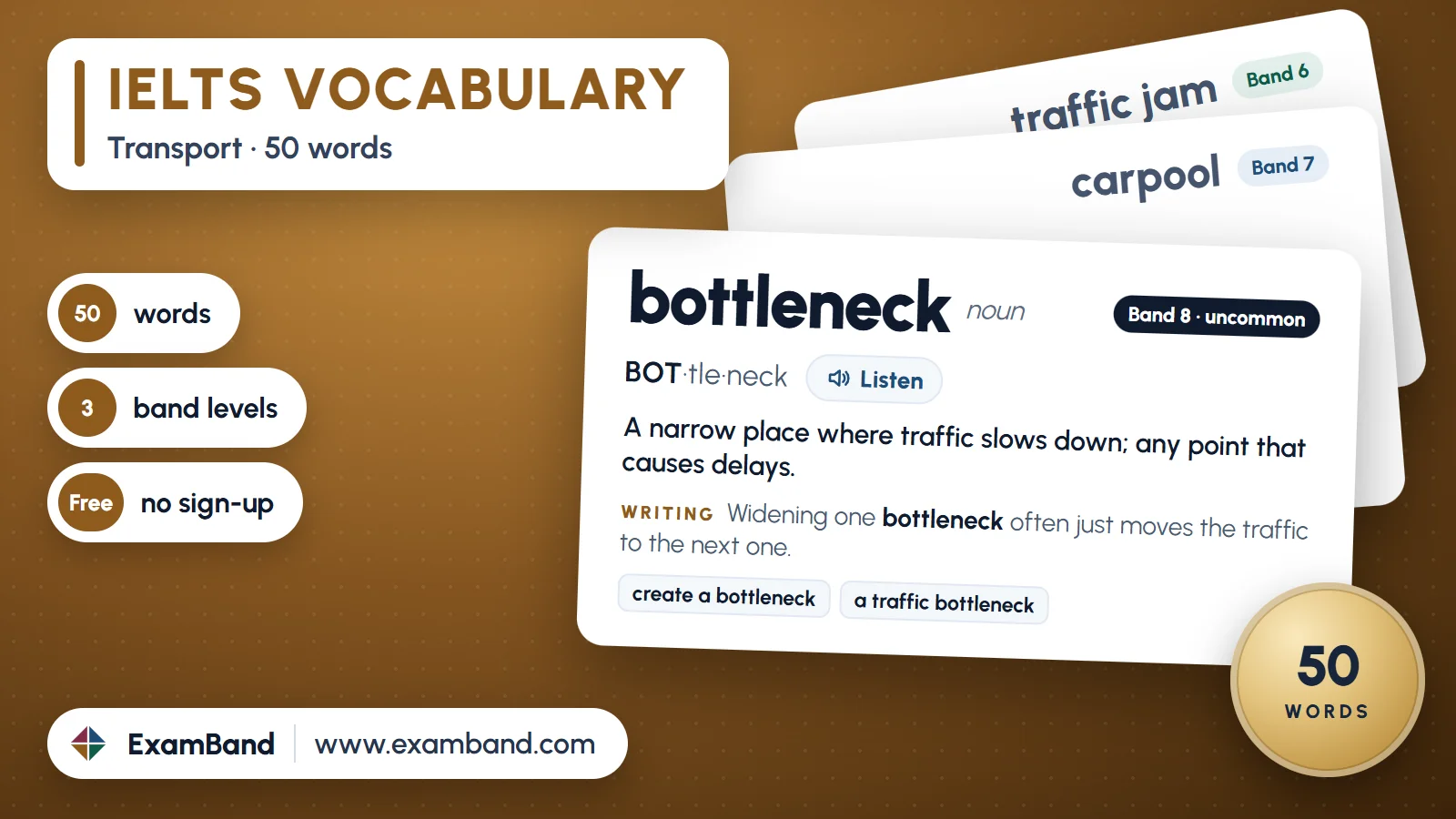
Questions about IELTS transport vocabulary
How do I learn IELTS transport vocabulary?
Learn about ten words a day. First, read the meaning, listen to the word and say it out loud with the right stress. Then test yourself with the quiz and the flashcards on this page. Finally, use five of the words in an essay and check it with our free Writing Checker.
Which words should I learn first?
Start with the band 6 words, because you need them to explain any idea clearly. After that, add the band 7 words. However, use the band 8 words only when you are sure of their meaning, because a rare word used wrongly can lower your score.
Are these official IELTS words?
No. IELTS has no official word list. Instead, our levels follow the words of the public IELTS band descriptors: band 7 asks for some “less common” words, and band 8 for “uncommon” words used with skill.