IELTS Technology Vocabulary: 50 Words with Examples
This list of IELTS technology vocabulary helps you write and talk about phones, the internet, artificial intelligence and the future of work. Each word has a simple meaning, its sound, a band level, examples for Writing and Speaking, and the mistake to avoid.
50 words · free quiz and flashcards · updated October 2026
innovation
in·no·VA·tion · nounA new idea, method or invention.Band 6 · everyday
Word family: innovate (verb) · innovative (adjective)
Collocations
- technological innovation
- encourage innovation
- a major innovation
Similar: invention, breakthrough
WritingGovernment funding can encourage innovation in green technology.
SpeakingI think the smartphone is the biggest innovation of my lifetime.
Common mistake: Spelling it “inovation”. There are two n’s: “innovation”.
device
de·VICE · nounA small machine or tool made for a special job, like a phone or a tablet.Band 6 · everyday
Word family: devise (verb): to plan something
Collocations
- electronic devices
- mobile devices
- smart devices
Similar: gadget, appliance
WritingChildren now spend hours a day on electronic devices.
SpeakingI have too many devices: a phone, a tablet and a laptop.
Common mistake: Mixing up “device” (noun) and “devise” (verb). You use a device; you devise a plan.
gadget
GADG·et · nounA small, clever piece of equipment.Band 6 · everyday
Word family: gadgetry (noun)
Collocations
- the latest gadgets
- electronic gadgets
- kitchen gadgets
Similar: device
WritingMany people buy the latest gadgets even when their old ones still work.
SpeakingMy brother loves gadgets; he has a smart watch and smart glasses.
Common mistake: Saying it with a hard g in the middle. It sounds like “GAJ-it”.
app
APP · nounA program you download onto a phone or tablet.Band 6 · everyday
Word family: application (noun, formal)
Collocations
- download an app
- a mobile app
- a banking app
Similar: application, program
WritingHealth apps can help people track their diet and exercise.
SpeakingI use a language app every morning on the bus.
Common mistake: Writing “App” with a capital letter in the middle of a sentence. Write “app”.
software
SOFT·ware · nounThe programs that run on a computer or phone.Band 6 · everyday
Collocations
- install software
- computer software
- software developers
Similar: programs
WritingCompanies spend large sums on software to protect their data.
SpeakingMy laptop needs new software; it’s so slow.
Common mistake: Saying “softwares”. It is uncountable: “a piece of software”.
artificial intelligence
ar·ti·FI·cial in·TEL·li·gence · nounComputer systems that can do tasks which normally need human thinking.Band 6 · everyday
Word family: AI (short form)
Collocations
- the rise of artificial intelligence
- use artificial intelligence
- AI tools
Similar: AI, machine intelligence
WritingArtificial intelligence may replace many routine office jobs.
SpeakingI use artificial intelligence tools to help me plan my studies.
Common mistake: Saying “an artificial intelligence” for the technology in general. Use no article: “Artificial intelligence is changing work.”
robot
RO·bot · nounA machine that can do work on its own, often a job that a person used to do.Band 6 · everyday
Word family: robotic (adjective) · robotics (noun)
Collocations
- industrial robots
- robots in factories
- replace workers with robots
Similar: machine
WritingIn many factories, robots now do the most dangerous jobs.
SpeakingI’d love a robot that could do the cleaning for me.
Common mistake: Saying “ro-BOT”. Stress the first part: RO-bot.
digital
DIG·i·tal · adjectiveUsing computers and the internet.Band 6 · everyday
Word family: digitise (verb) · digitally (adverb)
Collocations
- digital technology
- the digital age
- digital skills
Similar: online, electronic
WritingIn the digital age, children need to learn how to stay safe online.
SpeakingI prefer digital books because they’re lighter to carry.
Common mistake: Saying “numeric” to mean digital. The usual word is “digital”.
screen time
SCREEN TIME · nounThe time someone spends looking at a phone, computer or TV.Band 6 · everyday
Collocations
- limit screen time
- too much screen time
- daily screen time
Similar: time online
WritingParents should limit young children’s screen time to protect their sleep.
SpeakingMy screen time is about five hours a day, which is too much.
Common mistake: Saying “screen times”. It is uncountable.
data
DA·ta · nounFacts and information, especially when they are stored on a computer.Band 6 · everyday
Word family: database (noun)
Collocations
- personal data
- collect data
- data protection
Similar: information
WritingTech companies collect huge amounts of personal data about their users.
SpeakingI always worry about apps using my data.
Common mistake: Saying “datas”. “Data” is already plural or uncountable: “the data is” or “the data are”.
upgrade
up·GRADE · verb / nounTo change something for a newer or better version.Band 6 · everyday
Collocations
- upgrade your phone
- a software upgrade
- upgrade to a newer model
Similar: update, improve
WritingManufacturers push customers to upgrade their phones every year.
SpeakingI need to upgrade my laptop; the battery dies so fast.
Common mistake: Saying “upgrade up”. “Up” is already in the word.
user-friendly
us·er-FRIEND·ly · adjectiveEasy for people to use.Band 6 · everyday
Collocations
- a user-friendly design
- user-friendly software
- make it more user-friendly
Similar: easy to use
WritingGovernment websites should be more user-friendly for older people.
SpeakingThis app is really user-friendly; even my grandma uses it.
Common mistake: Writing “user friendly” without a hyphen before a noun. Write “a user-friendly app”.
technological advances
tech·no·LOG·i·cal ad·VAN·ces · noun, pluralNew developments in science and technology.Band 6 · everyday
Word family: technology (noun)
Collocations
- rapid technological advances
- thanks to technological advances
- recent technological advances
Similar: technological progress
WritingRapid technological advances have changed the way we work.
SpeakingTechnological advances mean I can study from home now.
Common mistake: Saying “technologic advances”. The adjective is “technological”.
wireless
WIRE·less · adjectiveWorking without cables.Band 6 · everyday
Collocations
- wireless internet
- wireless headphones
- a wireless connection
Similar: cordless
WritingFree wireless internet in public places helps people stay connected.
SpeakingI just bought wireless earphones and I love them.
Common mistake: Using “wireless” as a noun for the internet. Say “Wi-Fi” or “a wireless connection”.
browse
BROWSE · verbTo look at websites or things in a relaxed way, without a clear aim.Band 6 · everyday
Word family: browser (noun)
Collocations
- browse the internet
- browse online
- browse social media
Similar: surf, scroll
WritingMany teenagers spend hours browsing social media late at night.
SpeakingI usually browse online shops but don’t buy anything.
Common mistake: Saying “browse on the internet”. Just say “browse the internet”.
online banking
ON·line BANK·ing · nounManaging your bank account on the internet.Band 6 · everyday
Collocations
- use online banking
- online banking apps
- the rise of online banking
Similar: mobile banking
WritingOnline banking has led to the closure of many local bank branches.
SpeakingI do all my online banking on my phone.
Common mistake: Saying “internet bank” for the service. Say “online banking”.
video call
VID·e·o CALL · noun / verbA call over the internet where you can see each other.Band 6 · everyday
Collocations
- make a video call
- a video call with family
- video call someone
Similar: video chat
WritingVideo calls allow families who live far apart to stay in touch.
SpeakingI video call my parents every Sunday.
Common mistake: Saying “a visio call”. In English it is “a video call”.
hardware
HARD·ware · nounThe physical parts of a computer, like the screen and the keyboard.Band 6 · everyday
Collocations
- computer hardware
- hardware and software
- upgrade the hardware
Similar: equipment
WritingSchools need money for both hardware and teacher training.
SpeakingMy laptop’s hardware is fine, but the software is old.
Common mistake: Saying “hardwares”. It is uncountable.
automation
au·to·MA·tion · nounUsing machines and computers to do work that people used to do.Band 7 · less common
Word family: automate (verb) · automated (adjective)
Collocations
- the rise of automation
- job losses due to automation
- factory automation
Similar: mechanisation
WritingAutomation could replace millions of jobs in manufacturing.
SpeakingAt my bank, automation means you rarely talk to a person.
Common mistake: Saying “automatisation”. The usual English word is “automation”.
cybersecurity
cy·ber·se·CU·ri·ty · nounProtecting computers and networks from attacks.Band 7 · less common
Collocations
- improve cybersecurity
- cybersecurity threats
- a cybersecurity expert
Similar: online security
WritingBanks invest heavily in cybersecurity to protect customers’ money.
SpeakingMy cousin studies cybersecurity; he says passwords are our weakest point.
Common mistake: Thinking it only means antivirus software. It covers every way of protecting systems and data.
cutting-edge
cut·ting-EDGE · adjectiveVery new and advanced.Band 7 · less common
Collocations
- cutting-edge technology
- cutting-edge research
- at the cutting edge
Similar: state-of-the-art, advanced
WritingHospitals need cutting-edge equipment to treat serious diseases.
SpeakingThe phone has a cutting-edge camera, but it’s really expensive.
Common mistake: Writing “cutting edge technology” without a hyphen. Use one before a noun: “cutting-edge technology”.
obsolete
OB·so·lete · adjectiveNo longer used because something newer exists.Band 7 · less common
Word family: obsolescence (noun)
Collocations
- become obsolete
- obsolete technology
- render something obsolete
Similar: outdated, out of date
WritingMany skills learned at school may become obsolete within ten years.
SpeakingMy old phone is basically obsolete; no apps work on it.
Common mistake: Using it for things that are just old. Obsolete means nobody uses it any more.
digital divide
DIG·i·tal di·VIDE · nounThe gap between people who have good internet and computers and people who do not.Band 7 · less common
Collocations
- bridge the digital divide
- the digital divide between rich and poor
- widen the digital divide
Similar: technology gap
WritingFree laptops for poorer pupils could help to close the digital divide.
SpeakingIn my country, the digital divide between cities and villages is huge.
Common mistake: Saying “digital difference”. The fixed phrase is “digital divide”.
tech-savvy
TECH-sav·vy · adjectiveKnowing a lot about modern technology.Band 7 · less common
Collocations
- tech-savvy young people
- become more tech-savvy
- a tech-savvy generation
Similar: computer-literate
WritingToday’s tech-savvy children often understand devices better than their parents.
SpeakingMy grandma is surprisingly tech-savvy; she uses three apps.
Common mistake: Writing “tech savy”. Write “savvy”, with two v’s.
privacy
PRIV·a·cy · nounThe right to keep your personal life and information to yourself.Band 7 · less common
Word family: private (adjective)
Collocations
- invade someone’s privacy
- online privacy
- privacy settings
Similar: confidentiality
WritingSocial media companies are often accused of ignoring users’ privacy.
SpeakingI changed my privacy settings so strangers can’t see my photos.
Common mistake: Saying “privateness”. The noun is “privacy”.
surveillance
sur·VEIL·lance · nounWatching people closely, often with cameras or other technology.Band 7 · less common
Collocations
- CCTV surveillance
- mass surveillance
- under surveillance
Similar: monitoring
WritingMore surveillance may reduce crime, but it also threatens privacy.
SpeakingThere are surveillance cameras on every street in my city.
Common mistake: Spelling it “surveillence”. It ends in “-ance”.
addictive
ad·DIC·tive · adjectiveMaking people want to keep doing or using it.Band 7 · less common
Word family: addiction (noun) · addicted (adjective)
Collocations
- highly addictive
- addictive games
- addictive apps
Similar: habit-forming
WritingMany apps are designed to be addictive, so users keep scrolling.
SpeakingThat game is so addictive; I played until 3 a.m.
Common mistake: Mixing up “addictive” and “addicted”. The game is addictive; the player is addicted.
virtual reality
VIR·tu·al re·AL·i·ty · nounA computer world that feels real, usually seen through a special headset.Band 7 · less common
Word family: VR (short form)
Collocations
- virtual reality headsets
- in virtual reality
- virtual reality games
Similar: VR
WritingVirtual reality could let medical students practise operations safely.
SpeakingI tried virtual reality once and felt really dizzy.
Common mistake: Saying “a virtual reality” for the technology. Use no article: “Virtual reality is improving fast.”
algorithm
AL·go·rithm · nounA set of rules a computer follows to solve a problem or to choose what to show you.Band 7 · less common
Word family: algorithmic (adjective)
Collocations
- social media algorithms
- a search algorithm
- the algorithm decides
Similar: set of rules
WritingSocial media algorithms tend to show users opinions they already agree with.
SpeakingThe algorithm keeps showing me cooking videos now.
Common mistake: Spelling it “algorythm”. Write “algorithm”.
streaming
STREAM·ing · nounWatching or listening to films and music online without downloading them.Band 7 · less common
Word family: stream (verb)
Collocations
- streaming services
- live streaming
- stream a film
Similar: watching online
WritingStreaming services have changed how people watch films and TV.
SpeakingI don’t have a TV; I watch everything on streaming apps.
Common mistake: Saying “stream on a film”. You stream a film.
e-commerce
e-COM·merce · nounBuying and selling things on the internet.Band 7 · less common
Collocations
- the growth of e-commerce
- e-commerce websites
- e-commerce sales
Similar: online shopping
WritingThe growth of e-commerce has forced many high-street shops to close.
SpeakingMy uncle runs a small e-commerce business selling shoes.
Common mistake: Saying “e-commerces”. It is uncountable.
cloud storage
CLOUD STOR·age · nounKeeping files on the internet instead of on your own device.Band 7 · less common
Collocations
- use cloud storage
- free cloud storage
- back up to cloud storage
Similar: online storage
WritingCloud storage means students can reach their work from any device.
SpeakingAll my photos are in cloud storage, so I never lose them.
Common mistake: Saying “in the clouds”. Say “in the cloud” or “in cloud storage”.
data breach
DA·ta BREACH · nounWhen private information is stolen from a company or a website.Band 7 · less common
Collocations
- suffer a data breach
- a major data breach
- the risk of data breaches
Similar: data leak, hack
WritingA single data breach can expose the details of millions of customers.
SpeakingMy bank had a data breach, so I changed all my passwords.
Common mistake: Spelling it “breech”. Write “breach”.
wearable technology
WEAR·a·ble tech·NOL·o·gy · nounDevices you wear, like smart watches and fitness trackers.Band 7 · less common
Word family: wearables (noun)
Collocations
- wearable technology devices
- the rise of wearable technology
- use wearable technology
Similar: wearables
WritingWearable technology helps people check their health every day.
SpeakingMy smart watch is the only wearable technology I own.
Common mistake: Saying “wearing technology”. The adjective is “wearable”.
information overload
in·for·MA·tion O·ver·load · nounHaving so much information that it is hard to think or decide.Band 7 · less common
Collocations
- suffer from information overload
- avoid information overload
- cause information overload
Similar: too much information
WritingConstant news alerts can lead to information overload and stress.
SpeakingBefore exams I get information overload from too many websites.
Common mistake: Saying “too many information”. Information is uncountable: “too much information”.
computer literacy
com·PU·ter LIT·er·a·cy · nounThe skills you need to use computers well.Band 7 · less common
Word family: computer-literate (adjective)
Collocations
- basic computer literacy
- improve computer literacy
- computer literacy courses
Similar: digital skills
WritingBasic computer literacy is now essential for almost every job.
SpeakingMy grandparents took a computer literacy course at the library.
Common mistake: Saying “computer literature”. The word is “literacy”.
hacker
HACK·er · nounSomeone who breaks into computer systems without permission.Band 7 · less common
Word family: hack (verb) · hacking (noun)
Collocations
- hackers steal data
- a computer hacker
- be targeted by hackers
Similar: cybercriminal
WritingHackers increasingly target hospitals and schools.
SpeakingHackers got into my email last year, which was scary.
Common mistake: Saying “hackered”. The verb is “hack”: “My account was hacked.”
labour-saving
LA·bour-sav·ing · adjectiveMaking work easier and quicker.Band 7 · less common
Collocations
- labour-saving devices
- labour-saving technology
- labour-saving machines
Similar: time-saving
WritingLabour-saving devices like washing machines gave women more free time.
SpeakingMy dishwasher is the best labour-saving gadget in my house.
Common mistake: Writing “labor-saving” in a British English essay. British English spells it “labour”.
ubiquitous
u·BIQ·ui·tous · adjectiveSeeming to be everywhere.Band 8 · uncommon
Word family: ubiquity (noun)
Collocations
- become ubiquitous
- ubiquitous smartphones
- almost ubiquitous
Similar: everywhere, widespread
WritingSmartphones have become ubiquitous, even among young children.
SpeakingCoffee shops are ubiquitous in my city; there’s one on every corner.
Common mistake: Putting the stress at the start. Stress “-biq-”: you-BIK-wi-tous.
disruptive
dis·RUP·tive · adjectiveChanging an industry or a way of doing things in a big way.Band 8 · uncommon
Word family: disrupt (verb) · disruption (noun)
Collocations
- disruptive technology
- disruptive innovation
- highly disruptive
Similar: game-changing
WritingRide-sharing apps were a disruptive force in the taxi industry.
SpeakingAI is going to be really disruptive for jobs like mine.
Common mistake: Thinking it is always negative. In business, “disruptive” can mean new and powerful.
proliferation
pro·lif·er·A·tion · nounA very fast increase in the number of something.Band 8 · uncommon
Word family: proliferate (verb)
Collocations
- the proliferation of smartphones
- rapid proliferation
- the proliferation of fake news
Similar: spread, rapid growth
WritingThe proliferation of smartphones has changed childhood.
SpeakingThere’s been a proliferation of delivery apps in my city.
Common mistake: Using it for slow growth. It means a very fast increase.
planned obsolescence
PLANNED ob·so·LES·cence · nounMaking products that will soon break or go out of date, so that people must buy new ones.Band 8 · uncommon
Word family: obsolete (adjective)
Collocations
- the practice of planned obsolescence
- accuse companies of planned obsolescence
- fight planned obsolescence
Similar: built-in obsolescence
WritingPlanned obsolescence creates huge amounts of electronic waste.
SpeakingMy phone slowed down after two years; I’m sure it’s planned obsolescence.
Common mistake: Spelling it “obsolesence”. Write “obsolescence”, with “sc”.
indispensable
in·dis·PEN·sa·ble · adjectiveSo important that you cannot manage without it.Band 8 · uncommon
Collocations
- an indispensable tool
- become indispensable
- indispensable to
Similar: essential, vital
WritingThe internet has become an indispensable tool for students.
SpeakingMy phone is indispensable; I use it for everything.
Common mistake: Spelling it “indispensible”. It ends in “-able”.
revolutionise
rev·o·LU·tion·ise · verbTo change something completely, usually for the better.Band 8 · uncommon
Word family: revolution (noun) · revolutionary (adjective)
Collocations
- revolutionise the way we work
- revolutionise medicine
- revolutionise communication
Similar: transform
WritingThe internet has revolutionised the way people communicate.
SpeakingOnline maps have revolutionised travelling for me.
Common mistake: Mixing spellings. British English writes “revolutionise”; American English writes “revolutionize”.
digital footprint
DIG·i·tal FOOT·print · nounThe record of everything you do online.Band 8 · uncommon
Collocations
- leave a digital footprint
- manage your digital footprint
- a permanent digital footprint
Similar: online presence
WritingYoung people should learn that their digital footprint may affect future job offers.
SpeakingI deleted old posts to clean up my digital footprint.
Common mistake: Thinking it disappears when you delete something. Much of a digital footprint stays online.
over-reliance
o·ver-re·LI·ance · nounDepending on something too much.Band 8 · uncommon
Word family: rely (verb) · reliant (adjective)
Collocations
- an over-reliance on technology
- over-reliance on cars
- reduce over-reliance
Similar: dependence
WritingAn over-reliance on calculators may weaken children’s mental arithmetic.
SpeakingI think my over-reliance on my phone is a problem.
Common mistake: Saying “over-reliance in”. Use “on”: “over-reliance on technology”.
machine learning
ma·CHINE LEARN·ing · nounA kind of artificial intelligence where computers learn from data.Band 8 · uncommon
Collocations
- use machine learning
- machine learning models
- advances in machine learning
Similar: AI
WritingDoctors are using machine learning to spot diseases earlier.
SpeakingMy friend works on machine learning for a bank.
Common mistake: Saying “machine learnings”. It is uncountable.
pervasive
per·VA·sive · adjectiveSpreading into every part of something.Band 8 · uncommon
Word family: pervade (verb)
Collocations
- a pervasive influence
- pervasive technology
- increasingly pervasive
Similar: widespread
WritingTechnology now has a pervasive influence on every part of daily life.
SpeakingAdvertising is so pervasive online; it’s in every app.
Common mistake: Saying “perversive”. The word is “pervasive”.
erode
e·RODE · verbTo slowly reduce or destroy something.Band 8 · uncommon
Word family: erosion (noun)
Collocations
- erode privacy
- erode trust
- gradually erode
Similar: wear away, undermine
WritingConstant data collection is slowly eroding our privacy.
SpeakingI think social media erodes people’s ability to concentrate.
Common mistake: Using it for sudden damage. Erode means slowly, over time.
double-edged sword
dou·ble-EDGED SWORD · nounSomething that has both good and bad results.Band 8 · uncommon
Collocations
- a double-edged sword
- prove a double-edged sword
- technology is a double-edged sword
Similar: mixed blessing
WritingSocial media is a double-edged sword: it connects people but spreads false news.
SpeakingWorking from home is a double-edged sword for me.
Common mistake: Saying “double-sided sword”. The idiom is “double-edged sword”.
Technology vocabulary in IELTS Writing and Speaking
Here is how IELTS technology vocabulary can come up in the test, with our own practice questions. So, try to answer them with words from the list above.
Writing Task 2
Some people think the internet has made people less sociable, while others believe it has helped them build closer relationships. Discuss both views and give your own opinion.
Speaking
- Part 1: How often do you use your phone each day?
- Part 1: Which apps do you find most useful?
- Part 2: Describe a piece of technology that you find very useful.
- Part 3: Will robots take over most jobs in the future?
- Part 3: At what age should children have their own smartphone?
Our free tests on this topic
- Reading Practice Test 6, Passage 2why teaching computers to see took half a century
- Reading Practice Test 7, Passage 3whether technology has made sport fairer
- Listening Practice Test 9, Part 3two students planning a podcast
A model paragraph with IELTS technology vocabulary
Artificial intelligence and automation are changing the way we live and work. Smartphones are now ubiquitous, and streaming has replaced traditional television for many people. However, technology is a double-edged sword. An over-reliance on devices may harm our concentration, and every click adds to our digital footprint.
Practise this IELTS technology vocabulary
Take the 10-question quiz on this IELTS technology vocabulary, or go through every word with the flashcards.
Question 1 of 10
Which word means “a small, clever piece of equipment”?
Now use the words
Write a Task 2 essay with five of these words. Then our free Writing Checker gives you a band for vocabulary and for the other three criteria.
Open the Writing Checker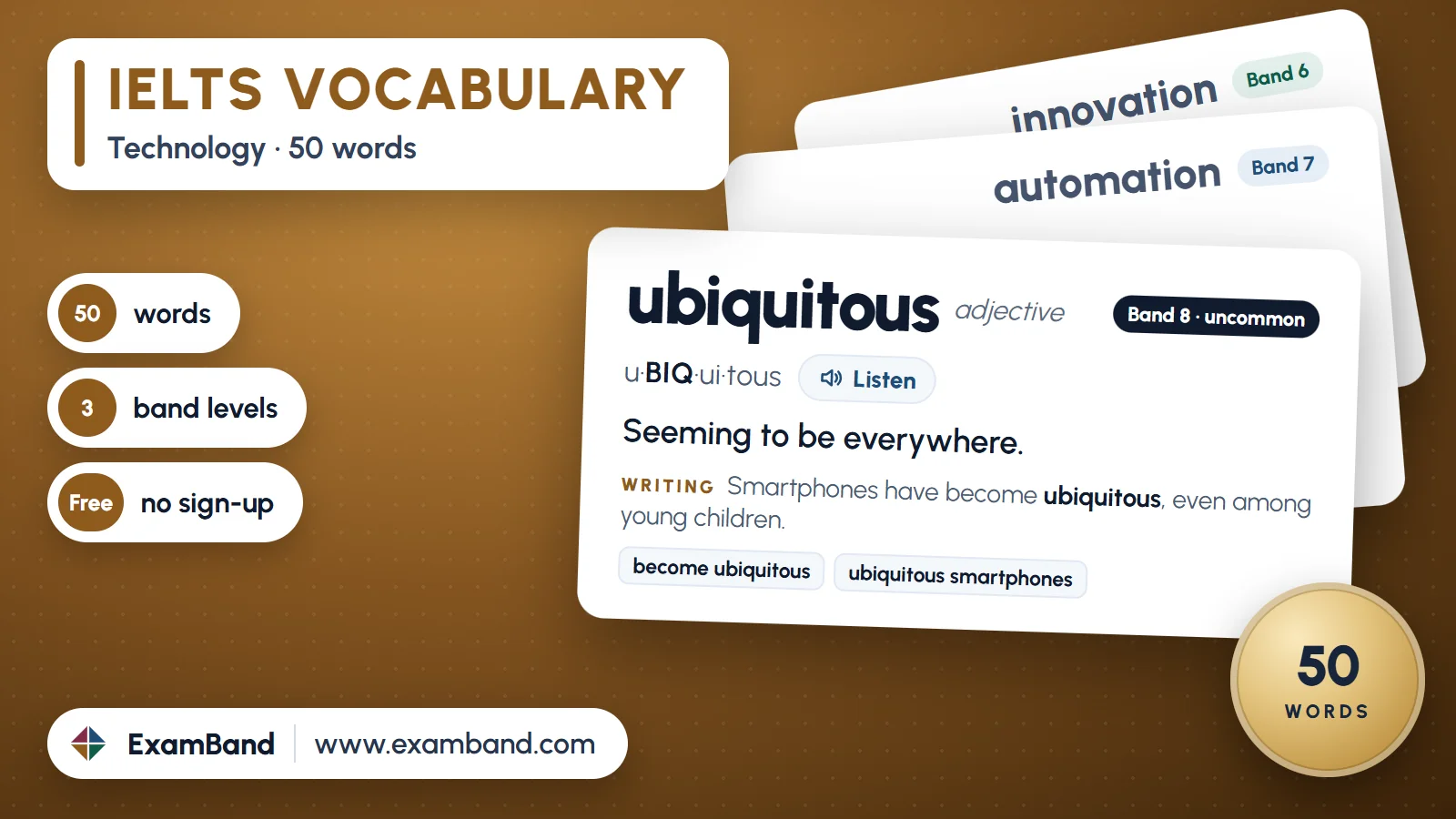
Questions about IELTS technology vocabulary
How do I learn IELTS technology vocabulary?
Learn about ten words a day. First, read the meaning, listen to the word and say it out loud with the right stress. Then test yourself with the quiz and the flashcards on this page. Finally, use five of the words in an essay and check it with our free Writing Checker.
Which words should I learn first?
Start with the band 6 words, because you need them to explain any idea clearly. After that, add the band 7 words. However, use the band 8 words only when you are sure of their meaning, because a rare word used wrongly can lower your score.
Are these official IELTS words?
No. IELTS has no official word list. Instead, our levels follow the words of the public IELTS band descriptors: band 7 asks for some “less common” words, and band 8 for “uncommon” words used with skill.