IELTS Education Vocabulary: 50 Words with Examples
This list of IELTS education vocabulary covers one of the most common topics in Writing Task 2 and Speaking. Each word has a simple meaning, its sound, a band level, examples for Writing and Speaking, and the mistake to avoid.
50 words · free quiz and flashcards · updated October 2026
curriculum
cur·RIC·u·lum · nounAll the subjects taught in a school, college or course.Band 6 · everyday
Word family: curricular (adjective)
Collocations
- the school curriculum
- the national curriculum
- on the curriculum
Similar: syllabus, programme of study
WritingPractical skills such as cooking should be part of the school curriculum.
SpeakingOur curriculum was very heavy on science and maths.
Common mistake: Spelling it “curriculam”. Write “curriculum”.
tuition fees
tu·I·tion FEES · noun, pluralThe money students pay to study at a college or university.Band 6 · everyday
Word family: tuition (noun)
Collocations
- pay tuition fees
- high tuition fees
- abolish tuition fees
Similar: course fees
WritingHigh tuition fees stop many talented students from going to university.
SpeakingMy parents paid my tuition fees, so I worked to pay for food.
Common mistake: Saying “tuition fee” for the total cost of a course. People usually say “tuition fees”.
literacy
LIT·er·a·cy · nounThe ability to read and write.Band 6 · everyday
Word family: literate (adjective) · illiterate (adjective)
Collocations
- literacy rates
- improve literacy
- adult literacy
Similar: reading and writing skills
WritingFree primary education has raised literacy rates in many developing countries.
SpeakingMy grandmother ran literacy classes for adults in her village.
Common mistake: Thinking it means knowing about literature. Literacy means being able to read and write.
numeracy
NU·mer·a·cy · nounThe ability to understand and work with numbers.Band 6 · everyday
Word family: numerate (adjective)
Collocations
- basic numeracy
- literacy and numeracy
- numeracy skills
Similar: maths skills
WritingEmployers complain that some school leavers lack basic numeracy.
SpeakingApps can make numeracy practice fun for young children.
Common mistake: Saying “numeracity”. The word is “numeracy”.
primary school
PRI·ma·ry SCHOOL · nounA school for children from about 5 to 11 years old.Band 6 · everyday
Collocations
- go to primary school
- primary school teachers
- at primary school
Similar: elementary school
WritingChildren should start learning a second language at primary school.
SpeakingMy primary school was just five minutes from my house.
Common mistake: Saying “first school”. Say “primary school” (UK) or “elementary school” (US).
secondary school
SEC·on·da·ry SCHOOL · nounA school for children from about 11 to 16 or 18 years old.Band 6 · everyday
Collocations
- secondary school students
- leave secondary school
- at secondary school
Similar: high school
WritingMany secondary school students feel stressed by constant exams.
SpeakingI loved my secondary school because the teachers were so kind.
Common mistake: Saying “middle school” for all of it. In the UK, “secondary school” covers ages 11 to 16 or 18.
higher education
HIGH·er ed·u·CA·tion · nounStudy at a college or university after school.Band 6 · everyday
Collocations
- access to higher education
- go into higher education
- institutions of higher education
Similar: university education
WritingGovernments should widen access to higher education for poorer students.
SpeakingIn my country, higher education is free for good students.
Common mistake: Saying “high education”. Use “higher education”.
graduate
GRAD·u·ate · noun / verbSomeone who has finished a university degree; to finish a degree.Band 6 · everyday
Word family: graduation (noun)
Collocations
- university graduates
- graduate from university
- recent graduates
Similar: degree holder
WritingMany graduates struggle to find jobs that match their skills.
SpeakingI graduated last year with a degree in economics.
Common mistake: Saying “graduate university”. You graduate from university.
degree
de·GREE · nounThe qualification you get when you finish a university course.Band 6 · everyday
Collocations
- a degree in economics
- do a degree
- a university degree
Similar: qualification
WritingA university degree no longer guarantees a well-paid job.
SpeakingI’m doing a degree in nursing at the moment.
Common mistake: Saying “a degree of economics”. Use “in”: “a degree in economics”.
scholarship
SCHOL·ar·ship · nounMoney given to a student to help pay for their studies.Band 6 · everyday
Word family: scholar (noun)
Collocations
- win a scholarship
- apply for a scholarship
- a full scholarship
Similar: grant, bursary
WritingScholarships allow talented students from poor families to study abroad.
SpeakingI’m applying for a scholarship to study in Canada.
Common mistake: Saying “take a scholarship”. You “win”, “get” or “are awarded” a scholarship.
homework
HOME·work · nounWork that teachers give students to do at home.Band 6 · everyday
Collocations
- do homework
- set homework
- a lot of homework
Similar: assignments
WritingToo much homework can leave children with no time to play.
SpeakingI usually do my homework straight after dinner.
Common mistake: Saying “homeworks” or “make homework”. It is uncountable, and you “do” homework.
qualification
qual·i·fi·CA·tion · nounAn exam you pass or a course you finish that shows you have a skill.Band 6 · everyday
Word family: qualify (verb) · qualified (adjective)
Collocations
- academic qualifications
- gain a qualification
- formal qualifications
Similar: certificate, diploma
WritingFormal qualifications are not the only sign of a person’s ability.
SpeakingI want a teaching qualification so I can work abroad.
Common mistake: Saying “a qualification of English”. Use “in”: “a qualification in English”.
online learning
ON·line LEARN·ing · nounStudying through the internet instead of in a classroom.Band 6 · everyday
Collocations
- the rise of online learning
- online learning platforms
- switch to online learning
Similar: e-learning, distance learning
WritingOnline learning lets people in remote areas take university courses.
SpeakingI found online learning hard because I missed my classmates.
Common mistake: Saying “online learnings”. It is uncountable.
lecture
LEC·ture · noun / verbA long talk on a subject, given to students at a university.Band 6 · everyday
Word family: lecturer (noun)
Collocations
- attend a lecture
- give a lecture
- a lecture hall
Similar: talk, class
WritingSome experts argue that long lectures are a poor way to teach.
SpeakingMy first lecture starts at eight, which is far too early.
Common mistake: Using it to mean “reading”, as in some languages. In English a lecture is a talk.
student loan
STU·dent LOAN · nounMoney a student borrows to pay for university and pays back later.Band 6 · everyday
Collocations
- take out a student loan
- pay off a student loan
- student loan debt
Similar: student debt
WritingMany young people start working life with a large student loan to repay.
SpeakingI’ll be paying off my student loan for years!
Common mistake: Saying “borrow a student loan”. You “take out” a loan.
timetable
TIME·ta·ble · nounA list of the times when lessons or other events happen.Band 6 · everyday
Collocations
- a school timetable
- a busy timetable
- on the timetable
Similar: schedule
WritingSchools could give more space on the timetable to art and sport.
SpeakingMy timetable this term is quite relaxed.
Common mistake: Writing “time table” as two words. Write “timetable”.
discipline
DIS·ci·pline · noun / verbRules that make people behave well, and the control used to keep them.Band 6 · everyday
Word family: disciplined (adjective) · self-discipline (noun)
Collocations
- strict discipline
- maintain discipline
- discipline problems
Similar: order, control
WritingTeachers need parents’ support to maintain discipline in the classroom.
SpeakingMy school had very strict discipline; we stood up when teachers came in.
Common mistake: Putting the stress on the second part. Stress the first: DIS-ci-pline.
peer pressure
PEER PRES·sure · nounThe strong wish to do what people of your own age do, so that they accept you.Band 6 · everyday
Word family: peer (noun)
Collocations
- give in to peer pressure
- resist peer pressure
- under peer pressure
Similar: social pressure
WritingTeenagers often start smoking because of peer pressure.
SpeakingThere’s a lot of peer pressure to have the latest phone at my school.
Common mistake: Writing “pair pressure”. A peer is someone of your age or level.
vocational training
vo·CA·tion·al TRAIN·ing · nounTraining for a particular job, such as plumbing or nursing.Band 7 · less common
Word family: vocation (noun)
Collocations
- provide vocational training
- vocational training courses
- vocational qualifications
Similar: job training, apprenticeship
WritingVocational training can be a better route into work than a university degree.
SpeakingMy brother did vocational training to become an electrician.
Common mistake: Mixing it up with “vacation”. Vocational is about jobs, not holidays.
extracurricular activities
ex·tra·cur·RIC·u·lar ac·TIV·i·ties · noun, pluralThings students do outside normal lessons, like sport, music or clubs.Band 7 · less common
Collocations
- take part in extracurricular activities
- a wide range of extracurricular activities
- school clubs
Similar: after-school activities
WritingExtracurricular activities help children develop teamwork and confidence.
SpeakingMy favourite extracurricular activity was the drama club.
Common mistake: Writing “extra curricular” as two words. Write “extracurricular”.
academic performance
ac·a·DEM·ic per·FOR·mance · nounHow well a student does in their studies and exams.Band 7 · less common
Collocations
- improve academic performance
- poor academic performance
- affect academic performance
Similar: results, achievement
WritingLack of sleep has a clear effect on children’s academic performance.
SpeakingMy academic performance got much better when I started studying with friends.
Common mistake: Saying “academical performance”. The adjective is “academic”.
rote learning
ROTE LEARN·ing · nounLearning by repeating facts until you remember them, often without understanding them.Band 7 · less common
Word family: learn by rote (phrase)
Collocations
- rely on rote learning
- rote learning and memorisation
- move away from rote learning
Similar: memorisation
WritingSchools that rely on rote learning may not prepare students for real problems.
SpeakingAt my school it was mostly rote learning, so I forgot a lot after the exams.
Common mistake: Writing “rot learning” or “wrote learning”. Write “rote”.
critical thinking
CRIT·i·cal THINK·ing · nounThinking carefully about ideas and facts before you decide what is true.Band 7 · less common
Word family: critically (adverb)
Collocations
- develop critical thinking
- critical thinking skills
- encourage critical thinking
Similar: analytical thinking
WritingSchools should teach critical thinking so that young people can spot false news.
SpeakingMy university course really improved my critical thinking.
Common mistake: Thinking “critical” here means negative. In “critical thinking” it means careful and logical.
compulsory
com·PUL·so·ry · adjectiveSomething you must do because a rule or law says so.Band 7 · less common
Word family: compulsion (noun)
Collocations
- compulsory education
- compulsory subjects
- make something compulsory
Similar: mandatory, obligatory
WritingPhysical education should be compulsory for all secondary school students.
SpeakingMaths was compulsory until the last year of school.
Common mistake: Spelling it “compulsary”. Write “compulsory”.
mixed-ability class
MIXED-a·BIL·i·ty CLASS · nounA class where students of different levels learn together.Band 7 · less common
Collocations
- teach mixed-ability classes
- in a mixed-ability class
- mixed-ability groups
Similar: mixed-level class
WritingIn mixed-ability classes, strong students can help weaker ones.
SpeakingMy English group was a mixed-ability class, so it was sometimes slow.
Common mistake: Writing “mix ability class”. Write “mixed-ability”, with -ed and a hyphen.
standardised tests
STAN·dard·ised TESTS · noun, pluralExams that are the same for every student and are marked in the same way.Band 7 · less common
Word family: standardise (verb)
Collocations
- take standardised tests
- rely on standardised tests
- standardised test scores
Similar: national exams
WritingStandardised tests make it easy to compare schools, but they narrow what is taught.
SpeakingWe had standardised tests every year, and everyone was nervous.
Common mistake: Mixing spellings in one essay. Use “standardised” (UK) or “standardized” (US), not both.
gap year
GAP YEAR · nounA year off between school and university, often to work or travel.Band 7 · less common
Collocations
- take a gap year
- go on a gap year
- during a gap year
Similar: year out
WritingTaking a gap year can help young people become more independent.
SpeakingI’d love to take a gap year and travel around South America.
Common mistake: Saying “do a gap year holiday”. Just say “take a gap year”.
lifelong learning
LIFE·long LEARN·ing · nounContinuing to learn new skills all through your life.Band 7 · less common
Collocations
- promote lifelong learning
- the importance of lifelong learning
- lifelong learning opportunities
Similar: continuing education
WritingIn a fast-changing job market, lifelong learning is no longer optional.
SpeakingMy dad believes in lifelong learning; he started piano at fifty.
Common mistake: Saying “longlife learning”. The word is “lifelong”.
blended learning
BLEND·ed LEARN·ing · nounLearning that mixes classroom lessons with online study.Band 7 · less common
Word family: blend (verb)
Collocations
- a blended learning course
- offer blended learning
- blended learning programmes
Similar: hybrid learning
WritingBlended learning combines the freedom of online study with face-to-face support.
SpeakingMy college uses blended learning: two days in class and three online.
Common mistake: Saying “mixed learning”. The usual term is “blended learning”.
tertiary education
TER·ti·a·ry ed·u·CA·tion · nounEducation at a college or university, after secondary school.Band 7 · less common
Collocations
- access to tertiary education
- tertiary education institutions
- enter tertiary education
Similar: higher education
WritingThe number of women in tertiary education has risen sharply.
SpeakingIn my country, tertiary education is free at public universities.
Common mistake: Saying “third education”. The formal word is “tertiary education”.
dropout rate
DROP·out RATE · nounThe number of students who leave school or university before they finish.Band 7 · less common
Word family: drop out (phrasal verb) · dropout (noun)
Collocations
- a high dropout rate
- reduce the dropout rate
- university dropout rates
Similar: attrition rate
WritingFree school meals have helped to cut the dropout rate in poorer areas.
SpeakingThe dropout rate at my university is quite high in the first year.
Common mistake: Writing the noun as “drop out”. The noun is “dropout”; the verb is “drop out”.
single-sex school
SIN·gle-SEX SCHOOL · nounA school only for boys or only for girls.Band 7 · less common
Collocations
- go to a single-sex school
- single-sex education
- single-sex and mixed schools
Similar: boys’ school, girls’ school
WritingSome research suggests that girls are more confident in single-sex schools.
SpeakingI went to a single-sex school, so university felt very different.
Common mistake: Saying “one-sex school” or “gender school”. Say “single-sex school”.
boarding school
BOARD·ing SCHOOL · nounA school where students live during term time.Band 7 · less common
Word family: boarder (noun)
Collocations
- go to boarding school
- send children to boarding school
- a boarding school student
Similar: residential school
WritingSending young children to boarding school can weaken their bond with their parents.
SpeakingMy cousin went to a boarding school and only came home at weekends.
Common mistake: Saying “living school”. The word is “boarding school”.
enrol
en·ROL · verbTo officially join a course or a school.Band 7 · less common
Word family: enrolment (noun)
Collocations
- enrol on a course
- enrol in a school
- enrol students
Similar: sign up, register
WritingMore adults are enrolling on part-time university courses.
SpeakingI enrolled on a cooking course last month.
Common mistake: Mixing spellings. British English writes “enrol” and “enrolment”; American English writes “enroll” and “enrollment”.
coursework
COURSE·work · nounWork students do during a course that counts towards their final mark.Band 7 · less common
Collocations
- hand in coursework
- coursework deadlines
- assessed coursework
Similar: assignments
WritingCoursework rewards steady effort better than a single final exam.
SpeakingI have three pieces of coursework due next week!
Common mistake: Saying “courseworks”. It is uncountable: “pieces of coursework”.
continuous assessment
con·TIN·u·ous as·SESS·ment · nounMarking students on their work all through a course, instead of with one final exam.Band 7 · less common
Word family: assess (verb)
Collocations
- be based on continuous assessment
- a system of continuous assessment
- continuous assessment and exams
Similar: ongoing assessment
WritingContinuous assessment reduces the stress of one big final exam.
SpeakingMy course uses continuous assessment, so every essay counts.
Common mistake: Saying “continuous assessing”. The noun is “assessment”.
well-rounded
well-ROUND·ed · adjectiveHaving a good range of skills, interests and experience.Band 7 · less common
Collocations
- a well-rounded education
- well-rounded students
- a well-rounded person
Similar: balanced, all-round
WritingSchools should aim to produce well-rounded young people, not just good exam takers.
SpeakingSport and music made me a more well-rounded person.
Common mistake: Writing “well rounded” without the hyphen before a noun. Write “a well-rounded education”.
hands-on learning
hands-ON LEARN·ing · nounLearning by doing things yourself, not just by listening or reading.Band 7 · less common
Collocations
- hands-on learning experiences
- encourage hands-on learning
- through hands-on learning
Similar: practical learning, learning by doing
WritingScience is easier to understand through hands-on learning in the laboratory.
SpeakingI prefer hands-on learning; I need to try things myself.
Common mistake: Saying “hand-on learning”. Use the plural: “hands-on”.
pedagogy
PED·a·go·gy · nounThe methods and theory of teaching.Band 8 · uncommon
Word family: pedagogical (adjective)
Collocations
- modern pedagogy
- effective pedagogy
- pedagogical approaches
Similar: teaching methods
WritingModern pedagogy puts students at the centre of the learning process.
SpeakingMy teacher training course focused a lot on pedagogy.
Common mistake: Saying the last g like the g in “go”. It sounds like the j in “jam”: PED-a-go-jee.
meritocracy
mer·i·TOC·ra·cy · nounA system where people succeed because of their ability and effort, not their family or money.Band 8 · uncommon
Word family: meritocratic (adjective) · merit (noun)
Collocations
- a true meritocracy
- a meritocratic system
- believe in meritocracy
Similar: merit-based system
WritingFree university education helps to create a genuine meritocracy.
SpeakingI’m not sure my country is a meritocracy; connections still matter a lot.
Common mistake: Putting the stress on the first part. Stress “-toc-”: meri-TOC-racy.
instil
in·STIL · verbTo slowly make someone have a feeling, idea or habit.Band 8 · uncommon
Collocations
- instil discipline
- instil values
- instil a love of reading
Similar: build, foster
WritingGood teachers instil a love of learning that lasts a lifetime.
SpeakingMy parents instilled in me the habit of reading every night.
Common mistake: Mixing spellings. British English writes “instil”; American English writes “instill”.
cognitive development
COG·ni·tive de·VEL·op·ment · nounThe growth of a child’s ability to think, learn and remember.Band 8 · uncommon
Word family: cognition (noun)
Collocations
- support cognitive development
- early cognitive development
- cognitive and social development
Similar: mental development
WritingPlaying with others is vital for young children’s cognitive development.
SpeakingI think puzzle games are good for kids’ cognitive development.
Common mistake: Saying “cognitive developing”. The noun is “development”.
holistic
ho·LIS·tic · adjectiveDealing with the whole person or thing, not just one part.Band 8 · uncommon
Word family: holistically (adverb)
Collocations
- a holistic approach
- holistic education
- a holistic view
Similar: all-round, whole-person
WritingA holistic approach to education develops social skills as well as grades.
SpeakingI like schools with a more holistic approach, with art, sport and music.
Common mistake: Spelling it “wholistic”. Write “holistic”.
learner autonomy
LEARN·er au·TON·o·my · nounThe ability of students to control and plan their own learning.Band 8 · uncommon
Word family: autonomous (adjective)
Collocations
- develop learner autonomy
- encourage learner autonomy
- a lack of learner autonomy
Similar: independent learning
WritingOnline courses demand a high level of learner autonomy.
SpeakingUniversity really tested my learner autonomy; nobody checked my homework.
Common mistake: Putting the stress at the start of “autonomy”. Stress “-ton-”: au-TON-omy.
educational disparity
ed·u·CA·tion·al dis·PAR·i·ty · nounA big, unfair difference in the education that different groups receive.Band 8 · uncommon
Word family: disparate (adjective)
Collocations
- reduce educational disparities
- regional disparities
- the disparity between rich and poor
Similar: inequality, gap
WritingEducational disparity between rural and urban areas remains a serious problem.
SpeakingThere’s a big educational disparity between private and state schools here.
Common mistake: Saying “a disparity of rich and poor”. Use “between”: “a disparity between rich and poor areas”.
rigorous
RIG·or·ous · adjectiveVery careful, thorough and strict.Band 8 · uncommon
Word family: rigour (noun) · rigorously (adverb)
Collocations
- rigorous training
- rigorous standards
- academically rigorous
Similar: thorough, demanding
WritingTeachers in some countries must complete rigorous training before they qualify.
SpeakingMy university entrance exam was really rigorous.
Common mistake: Spelling it “rigourous”. The noun is “rigour” in British English, but the adjective is “rigorous”.
intellectual curiosity
in·tel·LEC·tu·al cu·ri·OS·i·ty · nounA strong wish to learn about and understand new things.Band 8 · uncommon
Word family: curious (adjective)
Collocations
- encourage intellectual curiosity
- spark intellectual curiosity
- a lack of intellectual curiosity
Similar: thirst for knowledge
WritingExam-focused teaching can kill children’s natural intellectual curiosity.
SpeakingMy grandfather had amazing intellectual curiosity; he read about everything.
Common mistake: Spelling it “curiousity”. The noun is “curiosity”.
spoon-feed
SPOON-feed · verbTo give students so much help that they do not learn to think for themselves.Band 8 · uncommon
Collocations
- spoon-feed students
- spoon-fed information
- be spoon-fed the answers
Similar: over-help
WritingStudents who are spoon-fed at school often struggle at university.
SpeakingOur teachers spoon-fed us the answers before every exam.
Common mistake: Using it only for feeding babies. In education it means giving students too much help.
cram
CRAM · verbTo study a lot in a very short time just before an exam.Band 8 · uncommon
Word family: cramming (noun)
Collocations
- cram for an exam
- last-minute cramming
- cram schools
Similar: swot (informal)
WritingCramming the night before an exam rarely leads to real understanding.
SpeakingI always cram the night before exams, which isn’t a good idea.
Common mistake: Saying “cram an exam”. You cram for an exam.
academically gifted
ac·a·DEM·i·cal·ly GIFT·ed · adjectiveMuch more able than most students at school subjects.Band 8 · uncommon
Word family: gift (noun)
Collocations
- academically gifted children
- programmes for the academically gifted
- be academically gifted
Similar: high-achieving, bright
WritingSeparate classes for academically gifted children remain controversial.
SpeakingMy sister was academically gifted; she finished school two years early.
Common mistake: Saying “academic gifted”. You need the adverb: “academically gifted”.
Education vocabulary in IELTS Writing and Speaking
Here is how IELTS education vocabulary can come up in the test, with our own practice questions. So, try to answer them with words from the list above.
Writing Task 2
Some people believe universities should accept only the students with the highest marks. Others think they should also accept students who show other strengths. Discuss both views and give your own opinion.
Speaking
- Part 1: Did you enjoy your time at secondary school?
- Part 1: What subject would you like to study in the future?
- Part 2: Describe a teacher who helped you a lot.
- Part 3: Should university education be free for everyone?
- Part 3: How will technology change the way children learn?
Our free tests on this topic
- Writing Practice Test 2, Task 2when children should start learning a foreign language
- Reading Practice Test 5, Passage 3whether the lecture is still a good way to teach
- Listening Practice Test 5, Part 3two students planning a dissertation
- Writing Practice Test 8, Task 2taking a year off before university
A model paragraph with IELTS education vocabulary
Many people believe a university degree is the key to success, but vocational training can be just as valuable. Not every student enjoys rote learning or long lectures; some learn best through hands-on learning. If tuition fees keep rising, more young people may choose practical courses. Ideally, schools should offer a well-rounded education that builds critical thinking as well as exam skills.
Practise this IELTS education vocabulary
Take the 10-question quiz on this IELTS education vocabulary, or go through every word with the flashcards.
Question 1 of 10
Which word means “the ability to read and write”?
Now use the words
Write a Task 2 essay with five of these words. Then our free Writing Checker gives you a band for vocabulary and for the other three criteria.
Open the Writing Checker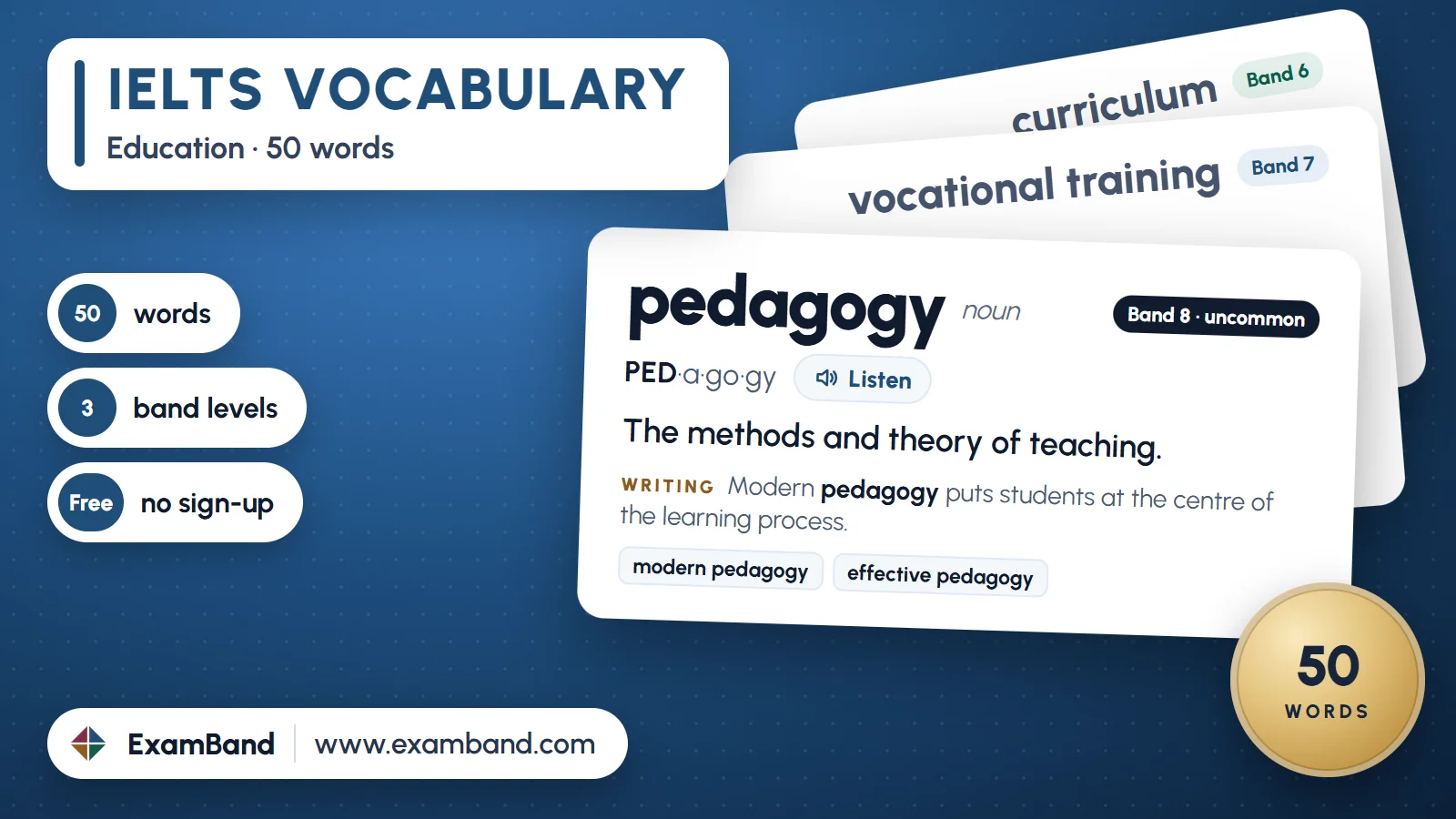
Questions about IELTS education vocabulary
How do I learn IELTS education vocabulary?
Learn about ten words a day. First, read the meaning, listen to the word and say it out loud with the right stress. Then test yourself with the quiz and the flashcards on this page. Finally, use five of the words in an essay and check it with our free Writing Checker.
Which words should I learn first?
Start with the band 6 words, because you need them to explain any idea clearly. After that, add the band 7 words. However, use the band 8 words only when you are sure of their meaning, because a rare word used wrongly can lower your score.
Are these official IELTS words?
No. IELTS has no official word list. Instead, our levels follow the words of the public IELTS band descriptors: band 7 asks for some “less common” words, and band 8 for “uncommon” words used with skill.