IELTS Writing Task 1 Vocabulary: Charts, Maps, Processes
This IELTS Writing Task 1 vocabulary helps you describe line graphs, bar charts, pie charts, tables, maps and processes. Each word has a simple meaning, its sound, a band level, a Task 1 example and the mistake to avoid.
58 words · free quiz and flashcards · updated October 2026
Going up
Words for numbers that rise. Strong words like “soar” are only for big, fast changes.
rise
RISE · verb / nounTo go up.Band 6 · everyday
Word family: rose (past) · risen (past participle)
Collocations
- rise sharply
- a steady rise
- rise from 10% to 20%
Similar: increase, go up
WritingThe number of car owners rose sharply between 2000 and 2010.
Common mistake: Mixing up “rise” and “raise”. Prices rise; the government raises taxes.
increase
in·CREASE · verb / nounTo become bigger in number or amount.Band 6 · everyday
Word family: increasingly (adverb)
Collocations
- increase significantly
- a sharp increase in
- increase by 5%
Similar: rise, grow
WritingSales increased by 20% over the five-year period.
Common mistake: Mixing up “by” and “to”. “Increased by 20%” is the change; “increased to 20%” is the final figure.
grow
GROW · verbTo get bigger over time.Band 6 · everyday
Word family: growth (noun)
Collocations
- grow steadily
- grow rapidly
- growth in sales
Similar: expand, increase
WritingThe city’s population grew steadily throughout the century.
Common mistake: Writing “growed”. The past is “grew” and the past participle is “grown”.
double
DOU·ble · verbTo become two times as big.Band 6 · everyday
Word family: triple (verb) · halve (verb)
Collocations
- double in size
- nearly double
- double over the period
Similar: twofold increase
WritingThe number of students doubled between 1990 and 2020.
Common mistake: Saying “doubled two times”. If something doubled twice, it became four times as big: it “quadrupled”.
climb
CLIMB · verbTo rise slowly and steadily.Band 7 · less common
Collocations
- climb steadily
- climb to a high of
- climb gradually
Similar: rise, go up
WritingUnemployment climbed steadily to a high of 9% in 2012.
Common mistake: Saying the b. The b is silent: CLIME.
peak
PEAK · verb / nounTo reach the highest point.Band 7 · less common
Collocations
- peak at
- reach a peak
- the peak of
Similar: reach a high
WritingVisitor numbers peaked at 2 million in August.
Common mistake: Writing “peek”, which means to look quickly. The highest point is a “peak”.
soar
SOAR · verbTo rise very quickly to a high level.Band 8 · uncommon
Word family: soaring (adjective)
Collocations
- soar to
- prices soared
- soaring demand
Similar: rocket, shoot up
WritingHouse prices soared to a record high in 2007.
Common mistake: Adding “sharply” to it. “Soar” already means a very fast rise.
surge
SURGE · noun / verbA sudden, large increase.Band 8 · uncommon
Collocations
- a surge in demand
- surge to
- a sudden surge
Similar: jump, spike
WritingThere was a sudden surge in online sales in 2020.
Common mistake: Saying “a surge of” with figures. Use “in”: “a surge in sales”.
Going down
Words for numbers that fall. A dip is small; plummet is very big.
fall
FALL · verb / nounTo go down.Band 6 · everyday
Word family: fell (past) · fallen (past participle)
Collocations
- fall sharply
- a slight fall
- fall to
Similar: drop, decline
WritingThe price of oil fell to its lowest point in 2016.
Common mistake: Writing “falled”. The past is “fell”, and the past participle is “fallen”.
decrease
de·CREASE · verb / nounTo become smaller in number or amount.Band 6 · everyday
Word family: decreasing (adjective)
Collocations
- decrease steadily
- a decrease in
- decrease by half
Similar: fall, decline
WritingThe number of smokers decreased steadily over the period.
Common mistake: Saying “a decrease of the number”. Use “in”: “a decrease in the number of smokers”.
drop
DROP · verb / nounTo fall, often suddenly.Band 6 · everyday
Collocations
- drop sharply
- a drop in
- drop to
Similar: fall
WritingThe temperature dropped sharply at the end of the year.
Common mistake: Spelling the past “droped”. Write “dropped”, with double p.
decline
de·CLINE · verb / nounTo become less, often slowly over time.Band 7 · less common
Collocations
- decline gradually
- a sharp decline
- a decline in
Similar: fall, drop
WritingNewspaper sales have declined every year since 2005.
Common mistake: Writing “declined down”. “Decline” already means going down.
dip
DIP · verb / nounA small fall that soon goes back up.Band 7 · less common
Collocations
- a slight dip
- dip briefly
- a dip in
Similar: small drop
WritingSales dipped slightly in March before recovering.
Common mistake: Using it for a big fall. A dip is small and short.
hit a low
HIT a LOW · verb phraseTo reach the lowest point.Band 7 · less common
Collocations
- hit a low of
- hit an all-time low
- reach its lowest point
Similar: bottom out
WritingUnemployment hit a low of 3% in 2019.
Common mistake: Saying “hit the lowest”. Say “hit a low” or “reached its lowest point”.
plummet
PLUM·met · verbTo fall very quickly and suddenly.Band 8 · uncommon
Collocations
- plummet to
- prices plummeted
- plummet dramatically
Similar: plunge, crash
WritingThe number of visitors plummeted from 5 million to 1 million in one year.
Common mistake: Spelling the past “plummetted”. Write “plummeted”, with one t.
plunge
PLUNGE · verb / nounTo fall suddenly and by a large amount.Band 8 · uncommon
Collocations
- plunge to
- a sharp plunge
- plunge by
Similar: plummet
WritingProfits plunged by 40% after the factory closed.
Common mistake: Using it for a slow fall. A plunge is sudden.
Staying the same, or going up and down
Words for numbers that stop changing, or that keep changing.
remain stable
re·MAIN STA·ble · verb phraseTo stay at the same level.Band 6 · everyday
Word family: stability (noun)
Collocations
- remain stable at
- remain fairly stable
- remain stable throughout
Similar: stay the same, remain constant
WritingThe number of teachers remained stable at around 500.
Common mistake: Writing “remained stably”. After “remain”, use the adjective: “remained stable”.
remain unchanged
re·MAIN un·CHANGED · verb phraseTo stay exactly the same.Band 6 · everyday
Collocations
- remain unchanged at
- remain largely unchanged
- remained unchanged throughout
Similar: stay the same
WritingThe price of bread remained unchanged for the first three years.
Common mistake: Writing “remained no change”. Use “remained unchanged” or “there was no change”.
level off
LEV·el OFF · phrasal verbTo stop rising or falling and stay at the same level.Band 7 · less common
Collocations
- level off at
- begin to level off
- level off after
Similar: flatten out
WritingAfter rising for ten years, prices levelled off at $300.
Common mistake: Mixing spellings. British English writes “levelled”; American English writes “leveled”.
fluctuate
FLUC·tu·ate · verbTo go up and down many times.Band 7 · less common
Word family: fluctuation (noun)
Collocations
- fluctuate between
- fluctuate wildly
- fluctuate around
Similar: vary, go up and down
WritingThe exchange rate fluctuated between 1.2 and 1.4 during the year.
Common mistake: Writing “fluctuated up and down”. “Fluctuate” already means up and down.
stabilise
STA·bi·lise · verbTo stop changing and stay steady.Band 7 · less common
Word family: stable (adjective) · stability (noun)
Collocations
- stabilise at
- begin to stabilise
- prices stabilised
Similar: level off, settle
WritingThe birth rate stabilised at about 1.8 children per woman.
Common mistake: Mixing spellings. British English writes “stabilise”; American English writes “stabilize”.
plateau
PLAT·eau · verb / nounTo stay at the same level after a period of growth.Band 8 · uncommon
Collocations
- reach a plateau
- plateau at
- a long plateau
Similar: level off
WritingSales plateaued at 2,000 units a month from June to September.
Common mistake: Saying every letter. It sounds like “PLAT-oh”.
How big and how fast
Add these to a verb (“rose sharply”), or use the adjective with a noun (“a sharp rise”).
sharply
SHARP·ly · adverbSuddenly and by a large amount.Band 6 · everyday
Word family: sharp (adjective)
Collocations
- rise sharply
- fall sharply
- a sharp drop
Similar: steeply, dramatically
WritingTicket sales fell sharply in the final quarter.
Common mistake: Using it for slow changes. A sharp change is sudden.
steadily
STEAD·i·ly · adverbAt an even speed over time.Band 6 · everyday
Word family: steady (adjective)
Collocations
- rise steadily
- grow steadily
- a steady decline
Similar: gradually, consistently
WritingThe number of cyclists rose steadily over the decade.
Common mistake: Spelling it “steadyly”. Write “steadily”.
gradually
GRAD·u·al·ly · adverbSlowly, over a long time.Band 6 · everyday
Word family: gradual (adjective)
Collocations
- increase gradually
- gradually decline
- a gradual rise
Similar: slowly, steadily
WritingCar use gradually declined as more people took the train.
Common mistake: Spelling it “gradualy”. Write “gradually”, with double l.
slightly
SLIGHT·ly · adverbBy a small amount.Band 6 · everyday
Word family: slight (adjective)
Collocations
- rise slightly
- slightly higher
- a slight fall
Similar: a little, marginally
WritingPrices rose slightly in the first month and then remained stable.
Common mistake: Writing “a slightly increase”. Use the adjective before a noun: “a slight increase”.
rapidly
RAP·id·ly · adverbVery quickly.Band 6 · everyday
Word family: rapid (adjective)
Collocations
- grow rapidly
- rapidly increasing
- rapid growth
Similar: quickly, swiftly
WritingInternet use grew rapidly in the early 2000s.
Common mistake: Writing “rapidly fast”. “Rapidly” already means fast.
dramatically
dra·MAT·i·cal·ly · adverbBy a very large amount.Band 7 · less common
Word family: dramatic (adjective)
Collocations
- rise dramatically
- fall dramatically
- a dramatic increase
Similar: sharply, significantly
WritingThe use of mobile phones increased dramatically after 2005.
Common mistake: Spelling it “dramaticly”. Write “dramatically”.
significantly
sig·NIF·i·cant·ly · adverbBy a large amount that matters.Band 7 · less common
Word family: significant (adjective)
Collocations
- increase significantly
- significantly higher
- a significant fall
Similar: considerably, substantially
WritingWomen earned significantly less than men in all three years.
Common mistake: Spelling it “significantely”. Write “significantly”.
considerably
con·SID·er·a·bly · adverbQuite a lot.Band 7 · less common
Word family: considerable (adjective)
Collocations
- considerably higher
- rise considerably
- a considerable amount
Similar: significantly, substantially
WritingSpending on health was considerably higher in 2020 than in 2000.
Common mistake: Mixing it up with “considerately”, which means kindly.
substantial
sub·STAN·tial · adjectiveLarge in size or amount.Band 7 · less common
Word family: substantially (adverb)
Collocations
- a substantial increase
- substantial growth
- a substantial proportion
Similar: considerable, significant
WritingThere was a substantial increase in the number of female students.
Common mistake: Spelling it “substancial”. Write “substantial”.
marginally
MAR·gin·al·ly · adverbBy a very small amount.Band 8 · uncommon
Word family: marginal (adjective)
Collocations
- marginally higher
- fall marginally
- a marginal increase
Similar: slightly, fractionally
WritingRural incomes were marginally lower than urban incomes in 2015.
Common mistake: Using it for big changes. Marginally means very slightly.
Numbers, shares and comparisons
Words for pie charts and tables, and for comparing groups.
make up
make UP · phrasal verbTo form a part of a whole.Band 6 · everyday
Collocations
- make up a third
- make up the majority
- be made up of
Similar: account for, constitute
WritingStudents made up the largest group of library users.
Common mistake: Mixing it up with the other meanings of “make up” (to invent a story, or to put on cosmetics). In charts it means to form part of a total.
the majority
the ma·JOR·i·ty · nounMore than half.Band 6 · everyday
Word family: major (adjective)
Collocations
- the vast majority
- the majority of
- a clear majority
Similar: most
WritingThe majority of workers travelled to work by car.
Common mistake: Writing “the most of workers”. Say “most workers” or “the majority of workers”.
a minority
a mi·NOR·i·ty · nounLess than half; a small part.Band 6 · everyday
Word family: minor (adjective)
Collocations
- a small minority
- only a minority
- a minority of
Similar: a small number
WritingOnly a minority of households had a computer in 1995.
Common mistake: Using it for a large group. A minority is less than half, usually much less.
percentage
per·CENT·age · nounAn amount shown as a part of 100.Band 6 · everyday
Word family: per cent (noun)
Collocations
- a high percentage
- the percentage of
- in percentage terms
Similar: proportion, share
WritingThe percentage of homes with internet access rose from 30% to 90%.
Common mistake: Mixing up “percentage” and “per cent”. Write “20 per cent”, but “a high percentage”.
twice as many
TWICE as MAN·y · phraseTwo times the number of.Band 6 · everyday
Collocations
- twice as many people
- twice as much money
- twice as high as
Similar: double the number
WritingTwice as many women as men studied nursing.
Common mistake: Mixing up “many” and “much”. Use “many” with things you count and “much” with things you can’t: “twice as much money”.
compared with
com·PARED with · phraseUsed when you look at two things to show how they are different.Band 6 · everyday
Word family: comparison (noun)
Collocations
- compared with last year
- compared with men
- in comparison with
Similar: in comparison with
WritingCompared with 2010, far fewer people bought DVDs in 2020.
Common mistake: Writing “Compare with 2010, …” at the start of a sentence. Use “Compared with 2010, …”.
account for
ac·COUNT for · phrasal verbTo make up a part of a total.Band 7 · less common
Collocations
- account for 20%
- account for the largest share
- account for half
Similar: make up, represent
WritingCoal accounted for almost half of the country’s electricity in 1990.
Common mistake: Leaving out “for”: “Coal accounted 40%”. Write “accounted for 40%”.
proportion
pro·POR·tion · nounA part of a whole, compared with the whole.Band 7 · less common
Word family: proportional (adjective)
Collocations
- a large proportion of
- the proportion of
- in proportion to
Similar: share, percentage
WritingThe proportion of people over 65 is expected to rise.
Common mistake: Writing “the proportion from”. Use “of”: “the proportion of students”.
by contrast
by CON·trast · phraseUsed to show that one thing is very different from another.Band 7 · less common
Word family: contrasting (adjective)
Collocations
- by contrast
- in contrast to
- in stark contrast
Similar: in contrast, whereas
WritingSales of tea fell. By contrast, coffee sales rose sharply.
Common mistake: Writing “by contrary”. The phrase is “by contrast”.
approximately
ap·PROX·i·mate·ly · adverbClose to a number, but not exactly.Band 7 · less common
Word family: approximate (adjective)
Collocations
- approximately half
- approximately 20%
- at approximately
Similar: about, roughly, around
WritingApproximately 60% of the land was used for farming.
Common mistake: Spelling it “aproximately”. Write “approximately”, with double p.
respectively
re·SPEC·tive·ly · adverbIn the same order as the things you have just mentioned.Band 8 · uncommon
Collocations
- 20% and 30% respectively
- figures of 5 and 8 respectively
Similar: in that order
WritingSales in France and Spain were 40% and 25% respectively.
Common mistake: Mixing it up with “respectfully”, which means politely.
Maps
Words for how a place changed between two years. Maps often use the passive: “was built”, “was replaced”.
expand
ex·PAND · verbTo get bigger.Band 6 · everyday
Word family: expansion (noun)
Collocations
- expand into
- expand rapidly
- be expanded to include
Similar: grow, spread
WritingThe town expanded to the north and east over the forty years.
Common mistake: Saying “extend” for a whole town. Towns “expand”; a road or a building is “extended”.
be replaced by
be re·PLACED by · verb phraseWhen one thing is removed and something new is put in its place.Band 6 · everyday
Word family: replacement (noun)
Collocations
- be replaced by a car park
- be replaced with
- replace the farmland
Similar: make way for
WritingThe old factory was replaced by a shopping centre.
Common mistake: Writing “replaced to”. Use “replaced by” or “replaced with”.
construct
con·STRUCT · verbTo build something.Band 6 · everyday
Word family: construction (noun)
Collocations
- be constructed
- construct a bridge
- the construction of
Similar: build, erect
WritingA new bridge was constructed across the river in 2005.
Common mistake: Using it for small things. “Construct” is for buildings, roads and bridges.
to the north of
to the NORTH of · phraseUsed to give the position of one thing compared with another.Band 6 · everyday
Word family: northern (adjective)
Collocations
- to the north of the river
- north-east of
- in the north of
Similar: north of
WritingA new hospital was built to the north of the river.
Common mistake: Writing “in the north of the river” for a place outside it. Use “to the north of” for outside an area, and “in the north of” for inside it.
be converted into
be con·VERT·ed into · verb phraseTo change in form or use.Band 7 · less common
Word family: conversion (noun)
Collocations
- be converted into flats
- convert a warehouse into
- the conversion of
Similar: turned into
WritingThe warehouse was converted into apartments.
Common mistake: Writing “converted in flats”. Use “into” or “to”.
demolish
de·MOL·ish · verbTo knock down a building completely.Band 7 · less common
Word family: demolition (noun)
Collocations
- be demolished
- demolish the old houses
- the demolition of
Similar: knock down, pull down
WritingThe old houses were demolished to make room for a park.
Common mistake: Spelling it “demolisch”. Write “demolish”.
relocate
re·lo·CATE · verbTo move to a new place.Band 7 · less common
Word family: relocation (noun)
Collocations
- relocate to
- be relocated
- relocate the market
Similar: move
WritingThe car park was relocated to the south of the station.
Common mistake: Writing “re-located” with a hyphen. Write “relocated”.
Processes
Words for the steps of a process. Process descriptions usually use the passive: “is heated”, “is transported”.
stage
STAGE · nounOne step in a process.Band 6 · everyday
Collocations
- the first stage
- in the final stage
- stage by stage
Similar: step, phase
WritingIn the first stage, the raw materials are collected.
Common mistake: Writing “in the stage one”. Write “in stage one” or “in the first stage”.
once
ONCE · conjunctionAs soon as; after.Band 6 · everyday
Collocations
- once dried
- once the water has boiled
- once complete
Similar: after, as soon as
WritingOnce the clay has dried, it is placed in an oven.
Common mistake: Thinking “once” only means “one time”. In processes it means “as soon as”.
raw material
RAW ma·TE·ri·al · nounA natural material used to make products.Band 6 · everyday
Collocations
- raw materials such as
- process raw materials
- the supply of raw materials
Similar: ingredient
WritingThe raw materials, such as sand and lime, are first mixed together.
Common mistake: Writing “rough materials”. The term is “raw materials”.
transport
trans·PORT · verbTo move things from one place to another, usually by vehicle.Band 6 · everyday
Word family: transport (noun)
Collocations
- be transported to
- transported by lorry
- transported to factories
Similar: carry, move
WritingThe milk is transported to the factory in refrigerated lorries.
Common mistake: Stressing the verb like the noun. The verb is trans-PORT; the noun is TRANS-port.
heat
HEAT · verbTo make something hot.Band 6 · everyday
Word family: heating (noun)
Collocations
- be heated to
- heat the mixture
- heated at 100°C
Similar: warm
WritingThe mixture is heated to 1,500 degrees until it melts.
Common mistake: Writing “is heat”. The passive is “is heated”.
cycle
CY·cle · nounA process that repeats itself again and again.Band 6 · everyday
Word family: cyclical (adjective)
Collocations
- the life cycle
- the water cycle
- the cycle begins again
Similar: loop
WritingThe cycle then begins again with the next harvest.
Common mistake: Writing “circle” for a process. A repeated process is a “cycle”.
finally
FI·nal·ly · adverbAs the last step.Band 6 · everyday
Word family: final (adjective)
Collocations
- finally packaged
- and finally
- in the final stage
Similar: lastly, in the final stage
WritingFinally, the bread is packaged and delivered to shops.
Common mistake: Writing “at last” for the last step. “At last” means after a long wait; for steps, use “finally”.
subsequently
SUB·se·quent·ly · adverbAfter that.Band 7 · less common
Word family: subsequent (adjective)
Collocations
- subsequently transported
- is subsequently
- in subsequent stages
Similar: then, afterwards
WritingThe bottles are cleaned and subsequently refilled.
Common mistake: Mixing it up with “consequently”, which means as a result.
How to use IELTS Writing Task 1 vocabulary
Use verbs and nouns
Mix “Sales rose sharply” with “There was a sharp rise in sales”. Changing the form shows a wider range of vocabulary.
Match the size of the change
Use strong words like “soar” and “plummet” only for big changes, and “slightly” or “marginally” for small ones.
Check “by” and “to”
“Rose by 10%” is the change, but “rose to 10%” is the final figure. Mixing them up changes the meaning.
Keep your opinion out
Academic Task 1 describes what the chart shows. So avoid words like “unfortunately” or “I think”.
A model paragraph with IELTS Writing Task 1 vocabulary
The chart shows how many people used three types of transport between 2000 and 2020. Car use rose steadily until 2010 and then levelled off at about 60%. Bus travel, by contrast, fluctuated between 20% and 25%. Cycling accounted for only a small share in 2000, but it had doubled by the end of the period.
Practise IELTS Writing Task 1 vocabulary
Take the 10-question quiz on this list, or go through every word with the flashcards.
Question 1 of 10
Which word means “to get bigger over time”?
Now use the words
Write a Task 2 essay with five of these words. Then our free Writing Checker gives you a band for vocabulary and for the other three criteria.
Open the Writing Checker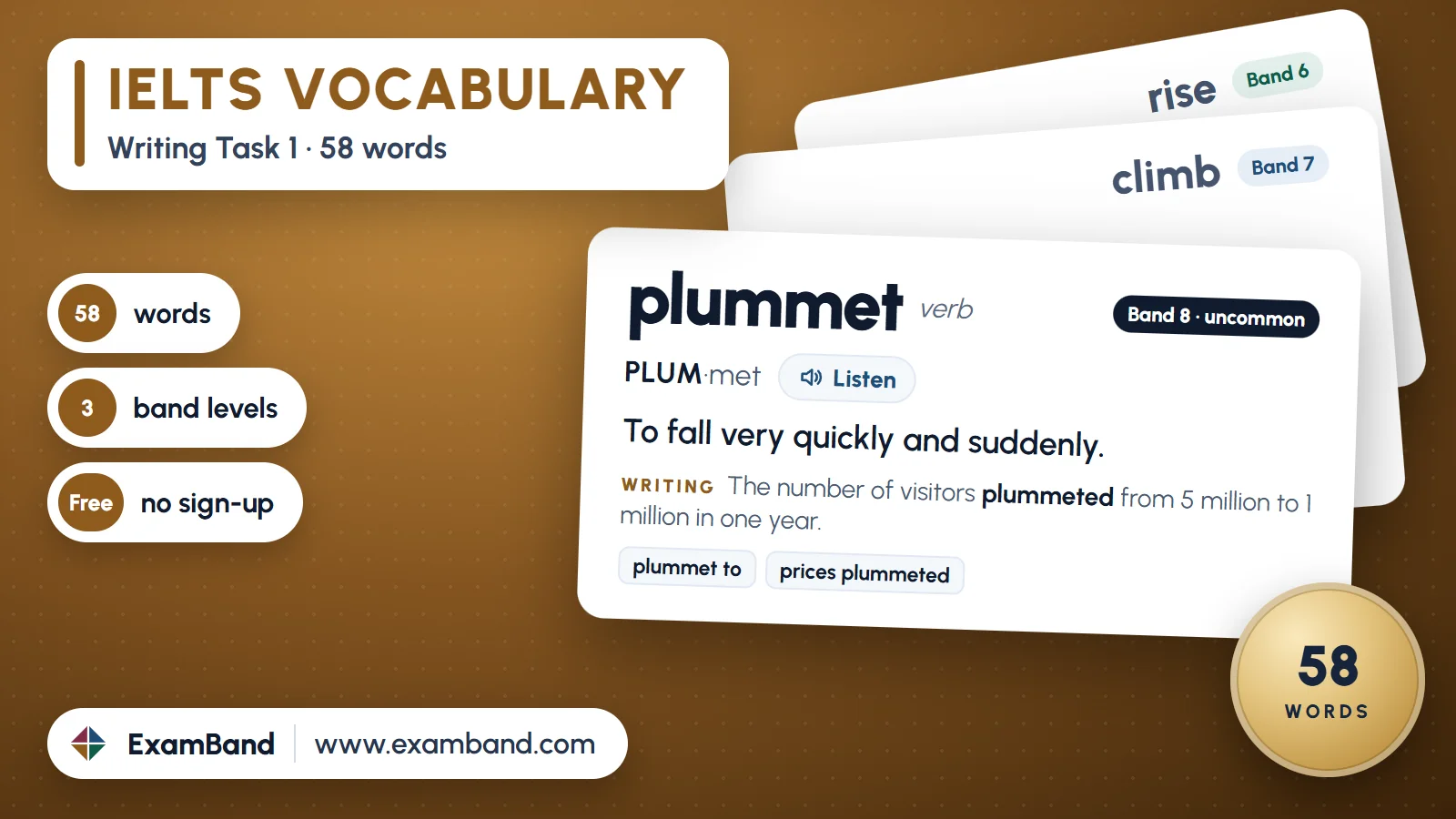
Questions about IELTS Writing Task 1 vocabulary
How do I learn these writing task 1 words?
Learn about ten words a day. First, read the meaning, listen to the word and say it out loud with the right stress. Then test yourself with the quiz and the flashcards on this page. Finally, use five of the words in an essay and check it with our free Writing Checker.
Which words should I learn first?
Start with the band 6 words, because you need them to explain any idea clearly. After that, add the band 7 words. However, use the band 8 words only when you are sure of their meaning, because a rare word used wrongly can lower your score.
Are these official IELTS words?
No. IELTS has no official word list. Instead, our levels follow the words of the public IELTS band descriptors: band 7 asks for some “less common” words, and band 8 for “uncommon” words used with skill.