IELTS Speaking Part 3: question types, a simple answer method and band 7 samples
IELTS Speaking Part 3 is the last part of the Speaking test. It is a 4–5 minute discussion with the examiner about more general questions linked to your Part 2 topic. Here you move from your own life to people and society, so you need to give opinions, explain reasons and compare ideas. This guide explains how Part 3 works, the seven question types and a simple 4-step way to answer. You will also find four band 7 sample answers and 18 practice questions.
What is IELTS Speaking Part 3?
IELTS Speaking Part 3 is a two-way discussion. The examiner asks further questions connected to your Part 2 topic, and you discuss them in a more general and abstract way (IELTS). It lasts 4–5 minutes. The whole Speaking test takes 11–14 minutes, and it is the same in IELTS Academic and General Training.
In Part 2 you talked about yourself: a person, a place or something that happened to you. In Part 3, the examiner zooms out to the bigger picture. The British Council describes this as a move from the personal to the general, where you give opinions and speculate about wider issues (British Council).
Part 1
- How long
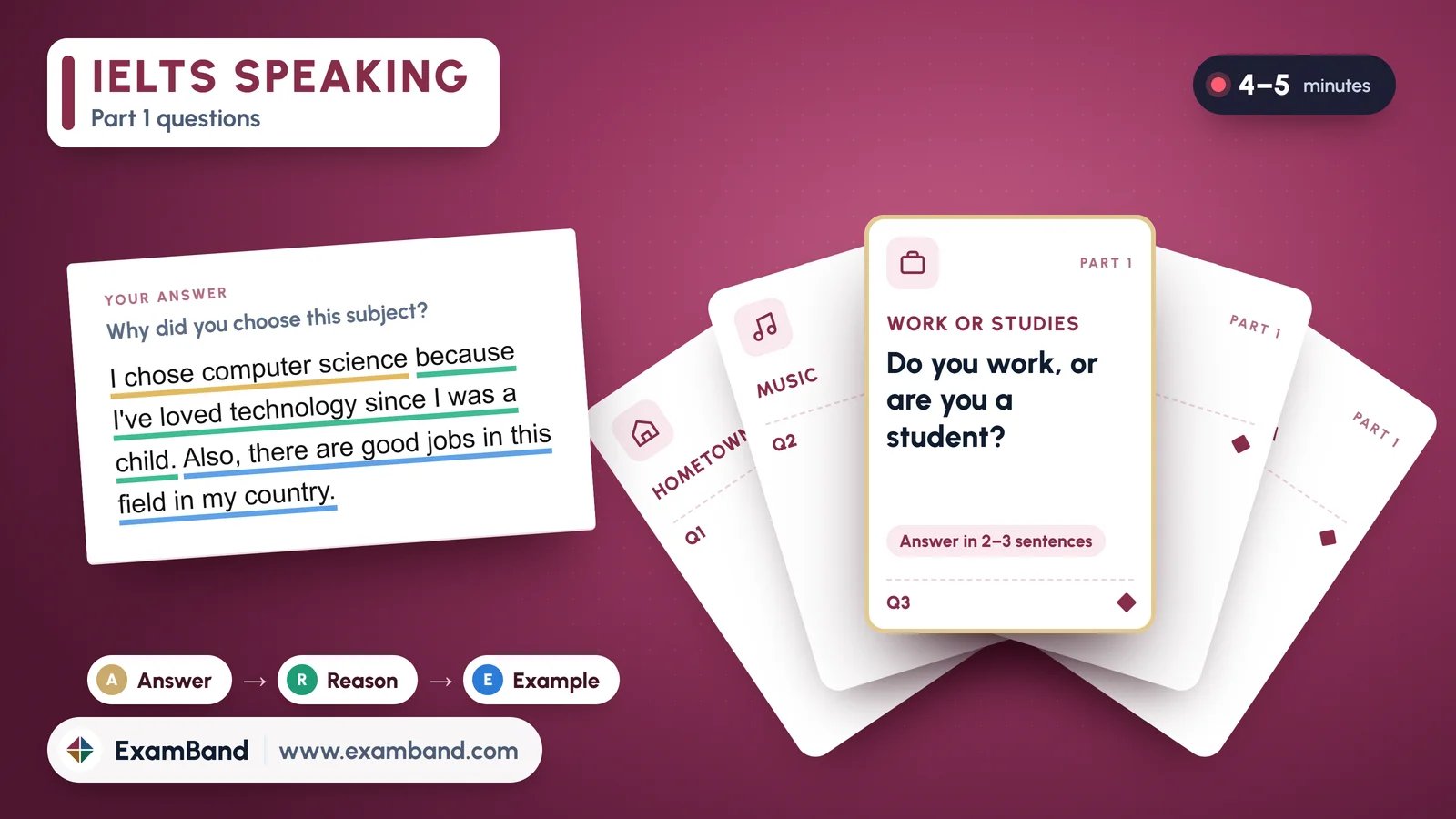
- 4–5 minutes
- What about
- You and your everyday life
- Answer length
- 2–3 sentences
- Main skill
- Answering simply and naturally
Part 2
- How long
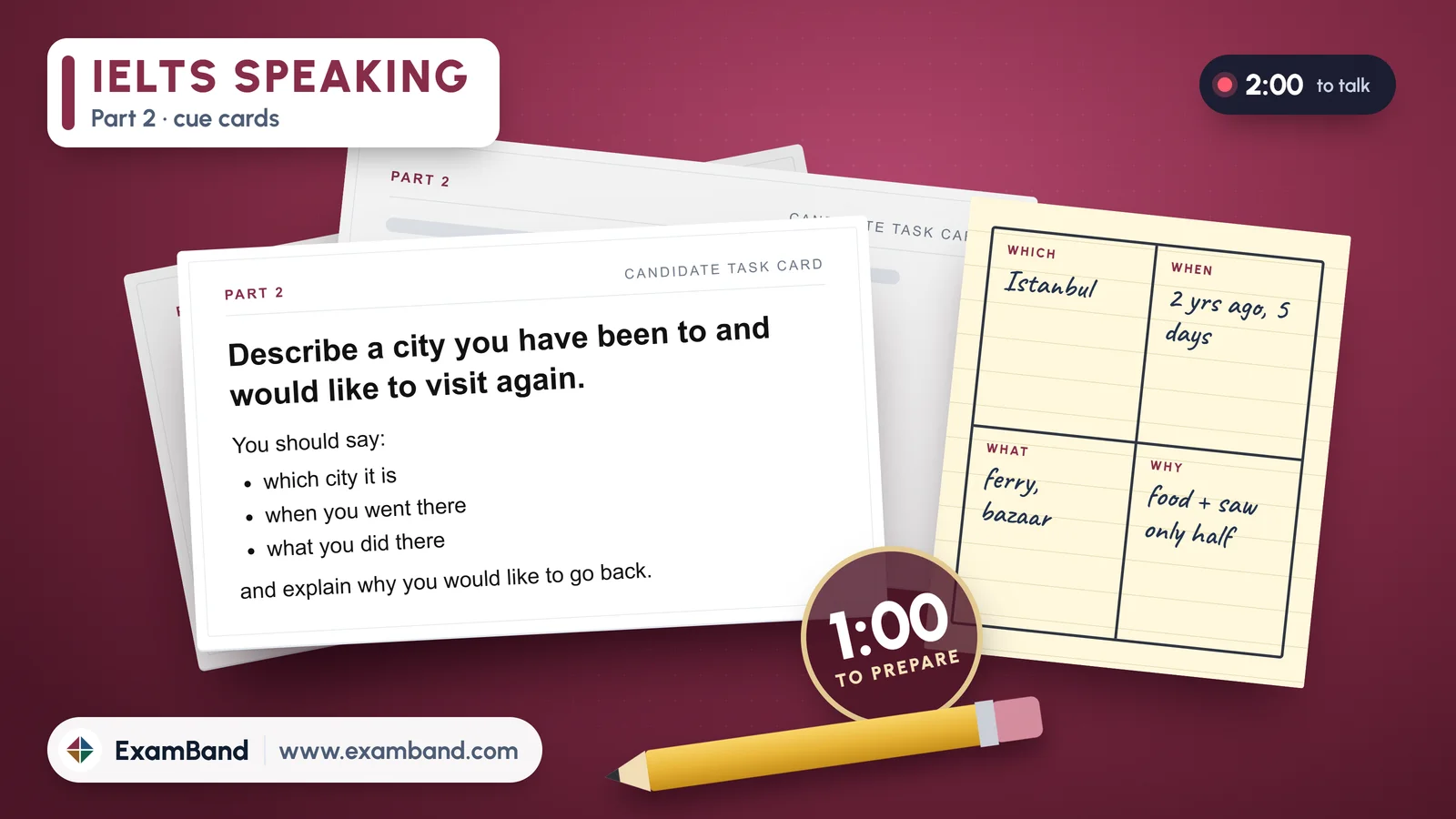
- 3–4 minutes, with 1 minute to prepare
- What about
- One story from your life, from a card
- Answer length
- Up to 2 minutes
- Main skill
- Speaking at length
Part 3
- How long
- 4–5 minutes
- What about
- People, society and ideas
- Answer length
- 3–5 sentences
- Main skill
- Giving and explaining opinions
How IELTS Speaking Part 3 is marked
There is no separate score for Part 3. The examiner gives you one Speaking band for the whole test, using four criteria that count equally. However, Part 3 is where you can show your best English. IDP says this part tests your ability to express and justify opinions, and to analyse, discuss and speculate about issues (IDP).
Fluency and Coherence
Can you keep talking, in a clear order?
You speak at length without noticeable effort, and your ideas stay clear. Some hesitation, repetition or self-correction is fine, and you use linking words with some flexibility.
Lexical Resource
Do you have the words for the topic?
You use vocabulary flexibly on different topics, including some less common words and idioms, with a few wrong choices. When you don't know a word, you paraphrase well.
Grammatical Range and Accuracy
Are your sentences varied and correct?
You use a range of complex structures with some flexibility. Many of your sentences have no errors, although some mistakes remain.
Pronunciation
Are you easy to understand?
You can be understood throughout, with only a few unclear words, and you use stress and intonation well most of the time. Having an accent is fine.
The band 7 lines paraphrase the official public band descriptors (IELTS). Also, you are not marked on your opinions, so there are no right or wrong answers (British Council). An unusual view, explained well, scores as well as a popular one.
The 7 types of IELTS Speaking Part 3 questions
Part 3 questions come in a few common shapes. Once you recognise the shape, you know what your answer must do. Here are seven types, each with an example from our practice questions and phrases that fit it.
Opinion
What do you think?
Do you think top sports players are paid too much?
Give a clear view, then explain it.
- I'd say that…
- In my view,…
- I'm not sure, but I think…
Explain why
What is the reason?
Why do some people remember a good teacher for the rest of their lives?
Give one or two reasons and explain each one.
- One reason is that…
- This is mainly because…
- Another factor is…
Compare
How is it different?
Are young people today more ambitious than their parents were at their age?
Compare two times, places or groups of people.
- Compared with…
- …whereas…
- These days…, but in the past…
Predict the future
What will happen?
Will gift cards and money replace traditional presents in the future?
Make a careful guess and give a reason for it.
- I imagine that…
- It's quite likely that…
- In twenty years' time,…
Advantages and disadvantages
What is good and bad about it?
What are the advantages and disadvantages of working in a team?
Give one of each, then say which is stronger.
- The main advantage is…
- On the other hand,…
- Overall, I think…
Solve a problem
What can be done?
How could big cities help people who feel lonely?
Suggest a solution and say who should act.
- One solution would be to…
- Governments could…
- It would help if…
Agree or disagree
Is this statement true?
Some people say that failure teaches us more than success. Do you agree?
Agree, disagree or partly agree, and say why.
- I partly agree, because…
- That's true to some extent, but…
- I can see why people say that, but…
Some questions mix two types, for example “Why is this happening, and what can be done about it?”. In that case, answer both parts, because the examiner asked for both.
How to answer: a simple 4-step method
A good Part 3 answer is longer than a Part 1 answer, but it is not a speech. IDP suggests a simple structure that works for any question (IDP). We call it Answer, Reason, Example, Other side.
Do you think top sports players are paid too much?
- Answer Answer the question directly in your first sentence.
“Yes, I'd say the very top players are paid far more than their work is worth.”
- Reason Explain why. This is where your linking words and complex sentences go.
“Their salaries come from huge television deals and sponsors, so the money depends on fame, not on how useful the job is.”
- Example Give a short real example from your city, your country or the news.
“For example, some footballers earn more in a week than a nurse does in a whole year.”
- Other side Add another view, a result or a future change. Then stop.
“On the other hand, their careers are short, and only a tiny number of players ever reach that level.”
That answer has four sentences and takes about 30 seconds to say. Most good Part 3 answers are 3–5 sentences long. If you speak for much longer, you may start to repeat yourself or move away from the question. In that case, the examiner may stop you and ask the next one.
IELTS Speaking Part 3 sample answers (band 7)
Here are four band 7 sample answers to questions linked to four of our Part 2 cue cards. Each one follows the 4-step method, and the useful phrases are highlighted. They are our own answers, and the band is a teaching estimate, not an official score.
Why is traffic getting worse in so many cities?
I think the main reason is simply that there are far more cars on the roads than there used to be.
As people earn more money, a car is often one of the first big things a family buys, but city roads can't grow at the same speed.
In my city, for instance, the drive to the airport used to take about twenty minutes, and now it can easily take an hour in the evening.
Having said that, things may improve as more cities build metro lines, but only if people are willing to leave their cars at home.
Why it works: It answers the “why” directly, explains the cause, gives a real example and ends with a look at the future.
- the main reason is simply that
- than there used to be
- can't grow at the same speed
- for instance
- Having said that
- only if people are willing to
Do people trust the news less than they used to?
Yes, I'd say most people are much more careful about what they believe these days.
In the past, there were only a few newspapers and TV channels, so people tended to accept what they were told. Now anyone can post a story online, and false stories spread very quickly.
My grandparents, for example, still believe almost everything on the evening news, whereas my friends usually check two or three sources first.
Oddly enough, that might be a good thing, because it makes people think more carefully about where information comes from.
Why it works: It compares the past with now, uses a contrast with “whereas”, and the last sentence adds a fresh point instead of repeating the first.
- I'd say
- these days
- tended to accept
- whereas
- Oddly enough
- think more carefully about
Who should be responsible for keeping rivers clean?
In my opinion, it has to be a shared responsibility, but governments should take the lead.
Only governments can pass laws that stop factories from pouring waste into rivers, and they have the money to check that companies follow those laws.
A few years ago, a river near my hometown was so polluted that nobody could swim in it, and it only recovered after the local council fined the factories along its banks.
Still, ordinary people play a part too, because no law can stop someone from throwing rubbish into the water.
Why it works: The opinion is clear in the first sentence, the reason uses a complex sentence, and the answer shows the other side without changing the view.
- In my opinion
- a shared responsibility
- take the lead
- so polluted that
- Still,
- play a part
Will technology change the way people make friends in the future?
It probably will, although I don't think it will ever replace meeting people face to face.
More and more people already meet through apps and online games, and as those become more realistic, starting a friendship online will feel even more natural.
My younger brother, for example, has a close friend in Canada whom he has never actually met, and they talk every day while they play.
Even so, I suspect the deepest friendships will still begin at school or at work, because sharing real experiences brings people closer.
Why it works: It speculates carefully with “probably” and “I suspect”, gives a reason and an example, and ends with a balanced view.
- It probably will
- More and more people
- as those become more realistic
- whom he has never actually met
- Even so
- I suspect
Notice what the four answers share. Each one starts with a clear answer, and none of them is about the speaker's own life alone. Also, the useful phrases are ordinary English used well, not rare words.
Useful phrases for IELTS Speaking Part 3
You don't need rare words in Part 3. Instead, you need a small set of phrases for the jobs you do again and again: giving a view, explaining, comparing and guessing about the future. Use them naturally, not in every sentence.
Giving your opinion
- I'd say that…
- In my view,…
- Personally, I think…
- I'm not an expert, but I'd guess that…
Explaining a reason
- This is mainly because…
- One reason is that…
- That's partly due to…
- The thing is,…
Giving an example
- For instance,…
- Take my city, for example.
- A good example of this is…
Comparing
- Compared with the past,…
- …whereas…
- These days…, but when my parents were young…
Talking about the future
- I imagine that…
- It's quite likely that…
- I suspect that…
- There's a good chance that…
Showing the other side
- Having said that,…
- On the other hand,…
- Even so,…
- That said,…
Buying time
- That's an interesting question.
- Let me think about that for a second.
- I've never really thought about that, but…
If you don't understand
- Could you rephrase that, please?
- Sorry, do you mean…?
- Could you explain what you mean by…?
In Part 3, you can ask the examiner to rephrase a question if you don't understand it (IDP). Just don't do it for every question.
7 mistakes to avoid in IELTS Speaking Part 3
In ten years of teaching IELTS, the Part 3 problem I hear most often is the one-sentence answer. Here are seven mistakes to avoid.
- Talking only about yourself
Part 3 is about people and society. Use personal examples, but only to support a general point.
- One-sentence answers
“Yes, I agree.” gives the examiner almost nothing to mark. So add a reason, an example and the other side.
- Speeches that never end
Very long answers often repeat ideas or drift away from the question. Make your point in 3–5 sentences, then stop.
- Memorised answers
Examiners are trained to notice learned answers, and these rarely fit the exact question. Learn phrases, not speeches.
- Saying “I don't know” and stopping
You don't need to be an expert. Say what you think, or explain why the question is hard to answer.
- Too many fillers
Saying “um”, “like” and “you know” all the time sounds as if you can't find the words. A short pause or “Let me think” is better.
- Answering a different question
If the question asks about the future, talk about the future. Listen for the question word: why, how, will or should.
IELTS Speaking Part 3 questions to practise
Here are 18 practice questions for six Part 2 cue cards from our list of IELTS cue cards. We wrote the questions ourselves, so they are not from real tests. First talk about the card for two minutes, then answer its three Part 3 questions out loud.
Traffic: Describe a time you were stuck in a traffic jam
- Why is traffic getting worse in so many cities?
- What could governments do to persuade more people to use public transport?
- Will people still want to own a car in the future?
News: Describe a piece of local news that interested you
- Do people trust the news less than they used to?
- Why are some people more interested in news about celebrities than in local news?
- How can people tell whether a news story is true?
Water: Describe an important river, lake or area of water in your country
- Who should be responsible for keeping rivers clean?
- Why have so many cities grown up next to rivers or the sea?
- Will some countries run short of clean water in the future?
Friends: Describe a friend from your childhood
- Will technology change the way people make friends in the future?
- Is it easier for children or for adults to make new friends?
- Why do some friendships last for many years while others end quickly?
Sport: Describe a live sports event you watched
- Do you think top sports players are paid too much?
- Why do many people enjoy watching sport more than doing it?
- Why do some sports become popular all over the world, while others stay local?
Learning: Describe a course or lesson that impressed you
- Why do some people remember a good teacher for the rest of their lives?
- How will classrooms change in the next twenty years?
- Are exams the best way to measure what students have learned?
Practise IELTS Speaking Part 3 out loud
Reading sample answers helps, but Part 3 is a skill you build by speaking. Our free Speaking Practice Test 1 works like the real test: an examiner asks you Part 1 questions, gives you a cue card with one minute to prepare, and then asks you Part 3 questions out loud. Your whole test is recorded, so you can listen to yourself afterwards.
When you finish, you can get AI Speaking feedback for $4: an estimated band for fluency, vocabulary and grammar, and your own sentences corrected. It is an estimate, not an official IELTS score. Pronunciation is not marked, because the AI reads what you said but cannot hear how you said it.
Questions about IELTS Speaking Part 3
How long is IELTS Speaking Part 3?
About 4–5 minutes. It comes straight after Part 2, and the whole Speaking test takes 11–14 minutes.
How long should my answers be in IELTS Speaking Part 3?
Usually 3–5 sentences. That gives the examiner enough English to mark, and it leaves time for several questions.
Is IELTS Speaking Part 3 harder than Part 1 and Part 2?
It usually feels harder, because the questions are more general and abstract. However, there is no separate score for Part 3: the examiner marks the whole test on the same four criteria.
What if I don't understand a Part 3 question?
Ask the examiner to rephrase it, for example “Could you rephrase that, please?”. This is fine in Part 3, but don't do it for every question.
What if I know nothing about the topic?
You are marked on your English, not on your knowledge or your opinions. So say what you think and give a reason, or explain why the question is difficult. A guess with a reason is better than “I don't know”.
Can I talk about myself in IELTS Speaking Part 3?
Yes, as an example. But Part 3 asks about people and society, so use your own experience to support a general point.
Are these real IELTS Speaking Part 3 questions?
No. IELTS does not publish its questions. We wrote these practice questions ourselves, and each set follows a Part 2 cue card that test takers report.
Can I practise IELTS Speaking Part 3 online?
Yes. ExamBand's free Speaking Practice Test 1 has all three parts, with an examiner who asks every question out loud, and your whole test is recorded.
Read next: IELTS Speaking Part 1 questions, with band 7 answers · IELTS cue cards: 18 Part 2 topics with sample answers
Facts checked on 19 October 2026 with official sources
- IELTS: Speaking test format (IELTS Academic)
- IELTS: Speaking band descriptors (PDF)
- British Council: How the IELTS Speaking test works
- British Council: IELTS Academic Speaking preparation
- British Council: Speaking Part 3 overview and practice (PDF)
- IDP: How to perform at your best in Part 3 of the Speaking test
- IDP: 3 parts of IELTS Speaking, and what to look out for
- IDP: Functional language can improve IELTS Speaking performance