IELTS cue cards for September–December 2026: Speaking Part 2 topics and sample answers
IELTS cue cards are the topic cards in Speaking Part 2. The examiner gives you a card, you get one minute to make notes, and then you talk for up to two minutes. Below you will find the 18 cue cards that test takers report most for September–December 2026, a simple way to use your minute, and three sample answers you can learn from.
What happens in IELTS Speaking Part 2?
Part 2 is called the long turn, because you speak alone. The examiner gives you a task card with a topic. The card tells you what points to include, and it asks you to explain one part of the topic. You have one minute to prepare, and the examiner gives you a pencil and paper for notes (IELTS).
Then the examiner asks you to start. You talk for up to two minutes, and the examiner stops you when the time is up. After that, the examiner may ask you one or two short questions on the same topic. The whole of Part 2 takes 3–4 minutes, including the minute to prepare.
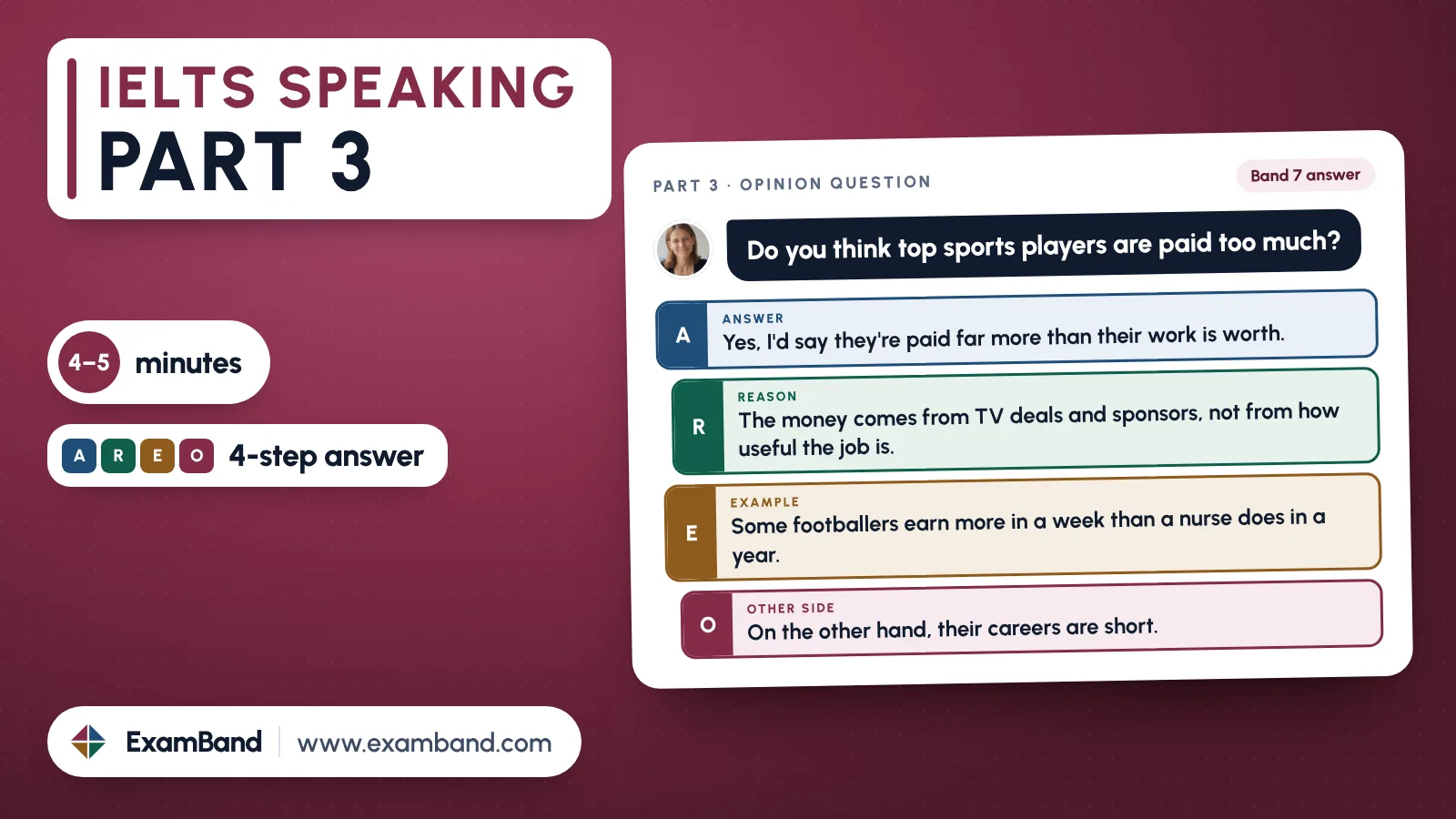
Part 3 comes next. In Part 3, the examiner asks you more general questions about the same topic, for 4–5 minutes. So the card you get in Part 2 also decides what you discuss in Part 3. Our IELTS Speaking Part 3 guide shows how to answer those questions.
How to read a cue card
Every card follows the same pattern. First there is the topic, which starts with Describe. Then there are three points that start with a question word, such as who, where or when. Finally, there is one last line that starts with and explain (IDP).
Describe a city you have been to and would like to visit again.
You should say:
- which city it is
- when you went there
- what you did there
and explain why you would like to go back.
The three points are your plan, so talk about them in order. However, the last line is the most important part. It asks for reasons and feelings, and that is where you can show your best English. So keep the most time for it.
How to use your one minute: the 4-box notes
Do not write sentences in your minute. Instead, draw a cross on your paper to make four boxes: one box for each point, and one for the last line. Then write two or three key words in each box, such as names, places, times and feelings. You are not marked on your notes, so spelling does not matter.
When the examiner asks you to start, follow your boxes from the first to the last. As a rough guide, spend about 20 seconds on each of the three points. Then spend the rest of your time, about a minute, on the last line.
IELTS cue cards for September–December 2026
IELTS does not publish its cue cards, so no list is official. To find the topics that come up most, we compared the September–December 2026 lists of four IELTS websites. Then we kept only the topics that at least three of them report. These are the 18 IELTS cue cards that test takers mention most this season.
Cue cards about people
Describe a person you met only once and would like to know more about.
You should say:
- who this person is
- where you met
- what you talked about
and explain why you would like to know more about them.
Describe a friend from your childhood.
You should say:
- who this friend is
- how you met
- what you did together
and explain how your friendship has changed.
Describe a person who faced difficulties but succeeded.
You should say:
- who this person is
- what the difficulties were
- how they dealt with them
and explain what you learned from this person.
Cue cards about places
Describe a city you have been to and would like to visit again.
You should say:
- which city it is
- when you went there
- what you did there
and explain why you would like to go back.
Describe a place you have visited that you would recommend to others.
You should say:
- where it is
- when you went there
- what people can do there
and explain why you would recommend it.
Describe a noisy place you have been to.
You should say:
- where it was
- when you went there
- what made it noisy
and explain how you felt there.
Describe an important river, lake or area of water in your country.
You should say:
- where it is
- what it looks like
- what people do there
and explain why it is important.
Cue cards about things
Describe a gift you would like to buy for a friend.
You should say:
- what the gift is
- who it is for
- where you would buy it
and explain why you chose this gift.
Describe a special cake you received from someone.
You should say:
- who gave it to you
- what it looked and tasted like
- why you received it
and explain why it was special.
Cue cards about events and experiences
Describe a live sports event you watched.
You should say:
- what the event was
- where you watched it
- who you were with
and explain why you remember it.
Describe an enjoyable evening you spent with friends.
You should say:
- when it was
- where you went
- what you did
and explain why you enjoyed it.
Describe a course or lesson that impressed you.
You should say:
- what it was about
- when and where you took it
- who taught it
and explain why it impressed you.
Describe a time you worked as part of a team.
You should say:
- what the task was
- who was in the team
- what you did
and explain how you felt about the result.
Describe a time you were stuck in a traffic jam.
You should say:
- when it happened
- where you were
- what you did while you waited
and explain how you felt.
Describe an important decision you made.
You should say:
- what the decision was
- when you made it
- how you decided
and explain how you feel about it now.
Describe a time you changed an important plan.
You should say:
- what the plan was
- why you changed it
- what you did instead
and explain whether it was the right choice.
Cue cards about plans and news
Describe a long-term goal you would like to achieve.
You should say:
- what the goal is
- why you chose it
- how you plan to achieve it
and explain how you will feel when you achieve it.
Describe a piece of local news that interested you.
You should say:
- what the news was
- how you heard about it
- who it affected
and explain why it interested you.
Many cards are close to each other. For example, a story about a city can also answer the card about a place to recommend. So prepare one good story for each group, and then practise changing it to fit a new card.
Sample answers for three IELTS cue cards
Here are three sample answers, one for a person, one for a place and one for an experience. Each one is about two minutes long when you speak at a natural speed. Read them for the plan and the useful phrases, but do not learn them by heart. The examiner can tell when an answer is memorised, and that may lower your band (IDP).
Describe a person you met only once and would like to know more about.
I'd like to talk about an elderly man I met on a train last summer. I was travelling to Kandy to visit my cousins, and the journey took about four hours, so we had plenty of time to chat.
He was probably in his seventies, and he told me he used to teach geography at a secondary school. At first, we only talked about the weather and the view, because the train climbs through beautiful green hills. But then he opened a small notebook and showed me drawings of places he had visited. It turned out that he had travelled to more than forty countries, mostly by bus and train, and he had never owned a mobile phone.
What surprised me most was how calm and curious he was. He asked me lots of questions about my studies, and he really listened to my answers, which doesn't happen very often these days. He even recommended a small café near the lake in Kandy, and I went there the next day.
The reason I'd like to know more about him is his travel stories. He only had time to tell me two of them before I got off, and I still think about them. I'd love to know how he planned his trips without the internet, and what he learned from meeting so many different people. Unfortunately, I didn't ask for his address, and I regret that. If I ever met him again, I would definitely ask him to tell me the rest of his stories.
Useful phrases
- It turned out that
- which doesn't happen very often these days
- The reason I'd like to … is
- If I ever met him again, I would
The examiner might then ask
- Do you often talk to strangers?
- Do you think it is easy to make friends on a journey?
Describe a city you have been to and would like to visit again.
The city I'd like to describe is Istanbul, in Turkey. I went there two years ago with my older sister, and we stayed for five days in a small hotel near the old part of the city. It was my first trip abroad, so everything felt new and exciting.
We did a lot in a short time. On the first day, we visited the famous mosques and the Grand Bazaar, which is a huge covered market with thousands of shops. I remember that we got lost there for almost an hour, but it was fun because we kept finding new things to look at. My favourite part, though, was taking the ferry across the Bosphorus. It only cost about a dollar, and in twenty minutes you travel from Europe to Asia, which still sounds amazing to me. In the evenings, we walked along the water and watched the sun go down behind the mosques.
There are two main reasons why I'd like to go back. The first is the food. Every morning we had a big Turkish breakfast with cheese, olives, eggs and fresh bread, and I've never found anything like it at home. The second reason is that five days weren't nearly enough. We only saw the most popular places, so I feel I've seen just half of the city. Next time, I'd like to stay longer and explore the quieter neighbourhoods where local people actually live, and maybe take a day trip to one of the islands. I'm already saving money for that trip.
Useful phrases
- My favourite part, though, was
- which still sounds amazing to me
- There are two main reasons why
- weren't nearly enough
The examiner might then ask
- Do you prefer travelling alone or with other people?
- Is your own city a good place for tourists?
Describe a time you were stuck in a traffic jam.
I'm going to talk about a time I was stuck in a terrible traffic jam last March. It was a Friday, at about five in the evening, and I was driving home from work on the ring road near the airport.
Suddenly, all three lanes stopped completely. I found out later that two lorries had crashed about a kilometre ahead, so nobody could move at all. There was nowhere to turn off, so we just had to sit and wait. In the end, I was stuck there for almost two hours.
At first, I didn't know what to do. I phoned my mum to tell her I would be late for dinner, and then I put on a long podcast about history. My phone battery was getting low, though, so I had to be careful. After a while, I started watching the people in the other cars. In the car next to mine, there was a family with two small children, and the kids were playing a game with their dad, so they were laughing the whole time.
As for how I felt, I was really angry at the beginning, because I had been looking forward to a relaxing evening. But watching that family slowly changed my mood. I realised that being angry wouldn't make the traffic move any faster, so I might as well relax. Since then, I always leave a bit earlier on Fridays, and I keep a few podcasts on my phone, just in case. In a strange way, it became a quiet evening that I still remember.
Useful phrases
- In the end,
- After a while,
- As for how I felt,
- I might as well
- just in case
The examiner might then ask
- Is traffic a big problem where you live?
- How do you usually travel to work or school?
5 mistakes that cost marks in Part 2
Stopping after one minute
If you stop early, the examiner waits for you to continue. Go back to your notes and add an example or a feeling. Two full minutes show that you can speak at length.
Learning answers by heart
Examiners notice memorised answers, and this may lower your band. Learn a plan and some phrases instead, and then use your own words on the day.
Forgetting the last line
Many students talk about the three points and never get to the “explain” part. However, that is where you give reasons and feelings, so keep about a minute for it.
Writing sentences in your minute
A sentence takes too long to write. Write key words in four boxes, because you only need enough to remind you what to say next.
Panicking when the examiner stops you
The examiner stops everyone at two minutes. It does not matter if you have not finished your last idea, because you have already shown that you can keep talking.
Practise a real Part 2 with a timer
Reading IELTS cue cards helps, but the real skill is speaking for two minutes with almost no time to prepare. That is why our free Speaking Practice Test 1 works like the real test. An examiner gives you a cue card, a timer counts your one minute, and you can type notes while you prepare. Then you talk while the timer counts your two minutes, and Part 3 follows.
When you finish, you can get AI Speaking feedback on your recording: an estimated band, marks for fluency, vocabulary and grammar, and your own sentences corrected. It is an estimate, not an official IELTS score.
Questions about IELTS cue cards
What is a cue card in IELTS?
A cue card is the task card in Speaking Part 2. It gives you a topic, three points to talk about and a last line that asks you to explain something. You get one minute to prepare and then talk for up to two minutes.
How long should I speak in Part 2?
Aim to speak for the full two minutes. The examiner stops you when the time is up, so you do not need to finish your last sentence. The whole of Part 2, with the minute to prepare, takes 3–4 minutes.
Can I write notes during the preparation time?
Yes. The examiner gives you a pencil and paper, and you can write notes for the whole minute. Your notes are not marked, so write key words, not sentences.
Are these the official IELTS cue cards for September–December 2026?
No. IELTS does not publish its cue cards. These 18 topics are the ones that test takers report most on four IELTS websites this season, so use them to practise the skill, not to learn answers.
Does my story have to be true?
The examiner marks your English, using four criteria: fluency and coherence, vocabulary, grammar and pronunciation. None of them is about whether your story is true. Still, a real memory is usually easier to talk about for two minutes.
Read next: IELTS Speaking Part 3: question types, a simple answer method and band 7 samples
Facts checked on 17 October 2026 with official sources