IELTS Speaking Part 1 questions are short questions about you and your everyday life. Part 1 lasts 4–5 minutes, and the examiner asks about a few familiar topics. Below you will find the topics that test takers report for September–December 2026, practice questions for each one, and sample answers you can learn from.
What happens in IELTS Speaking Part 1?
The whole Speaking test takes 11–14 minutes and has three parts. It is a face-to-face interview with an examiner, and it is recorded. In Part 1, the examiner introduces himself or herself and checks your identity. After that, the examiner asks general questions on familiar topics, such as home, family, work, studies or interests (IELTS). Part 2 is a talk from a cue card, and Part 3 is a discussion.
The examiner reads the questions from a script, so every question is short and clear. However, if your answer is very short, the examiner may ask you “Why?” to help you say more. So it is better to add a reason from the start.
The 4 topics almost every test starts with
Most IELTS Speaking Part 1 questions start with you. In most reports, these first questions are about one of four topics, so prepare all four. One of them will very likely be your first question.
Work or studies
- Q1Do you work, or are you a student?
- Q2Why did you choose this job or this subject?
- Q3What is the most difficult part of your work or studies?
“Why did you choose this subject?”
I chose computer science because I've loved technology since I was a child. Also, there are good jobs in this field in my country. The hardest part is maths, to be honest, but I'm getting better at it.
Home and accommodation
- Q1Do you live in a house or an apartment?
- Q2Which room in your home do you like most, and why?
- Q3Who do you live with?
Hometown
- Q1Where is your hometown?
- Q2What is your hometown famous for?
- Q3How has your hometown changed since you were a child?
The area you live in
- Q1Is the area where you live quiet or noisy?
- Q2What can people do in your area when they want to have fun?
- Q3If you could, would you move to a different area?
IELTS Speaking Part 1 questions: September–December 2026 topics
We compared the topic lists of four IELTS teaching websites, and then we kept only the topics that at least three of them report. As a result, these are the 31 topics that test takers mention most this season.
About you
Things in daily life
Free time and culture
Learning and ideas
Red cards: practice questions for this topic are in this article.
IELTS does not publish the Speaking topics, and the examiner can ask about any everyday subject. So use this list to practise, not as a promise of what will come up.
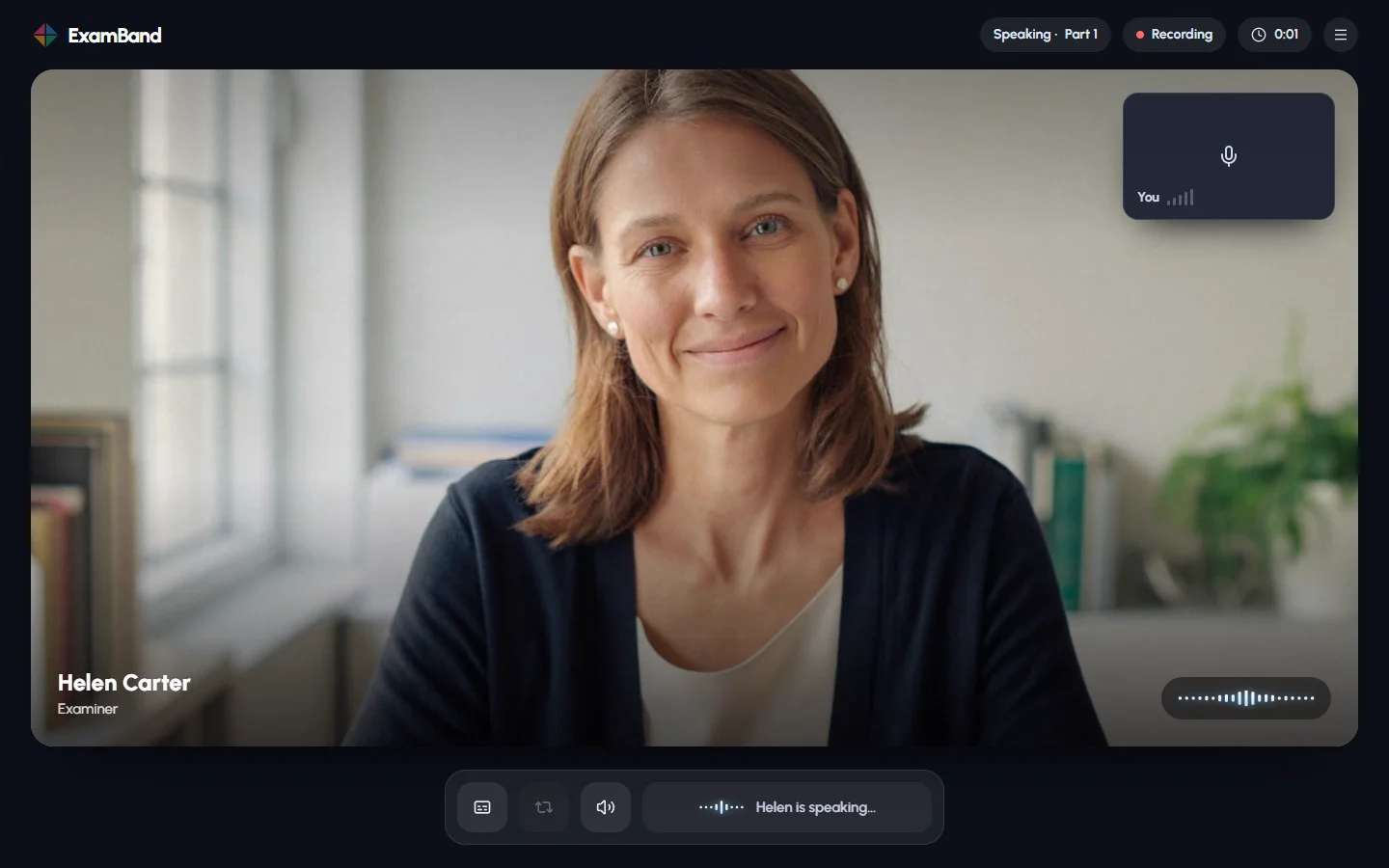
Hear the questions like on test day
Our free Speaking test works like the real one: an examiner asks you Part 1, 2 and 3 questions, and you answer out loud.
Start the free Speaking testIELTS Speaking Part 1 questions with band 7 sample answers
Here are IELTS Speaking Part 1 questions for eight of the most reported topics. Each topic has one sample answer at about band 7. Read it, notice the useful phrases, and then give your own answer out loud.
Technology: IELTS Speaking Part 1 questions
Headphones
- Q1Do you use headphones a lot?
- Q2When you listen to music at home, do you use headphones or speakers?
- Q3Would you pay a lot for good headphones if they lasted for years?
“Do you use headphones a lot?”
Yes, especially on the way to work. I wear them on the bus so I can listen to podcasts, and they also block out the noise of the traffic. I try not to wear them for too long, though, because my ears start to hurt after a few hours.
Watches
- Q1Do you wear a watch?
- Q2Do you think watches are still useful now that we all have phones?
- Q3Have you ever received a watch as a gift?
“Do you wear a watch?”
Not really. I used to wear one when I was at school, but now I just check the time on my phone. My father still wears the same watch he bought twenty years ago, though, and he says it has never let him down.
Things at home and daily life
Mirrors
- Q1How often do you look in the mirror?
- Q2Do you think people look in mirrors too much?
- Q3If you could, would you put a big mirror in your living room?
“How often do you look in the mirror?”
A few times a day, I suppose. I check my hair before I leave home, and then maybe once more before a meeting. I don't spend long in front of it, though, unlike my sister, who can stand there for ages!
Shopping
- Q1Do you prefer shopping online or in shops?
- Q2How often do you go shopping?
- Q3Do you enjoy shopping more when you go with friends?
“Do you prefer shopping online or in shops?”
It depends on what I'm buying. For books and electronics I shop online, because it's quicker and usually cheaper. But for clothes I'd rather go to a real shop, so I can try things on and avoid sending them back.
Morning routines
- Q1What do you usually do in the morning?
- Q2Are you a morning person?
- Q3Has your morning routine changed since you were a child?
“What do you usually do in the morning?”
Actually, on weekdays my mornings are quite busy. I get up at half past six, make a quick coffee and check my emails before work. At weekends, however, it's completely different: I sleep in and have a long breakfast with my family.
Free time and places
Music
- Q1What kind of music do you like?
- Q2When do you usually listen to music?
- Q3Did you learn to play an instrument when you were a child?
“What kind of music do you like?”
I listen to almost everything, but my favourite is acoustic music, like a singer with just a guitar. It helps me relax after a long day. When I'm studying, though, I prefer music without words, because lyrics distract me.
Old buildings
- Q1Are there many old buildings in your city?
- Q2Do you like visiting old buildings when you travel?
- Q3Should governments protect old buildings, even if it is expensive?
“Are there many old buildings in your city?”
Yes, especially in the city centre. There's a market from the nineteenth century that people still use today, and I love walking around it. However, many old houses near it have disappeared to make room for new apartments.
How to answer IELTS Speaking Part 1 questions
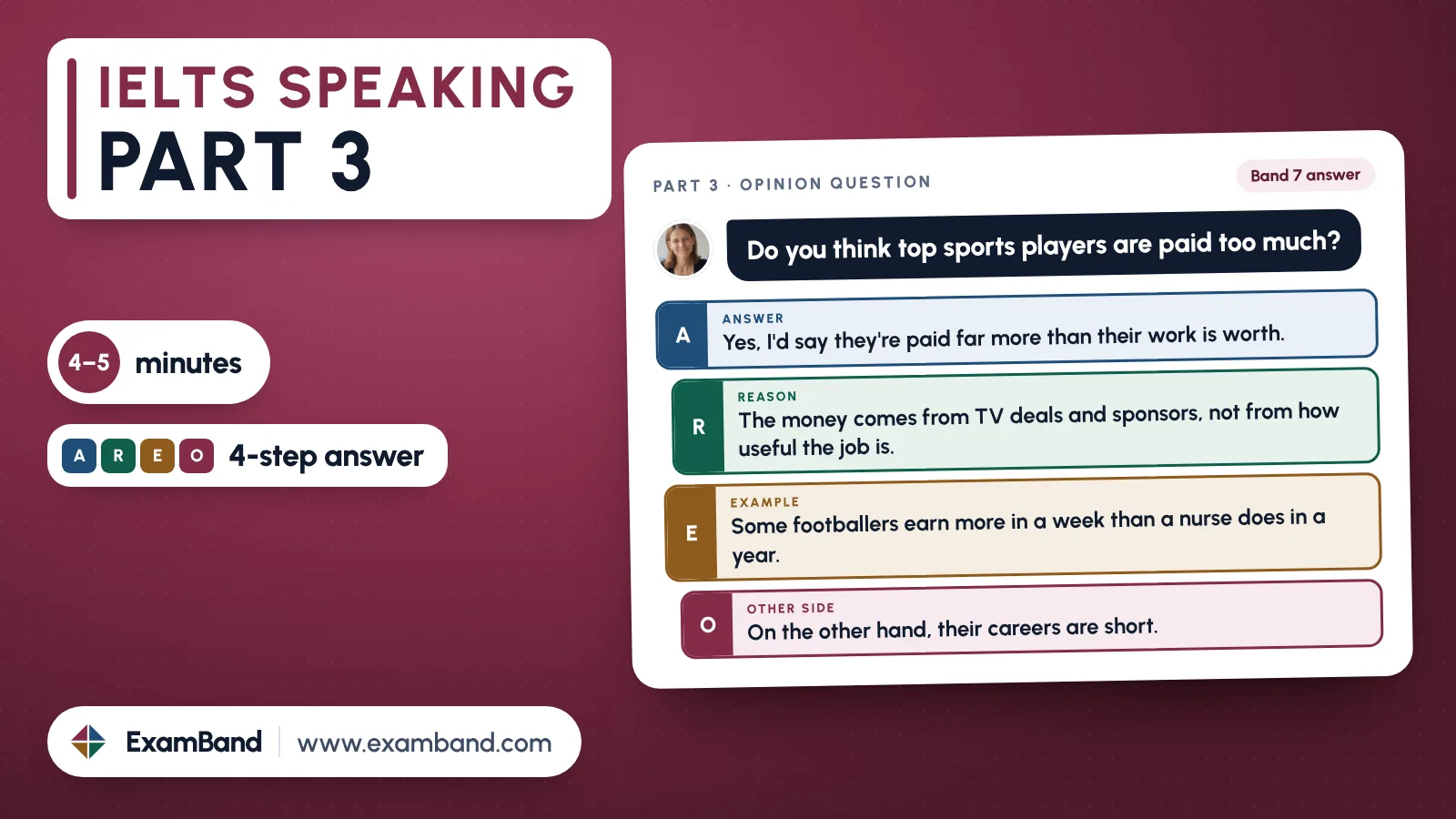
A good Part 1 answer is short, but it is never just one word. We teach our students a simple pattern for every answer: Answer, Reason, Example. First, answer the question directly. Next, give a reason. Finally, add a short example or detail. That is usually 2–3 sentences, which is the length the British Council recommends.
Use your own words
Try not to repeat the words in the examiner’s question. Instead, say the same idea in a different way. This is advice from IDP, one of the organisations that run IELTS.
Use the same tense as the question
If the question is “Did you…?”, answer in the past. If it is “Do you…?”, answer in the present.
Choose words you know well
Simple words used correctly are better than difficult words used wrongly. So choose words you are sure about.
Ask the examiner to repeat
If you did not hear or understand a question, politely say “Could you repeat that, please?”. IDP says this is “definitely acceptable”, and the British Council says it “will not affect your score”.
Take a moment to think
If you need a second, use a natural phrase such as “Let me think about that”. The British Council says a short pause like this is perfectly acceptable.
Don’t worry about your accent
IDP says your accent “does not affect your score”. What matters is that you are easy to understand.
Give your real opinion
There are no right or wrong answers, because the examiner marks your English, not your opinions.
5 mistakes that cost marks in Part 1
One-word answers
“Yes.” or “No, I don’t.” gives the examiner almost no English to mark, so always add a reason.
Memorised speeches
A learned answer often does not fit the exact question, and it sounds less natural. Use your own words instead.
Very long answers
Part 1 has many short questions. If you talk for a minute, the examiner has to stop you, so you lose time for other questions.
The wrong tense
If you answer “Did you like music as a child?” in the present tense, the examiner will notice the grammar mistake.
Repeating the question
“Do I like shopping? Yes, I like shopping.” uses the examiner’s words, not yours. Instead, start with your own answer.
How your Speaking is marked
The examiner gives one Speaking band for the whole test, using four criteria (IELTS). Since Part 1 is your first chance to show all four, a calm, clear start really helps.
| Criterion | What it means | A quick tip for Part 1 |
|---|---|---|
Fluency and coherence | You speak without long pauses, and your ideas are in a clear order. | Link your ideas with because, so, but and also. |
Lexical resource | You use a good range of words correctly. | Before your test, learn a few useful words for each topic in the list above. |
Grammatical range and accuracy | You use different sentence types, mostly without mistakes. | Mix short sentences with longer ones. |
Pronunciation | You are easy to understand, even with an accent. | Speak at a natural speed, and also practise numbers and word stress. |
Practise Part 1 on our free Speaking test
Reading answers is useful, but the real skill is answering out loud, with no time to prepare. That is why our free Speaking Practice Test 1 works like the real test: an examiner asks you the questions, and then you answer them in your own words. It starts with IELTS Speaking Part 1 questions about where you live, the weather and photographs.
Try IELTS Speaking Part 1 now, for free
No booking and no waiting: start the test in your browser. With an Exam Pass, you also get AI feedback with an estimated band and corrections of your own sentences.

Questions students ask about Part 1
How long is IELTS Speaking Part 1?
Part 1 lasts 4–5 minutes. Overall, the whole Speaking test takes 11–14 minutes and has three parts.
What topics come up in Part 1?
First, the examiner asks about you: your work or studies, your home or your hometown. Then the questions are about everyday topics, such as music, shopping or social media. IELTS does not publish the topics in advance.
How long should my answers be?
Two or three sentences is usually enough: an answer, a reason and a short example. Also, the British Council gives the same advice.
Can I ask the examiner to repeat a question?
Yes. You can politely ask the examiner to repeat or explain a question. The British Council says this will not affect your score.
Do the Part 1 topics change?
Teachers and IELTS websites update their lists of reported topics every few months. IELTS itself does not publish the topics, so practise answering any everyday question, rather than learning answers by heart.
Does my accent affect my Speaking score?
No. The examiner does not mark you down for your accent. What matters is that you are clear and easy to understand.
Social media
“How much time do you spend on social media?”
Probably too much, to be honest. I check Instagram in the morning and again at night, so it adds up to about two hours a day. Recently I've started turning off notifications, because they were breaking my concentration while I studied.