IELTS Reading band score 2026: the Academic and General Training charts, and what your score out of 40 means
Your IELTS Reading band score comes from the number of correct answers out of 40. But the surprise for many students is that the same number gives a different band in the two tests. For example, IELTS says about 30 correct answers give band 7 in Academic Reading, but General Training needs about 35 for the same band. This guide gives both charts, answers every score out of 40, and shows where the next half band is.
Find your IELTS Reading band score
Set your number of correct answers. You will see your band in both tests, the mistakes it allows and how many more answers the next half band needs.
A guide based on the numbers IELTS publishes. However, the real number can change a little between versions of the test.
How the IELTS Reading band score works
The Reading test has three sections and 40 questions, and you have 60 minutes. Each correct answer gets one mark, so your raw score is a number out of 40. IELTS then changes that number into a band from 1 to 9, in whole or half bands.
A wrong answer scores zero, the same as an empty one. In other words, there is no penalty for a wrong answer, so never leave a box empty.
There is also no extra time at the end to copy your answers. So write each answer as soon as you find it. On computer you type it straight onto the screen.
Academic Reading
Three long texts from books, journals, magazines, newspapers and online sources. Together they have 2,150 to 2,750 words.
General Training Reading
Short everyday texts, such as notices and timetables, then two texts about work, then one longer text. Also, the sections get harder as you go.
Why General Training needs more correct answers
Both tests use the same band scale. However, IELTS says Academic texts may have more difficult words and a more complex style. So, to reach the same band, General Training students usually need more correct answers.
For example, 30 correct answers give about band 7 in Academic but only band 6 in General Training. Band 7 in General Training, however, needs about 35. That is only five mistakes in the whole test.
The IELTS Reading band score charts
IELTS publishes four numbers for each test. They are the average marks for each band, so the real number can move a little from one version of the test to another. This is because each version is a little easier or harder, and the change keeps the band fair.
IELTS does not publish the other rows. For this reason, the charts below add the usual guide that teachers use, which is also the table in ExamBand's tests and our band score calculator. In addition, the rows IELTS publishes are marked.
| Band | Correct answers (out of 40) | Mistakes you can make |
|---|---|---|
| 9.0 | 39–40 | 0–1 |
| 8.5 | 37–38 | 2–3 |
| 8.0 | 35–36 | 4–5 |
| 7.5 | 33–34 | 6–7 |
| 7.0 | 30–32 | 8–10 |
| 6.5 | 27–29 | 11–13 |
| 6.0 | 23–26 | 14–17 |
| 5.5 | 19–22 | 18–21 |
| 5.0 | 15–18 | 22–25 |
| 4.5 | 13–14 | 26–27 |
| 4.0 | 10–12 | 28–30 |
| Band | Correct answers (out of 40) | Mistakes you can make |
|---|---|---|
| 9.0 | 40 | 0 |
| 8.5 | 39 | 1 |
| 8.0 | 38 | 2 |
| 7.5 | 36–37 | 3–4 |
| 7.0 | 35 | 5 |
| 6.5 | 32–34 | 6–8 |
| 6.0 | 30–31 | 9–10 |
| 5.5 | 27–29 | 11–13 |
| 5.0 | 23–26 | 14–17 |
| 4.5 | 19–22 | 18–21 |
| 4.0 | 15–18 | 22–25 |
Why websites show different numbers
If you search for a chart, you will soon find two that do not match. For example, ielts.org says General Training band 7 is about 35 correct answers, but some IDP pages say 34. Similarly, one IDP page puts Academic band 5 at 16, not 15.
Both can be fair, because the real number changes with each version of the test. So do not plan for the lowest number you can find. Instead, aim one or two answers above the line, and then a hard version of the test will not take your band away.
Your score out of 40: what it means in each test
Find your number of correct answers below. Each line then shows the band for both tests, from the same chart as above.
From 28 to 40 correct answers
- 40 out of 40 is band 9.0 in Academic and 9.0 in General Training.
- 39 out of 40 is band 9.0 in Academic and 8.5 in General Training.
- 38 out of 40 is band 8.5 in Academic and 8.0 in General Training.
- 37 out of 40 is band 8.5 in Academic and 7.5 in General Training.
- 36 out of 40 is band 8.0 in Academic and 7.5 in General Training.
- 35 out of 40 is band 8.0 in Academic and 7.0 in General Training.
- 34 out of 40 is band 7.5 in Academic and 6.5 in General Training.
- 33 out of 40 is band 7.5 in Academic and 6.5 in General Training.
- 32 out of 40 is band 7.0 in Academic and 6.5 in General Training.
- 31 out of 40 is band 7.0 in Academic and 6.0 in General Training.
- 30 out of 40 is band 7.0 in Academic and 6.0 in General Training.
- 29 out of 40 is band 6.5 in Academic and 5.5 in General Training.
- 28 out of 40 is band 6.5 in Academic and 5.5 in General Training.
From 15 to 27 correct answers
- 27 out of 40 is band 6.5 in Academic and 5.5 in General Training.
- 26 out of 40 is band 6.0 in Academic and 5.0 in General Training.
- 25 out of 40 is band 6.0 in Academic and 5.0 in General Training.
- 24 out of 40 is band 6.0 in Academic and 5.0 in General Training.
- 23 out of 40 is band 6.0 in Academic and 5.0 in General Training.
- 22 out of 40 is band 5.5 in Academic and 4.5 in General Training.
- 21 out of 40 is band 5.5 in Academic and 4.5 in General Training.
- 20 out of 40 is band 5.5 in Academic and 4.5 in General Training.
- 19 out of 40 is band 5.5 in Academic and 4.5 in General Training.
- 18 out of 40 is band 5.0 in Academic and 4.0 in General Training.
- 17 out of 40 is band 5.0 in Academic and 4.0 in General Training.
- 16 out of 40 is band 5.0 in Academic and 4.0 in General Training.
- 15 out of 40 is band 5.0 in Academic and 4.0 in General Training.
Fewer than 15 correct answers give about band 4.5 or less in Academic and band 3.5 or less in General Training.
What each target band asks of you
Count your mistakes, not only your correct answers. For example, an Academic student can still miss about ten answers and get band 7. A General Training student, however, can miss only about five.
Your Reading band, your overall band and CEFR levels
Your overall IELTS band is the average of your four skill bands, rounded to the nearest half band. If the average ends in .25, it goes up to the next half band. Similarly, if it ends in .75, it goes up to the next whole band.
So half a band more in Reading can lift your overall band. In the example below, Reading 6.5 instead of 6.0 changes the overall band from 6.0 to 6.5. Try your own numbers in the IELTS band score calculator.
IELTS also gives a quick guide to CEFR levels: bands 5.5 to 6.5 are about B2, bands 7 to 8 are about C1, and band 9 is about C2.
Where students lose the most Reading marks
In ten years of teaching IELTS, I have seen the same six problems cost students most of their lost marks. Surprisingly, most of them are about the rules and the time, not about hard English.
False or Not Given
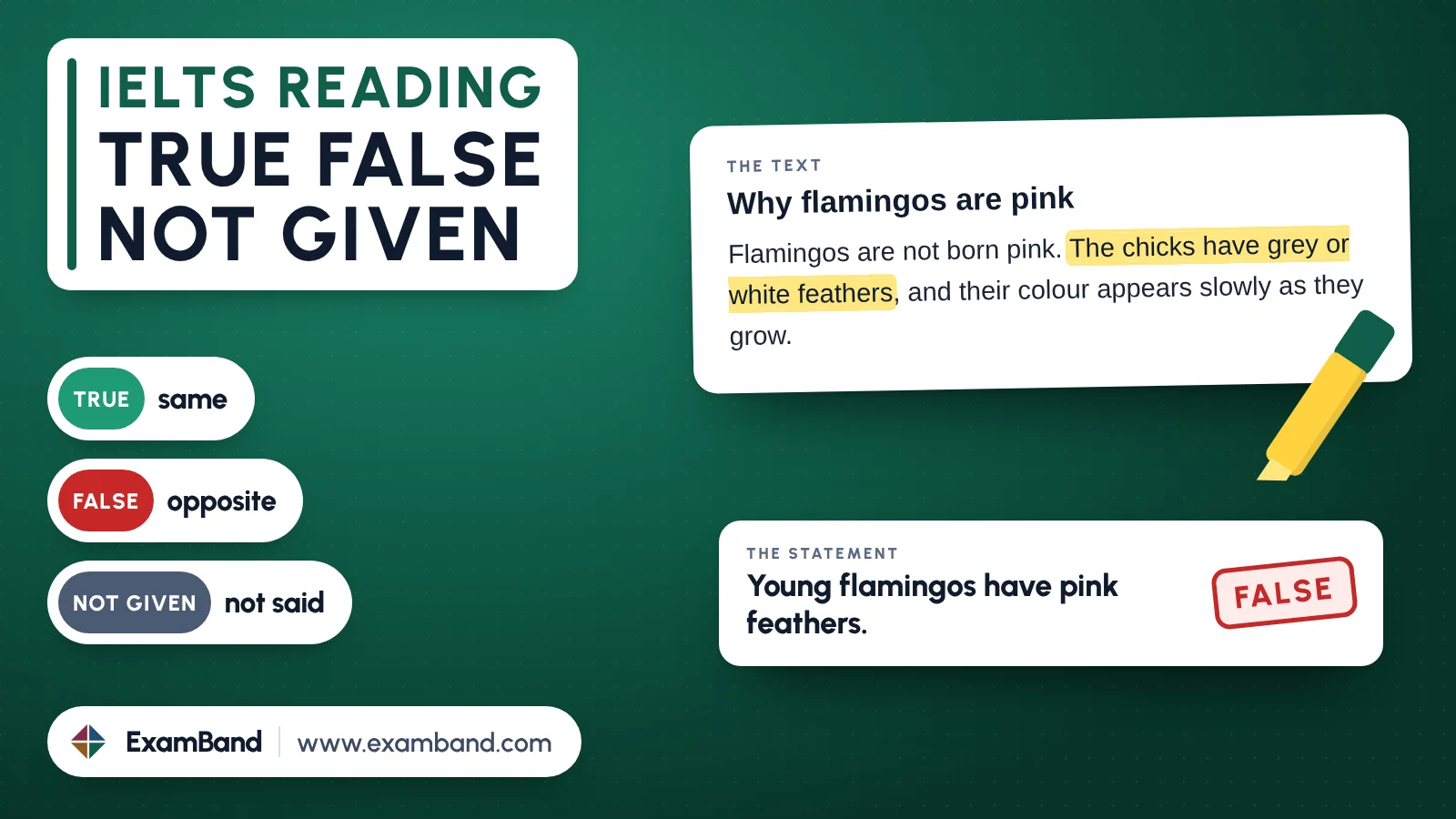
Students often choose False when, in fact, the text simply says nothing. So if the text does not give the information, the answer is Not Given. Our True False Not Given guide also shows how to decide.
Word limits
If the instructions say NO MORE THAN TWO WORDS, a three-word answer loses the mark, even when the words are in the text.
Spelling from the text
The answer is in the text, so copy it letter by letter. A wrong spelling is marked wrong.
A word that is already in the question
Do not repeat a word from the sentence around the gap, because the extra word can make the answer wrong.
Visitors must leave their bags in the ______ room.
One hard question
Ten minutes on one question can cost three easy answers later. So if you are stuck, guess, mark it and move on. Then you can come back at the end.
Empty boxes
A wrong answer and an empty box both score zero. Therefore, always guess. A guess may get the mark, but an empty box never will.
How to raise your IELTS Reading band score by half a band
In Academic, band 6 to 6.5 is 4 more correct answers, and 6.5 to 7 is 3 more. In General Training, 6 to 6.5 is only 2 more, and 6.5 to 7 is 3 more. These steps can win them back:
Read the questions first
First, read the questions and the word limit. Then you know what to look for in the text.
Skim, then scan
Skim the text for the main idea of each paragraph. Then scan for names, numbers and key words.
Look for the same idea, not the same words
In fact, the text often says the same thing in other words. So look for the meaning, not only the words in the question.
Give each section 20 minutes
Watch the clock, because there are three sections in 60 minutes. If one section takes too long, the last one gets no time. In General Training, it is also the hardest.
Use the highlight tool
On computer, highlight key words in the questions and in the text, so you can find them again fast.
Count your mistakes by question type
For example, if Matching headings always costs you marks, practise that type. Similarly, if True False Not Given is the problem, practise that.
Quick check: guess the band
Each student below got a score out of 40. Guess the band, then tap to see the answer.
Academic Reading: 33 out of 40.
33 is in the 33 to 34 row, so it is band 7.5. In General Training, however, the same score is only band 6.5.
General Training Reading: 33 out of 40.
32 to 34 correct answers give about band 6.5. So two more answers would make band 7.
General Training Reading: 30 out of 40.
IELTS publishes 30 as the average mark for band 6 in General Training. But in Academic, 30 is band 7.
Academic Reading: 26 out of 40.
26 is still band 6. However, one more correct answer, 27, would make band 6.5.
Academic Reading: 35 out of 40.
IELTS publishes 35 as the average mark for band 8 in Academic. So it allows five mistakes.
Know your Reading band before test day
Take a free Reading test in Academic or General Training. Then fix the traps you fall into, one question type at a time.
Try the band score calculatorIELTS Reading band score: questions students ask
What is 30 out of 40 in IELTS Reading?
About band 7 in Academic and band 6 in General Training. In fact, IELTS publishes 30 as the average mark for both of these bands.
What is 33 out of 40 in IELTS Reading?
About band 7.5 in Academic and band 6.5 in General Training. However, the exact band can change a little from one version of the test to another.
How many correct answers do I need for band 7 in IELTS Reading?
About 30 out of 40 in Academic and about 35 out of 40 in General Training.
Why is the General Training Reading score different?
Both tests use the same band scale, but Academic texts are usually harder. So General Training needs more correct answers for the same band.
Is IELTS band 7 B2 or C1?
IELTS gives bands 7 to 8 as about C1, and bands 5.5 to 6.5 as about B2. However, it calls this a very quick guide.
What is a good IELTS Reading band score?
It depends on what you need. Each university, employer and visa sets its own score, so check the exact band they ask for, both in each skill and overall.
Is my ExamBand band the same as a real IELTS band?
It is an estimate. Our tests follow the real format and also use the charts above. However, only the real test gives you an official score.
Read next: IELTS band score calculator · True False Not Given · IELTS Listening band score
Facts checked on 25 October 2026 with official sources