The IELTS Writing band descriptors are the official tables that examiners use to mark your Writing test. For each task, they describe four criteria at every band from 0 to 9: Task Achievement in Task 1 (Task Response in Task 2), Coherence and Cohesion, Lexical Resource, and Grammatical Range and Accuracy. The four criteria count equally, and Task 2 is worth twice as much as Task 1. Below, each criterion is explained in simple English, with example sentences at band 5, 6, 7 and 8, and one paragraph rewritten from band 6 to band 7.
Not sure of your band? Write the free Writing test first, then use the ladder.
Start freeWhat are the IELTS Writing band descriptors?
IELTS publishes two tables, one for Task 1 and one for Task 2, and each table covers both Academic and General Training. Both use the same scale, from band 9 down to band 0. The main difference is the first criterion: it is called Task Achievement in Task 1 and Task Response in Task 2.
An examiner reads your answer and gives a band for each criterion. Your score for the task is the average of those four bands. After that, the two tasks are combined into one Writing score, and Task 2 carries more weight. According to the British Council, Task 2 is worth twice as much as Task 1.
Two details in the official tables matter a lot. First, your writing must fully fit all the positive features of a band to get that band. Second, some phrases are printed in bold. These are problems that “will limit a rating”, so one weak point can hold a criterion back even when the rest is good.
Task Achievement and Task Response: did you answer the question?
This criterion checks whether you did what the task asked. It is also the only criterion that changes between the two tasks.
Task 1: Task Achievement
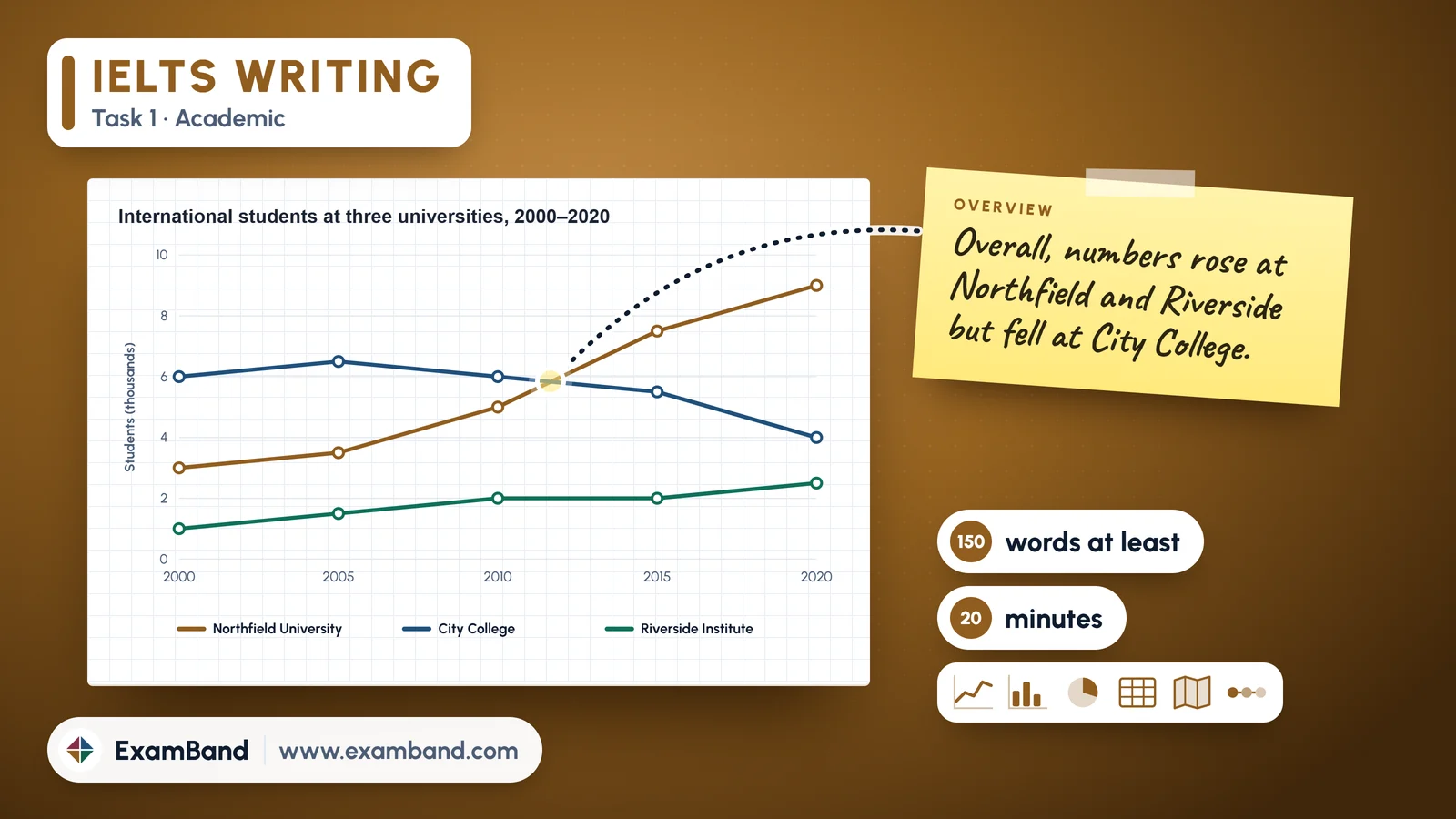
In Academic Task 1 you describe a chart, table, map or process in at least 150 words. The examiner looks for a clear overview of the main trends, the key features, and accurate figures, with comparisons where they matter. Do not explain causes that are not in the data.
In General Training Task 1 you write a letter. Here the examiner checks that the purpose is clear, that all three bullet points are covered and developed, and that the tone suits the reader.
“Overall, cycling to work became much more popular over the period, while car use fell slightly.”
One sentence, no numbers, and the two main trends compared.
Task 2: Task Response
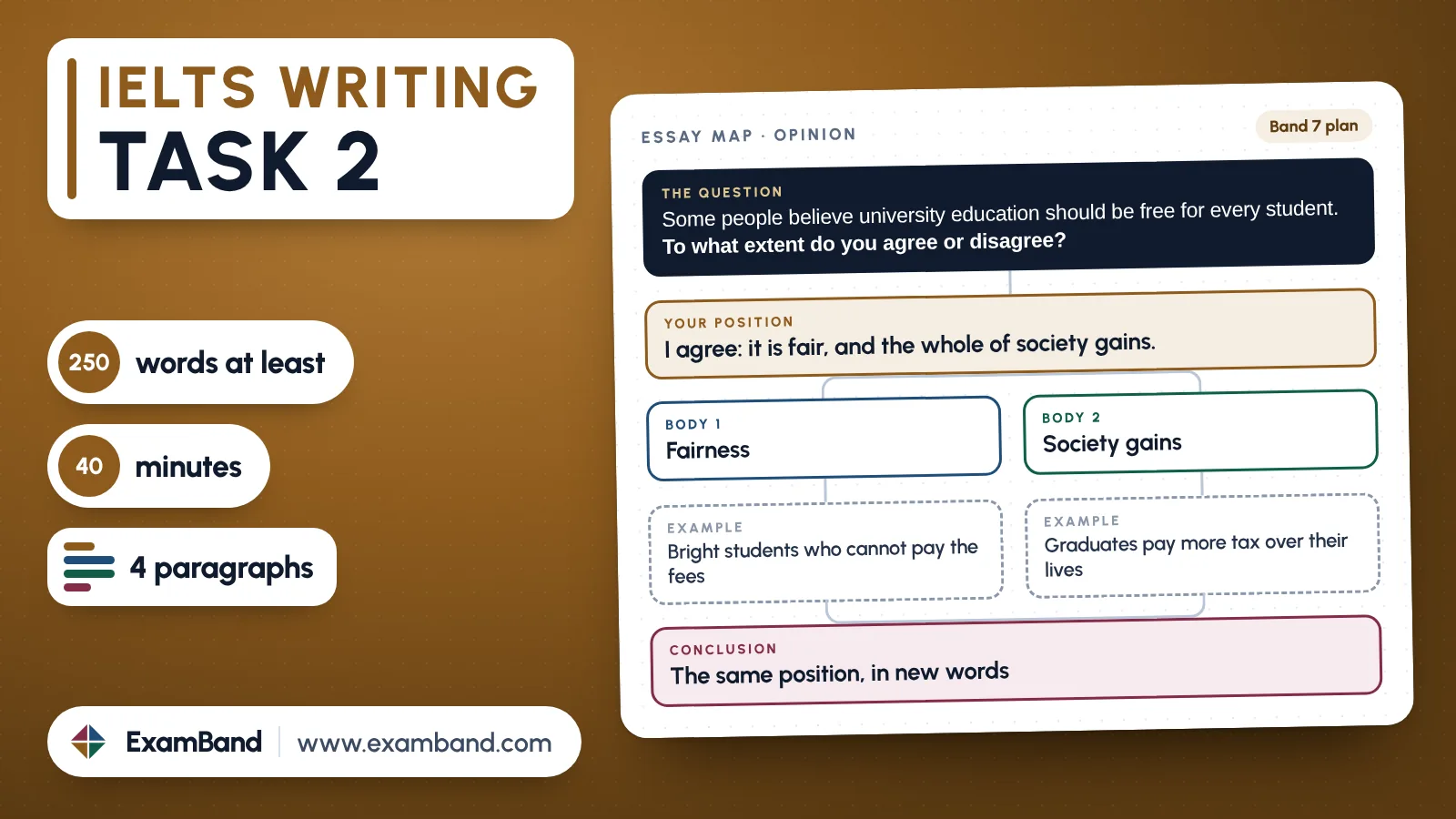
In Task 2 you write an essay of at least 250 words. You must answer every part of the question, give a clear position, and support your main ideas with explanations and examples. Your examples can come from your own experience.
Task Achievement / Task Response from band 5 to band 8
Some people believe that schools should teach children how to manage money. To what extent do you agree or disagree?
Band 8: You answer the question fully and in enough depth. Your position is clear and well developed, and your ideas are well supported, with only occasional slips.
I strongly agree that money management belongs on the school timetable: it protects young people from avoidable debt, and it gives every child the same start, whatever their parents know.
A precise position that previews two well-chosen ideas.
Band 7: You answer all the main parts properly. Your position is clear from start to finish, and your main ideas are extended and supported, though some may be too general.
I strongly agree that schools should teach money skills, because many young adults get into debt simply because nobody showed them how to budget.
A clear position with a specific reason that the essay can develop.
Band 6: You answer all the main parts, but some more fully than others. Your position is relevant, although the conclusion may be unclear or repetitive. Some ideas need more development.
I agree with this idea because money is important for children.
There is a position, but the reason is vague.
Band 5: You answer only part of the question. Your opinion is there, but it is not always clear, and your ideas are short lists rather than explained points.
Money is very important in our life, and people have different opinions about this topic.
No position: the reader still does not know if you agree.
These band descriptions paraphrase the official IELTS Writing band descriptors for Task Achievement / Task Response. The example sentences are our own.
Coherence and Cohesion: is your writing easy to follow?
Coherence means your ideas come in a logical order. Cohesion means the words that join them: linking words such as however and as a result, and reference words such as this, these and they. Paragraphing is part of this criterion too.
Many students think that more linking words bring a higher score. The descriptors say the opposite. At band 6, linking can be “faulty or mechanical”, while at band 9 cohesion “very rarely attracts attention”. In other words, good cohesion is almost invisible.
Coherence and Cohesion from band 5 to band 8
Band 8: Your writing is easy to follow. Ideas are logically sequenced, cohesion is well managed, and paragraphing is used well.
Band 7: Your ideas are logically organised and move forward clearly. You use a range of linking and reference words flexibly, with a few small slips, and your paragraphs work well.
Children who learn to save at an early age usually keep the habit as adults. This habit becomes especially valuable when they start earning, because it helps them avoid expensive loans.
“This habit” points back to the first sentence, and “because” shows the reason. Each idea builds on the last one.
Band 6: Your answer has a clear overall order. You use linking words, but sometimes wrongly or mechanically, and unclear reference words cause some repetition.
Band 5: There is some organisation, but the order is not fully logical and the sentences are not linked smoothly. Linking words are too few or too many, and in Task 2 paragraphs may be missing.
Firstly, children can learn to save. Secondly, children can learn to budget. Thirdly, children can avoid debt. Moreover, this is good for the country.
Band 5–6: Every sentence starts with a linker, and the ideas form a list, not a chain.
These band descriptions paraphrase the official IELTS Writing band descriptors for Coherence and Cohesion. The example sentences are our own.
Lexical Resource: how well do you use vocabulary?
Lexical Resource is your vocabulary. The examiner looks at your range of words, the precision of each choice, collocation (whether words go together naturally), and your spelling and word formation.
Rare words are not the goal. A band 7 answer shows “some ability” to use less common words, but it must use them correctly. Memorised phrases can also hurt you, because the band 4 description mentions memorised and formulaic language used in the wrong place.
Lexical Resource from band 5 to band 8
Band 8: You use a wide range of words fluently and precisely, including uncommon ones, with only occasional mistakes in word choice or spelling.
Many young adults fall into debt not through careless spending but because nobody ever taught them to budget.
Natural, exact phrasing with a less common structure.
Band 7: You use enough vocabulary to be flexible and precise, including some less common words. You show awareness of style and collocation, though some choices are not quite right.
Many young adults struggle financially because they have never learned how to budget.
Precise words: struggle financially, learn how to budget.
Band 6: Your vocabulary is adequate and the meaning is clear, but the range is limited or some words are imprecise. There are some spelling errors, but they do not block meaning.
Many young people have money problems because they spend more than they earn.
Clear and correct, but still general.
Band 5: Your vocabulary is limited but just enough for the task. You repeat words and simplify ideas, and spelling mistakes may make the reader stop.
Many young people have big problems with money because they buy too many things.
Simple, repeated words: big problems, too many things.
These band descriptions paraphrase the official IELTS Writing band descriptors for Lexical Resource. The example sentences are our own.
Grammatical Range and Accuracy: how varied and correct are your sentences?
This criterion looks at two things. Range means using different sentence types: simple, compound and complex. Accuracy means how many errors you make and whether they confuse the reader. Punctuation counts here as well.
Range and accuracy pull in different directions. Complex sentences full of errors stay around band 5 or 6, yet simple sentences with no errors cannot show range. Band 7 needs both: a variety of complex sentences, and frequent sentences with no errors at all.
Grammatical Range and Accuracy from band 5 to band 8
Band 8: You use a wide range of structures flexibly and accurately. Most sentences are error-free, and punctuation is well managed.
Children who are taught to budget early, and who see how quickly small purchases add up, are far less likely to borrow money they cannot repay.
Two relative clauses inside one controlled sentence, with accurate punctuation.
Band 7: You use a variety of complex structures with some flexibility. Grammar and punctuation are generally well controlled, and many sentences have no errors.
If children learned to budget at school, they would be far less likely to borrow money that they cannot repay.
A second conditional and a relative clause, both correct.
Band 6: You mix simple and complex sentences, but not very flexibly. Your complex sentences have more errors than your simple ones, though errors rarely block meaning.
If children learn about money at school, they will spend less, this is good for their future.
The conditional is correct, but the comma joins two sentences.
Band 5: You use a limited range of structures. You try complex sentences, but they often contain errors, and errors may make reading difficult. Punctuation may be faulty.
If children learn about money in school, they will spending less and saving more, this is good.
A wrong verb form, and two sentences joined with only a comma.
These band descriptions paraphrase the official IELTS Writing band descriptors for Grammatical Range and Accuracy. The example sentences are our own.
Band 5 vs 6 vs 7 vs 8: the IELTS Writing band descriptors in one table
Use this table to find your level for each criterion, then read the column to its right to see your next step.
The IELTS Writing band descriptors in action: one paragraph from band 6 to band 7
Here is a body paragraph for the money question above, written the way many band 6 students write. It is our own example, so the band is an estimate for teaching, not an official score.
Firstly, teaching money skills at school is very useful for students. Many young people don't know how to save money and they spend all of their salary in the first week. If school teach them about budget, they will not have this problem. For example, my cousin had a lot of debts when he was student because he used his credit card too much. So I think schools should teach this subject.
The main reason I support this idea is that many young people leave school without knowing how to manage their income. Some spend most of their first salary within days and then rely on credit cards until the end of the month. A short course on budgeting would show them how to divide their income between bills, savings and spending. My cousin is a good example: he got into serious debt at university, and he says that one lesson on interest rates would have changed his habits.
What changed in each criterion
Task
The main idea is relevant but vague (“very useful”), and the example is not linked back to the argument.
Organisation
“Firstly” and “So” are mechanical. The sentences sit side by side instead of building on each other.
Vocabulary
“Money” is repeated, “debts” should be “debt”, and the topic words are general.
Grammar
Two basic errors (“school teach”, “was student”) and almost no complex sentences.
Nothing in the second version is fancy. It states the idea precisely, links each sentence to the one before, uses exact topic words, and has no grammar errors.
What the IELTS Writing band descriptors penalise
Some problems pull a score down more than students expect. These come straight from the official tables and the key assessment criteria.
Writing too little
Task 1 needs at least 150 words and Task 2 at least 250. In the descriptors, an answer of 20 words or fewer is band 1, and a very short answer gives too little evidence of your vocabulary and grammar.
A memorised answer
If there is proof that an answer is totally memorised, it can get band 0. Memorised phrases used in the wrong place also lower your vocabulary score.
Copying the question
Words copied from the task do not count, because the descriptors say any copied rubric must be discounted. Put the question in your own words.
Bullet points or notes
IELTS says scripts may be penalised if they are not written as full, connected text. Never use bullet points or note form.
No paragraphs in Task 2
Missing or inadequate paragraphing is printed in bold at band 5 for Coherence and Cohesion, which means it limits that score.
No overview in Academic Task 1
Band 7 needs a clear overview of the main trends. Without one, Task Achievement cannot reach band 7.
How to move up one band in IELTS Writing
Plan before you write
Spend a few minutes deciding your position and your two main ideas. Most Task Response problems begin with no plan.
Write an overview in Task 1
In Academic Task 1, write one or two sentences about the main trends, without numbers, near the start or at the end.
One idea per paragraph
Start each body paragraph with a clear topic sentence, then explain it and give an example.
Use reference words
Words like this, these, such and they connect ideas naturally. Use however or moreover only when they add meaning.
Learn words in phrases
Note collocations by topic, such as get into debt or a tight budget, instead of single rare words.
Keep 3 minutes to check
Read your answer for your usual errors: articles, plurals, verb forms, and commas between sentences.
Practise with a free IELTS Writing test
Now see which band your writing fits
Reading the band descriptors is step one. Step two is writing a full test under real conditions and finding out where you stand on each criterion.
Questions students ask about the IELTS Writing band descriptors
What are the IELTS Writing band descriptors?
They are the official tables that examiners use to mark IELTS Writing. They describe four criteria at each band from 0 to 9, with one table for Task 1 and one for Task 2. The version on ielts.org is dated May 2023.
How is the IELTS Writing score calculated?
Each task gets a band for each of the four criteria, and the task score is the average of the four. The two tasks are then combined, with Task 2 counting more. The British Council says Task 2 is worth twice as much as Task 1.
Are the band descriptors the same for Academic and General Training?
Task 2 is marked in exactly the same way. In Task 1, the four criteria are the same, but Task Achievement checks different things: an overview of visual information in Academic, and a clear purpose, all three bullet points and the right tone in a General Training letter.
What happens if I write fewer than 150 or 250 words?
Those are the minimum lengths in the key assessment criteria. In the descriptors, 20 words or fewer is band 1, and an answer that is far too short does not give enough evidence of your vocabulary and grammar.
Can I use memorised phrases or templates?
A totally memorised answer can get band 0, and memorised or formulaic phrases used in the wrong place lower your vocabulary score. Learn useful phrases, but always adapt them to the question.
What does the bold text in the band descriptors mean?
Bold text marks negative features that limit a rating. For example, in Task 2, missing or inadequate paragraphing is in bold at band 5 for Coherence and Cohesion.